
- January 29, 2026
- Categories: Digital Marketing
Common PPC Mistakes and How to Avoid Them
Ever wondered why your PPC ads get the clicks but not the results? PPC advertisement can be one of the fastest ways to grow as a business. Stats show that 60% of the small to mid sized businesses run PPC campaigns. Running ads often results in more leads, sales and traffic. However, PPC mistakes can ruin your chance of a good ROI.
These mistakes cost marketers both time and money. The good news is that you can avoid these mistakes if you know what to look for.
This guide is for UK businesses running PPC on Google Ads, especially service brands and small ecommerce shops. It focuses on the mistakes that waste budget, lower leads and make tracking unclear. The fixes below are simple steps that improve results without changing the whole account.
In this blog, we will cover common mistakes involving PPC to avoid. We will help you discover why PPC ads mistakes happen and how to fix them.
This guide is written from hands on PPC work across UK campaigns We will also talk about:
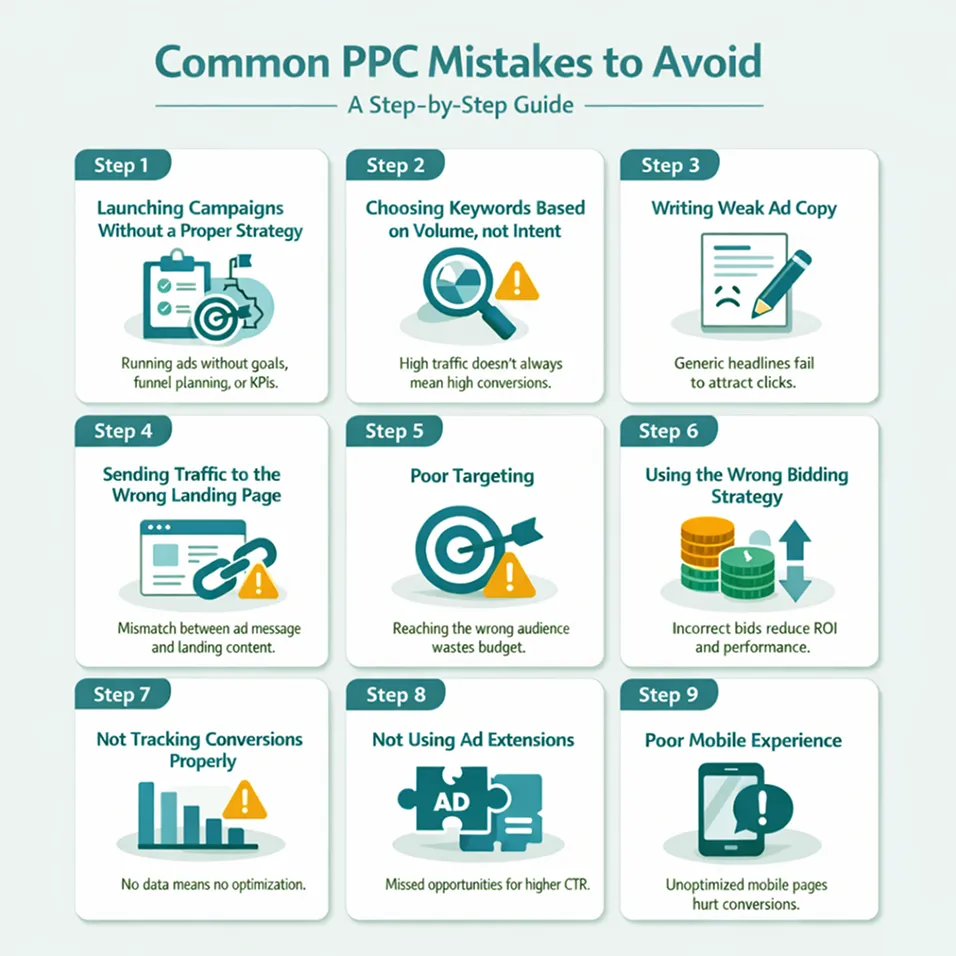
- Launching campaigns without a strategy
- Choosing keywords based on volume, not intent
- Writing weak ad copy
- Sending traffic to the wrong landing page
- Poor targeting
- Using the wrong bidding strategy
- Not tracking conversions properly
- Not using ad extensions
- Poor mobile experience
PPC and Why PPC Mistakes Are So Common
PPC advertisement is a model where you pay for every click on your ads.
Google Ads and Meta Ads allow you to run PPC ads. The ads on these platforms help you target the audience based on keywords, location, interests and behaviour.
PPC ads work best for you when your ad campaigns are clear and consistent. Many marketers forgo proper planning to chase quick returns. This is one of the common PPC ads mistakes. Such mistakes result in loss of money, effort and time. Some common causes for PPC ads not giving results are:
- Launch campaigns without a clear plan.
- Focus on clicks instead of outcomes.
- Trust automation without enough oversight.
- Failure to optimise.
Common PPC Mistakes to Avoid
PPC ads require well-planned campaigns. If they are not carefully planned, they can be a money drain. Here are pay-per click ads mistakes you must avoid.1. Launching Campaigns Without a Proper Strategy
One of the biggest pay-per-click mistakes is running ads without knowing your goal.
When you don’t know your goals, PPC ads can drain your budget fast. You can set your daily budgets in GBP. You can also use cap bids when you want to have more control.
Before starting a PPC ad campaign, you should ask three questions:
- Who is our target audience?
- What action do we need them to take?
- What metric for success do we have?
How to Fix PPC Mistakes at the Strategy Level
Before launching any campaign:- Set a single primary goal.
- Define one core conversion.
- Align KPIs with business outcomes.
2. Choosing Keywords Based on Volume, not Intent
Keyword research is the basis of a successful PPC campaign. Pay-per-click mistakes often happen during keyword research.
Choosing keywords based on search volume may seem right, it is the intent that really counts with search engines. Broad keywords often attract large traffic but they are unfocused.
Businesses often:
- Target keywords that are too broad.
- Choose high cost keywords with low intent.
- Ignore long tail opportunities.
How to Fix PPC Mistakes When Choosing Keywords
A strong keyword list must:- Reflect real buying behaviour.
- Include long tail variations.
- Match specific services or products.
- Stay within cost limits.
Even with good keywords, PPC can waste spend if the wrong searches trigger ads. The search terms report shows the real words people typed before clicking. It helps spot low intent traffic and cut it fast.
How To Fix PPC Mistakes With Search Terms
To avoid mistakes with search terms:- Check the search terms report often.
- Add negative keywords for irrelevant searches.
- Split high intent searches into tighter ad groups.
- Pause terms that spend but do not convert.
- Negative keywords reduce wasted clicks and protect budget.
3. Writing Weak Ad Copy
Your ad copy is your first impression. Weak ad copy is one of the most expensive pay-per-click mistakes because it lowers click-through rate and quality score.
Even with perfect targeting, poor ad copy will hold your campaigns back.
Common pay-per-click mistakes to avoid are:
- Generic headlines.
- No clear value proposition.
- Missing calls to action.
How to Fix PPC Mistakes in Ad Copy
Strong ads should:- Match keyword intent.
- Highlight a clear benefit.
- Include a strong CTA.
- Address a specific pain point.
Quality Score affects how much you pay and how often ads show. It is shaped by expected click rate, ad relevance and landing page experience. Low Quality Score can push costs up even if bids are high.
How To Fix PPC Mistakes That Hurt Quality Score
To avoid hurting quality score:- Make ads closely match the main keyword theme.
- Keep one clear message per ad group.
- Send traffic to a page that matches the ad promise.
- Improve page speed and mobile usability.
- Better relevance usually lowers costs over time.
4. Sending Traffic to the Wrong Landing Page
Many times, traffic gets sent to a generic landing page. Imagine clicking an ad for trainers and landing on a homepage with everything except trainers.
Landing pages fail when the first screen does not match the ad. PPC users decide fast, so the top of the page must be clear.
How To Fix PPC Mistakes Above The Fold
To avoid pay-per-click mistakes above the fold, make sure you:- Repeat the same main offer from the ad in the first headline.
- Show the key benefit in one short line.
- Place one clear call to action in view without scrolling.
- Remove extra menus or distractions on paid traffic pages.
How to Fix PPC Mistakes With Landing Pages
Your landing pages should:- Match the ad message exactly.
- Load quickly on all devices.
- Include one clear CTA.
- Remove distractions.
5. Poor Targeting
Trying to reach everyone usually means reaching no one properly. This is a classic PPC mistake that wastes the budget fast.
Many pay-per-click mistakes happen when businesses:
- Target audiences too broadly.
- Ignore location settings, like targeting all of the UK when only one city is served.
- Forget device targeting.
How to Avoid PPC Mistakes With Targeting
Improve targeting by:- Choosing the right locations.
- Adjusting for mobile or desktop.
- Using remarketing.
- Excluding low intent users.
6. Using the Wrong Bidding Strategy
Bidding decides how much you pay and how often your ads show. Using the wrong bidding option is one of those pay-per-click mistakes that quietly hurts performance.
Common issues include:
- Overbidding on low intent keywords.
- Underbidding on high value searches.
- Using the wrong bid strategy.
How to Avoid PPC Mistakes With Bidding
Match your bidding strategy to your aim:- Conversions for leads.
- ROAS for online sales.
- Manual bidding for control.
Budget control matters because costs rise fast in competitive UK markets.
Many accounts waste spend because the budget runs out early or ads show at the wrong times. This is common in the UK when ads run across all hours with no control.
How To Avoid PPC Mistakes With Budget Pacing
To avoid pay-per-click mistakes with budget pacing:- Check if the budget is spent too early in the day.
- Raise budget only after proving conversions are steady.
- Lower bids or tighten targeting if spend climbs without results.
- Use ad scheduling if leads mainly come during business hours.
- Good pacing keeps traffic and leads steady, not random.
7. Not Tracking Conversions Properly
Running PPC without tracking is one of the worst mistakes you can make. If you do not track conversions, you do not know what’s working.
Tracking should match the real goal, not just small actions. If tracking is noisy, Google Ads learns the wrong signals and optimises for the wrong users.
How To Avoid PPC Mistakes With Better Tracking
To avoid mistakes with better tracking, you should:- Set one primary conversion that matches the main business goal.
- Keep small actions as secondary so they do not distort results.
- Test tracking after changes to the site, forms or thank you pages.
- Check revenue tracking and duplicates if ecommerce is used.
- Clean tracking makes optimisation safer and faster.
How to Fix PPC Mistakes With Tracking
Make sure you:- Track real actions, not just clicks.
- Test tracking regularly.
- Use GA4 and Google Ads together.
- Exclude low value micro conversions.
8. Not Using Ad Extensions
Ad extensions add extra information to your ads, like links or call buttons. Not using them is a missed opportunity.How to Fix PPC Mistakes With Extensions
Make sure to use:- Sitelinks.
- Callouts.
- Call extensions.
- Structured snippets.
9. Poor Mobile Experience
Most people now search on their phones. If your ads or pages do not work well on mobile, you lose customers. 60% of mobile users click on a PPC ad at least once per week.
This is a very common PPC mistake.
How to Avoid PPC Mistakes for Mobile
Check that:- Pages load fast.
- Forms are simple.
- Buttons are easy to tap.
- Mobile ads look clean.
- Mobile first thinking is essential.
How to Avoid PPC Mistakes Long Term
PPC success comes from discipline, not luck. If they are planned carefully, you might lose your money. Here are the common mistakes to avoid.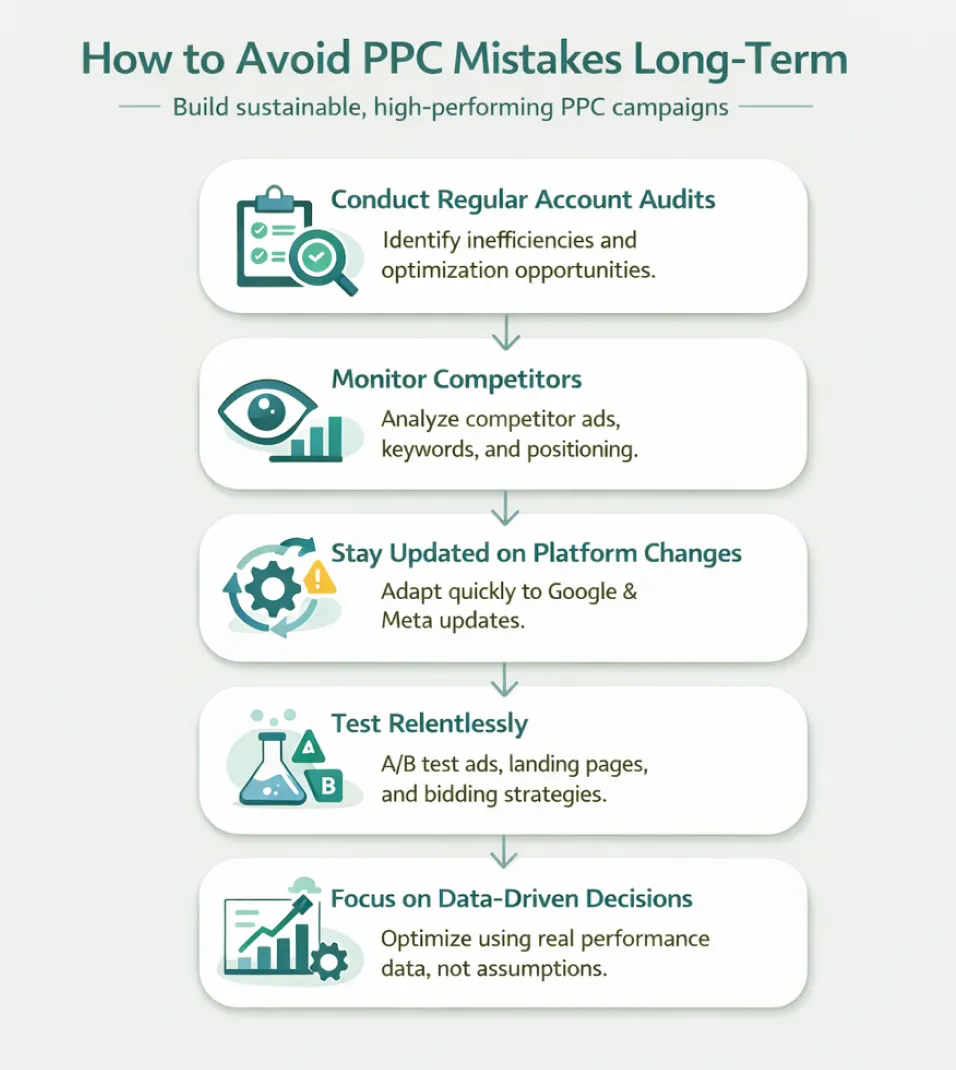
To avoid common mistakes long-term:
- Conduct regular account audits.
- Monitor competitors.
- Stay updated on platform changes.
- Test relentlessly.
- Focus on data driven decisions.
Conclusion
Every advertiser makes mistakes. What separates successful businesses is how quickly they identify and fix them.
By understanding PPC mistakes, recognising the common mistakes to avoid and learning how to fix PPC ads, you give your campaigns the best chance of success.
We at Xoomplus understand that PPC is one of the most powerful tools in digital marketing. With the right strategy, tracking and optimisation, it can deliver consistent, scalable growth for your business.
If your campaigns are not performing as they should, the issue is rarely PPC itself. More often, it’s a fixable mistake waiting to be addressed. Contact us now.
Making PPC mistakes can cost more than you think.
If you want your ads to work harder and your budget to go further, it’s time to get expert eyes on your campaigns.
Speak to our PPC team today and start turning clicks into real results.
FAQs
What Are The Most Common PPC Mistakes?
The most common PPC mistakes include choosing the wrong keywords, ignoring negative keywords, poor ad copy, weak landing pages, and not tracking conversions properly. These mistakes can waste budget and stop campaigns from being profitable.
How Do PPC Mistakes Affect My Ad Budget?
PPC mistakes can drain your budget very quickly. Overbidding, targeting the wrong audience, or paying for irrelevant clicks means you spend money without getting results. Fixing these issues helps your budget work smarter.
How Can I Avoid Common PPC Mistakes?
You can avoid common PPC mistakes by doing proper keyword research, using negative keywords, writing clear ad copy, improving landing pages, and checking your campaigns regularly instead of setting and forgetting them.
Why Is Conversion Tracking Important In PPC?
Without conversion tracking, you won’t know what’s actually working. Tracking helps Google optimise your ads and allows you to focus spend on campaigns that bring real leads or sales, not just clicks.
Are PPC Mistakes More Common For Beginners?
Yes, beginners often make PPC mistakes because the platform has many settings and options. However, even experienced advertisers can make errors if campaigns are not reviewed and optimised often.
Can Poor Landing Pages Cause PPC Campaigns To Fail?
Yes. Even great ads won’t convert if the landing page is slow, confusing, or not relevant. A clear message, fast load speed, and strong call to action are key to fixing PPC mistakes linked to conversions.
How Often Should PPC Campaigns Be Optimised?
PPC campaigns should be checked weekly at a minimum. Regular optimisation helps spot problems early, reduce wasted spend, and improve performance over time.
Is It Possible To Fix PPC Mistakes Without Increasing Budget?
Absolutely. Many PPC mistakes can be fixed by improving structure, targeting, ad copy, and tracking. In most cases, better optimisation delivers stronger results without spending more money.