

- March 2, 2026
- Categories: Digital Marketing
What Is E-Commerce SEO and Why Does It Matter in 2026?
Imagine spending thousands on a well-designed online store that no one can find. This could be you. E-commerce SEO helps you avoid this. You can make your store and page visible with the latest E-commerce SEO.
According to recent data, 27% of all business is now conducted online. This shows the continued growth and importance of search-led visibility in the online market. We are in 2026, and the digital commerce ecosystem has changed. Algorithmic search and AI-driven systems are changing the e-commerce landscape.
Paid media alone can no longer achieve visibility. Instead, you need the latest SEO. Google and other search engines now reward:
- Content quality
- Technical stability
- Intent satisfaction
In this blog, you will learn:
- What is E-commerce SEO?
- How is E-commerce SEO different from traditional SEO?
- Why does E-commerce matter in 2026?
- What is the long-term value of SEO?
- What are the structural components?
- What are the core strategies?
- How to make informed decisions for sustainable digital growth?
What is E-commerce SEO?
E-commerce SEO is a specific type of search engine optimisation. It focuses on:- how online shops can be found easily.
- improvement of online performance.
- page structure.
- improvement of product listing.
- presentation of products on the page.
- context of the page
- relevance of the page
- commercial intent of the page.
What Is the Purpose of E-commerce in 2026?
The main goal of E-commerce is to optimise online shopping websites. This optimisation process takes place across multiple layers of the website. It includes both visual content and underlying technical elements.
In this way, search engines can easily crawl, index, and rank pages for proper requests
Types of Queries Addressed
This approach helps pages to have long-term visibility across search engine results pages. It increases the visibility for a wide range of user search requests.
These requests are more than just casual browsing. They are usually linked to a combination of requests. These requests are:
- Commercial
- Informational
- Products
- Product Categories
- Brands
- Purchase drive intent
- Looking for a specific item
- Exploring categories
- Comparing different brands
Areas of Application in E-commerce
E-commerce SEO works across different parts of an online store. It works on both primary and supporting elements of the site.Key application areas include:- Category pages
- Product pages
- Internal link architecture
- Navigation systems
- Faceted URLs
- Buying guides and FAQs
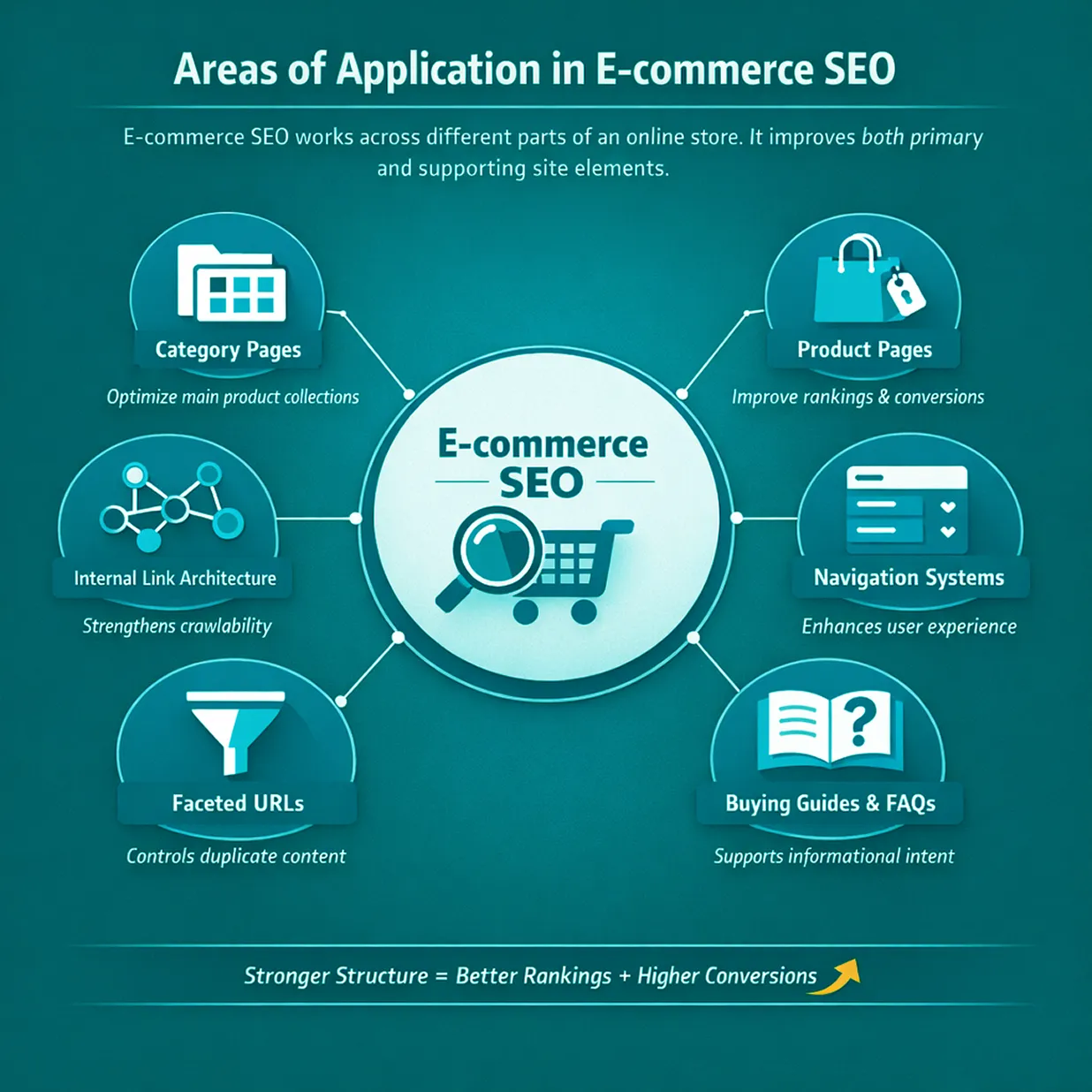
Each of these elements guides search engines. They also guide users through the site. This creates a pathway from discovery to purchase. The goal here is to increase the commercial objective of the business.
These elements are optimised in combination rather than in isolation. As a result, search engines get clear contextual signals about the following:
- What is the page for?
- Topic expertise
- Buying intent
How E-commerce SEO Differs From Traditional SEO?
To fully understand E-commerce SEO, we must learn the difference between traditional SEO and E-commerce SEO.| Factor | Traditional SEO | E-commerce SEO |
|---|---|---|
| Pages | Blogs, service pages | Product and category pages |
| Structure | Mostly stable | Complex and changing |
| Updates | Occasional updates | Frequent updates (stock, price, sorting) |
| Optimisation | Done from time to time | Ongoing and continuous |
| Seasonality | Rare | Common (inventory shifts, demand changes) |
Structural Complexity in E-commerce Websites
E-commerce sites often have:- Thousands of URLs
- Auto-generated pages
- Frequent inventory changes
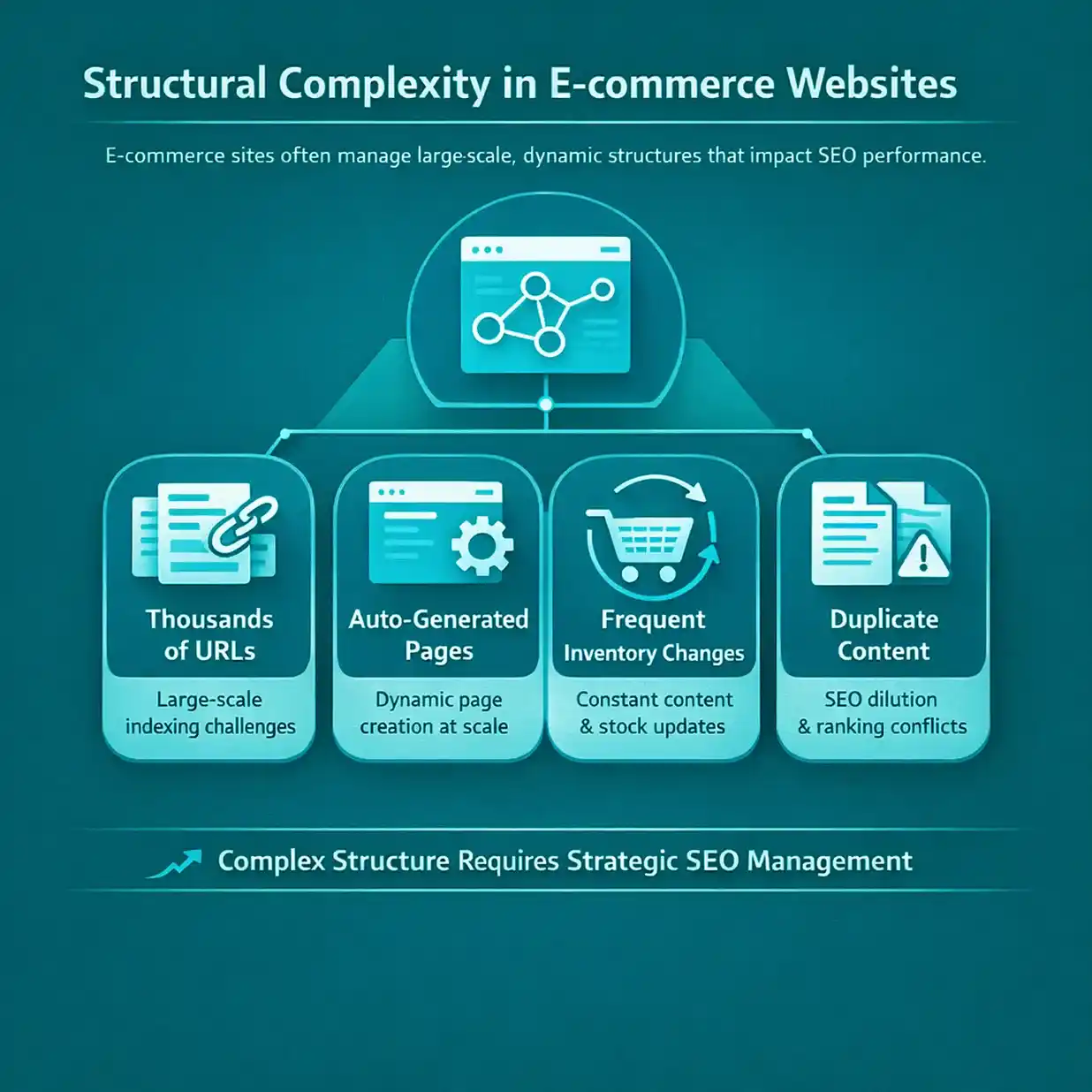
These characteristics create operational and indexing issues. These issues are not common in content-driven small websites.
For example, unmanaged URL parameters or duplicated product changes can dilute ranking signals. They can also lower crawl efficiency. Such challenges are technical and strategic in their nature.
As a result, optimising decisions requires proper planning. This includes:
- Careful consideration of site architecture
- Content hierarchy
- Long-term scalability
Technical Depth Beyond Content
E-commerce SEO’s primary focus is on extensive technical refinement. This refinement ensures performance stability and improves discoverability.
E-commerce SEO must also work on the backend system and structure elements. These factors affect how search engines interpret large volumes of product data. It also includes:
- URL parameters
- Canonical tags
- Structured data
- Pagination
- Scalable site structure
Core Objectives of SEO in E-commerce Environments
The main goal of SEO in E-commerce is to attract users with buying intent and those close to making a purchase. This strategic focus increases the chances of organic traffic being converted into revenue. Strategies involve:- adjusting keywords
- search behaviour analysis
- semantic clustering
- intent mapping
Finally, product pages are designed to attract high-intent transactional searches. These pages should be optimised with:
- clear value propositions
- structured data
- persuasive content
Reducing Paid Dependency and Building Sustainable Growth
E-commerce SEO is not just about getting traffic. It helps your business grow over time. It reduces reliance on paid ads, keeps revenue more stable, and builds a traffic source that grows. Key benefits include:- Less dependence on paid advertising
- More stable organic revenue
- Lower customer acquisition costs
- Budget savings for product and experience improvements
- Traffic that continues even without ads
- Strong rankings that bring consistent visitors
- Better protection against market and seasonal changes
Why E-commerce SEO Matters in 2026
In 2026, successful E-commerce SEO is about being clear and trustworthy. It should also align with buying behaviour. Businesses that learn and follow now will gain strong, long-term visibility across search, AI, and new channels.Algorithmic and Structural Shifts
The importance of E-commerce SEO has increased because of the changes in how search engines work. Big shifts are driven by:- AI
- User behaviour rankings
- Improved ranking systems
In this environment, websites have high search results when:
- They are technically strong.
- They offer a good user experience.
Machine Learning and Trust Signals
Modern ranking systems use machine learning to study performance signals. Most ranking systems use machine learning to predict the users’ experience with results. Because of this, E-commerce SEO helps pages rank higher in search results. Search engines track:- Engagement
- How long users stay on pages
- Clear content structure
- User actions
Structured Content and Reduced Ambiguity
Search engines now prefer pages that are enriched with:- Structured data
- Contextual content
- Clear category system
- Product details
- Prices
- Stock
- Category connections
Clear categories and structured signals prevent misunderstandings. They also help pages appear in advanced search features. As a result, sites that do not adapt to these changes often get fewer organic views. This can happen even if they keep spending on ads.
This means that paid ads cannot make up for a weak site structure in AI-driven search results.
Rising Customer Acquisition Costs and Organic Dependence
E-commerce is very necessary in 2026. One major reason is rising customer acquisition costs. This affects multiple channels, including:- Search ads
- Social media ads
- Marketplace promotions
E-commerce SEO helps build long-term organic visibility. This visibility grows over time. This lets brands attract customers without high marketing costs. Even with limited daily ad budgets, interested buyers can be attracted. This happens through category and product pages that get high rankings. This creates a growth model that is more predictable and flexible.
Alignment With AI-Driven Search and User Intent
In 2026, search engines are using AI-powered systems to improve results. These engines no longer rely only on exact match keywords. They also look at context, how users act, and the meaning behind the search. E-commerce SEO now focuses on more than individual optimisation tactics. It considers broader strategies that affect the whole site.
E-commerce SEO strategies are being made to address:
- Intent clusters
- Detailed topics
- User Experience signals
Improved User Experience as a Ranking and Revenue Factor
We cannot separate E-commerce SEO from user experience. There are several factors that link SEO with user experience. These factors include:- Page speed
- Mobile usability
- Navigational clarity
E-commerce SEO can be improved by focusing on:
- Site structure
- Internal links
- Technical performance
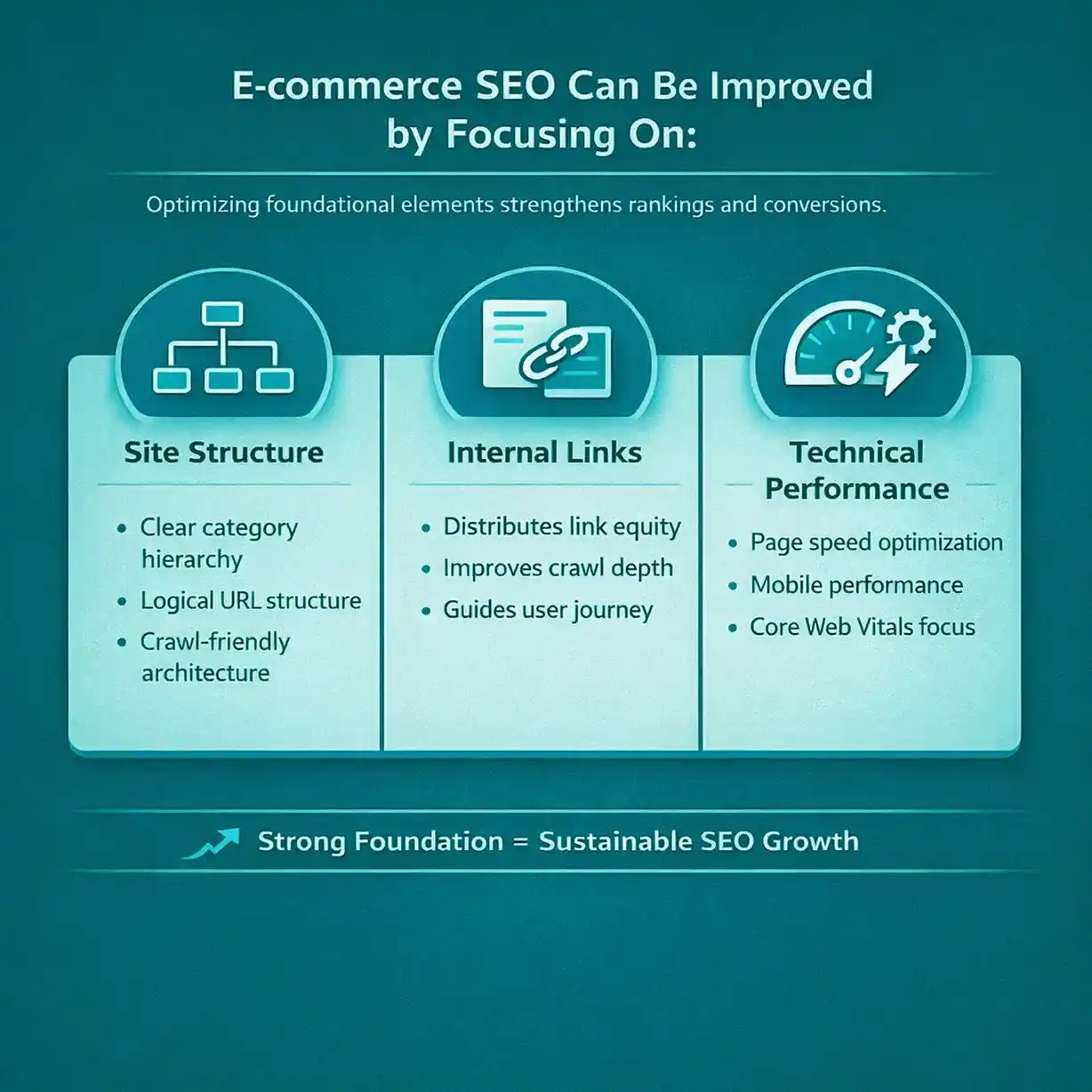
These strategies make it easy for users to navigate and use the site. They also improve how easily products can be found.
Core Strategies and Components of E-commerce SEO
In 2026, successful E-commerce SEO combines three types of strategies. These are:- Technical strategies
- Content strategies
- User experience strategies
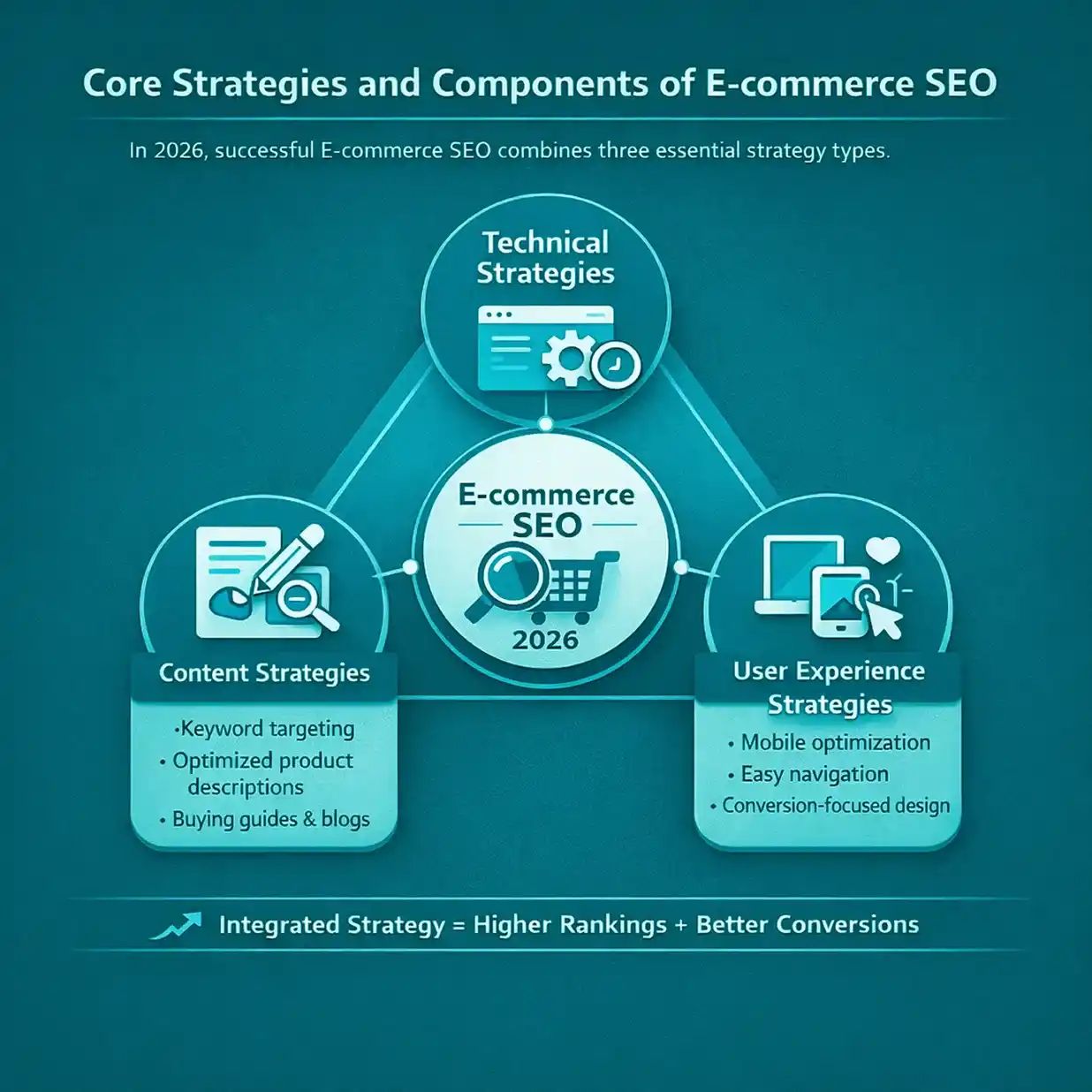
These strategies work together. They increase visibility, engagement, and conversion. E-commerce SEO differs from standard SEO. Standard SEO usually focuses on blog posts or fixed information pages. E-commerce SEO cannot work with fixed inventories. It is because products and stocks change constantly. It must:
- Handle dynamic product inventories
- Match buyer intent
- Manage complex site structures
1. Keyword Research Aligned With Buyer Intent
Keyword targeting in E-commerce SEO has improved. It now balances three types of user intent:- Buying intent
- Navigation intent
- Informational intent
2. Optimised Site Architecture and URL Structures
Online stores often have thousands of changing pages. This can cause crawl issues, repeat content, and index errors.| Element | Why It Matters |
|---|---|
| Clear categories | Help users find products easily and keep site structure organised |
| Filter options & clean URLs | Help search engines understand pages and preserve ranking signals |
| Canonical tags | Tell search engines which page is the main version to rank |
These steps help search engines crawl your site faster. They show the most important pages. They also guide users and the search engines to the top products.
3. Content Optimisation for Products and Categories
Every product and category page should be full and unique. They should also be easy for search engines to understand. Product pages need:- Clear product details with key search terms.
- Clear metadata like page titles, H1 headings, and image alt tags
- Helpful extra content like buying guides, FAQs, and comparison charts.
4. Technical SEO Foundations
Good technical SEO is key to succeed in 2026. It is more than an edge. Every online business needs it. Businesses need key SEO steps. These steps increase their traffic and results.
So always focus on:
- Fast load times, especially on mobile
- Clear product data, reviews and prices
- Secure HTTPS and strong hosting
- Clean site layout and easy indexing by search engines
5. Analytics, Reporting, and Continuous Optimisation
Online stock changes often. Seasonal changes affect sales and site results. So you need to track key data. These metrics include:- Where traffic comes from
- Sales rates
- Search rankings
Final Thoughts
SEO for online stores is very important in 2026. It helps stores get more views, increase sales, and rely less on paid ads. Using smart SEO strategies, stores can attract the right visitors and grow sales. Success comes from setting up the site, content, and technical parts to match changing algorithms and AI systems.
We have helped numerous businesses achieve top rankings for high-intent keywords, resulting in increased traffic, reduced paid acquisition costs, and improved conversion rates. At Xoom Plus, our strategies boost search visibility, get more users involved, and increase completed purchases.
Contact us to adjust content, fix weak pages, improve results, spot trends and suggest changes quickly.
Are your E-commerce pages failing to rank despite consistent marketing efforts? Many online stores struggle to convert traffic into sales.
Contact us today to enhance product discoverability, optimise category structures, and improve user engagement metrics across your online store.
Faqs
E-commerce SEO is the process of optimising online stores to improve visibility in search engines for product, category, and transactional queries. It involves technical optimisation, content creation, and site architecture improvements to attract qualified traffic.
SEO is critical because it drives organic traffic, reduces reliance on paid channels, and aligns with AI-driven search algorithms that prioritise relevance, authority, and user experience.
Unlike traditional SEO, E-commerce SEO focuses on dynamic inventories, product pages, category hierarchies, and transactional intent, requiring more technical precision and continuous content optimisation.
Key components include keyword research aligned with buyer intent, optimised site architecture, product and category content optimisation, technical SEO (site speed, structured data, HTTPS), and ongoing analytics for continuous improvement.
A professional impact report designer can transform your report from a basic document into a compelling and persuasive communication tool. Whether you are a charity, corporate company, or social enterprise, expert design helps present your impact clearly, strengthen credibility, and increase stakeholder engagement.
Yes. By optimising product pages, navigation, and technical performance, E-commerce SEO enhances user experience and visibility, which directly supports higher conversion rates and revenue growth.
Results vary by industry and competition, but most E-commerce SEO strategies begin showing measurable traffic and ranking improvements within 3–6 months, with compound growth over time.
Platforms like Shopify, WooCommerce, and BigCommerce are widely regarded for their SEO capabilities, offering clean site architecture, plugin support, and flexibility to implement technical and content optimisations.