Xoomplus

on-page vs off-page seo

What is the Difference Between On-Page vs Off-Page SEO?

Search Engine Optimisation is the foundation of a successful social media marketing strategy. When you search a query, a search engine answers it by comprehending your website’s content and link through SEO. You get relevant and meaningful results this way. Being listed on the first page of search engine results pages (SERPs) for the most important and useful keywords is the ultimate goal of SEO. It has two main types: on-page SEO and off-page SEO. Your visibility depends on each of their roles, which is equally crucial in terms of fulfilling the main goal of SEO. You need to grasp this distinction if you want to rank high on search engines. This blog breaks down the concept of on-page vs off-page SEO and their importance. 

What is On-Page SEO?

On page SEO means improving individual pages of your website so that they can be helpful to the users. This optimisation also helps these pages rank on SERP. The use of on-page vs off-page SEO makes your website simple and easy to understand for search engines. It also helps users read your content easily. Your pages should come off as useful and relevant to what visitors are looking for. The elements that you can improve for on-page SEO include 
  • Content
  • Keywords
  • Images 
  • Titles, 
  • Links
  • Page layout. 

What is Off-Page SEO?

Off-page SEO refers to the actions you take beyond the scope of your own website to make it rank better. Off-page SEO is also aimed at making your website more trustworthy. This means acquiring links from other websites (known as backlinks). It also includes mentions of your brand on social media. Good reviews and online shares are some other elements of off-page SEO. These indicators show search engines that your website is trusted by others. You have limited control over off-page SEO optimisation, but you can attempt to establish a solid online reputation.

Why You Need Both

Consider your website to be a home. Building the house and making it cosy inside is what on-page SEO is all about. When more people visit your home and refer it to others, that’s off-page SEO. Google and other search engines consider both. They can better comprehend the purpose of your website because of on-page vs off-page SEO. Off-page SEO optimization lets them know that other people value and trust your website. To remain visible and rank higher in 2025, you must do both.

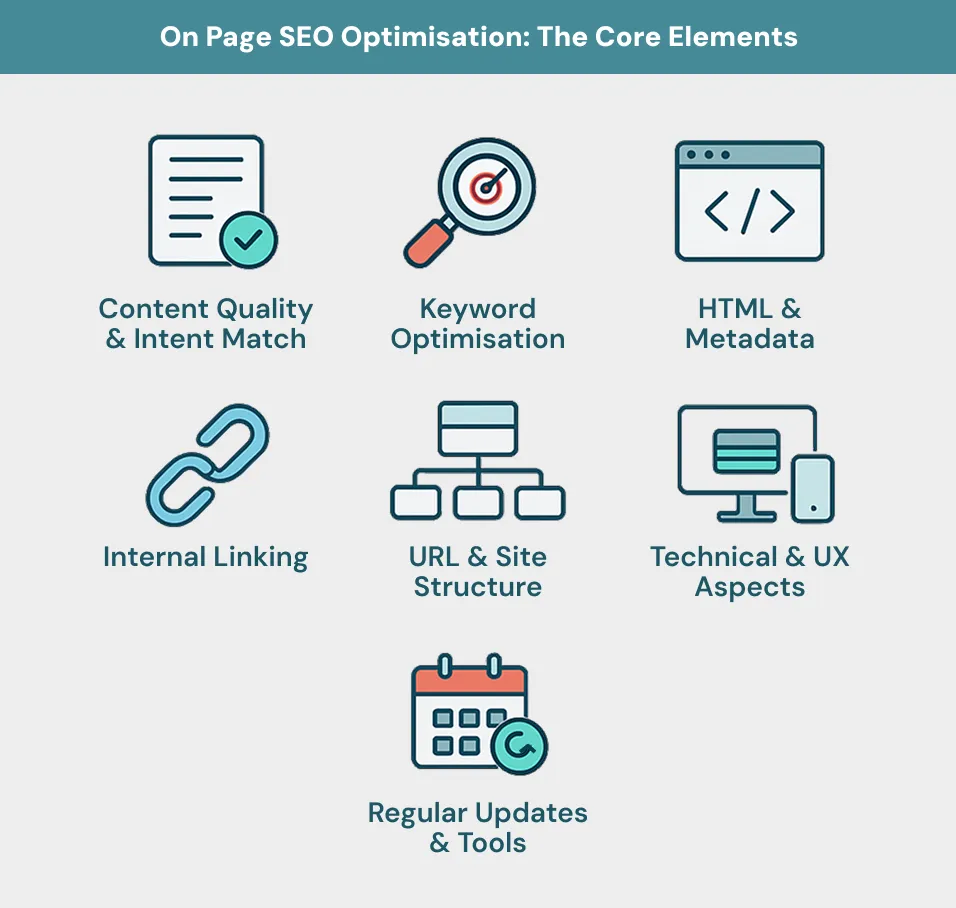
On Page SEO Optimisation: The Core Elements

Below are some of the main parts that you can focus on to make search engines understand your content:
  • Content Quality & Intent Match

Quality content is something that is original and helpful. Your content should be written in a way that it answers the user’s question. Now the user might be wanting to learn something, find a product or solve a problem. You must incorporate their queries in your content. Similarly, another attribute of quality content is the keyword being used naturally. Neither main nor relevant keywords should be used too often. Content quality matters more for on-page vs off-page SEO. Another way to improve content quality and intent match is to add words and topics related to the primary topic. This helps Google understand your content better. Finally, make sure your content is copied too short. 
  • Keyword Optimisation

For SEO, the keywords are still important. but not in the same way as before. More important than their frequency of use is the context in which they are now employed. For instance, the page’s title tag, URL, H1 heading, meta description, and introductory paragraph all need to contain your main keyword. For text and subheadings, you have to add related keywords. Keywords are more important for on-page vs off-page SEO.  If you keep on using the same keyword, it will come off as spammy. Your rating will be lowered because of this. Consider keywords to be useful clues for Google.
  • HTML & Metadata

Search engines employ metadata and HTML tags to determine the content of your page. Consequently, each page should have a clear title tag and meta description. The purpose of your text should be made clear by both of these. Alt text should be used to explain the images. This is advantageous for more on-page vs off-page SEO. This also increases accessibility. Additional information, including reviews, prices, or frequently asked questions, can be displayed in search results using schema markup, also known as structured data. All of these can make your page more noticeable and encourage more clicks. 
  • Internal Linking

Internal links are links that take you from one page of your website to another. People can easily move around your sites using these links. They are also helpful for the search engines to crawl all your pages. For internal linking, use clear and helpful anchor text. This refers to words that tell the user what they would see if they click on the link. For example, instead of stating only “click here,” write “learn about SEO tools.” All of your pages will be easily accessible and visitors will stay on your site longer if you have a well-designed linking structure. Another point that helps more with on-page vs off-page SEO.
  • URL & Site Structure

Make your RURLs short, clean and focused on your keyword. Don’t make it confusing with random numbers and long links. Similarly, the layout of your website needs to be simple as well. This is because a simple structure helps users and search engines both in finding everything easily. Make use of features like menus that are simple to navigate. URL structure helps very much with on-page SEO. Also, use tools like breadcrumbs to help users browse your website.
  • Technical & UX Aspects

Your website should be responsive, fast, and easy to use. When ranking, Google takes into account mobile layout, website speed, and security (HTTPS). It’s important to ensure that your website loads rapidly and without lag. Look for core web vitals such as LCP, FID, CLS, etc.. In order for Google to find your pages, address any crawling or indexing problems. A functional website helps more with on-page vs off-page seo.
  • Regular Updates & Tools

SEO is not a one-time thing that you can do and expect to work forever. You have to update regularly to remain correct and useful. Look for broken links and fix them. When necessary, add new information and update the statistics. Use tools like Yoast or RankMath to check your SEO. In a similar vein, you may track your website’s performance using Google Search Console or SE Ranking. You’ll know what’s broken and what needs to be fixed once you’ve used them all. This is more useful for on-page vs off-page SEO.
On Page SEO Optimisation The Core Elements

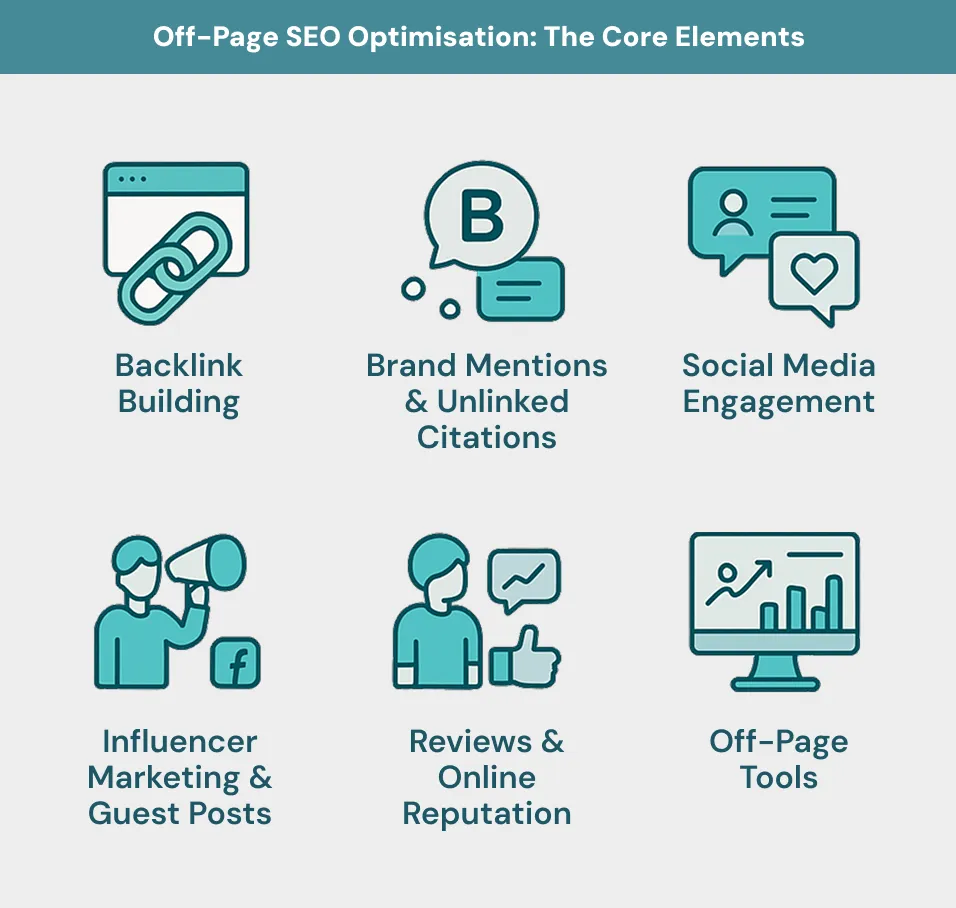
Off-Page SEO Optimisation: The Core Elements

Off-page SEO optimisation contributes to the online reputation and authority of your website. It tells search engines that people value, trust, and talk about your material even when they are not on your own website. The key components of off-page SEO in 2025 are listed below.
  •  Backlink Building

One of the most powerful ways to improve your rankings is to get backlinks from trusted websites. But you cannot just collect a lot of links and call it a day. The relevance and quality of these websites that give you backlinks matter more than quantity. Their authority is a factor as well. Your aim should be to collect backlinks by being useful. You can also get them by media mentions and partnerships. Tools like SEMrush and Ahrefs can help you identify any spammy or harmful links that are linking to you. You should remove them as soon as you find them.96.55% of all pages never get organic traffic because they don’t have backlinks (Ahrefs, 2024). That’s why off-page SEO is key to being found.
  • Brand Mentions & Unlinked Citations

Brand mentions, sometimes referred to as co-citations, increase search engines’ trust in your website. This works even if your website isn’t explicitly linked. Your brand name might appear in blogs, interviews, news articles, etc., without clickable links. Your website won’t be reached directly, but you may build authority over time by being featured in industry lists or expert roundups. Your digital footprint can grow to the point that you’ll get backlinks later.
  • Social Media Engagement

Search rankings are not closely correlated with social media signals. They can, however, be quite helpful in getting your material seen. This may increase website traffic. As more and more people like, share, and comment on your posts, your reach grows. Backlinks and brand awareness may eventually result from your improved presence. Make sure you interact with your audience on a frequent basis for this. Ensure that your material is worthy of being shared. Pay attention to all social media platforms, i.e., Facebook, Instagram, LinkedIn, and X/Twitter.

  • Influencer Marketing & Guest Posts

A highly effective strategy to increase your authority is to collaborate with influencers.  Contributing to guest blogging on reputable websites in your area is another great way for this. Influencers already have followers and credibility. You become more visible and credible when they share or mention your work. Similarly, guest posts allow you to share useful content on other websites and add a backlink to your own as well. For best results in both these domains, choose influencers and websites that are most relevant to your content.
  • Reviews & Online Reputation

Ratings and reviews from customers are very important, particularly for local SEO. This means you have to focus on reviews online on Google Reviews, Yelp,  Trustpilot, etc.. It will contribute to how your business is perceived online. In addition to fostering client trust, a consistent flow of positive reviews tells search engines that your company is authentic. You should also respond to reviews, both positive and negative. This shows that you are active and care about your audience.
  • Off-Page Tools

Your off-page SEO optimisation can be significantly enhanced by using certain tools. You can use Ahrefs, MOZ and SEMrush. These tools let you monitor backlinks and check domain authority. You can also view how your competitors are doing it. Also, you can use tools that can alert you when your brand is mentioned online. Using these tools, you can track activities that help you improve your strategy. You can fix issues before they start hurting your ranking.
Off-Page SEO Optimisation The Core Elements

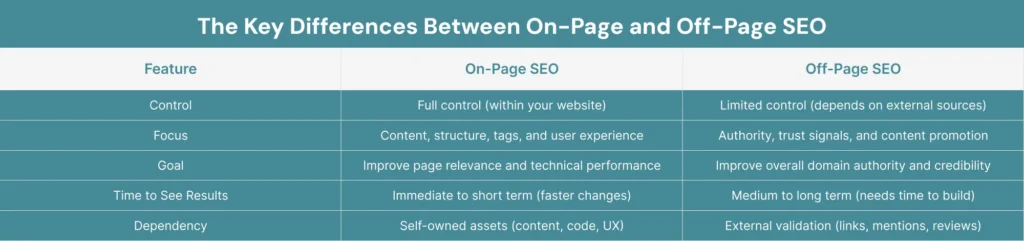
The Key Differences Between On-Page and Off-Page SEO

To properly implement both on-page vs off-page SEO on your website, it is essential to comprehend the differences between the two. Both are equally important for the success and visibility of your website. However, they both have different goals and employ different tactics. An overview of on-page vs off-page SEO is provided below.
  • On-page vs Off-page SEO: Control 

In on-page SEO, you have complete control over all the SEO elements. Anything written on your site, how fast your pages load, internal links, etc., is well within your control. You can change them anytime. Most off-page elements are out of your direct control. You can’t just force others to link to your site or talk about your brand. It mostly depends on external parties such as bloggers, influencers, your customers, etc.

  • On-page vs Off-page SEO: Main Focus

In on-page SEO, your focus is usually on optimising the content of your website. You also work to improve its structure. You keep keywords proper, use title tags, image alt text, etc., for this. The off-page SEO optimisation is about improving your site’s authority and trust. It works to make your content more popular. For this, you may use anything from backlinks to social media promotion.
  • On-page vs Off-page SEO: Purpose

Search engines can ascertain the topic of your material. If your content is pertinent to the user’s search query, it also directs them. Its overarching goal is to improve user experience, which is tangentially related to increased engagement and conversions. Conversely, off-page SEO optimization is primarily concerned with enhancing the reputation of your website. Search engines are aware that your content is reliable and valuable when other websites give you a vote of confidence.

  • On-page vs Off-page SEO: When do you see the results?

On-page SEO shows results rather quickly. This is especially;y the case when fixing a technical issue or improving content quality. For instance, your page speed may improve all of a sudden when you update meta titles. However, Off-page SEO is a long-term game. Building a reputation takes time. You may not see results for weeks and sometimes months, depending on your niche.
  •  On-page vs Off-page SEO: Dependency

On-page SEO generally relies on your own team and their tools. It also takes into account the decisions you make. In short, you are the one doing everything from content creation to UX and technical health. In contrast, off-page SEO optimisation depends on external validation. If others find your content valuable, they will spread it. For this reason, it’s crucial to focus on-page first. Your content becomes worthy of being shared.

Here is an overview of on-page vs off-page SEO:
The Key Differences Between On-Page and Off-Page SEO

How On-Page and Off-Page SEO Work Together

Getting on-page vs off-page SEO to work in harmony is the key to building an excellent strategy for online presence. The first step is to make a strong SEO foundation. This means that you add all the core elements, such as making your content helpful, using the right keywords, adding internal links, etc.. After that, concentrate on off-page SEO optimisation. Seek backlinks from related websites, post your material on social media, and build a reputation for your brand through reviews and mentions. Search engines are informed by these external signs that other people also appreciate your content.You can make on-page vs off-page SEO work by following these tips:
  • Make your content helpful enough that people want to share it on their own.
  • Utilise schema markup and other structured data to help search engines present rich results.
  • To get backlinks, highlight your top pages in social media articles or guest posts.
  • Continue to make your website better so that visitors who find it through a link remain and interact.
To rank your pages, Google goes over the entire parameters of on-page vs off-page SEO. This means that you’ll do a lot better in search ranking if your content is both well-made and well-liked.

Final Thoughts: Which One Should You Prioritise between On-Page vs Off-Page SEO?

Your first priority should be on-page SEO optimisation. If your content is clean, useful, and answers queries, then it will be shared by others on its own. You can follow it up with off-page SEO optimisation. At Xoomplus, we help you with both. Our SEO experts optimise your website in every way they can. We fix technical issues, provide you with remarkable content, etc.. We make sure your site is ready to rank in every way. We then support your off-page efforts with smart link-building and outreach. To get help, contact us now.

Struggling to Balance On-Page vs Off-Page SEO?

We’ve Got You Covered. At Xoomplus, we make sure your content is optimised and your authority grows. We fix your structure, build trusted backlinks, and boost your visibility. Get in touch today.

Faqs

On-page SEO refers to everything you do on your website, including improving content, keywords, and structure. Off-page SEO refers to measures taken outside of your website, such as establishing backlinks, obtaining reviews, or earning mentions on other websites.

On-page SEO enables search engines to understand your content and its significance. Off-page SEO increases your website's trust and authority. They work together to impact how high you rank.

You might rank for extremely low-competition terms, but not for competitive ones. Without off-page SEO, your website lacks trust signals, and Google values authority.

Yes, this is the greatest place to start. On-page SEO ensures that your website has structure and clarity. However, off-page SEO is required for long-term growth and competition.

Yoast and RankMath are useful tools for managing content and metadata. Use PageSpeed Insights to improve speed and Screaming Frog to perform technical audits.