- February 13, 2026
- Categories: Digital Marketing
8 Top SEO Trends To Watch In 2026
Is your SEO strategy as new as 2026? If not, then you might already be behind. Artificial intelligence is controlling the latest SEO trends in 2026. The SEO landscape is changing more quickly. With AI being used in search engines, 83% of users are now preferring AI search over traditional Google search. This, along with voice requests, predictive analytics, and semantic content, shows the fast growth of SEO. It is necessary to understand the SEO trends UK businesses need in 2026.
Search Engine Optimisation is all about increasing your reach in search engines. You do this by making it easy for the right people to find you. This leads to real engagement. This also increases traffic by bringing the right visitors. Such visitors are actually interested in what you offer.
Learning about the new SEO trend is not optional. You can lose your reach and your traffic if you keep using traditional ways. Businesses that follow the latest SEO trends in the UK will have high reach. This guide is for UK business owners and marketers who want to stay visible in the 2026 search. It breaks down the top SEO trends shaping rankings. It also shows what to adjust now to protect traffic, leads, and long-term growth.
In this post, you will learn:
- What are the biggest SEO trends affecting visibility in 2026?
- How are traffic patterns being transformed by AI and generative search?
- Why mobile and local optimisation can no longer be ignored
- What strategies top marketers are using to stay ahead
- How to future‑proof your SEO efforts in 2026
SEO Trends in 2026: Key Trends to Follow
According to the latest trends in SEO, it is confirmed that there is a movement towards the use of AI, predictive search, and user-first content. Businesses that do not consider these SEO trends will lose relevance in competitive environments such as the UK.
The following are the latest SEO trends shaping the future of search in 2026.
Trend 1: AI-Driven SEO and Generative Search
An AI-based search engine uses artificial intelligence to rank content and predict what the user is seeking. Among the latest SEO trends, this one is the most influential. Since the use of AI, SEO has never been the same. AI is changing SEO. It’s 2026, and search engines no longer look at the keywords and return a list of links.
Now they analyse the request’s content and understand its meaning. They understand the topic and check the intent of the search. Search engines also see how it relates to the content.
With generative AI, the interaction with digital content is being reshaped. Now it can summarise the answers. It now understands what the user is really looking for.
Context and Intent Matter More Than Keywords
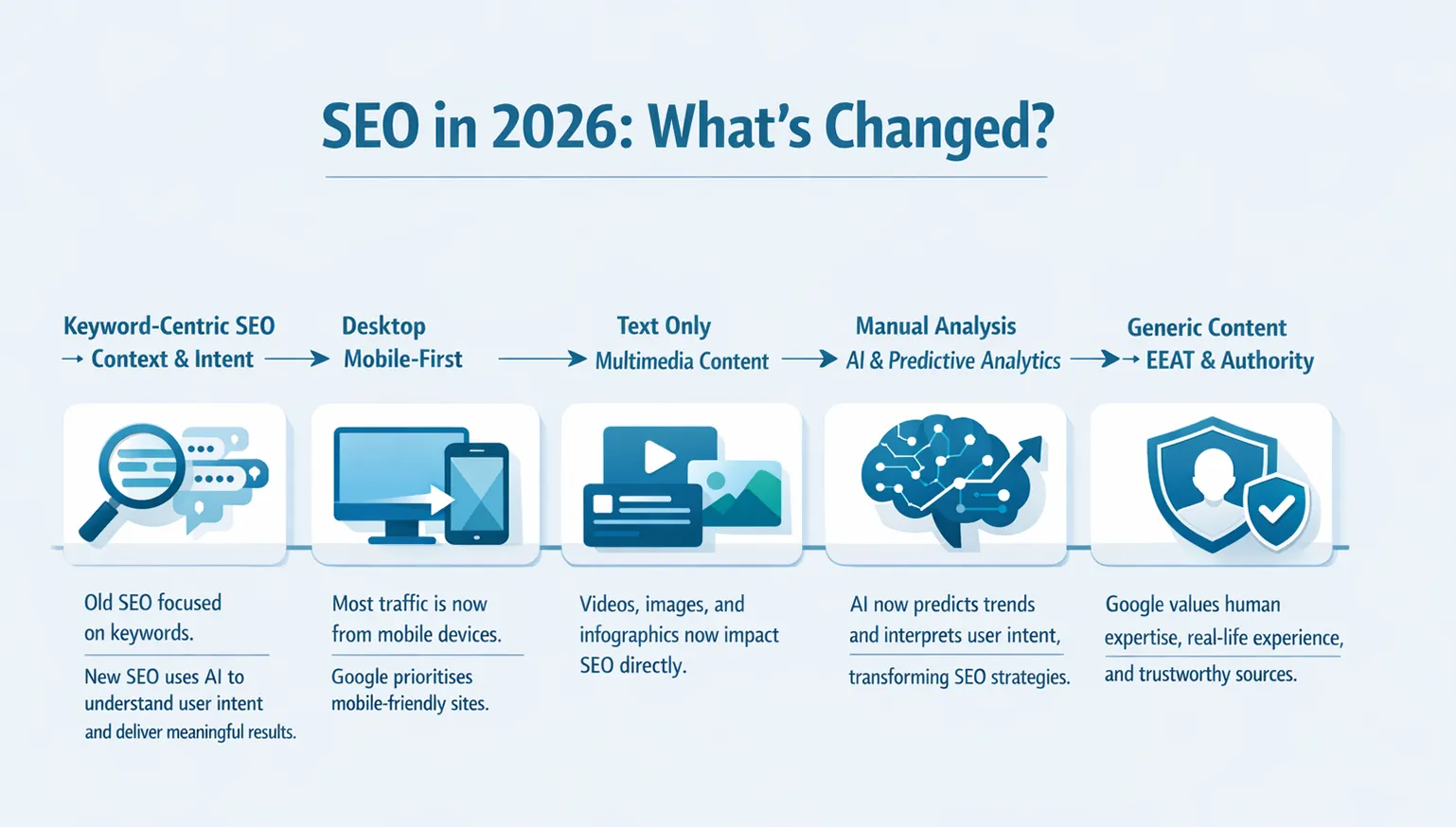
Before, SEO mainly involved keywords, backlinks, and meta tags. These things are called technical markers. They are used to understand the pages. They are also used to rank pages. These markers are still important. But the latest SEO trends now focus on content quality, context, and user interest.
Search engines are not just scanning for keywords. Now they are using AI algorithms to understand your language. They ensure the content truly answers your query.
This is why marketers need to update their game. They need to move beyond keyword stuffing. To align with the latest SEO trends, marketers must create content that is meaningful. Their content must be reliable. The content that creates and provides real value, answers questions and builds trust.
What Does it Mean for Marketers?
- Search engines now understand the meaning.
- AI analyses user intent before they even click.
- Generative AI powers summaries, snippets, and chat-based answers.
- Old SEO methods alone won’t assure traffic.
- Content quality and relevance are now decisive.
Quick Actions to Apply Now
- Use AI to create ideas.
- Add a human touch to ideas.
- Keep your content conversational.
- Make sure the content provides real answers to users’ questions.
- Align your content with chat-based searches.
- Structure your content with headings and bullets.
Trend 2: Mobile-First and Core Web Vitals Optimisation
Mobile-first SEO is used to make websites work well on mobile devices. Loading takes a short time, and interaction is made smooth. In 2026, mobile-first SEO is one of the most practical SEO trends. It is because most of the traffic is now driven by mobile devices. Search engines now promote websites that are fully optimised for mobiles.
An optimised website provides users with a smooth experience. Such websites are accessible across different devices. This gives high ranking to such optimised websites. This makes user experience central to SEO trends.
The ranking is measured by many factors. These factors include:
- page loading speed
- responsiveness
- layout stability
Understanding Core Web Vitals
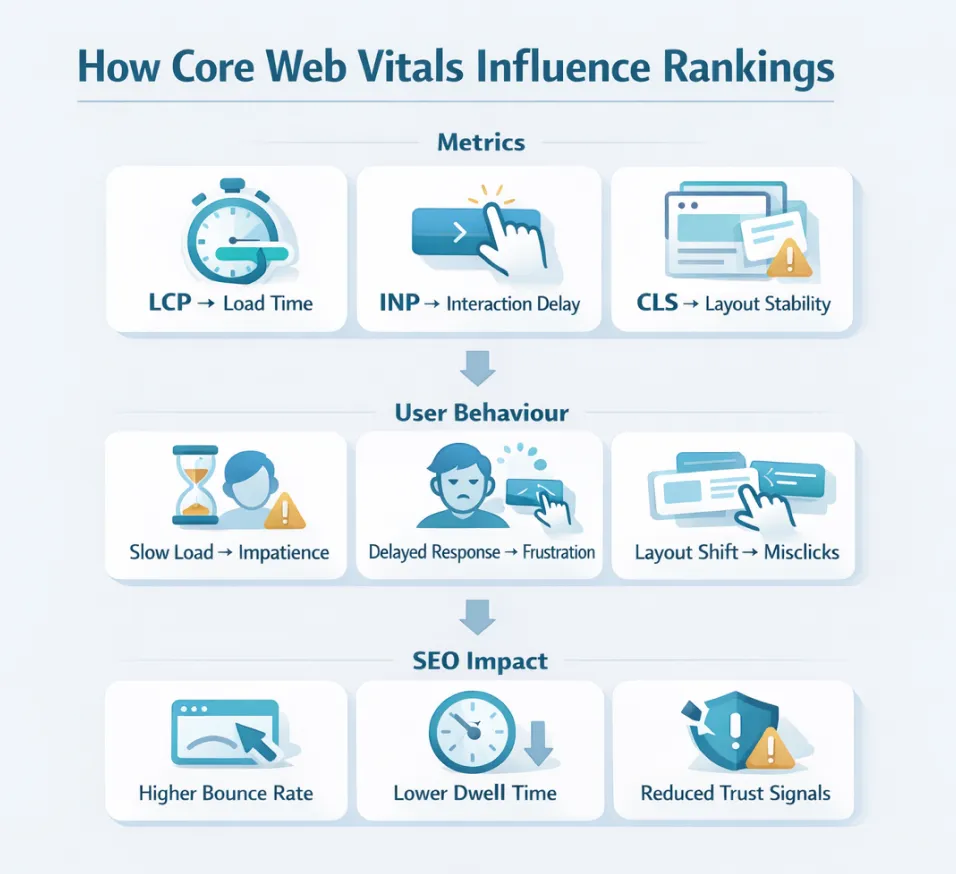
User engagement, retention and satisfaction are directly affected by the speed. They are also affected by the stability of the page. A website that loads slowly can have a bad effect on the ranking. A page that is difficult to navigate on mobile devices will also affect rankings. Such pages also have high bounce rates.
Core Web Vitals provide measurable metrics that search engines use to judge site quality. They measure how quickly a page loads. They also look at how the page responds and whether the content changes unexpectedly while loading.
What Does it Mean for Marketers?
- Mobile devices draw more traffic now.
- Mobile-friendly sites are given high priority.
- Slow or unresponsive websites lose reach.
- Core Web Vitals are essential.
- User experience directly impacts SEO performance.
- Pages need to appear accurately across all screen sizes.
Quick Actions to Apply Now
- Always check your website on different devices.
- Use optimised code to increase the loading speed of your page.
- Optimised images can also increase the loading speed.
- The buttons and links should be easy to tap.
- The fonts and layout should be optimised for mobile screens.
- Use Google Search Console to track Core Web Vitals.
- Use a touch-friendly interface, responsive design and images to retain users.
Trend 3: Voice Search and Conversational SEO
Voice search SEO is an optimisation of information to suit spoken or question-based searches, which demand direct answers. There has been a huge advancement in voice assistants, making voice search one of the most important and latest SEO trends. This optimisation is changing how information is searched online. More than 20% of internet users do not type now.
They are searching through their speech. Such a type of search is not focused on keywords. Instead, it focuses on length and tone. This shows voice search SEO as one of the fastest-growing SEO trends.
From Typing to Speaking.
Initially, the traditional keyword search was built for short and typed requests. Now users are using voice search. Such a search focuses on natural language and content. It gives clear and direct answers. Users no longer type a few words and hit the search button. Now they speak full sentences. They ask direct questions.
Therefore, the marketers need to improve their websites. They need to align their websites with conversational phrases and question-based searches. This will align their website with the latest SEO trends.
What Does It Mean for Marketers?
- More people are searching using voice assistants.
- Requests are longer, more natural, and often question-based.
- Traditional short keywords are less effective for voice searches.
- Users expect quick, precise answers.
- Content needs to match conversational language, not just typed searches.
Quick Actions To Apply Now
- Use long-tail, natural language keywords.
- Write content that answers specific questions.
- Include FAQs on your website for common requests.
- Optimise for direct answers.
- Focus on local SEO. Many voice searches are location-based.
- Make your content easy to understand by using structured data.
- Make sure your answers are clear and short.
Trend 4: AI-Generated Content and Semantic Search
Semantic SEO and artificial intelligence make search engines better understand what can be identified and what is meant by what is being said, not just mere keywords.
It’s 2026, and AI-generated content is no longer new. It’s now common across digital platforms. AI allows us to create content faster and with less effort. AI is affecting all the latest SEO trends in 2026.
Similarly, semantic search is also evolving. Search engines no longer just match the individual keywords. Semantic search helps them understand the meaning and context. It also understands the user’s intent behind a request.
Together, these two are reshaping 2026 SEO trends and strategies. They are changing how strategies are developed and applied.
Practical Value
AI is a valuable tool and is affecting 2026 SEO trends. It can create relevant content much faster. However, the content needs to align with the user’s intent and interest. It should answer the users’ questions clearly.
Similarly, semantic search has also become very reliable. It allows Google to check the data not by the keywords but with contextual fit. In light of factors like the meanings behind user requests and content quality, the search is optimised.
What Does It Mean for Marketers?
- AI tools can create content faster than ever.
- Search engines now understand meaning, not just keywords.
- Semantic search evaluates context, intent, and value.
- Low-quality AI content without insight risks poor rankings.
- Users are looking for real, helpful answers.
Quick Actions To Apply Now
- Take help from AI in your research and ideas.
- Use AI to create content.
- Make sure the content is accurate and useful.
- Use headings, subheadings and links to structure your content.
- Make your content easy to understand for users.
- Keep a check on your search visibility.
- Track users’ engagement and retention.
- Change your strategy according to the results.
Trend 5: Video and Visual Content Optimisation for SEO
Visual SEO enhances the level of interaction through the search engine optimisation of videos, images, and infographics. Visual content is becoming a key trend among the 2026 SEO trends. In 2026, images, videos, and infographics directly affect search rankings. Search engines now rank content higher when it offers value in a variety of formats. They prefer content that gives users more ways to use information.
Visual media can greatly increase the stay time on the page. It can lower the bounce rates. It can also bring more organic traffic. Visuals can keep visitors engaged for longer. For marketers, this means that they should add more visual elements. This improves search engine rankings and user experience.
What has changed?
You can no longer rely only on text-based content to rank higher in search results. 2026’s latest SEO trends require media along with text. Search engines like Google now index videos, images, and information. This gives users more engaging results.
When you optimise visual content well, it may appear in video displays and image frames. They may also appear in highlights with featured content. As a result, you can be at the top of the search results.
What Does It Mean for Marketers?
- Visuals influence rankings.
- Search engines now list Images, videos and interactive media.
- Rich media increases engagement time.
- Rich media also decreases bounce rates.
- Users engage more with visual content.
Quick Actions To Apply Now
- Use quality images and videos on your key pages.
- Optimise file names, alt text and captions for SEO.
- Create short, informative videos for blog posts.
- Use structured data for media content.
- Embed videos on your website, not just on YouTube.
- Keep track of click-watch time and engagement metrics.
Trend 6: Local SEO and Hyperlocal Targeting
Local SEO assists companies in being listed in the search engines of local users and queries that are based on location. If you want to get more customers in 2026, then ensure your reach in your local area. Google and other search engines prefer accurate content. They also prefer content that is relevant to the user’s location. This makes local ads essential for businesses to reach nearby customers quickly.
Besides location, search engines now adjust results to the user’s intent. This is where your content, signals and listings reach the nearby people. Hyperlocal is one of the important SEO trends UK businesses should follow in 2026.
How does it work?
One of the primary aims of the latest SEO trends in the UK is local optimisation. Getting into local search results can have significant effects on foot traffic. It also affects leads and sales for your business. Hyperlocal SEO helps local customers find your product. Google Business Profile, Google Maps and localised snippets help customers find businesses easily. They also make it easy for customers to contact businesses.
By focusing on boroughs or towns, hyperlocal SEO goes one step further. It raises search engine relevance. Your business appears to the right nearby customers. These customers are actively looking for your product. This increases foot traffic, calls, and conversions.
For a practical step-by-step list to improve local visibility, see our guide on local SEO best practices for 2026.
What Does It Mean for Marketers?
- Local searches are driving more conversions than ever.
- Results closer to the user’s location are ranked higher.
- Hyperlocal targeting reaches the right audience.
- Maps, reviews, and business listings affect rankings.
- Mobile users often search ‘near me’, so visibility here matters most.
Quick Actions To Apply Now
- Claim and update your Google Business Profile.
- Make sure your content has location keywords.
- Use location keywords in titles and headings.
- Encourage true customer reviews.
- List your business on local directories and niche platforms.
- Adjust for mobile since most local searches happen there.
- Track local rankings and map visibility for targeted areas.
Trend 7: Core E-A-T and Authoritative Content
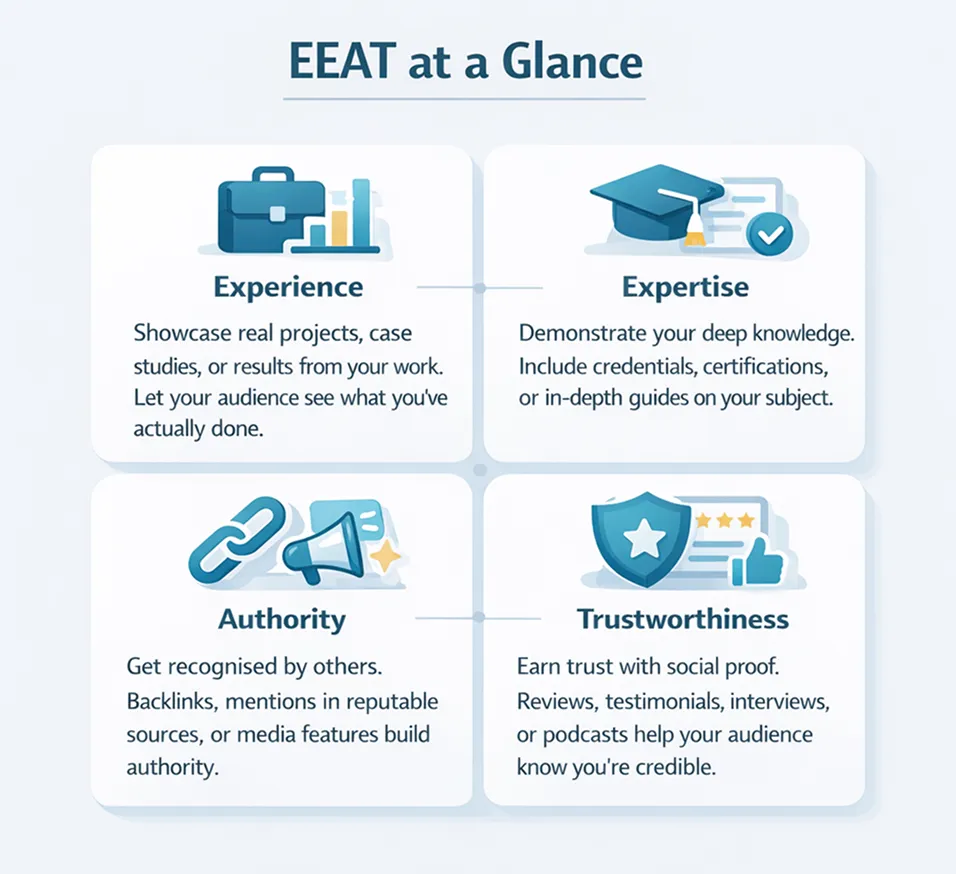
The focus of E-A-T SEO is on the development of highly professional, credible, and reliable content that can be ranked highly. In 2026, E-A-T is one of the latest SEO trends. It stands for Expertise, Authoritativeness, and Trustworthiness. It is the basis of SEO. Search engines check if your content is trustworthy. It also checks the authority of your content and how expert it is.
Your content is now judged on the basis of:
- Real-world expertise
- Credible
- Factual sourcing
- Practical value
These signs can be:
- Case studies
- Expert quotes
- Source references
- Actionable insights
Why This Matters
Search engines increasingly prioritise content that demonstrates- expertise,
- credibility, and
- reliability.
For a deeper guide on building topical authority and content depth, check out our detailed guide on topical authority and content clusters.
What Does It Mean for Marketers?
- Bulk publishing does not work anymore.
- Many low-value publications will get weak results.
- A few, but high-quality articles can give stronger results.
- Highlight author bios, certifications, and expertise to build trust with both search engines and readers.
- Link to reliable sources and include supporting evidence to increase trustworthiness.
Quick Actions To Apply Now
- Share personal stories and real examples.
- Guest post on trusted sites and get expert quotes.
- Collect and display user reviews.
- Update old content to reflect your latest skill.
- Include your own images, videos, or case studies.
Trend 8: AI-Powered Analytics and Predictive SEO
Predictive SEO is a type of AI that predicts trends and optimises the content before it becomes in demand. Predictive analytics is defining the future of the SEO trend in the UK, as it allows marketers to predict the search behaviour before others. It’s 2026, and traditional SEO approaches are no longer effective. AI-powered analytics are transforming SEO approaches. Now we can use predictive SEO to forecast and analyse trends.
Predictive SEO:
- Uses AI and machine learning
- Can make data-driven decisions
- Reduce trial and error
- Helps us to stay ahead of competitors
The Shift from Traditional SEO to Predictive SEO
Before AI, we had to manually analyse previous trends and historical performance. Now, with the help of AI-powered tools, we can- Identify patterns
- Predict search demand
- Highlight content gaps
What Does it Mean for Marketers?
- Data-driven decisions are now faster and more precise.
- AI predicts which keywords and topics will perform next.
- Search trends and user behaviour can be anticipated before they happen.
- You can spot content gaps and opportunities in advance.
Quick Actions to Apply Now
- Use AI tools to track keyword performance and trends.
- Analyse historical traffic to forecast what will work next.
- Plan content and campaigns based on predicted search demand.
- Test and iterate strategies quickly with AI.
- Use AI analytics in reporting to guide decision-making.
- Focus on topics your audience will search for, not just current trends.
Conclusion
The SEO landscape in 2026 is changing fast. It is driven by AI, voice search, mobile-first indexing, and rich media optimisation. To stay ahead, businesses must focus on reliable content and user experience. They must also adapt to semantic search and predictive analytics. Implementing these trends keeps your website visible, relevant, and competitive in search results. By remaining ahead of the trends in SEO in the UK, you ensure that your business remains visible, relevant and competitive in the year 2026.
At Xoom Plus, we understand that keeping up with SEO trends requires constant adaptation. Our team helps businesses implement strategies that are data-driven. Each strategy is designed around your audience and long-term growth goals.
If you’re ready to improve your website for the latest SEO trends, contact us today and get a customised roadmap built for 2026.
Ready to Future-Proof Your SEO Strategy?
Are you struggling to keep up with the fast-changing world of SEO and search engine updates?
Don’t get left behind in the SEO race. Optimise for voice, mobile, and AI-driven search while driving real traffic and results. At Xoom Plus, we help businesses stay ahead with cutting-edge SEO strategies and smart AI analytics.
FAQs
What are the top SEO trends for 2026?
The top SEO trends include AI-driven search, mobile-first optimisation, voice and conversational SEO, AI-generated content with semantic search, video and visual content optimisation, local and hyperlocal SEO, Core E-A-T, and AI-powered predictive analytics.
How is AI changing SEO in 2026?
AI is reshaping SEO by analysing search intent, optimising content for featured snippets, and predicting search trends. Marketers use AI to generate content, identify gaps, and improve user engagement.
Why is mobile-first SEO important?
With most web traffic coming from mobile devices, Google prioritises mobile-friendly websites. Fast, responsive designs and optimised Core Web Vitals are essential for rankings and user experience.
How do I optimise for voice search?
Focus on natural, conversational language, long-tail keywords, and direct answers to common questions. Optimising for local queries also helps capture voice search traffic.
What is semantic SEO, and why does it matter?
Semantic SEO focuses on understanding context and related topics, not just keywords. It improves rankings by helping search engines understand your content’s depth and authority.
How can video and visual content improve SEO?
Optimised videos, images, and infographics increase dwell time, reduce bounce rates, and appear in rich results. Proper metadata, alt text, and schema markup increase discoverability.
What is hyperlocal SEO, and how can I use it?
Hyperlocal SEO targets specific neighbourhoods or districts to attract nearby customers. Accurate business listings, local keywords, and reviews improve visibility in local search results.
How can predictive SEO help my strategy?
Predictive SEO uses AI to forecast trends, identify keyword opportunities, and suggest content updates before competitors. It enables data-driven decisions and proactive optimisation.