


- January 12, 2026
- Categories: Digital Marketing
Topical Authority: What It Is & How to Build It?
If you have been publishing content consistently but still struggling to rank, the issue is probably not your backlinks, site age or even technical SEO. More often than not, the real problem is a lack of topical coverage and authority. For anyone asking, “What is topical authority?”, Google’s guidance on creating helpful, reliable, people-first content explains why search systems try to reward content made for people, not for manipulation. In topical authority SEO, the main idea is that structure beats random posts.
Search engines no longer reward websites that randomly publish disconnected articles. Instead, they prioritise sites that show deep, structured work around a subject. That is why topical authority in SEO has become one of the most powerful SEO concepts today. Your ranking grows when those connected articles answer the full journey, not just one question.
In this guide, you will learn exactly what topical authority is, why it matters for rankings and how to build it step by step without falling into common traps.
What Is Topical Authority?
Topical authority SEO refers to a website’s expertise, depth and trust around a specific subject area. Rather than ranking pages one by one only, search engines also look at how well the full topic is covered. In simple words, it is the feeling that your site covers a topic fully, not half.
When your content keeps answering the key subtopics, questions and angles in a niche, search engines start to see your site as a strong source. As a result, new content can rank faster. Old pages can move up. And your overall reach can improve.
Authority is not a single metric you can track in a tool. Instead, it is an outcome built through content structure, internal linking, relevance and consistency.
Topical Authority Vs Domain Authority
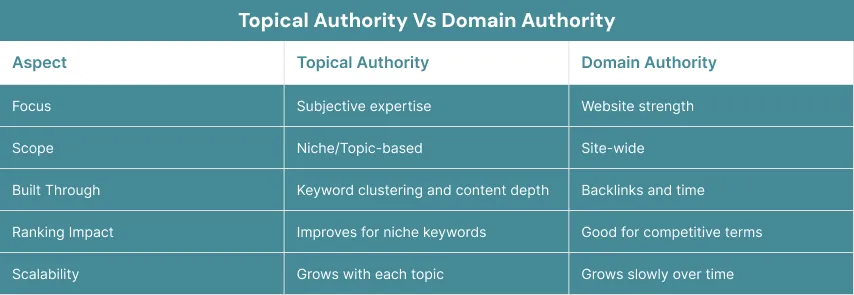
This comparison shows us that a site with moderate domain authority can easily outrank its competitors if it has strong topical command within a certain niche.
Why Is Topical Authority Important for SEO?
Google’s algorithm has come a long way. Topical dominance and authority can no longer be left out of SEO. With the recent updates and emphasis on EEAT, topical expertise and authority are now an integral part of SEO. Here is why it matters. Google has also publicly explained the addition of Experience to EEAT in guideline updates, which links closely to the idea of proving depth and trust over time.1. Improved Search Rankings
When your website shows command over a topic, it supports the EEAT side of quality. This can help rankings for harder keywords. Search engines no longer focus on isolated pages only. They now look at the topic as a whole. This means that each page should support the next page. Internal links, close meaning and real depth work together. This allows clusters of pages to rank higher even if they have low domain authority. This is why topical authority SEO often helps smaller websites compete in a smart way.
Topical dominance also helps relevant content rank faster. This is because search engines already see your site as more trusted on that topic. You often need less “proof” to look real for that keyword. So a page can rank even if it has fewer backlinks than a competitor.
Topical command also helps rank new content faster. When you have already built trust with the search engine, your pages on the same topic can get picked up more quickly. Over time, ranking can feel less heavy.
2. Alignment With Search Engine Algorithms
Modern search engines are designed to understand human intent. They go for meaning, not just keywords. They also look at entities and topic links across the whole site. This is why topical relevance is so key for alignment.
Topical command gives your content more weight as “a good fit” for the right query. It helps search engines line your pages up with the proper search intent. Strong topical coverage can also help your pages stay more stable when updates happen because the site looks like a real resource and not a set of random posts.
3. Increased User Trust
People trust websites that feel clear and consistent. When someone reads one page and then finds another page that answers the next question, trust grows naturally. It feels like the site understands the reader’s path. This trust matters because SEO is not only about traffic. It is also about what happens after traffic arrives. When readers trust a site, they are more likely to stay, share, subscribe or contact the business.4. Better User Experience
Topical authority improves the experience because content becomes organised. Users can find related pages easily through internal links. Instead of leaving the site to search again, they continue reading. This helps users feel supported and it also helps search engines crawl and discover the full site better. A well-linked topic cluster is like a clean map. It helps both humans and Google move through the topic without confusion.5. Further Alignment With Search Engine Algorithms
Google’s algorithm has moved towards meaning, relevance and helpfulness. It is not only about matching keywords anymore. It is also about meeting search intent and rewarding content that genuinely helps. Topical coverage fits this direction well because it supports semantic SEO in a simple way. The content is connected. The topic coverage is clear. The site looks like a proper resource, not a random blog. This also connects with EEAT thinking, because careful, helpful coverage shows trust over time.6. Attracts Backlinks
Strong topical content can attract backlinks naturally because people want to reference useful pages. When a site becomes known for covering a topic deeply, other websites are more likely to link to it. This works even better when those links come from relevant websites. A link from the same niche carries more meaning than a link from an unrelated niche. Relevance is a key part of link value and topical coverage makes it easier to earn those relevant links.7. More Content Opportunities
Topical command also makes content planning easier. Once a broad topic is selected, many subtopics and questions appear naturally. Keyword research, SERP checks and gap checks can create a long list of content ideas. This gives a website a clear roadmap. Instead of guessing what to write next, the site keeps building deeper and wider coverage around the same subject, which is exactly what you need to build authority on a topic.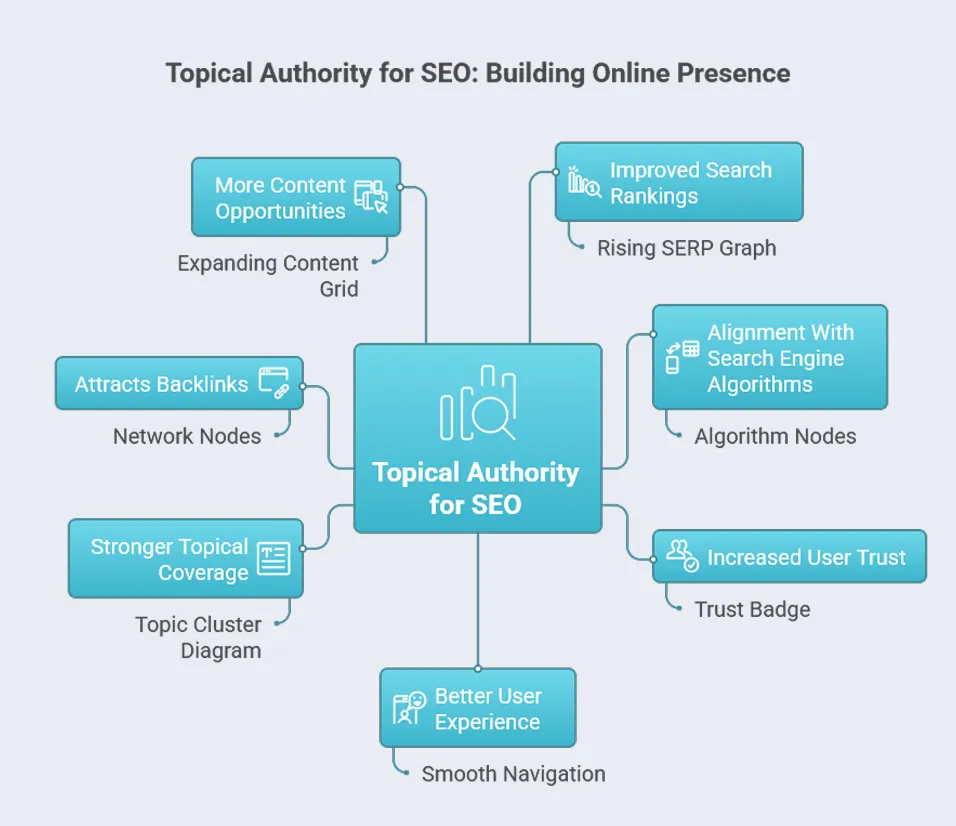
How to Build Topical Authority?
It is not complex to build topical authority, which takes time. The difficult part is doing it in a related manner, regularly and with order. Many sites do keyword research but skip structure. Some write good content but fail to link it well. Others post often and never update. These are the common topical authority mistakes that slow down growth.1. Pick a Broad Topic
It needs a broad subject matter in order to expand. When the topic is too small, ideas get exhausted fast. In case the subject matter is too broad, the site feels lost. The subject matter must also align with the business so the content supports real goals, not only traffic. Many subtopics can be supported using a good topic, such as definitions, advantages, comparisons, tools and guides.2. Do Keyword Research
It is in keyword research that the topic becomes clearer and wider at the same time. First, a seed keyword is taken. Then it is followed by related keywords and queries. This may be based on tools like Ahrefs, Semrush or Google Keyword Planner, but it may also be based on Google features like People Also Ask, related searches and autocomplete. SERPs are also useful because they show what ranks already and what format Google seems to prefer.
To learn more about keyword research and mapping, check out our guide on keyword mapping.
3. Create Content Clusters
Long content does not mean writing long pages with filler. It means answering the topic properly. The page should give complete answers. It should explain the main points clearly. It should have enough detail to be useful. It should also bring some information gain, so it does not feel copied or repeated.
This step fixes many topical authority mistakes because it stops the “random post” habit. It turns pages into a system. A pillar page becomes the hub. Supporting pages become the paths. Everything stays linked.
4. Write In-Depth Content
In-depth content does not mean filler. It means covering the topic properly. The page should answer the question fully. It should explain the important points in simple language. It should include enough detail to be truly useful. It should also add something extra, even if it is small, like clearer steps, better examples or a more direct explanation.5. Match Search Intent
The reason behind the search is search intent. In case the keyword is a definition, the content has to define it clearly. When the keyword is a “how to”, the content should guide step by step. In case the keyword is “best”, the content should compare and help make a decision. When content and intent are in line, it feels right to the reader. This often leads to better engagement and better rankings over time.6. Organise With Internal Links
Topical expertise and authority rely heavily on internal linking. It helps Google find pages and helps users find related pages. It also builds stronger topic links among URLs. The connections must not be artificial. Anchor text should be clear, not vague. Every pillar page should act like a hub with the supporting pages connected to it and the pillar page should also link back to the supporting ones. This is where topical authority in SEO becomes very clear because the topic path is easy to follow.7. Build Backlinks
Backlinks still matter. Good content may still need links to compete in hard niches. The focus should be on links from relevant websites. Guest blogging, useful “resource” pages, expert quotes and outreach can help. The best backlinks are the ones that are earned because the page is worth linking to. That is why good topical coverage comes first.8. Update Content Regularly
Topical coverage and authority are not established once and for all. Content gets old. SERPs change. New information appears. Content should be updated to stay useful and up to date. Updates can be new sections, clearer wording, updated examples and fixed broken links. Even small updates can protect rankings and strengthen topic trust.9. Monitor and Measure
There is no official score of topical or domain authority. But real signs can be tracked. More keywords ranking. More impressions and clicks in Search Console. More pages ranking inside the same cluster. More traffic that comes from many related searches, not just one. This is also part of topical authority in SEO because it shows topic growth, not only page growth.10. Promote Your Content
Promotion assists with content being found more quickly and assists it to gain links. Visibility can be improved through social media, email, communities and outreach. Great content can stay hidden if no one knows it exists. Promotion can also be repeated when content is updated, so the topic stays active and visible.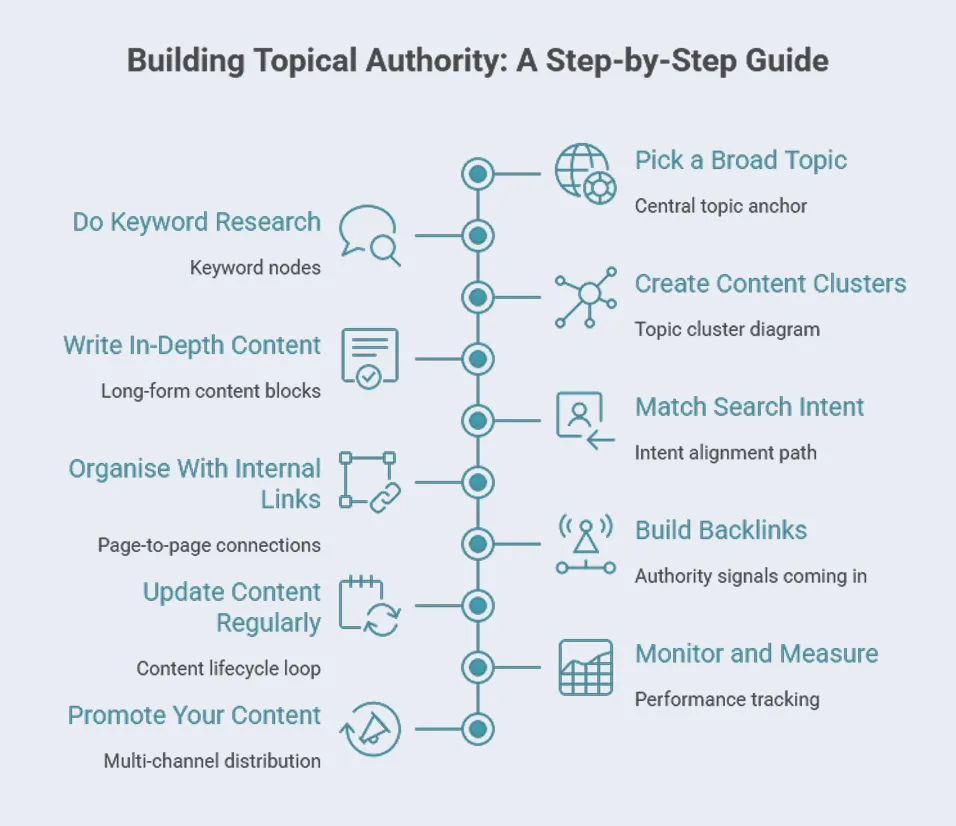
Conclusion
To gain topical power, it is necessary to be regular, systematised and really useful. It is not about writing one good article. It is about building a networked system of pages that covers a topic from many angles, with content clusters, strong internal links and real depth. Keyword research helps you expand the topic in the right way. Backlinks support growth, but relevance matters more than quantity. Updates keep the topic fresh. Promotion keeps the work seen. This also cuts topical authority mistakes before they grow into a bigger problem.
When handled properly, a site will begin to rank not just on one keyword, but throughout the entire topic. Over time, topical authority SEO becomes easier when the work stays connected and topical authority SEO becomes stronger when every page supports the next. If support is needed, Xoom Plus can guide the process and keep the system clean as an internal resource, so the work stays consistent and the results become easier to build. Contact us now to start ranking your content higher today.
Want real topical authority that brings rankings, not just more posts.
Our SEO services can build the full topic plan, write the cluster content, and link it properly so growth finally feels steady.
FAQs
To improve site authority, start by making the site feel more complete and more trusted in one clear area. Pick a topic theme and stay with it. Write pages that answer real questions, not just keywords. Link related pages together so the site feels organised. Keep titles and headings clear. Add real examples, simple steps, and clear definitions. Update older pages so they stay fresh and correct. Earn links from relevant sites by sharing useful pages, not by chasing random links. Site authority grows when the site looks helpful, consistent, and easy to trust.
Build authority means building trust and belief in your website. It means the site looks like it knows the topic. It also means people can rely on it. Search engines notice this through signals like topic depth, helpful content, strong internal links, and steady quality. Users notice it too. They stay longer, read more, and come back. So building authority is not one action. It is a habit. It is doing the right work again and again until your site feels like a proper source.
To build topical authority, pick one broad topic that matches your business, then cover it in depth. Create a main page for the big topic. Then write supporting pages for the smaller parts of the topic. Keep those pages linked in a natural way, so each page leads to the next question. Make sure every page matches search intent. If a query wants a meaning, define it clearly. If it wants steps, show steps. If it wants a comparison, compare in a fair way. Avoid topical authority mistakes like writing random posts, using vague internal links, or leaving older pages to go stale. When you keep the topic connected, topical authority in SEO grows faster. And topical authority SEO becomes easier over time because the trust is already there.
A topical authority is a website, or sometimes a section of a website, that is seen as strong and trusted in one topic. It is not about being famous. It is about being complete and consistent. It happens when the site covers the topic from many angles and keeps the pages connected. So when people ask what is topical authority, the simple answer is this. It is the trust your site earns in one subject because your content proves it understands the topic properly.
Backlinks still matter, but topical authority often comes first. Strong topic coverage can allow pages to rank with fewer links, especially in low to medium competition niches.
SEO has some technical parts, like site structure and speed, but it is not only an IT skill. It also involves content, keyword intent, and user experience. Many teams treat it as a mix of marketing, content, and technical basics.
Topical authority focuses on expertise in one subject area, while domain authority reflects overall site strength. A site with low domain authority can still rank well if it has strong topical coverage.
Topical authority takes time. Most sites see early signals in a few months, but strong authority usually develops over six to twelve months with consistent content and internal linking.