

- January 13, 2026
- Categories: Digital Marketing
What Is Affiliate Marketing? A Beginner’s Guide to Getting Started
Have you ever wondered what affiliate marketing is? Has affiliate marketing been a buzzword you hear a lot about but never quite understood how it works? If the answer is yes, then you are not alone.
Affiliate marketing has become one of the most popular forms of digital marketing. It is a performance-based activity where you, as an affiliate, promote content for other companies. Affiliates earn commissions for each successful referral. A business pays a commission when an affiliate sends a visitor who completes an action such as a purchase, click, sign up or lead through a tracked link. It is a great way to generate passive income.
The global affiliate market has been estimated at $17-18.5 billion in 2025. This value is projected to exceed $20 billion in 2026.
Affiliate marketing strategy can work well, but results are not guaranteed. It usually takes time to build traffic, trust and steady commissions.
This is a beginner’s guide to affiliate marketing. If you are a business owner wanting more leads or a content creator looking to enhance your reach, this guide will cover all you need to get started with an affiliate programme.
Key Takeaways:
Here are the key points in this blog at a glance.- Affiliate marketing uses third-party affiliates to drive leads, clicks or sales.
- It is one of the most popular forms of online marketing. It’s a billion-pound industry thanks to tracking tools, analytics and cookies.
- Affiliates earn commissions based on performance. Each click, sale or lead may result in earnings; it all depends on the programme.
- The main types of digital affiliate marketing are unattached, related, and involved.
- Success depends on the right programme, good content, and the right audience. If these are not clear, results stay slow.
What Is Affiliate Marketing?
Affiliate marketing is a performance-based model. In this model, a business pays a commission to affiliates when they bring results. The result can be a sale, a lead, click or a sign-up.
An affiliate uses a unique tracking link to promote products or services for any business. Every time a lead or sale is completed using that link, the affiliate earns a commission. The action could be clicks, subscriptions or purchases depending on the affiliate programme.
How Affiliates Get Paid (CPC, CPL, CPA)
| Model | What It Means | What Triggers Payment |
|---|---|---|
| CPC | Cost per click | A tracked click |
| CPL | Cost per lead | A sign up or enquiry |
| CPA | Cost per action/sale | A purchase or defined action |
Here is how the process goes:
- A company starts an affiliate programme.
- An affiliate gets a unique tracking link.
- The affiliate starts promoting the product or service.
- A user then clicks the link and completes an action i.e., click, sign up or make a purchase as a result of the affiliate’s efforts.
- The affiliate gets paid based on that result.
Related: Exploring the Digital Marketing Universe: Key Types Explained.
What Is Affiliate Advertising?
Affiliate advertising is the way in which affiliates promote products or services. This can include:- Blogs
- Reviews
- Tutorials and guides
- Paid ads like PPC
- Social media posts
- Emails and newsletters
The product or the service must address your target audience’s needs. Knowing your audience is key to the process.
How Does Affiliate Marketing Work?
Affiliate marketing strategy works in a simple way. An affiliate promotes a product or service with the help of a unique tracking link. A business pays a commission when an affiliate brings a result using this link. The result is taken by users in the form of a sale, a lead, or a sign-up.Key Players
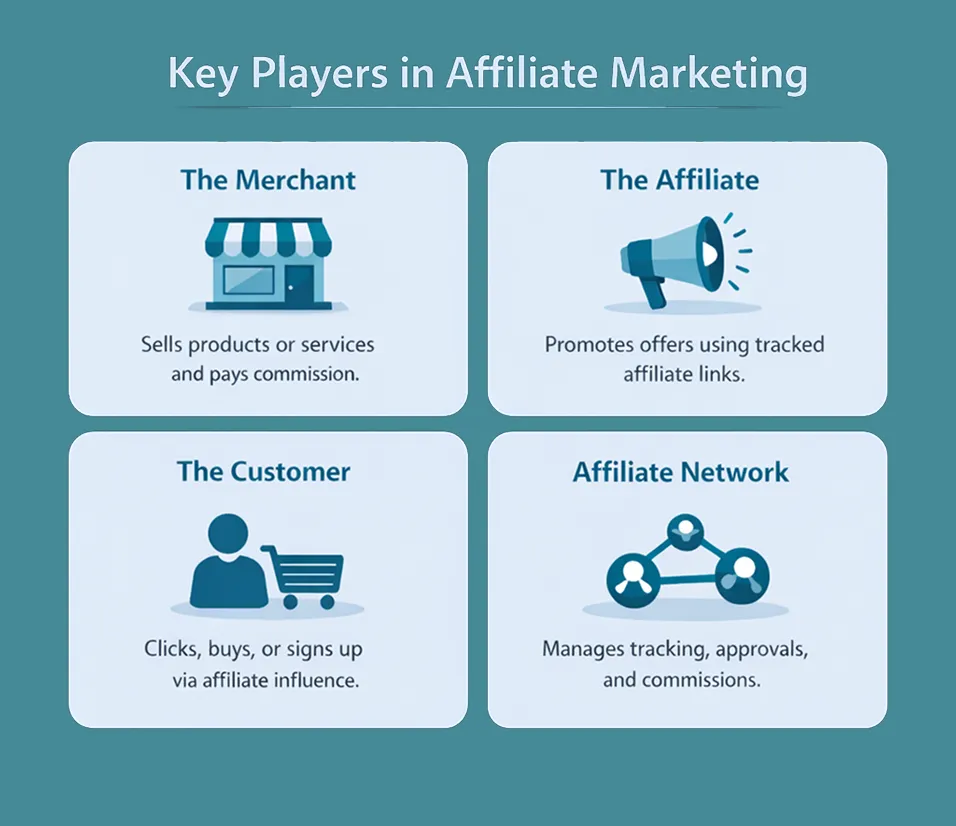
There are four main parties in this process:- The Merchant: The party selling a product or service.
- The Affiliate: The party promoting the product or service, using unique tracking links.
- The Customer: The user who clicks the link and completes a sale, subscription or click due to the affiliate’s efforts.
- The Affiliate Network: A third-party system that manages merchant affiliate relations.
The Flow Goes Like This
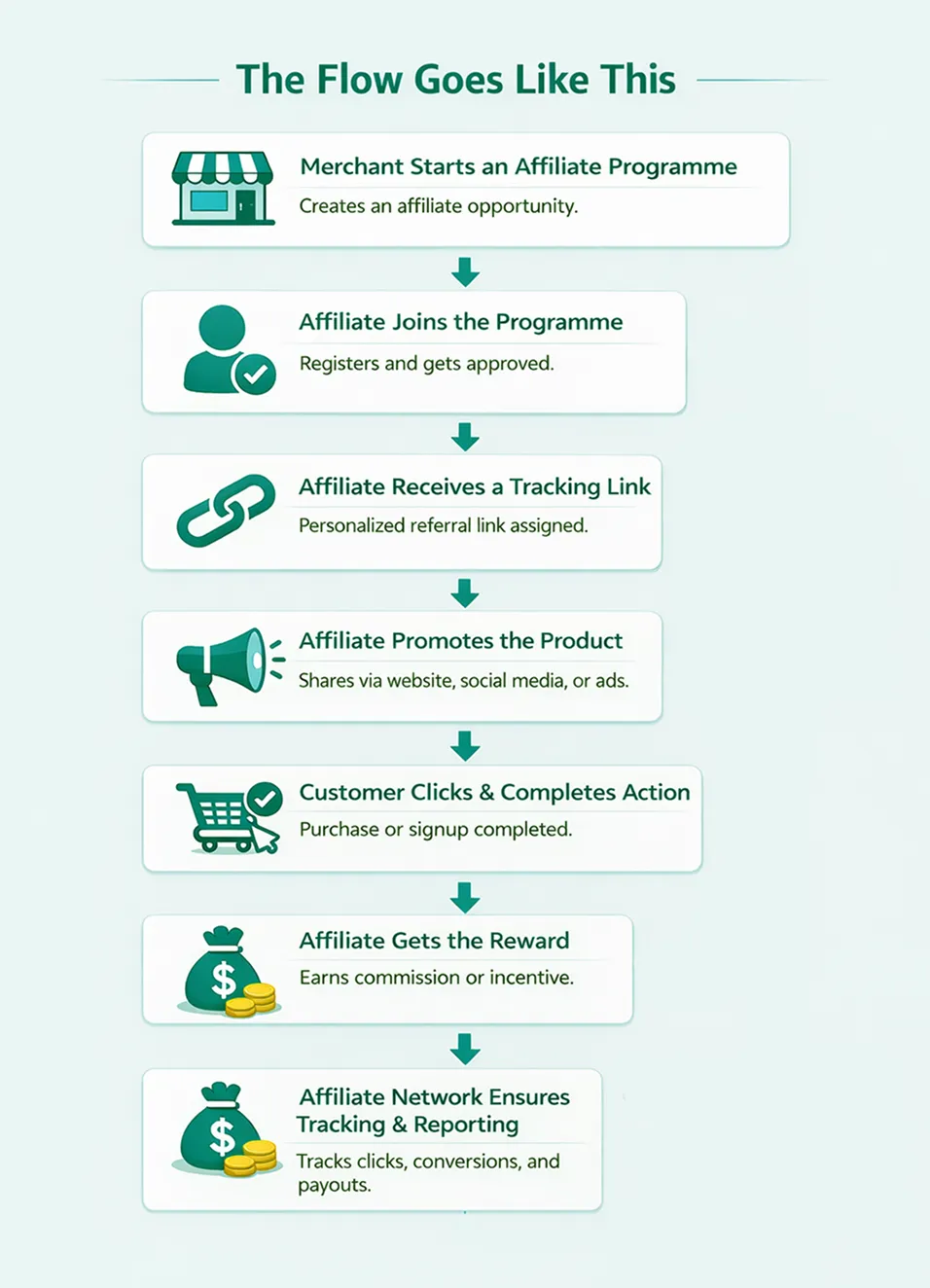
- A merchant starts an affiliate programme.
- The affiliate joins the programme.
- The affiliate gets a unique tracking link and a task to get as many actions done as possible through that link.
- The affiliate works to promote the product or service through their content.
- The customer clicks the link and completes the sale, click or subscription.
- The affiliate gets the reward.
- (Optional) The affiliate network ensures payment, tracking and reporting of results.
How to Do Affiliate Marketing as a Beginner?
Ever been wondering: what is affiliate marketing? Or how to join an affiliate programme. Affiliate marketing can be easy to start. But results are not guaranteed. It can take time. Building trust and traffic also takes time.
No big technical skill is needed in the beginning. Most people can start with basic tools. What matters more is following clear steps and staying consistent.
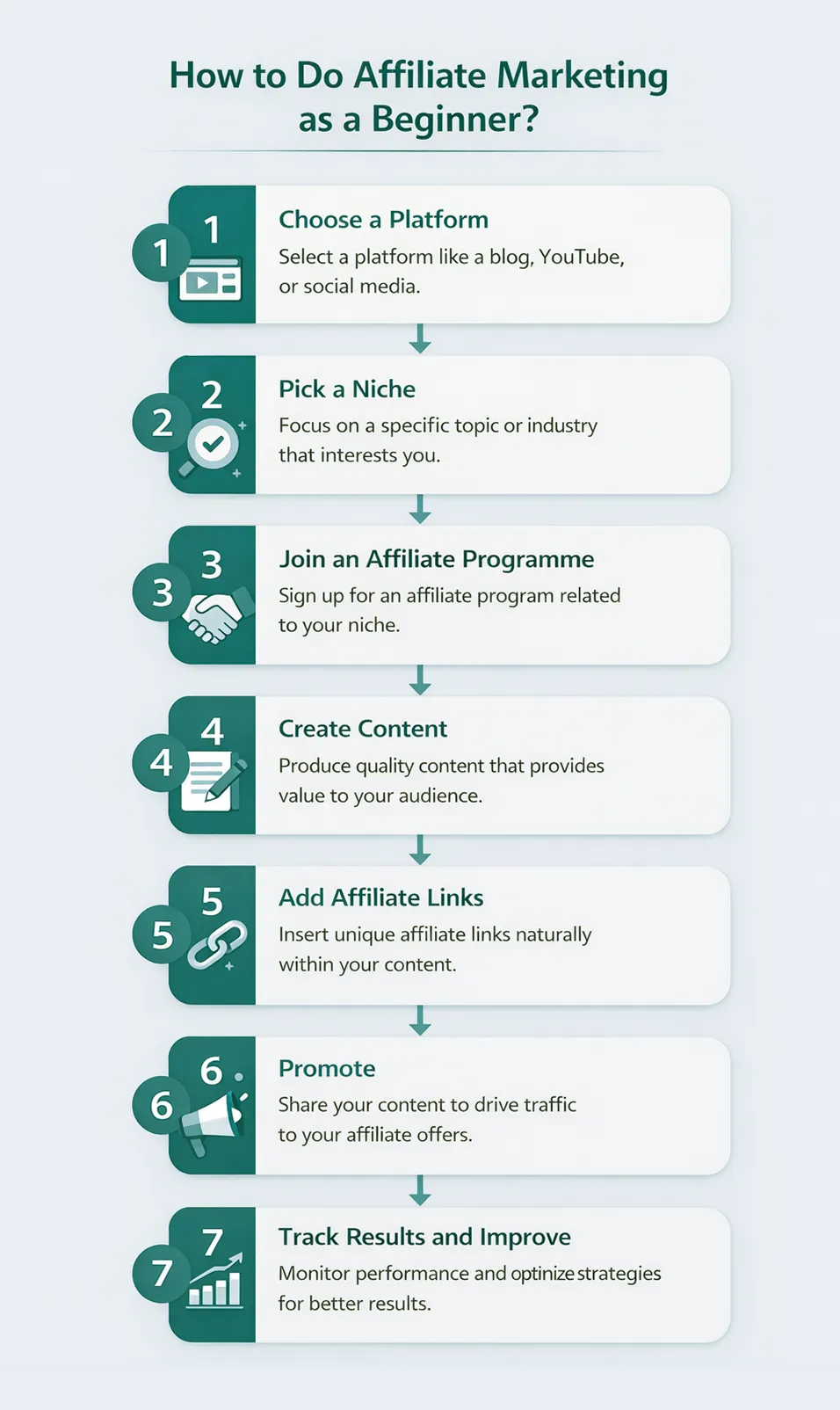
Step 1: Choose a Platform
Select where you want to post content. Without a popular platform, no one will see your content, let alone click your link. So pick wisely. Some popular options are:- A blog on a website
- TikTok
- YouTube
- Email marketing
Social media gives quick results. Many social media platforms like TikTok Shop and YouTube Shopping let you tag products in their content. This makes it easier to sell products.
Analytics are a great way to choose a platform. Keep an eye on what platforms affiliates are using. There is a lot of info out there in the affiliate community. The latest news and trends within the digital marketing world can provide invaluable information.
Step 2: Pick a Niche
A niche is something you create content around. Pick your niche wisely. It is the focused topic of your effort and content. When picking a niche, you should keep in mind:1. Competition:
If the topic is sexy, you may have a hard time getting in. It will need more effort to rank, convert or get leads in such areas. Some of the more competitive niches are:- Health and fitness
- Technology and gadgets
- Personal finance
- Travel
2. Knowledge of the Niche:
Pick a topic you have experience in. For instance, if you are a sports fan, then you can promote sporting equipment.3. Search Demand:
The niche must have a consistent demand. High search demand means more traffic. Competition can be high, but so is the chance to rank and score.4. Profitability:
Does investing in your niche yield a profit? A basic question that must be answered before selecting a niche. The affiliate marketing strategy you use will have a big part in deciding the profitability of your niche.Step 3: Join an Affiliate Programme
Ever been wondering: what is affiliate marketing strategy that works? Or how to join an affiliate programme. Affiliate programmes are the models that give you commission when a sale, click or subscription is taken through your link. There are many affiliate programmes that can be joined for free. Some of the more well-known are Amazon Associates, eBay Partner Network, Etsy Affiliates and Epidemic Sound. Here are some things that come with joining an affiliate programme.1. Commission
Commission varies by programme and category. As stated before, you get paid a commission for each successful referral. Most rates range from 5 to 30% with averages of 15 to 25%. Some programmes also pay a fixed amount. The amount varies with each programme.2. Cookie Duration
Cookies are the trackers used to detect the progress of referrals. A cookie is created when an affiliate link is clicked. It is stored in their browser. Cookie duration is the time window during which, if a user takes action, it is counted as a successful referral. The cookie duration varies by program.3. Programme Rules
Programme rules are the rules you have to abide by for the duration of the programme. These rules decide where to post content, what type of content is allowed and whether paid ads are allowed.Choose Products That Fit
Before writing content, decide what will be promoted:- Choose products that genuinely match the niche and the audience problem.
- Prefer products with clear benefits, strong reviews and low confusion.
- Avoid random offers that do not belong on the site or channel.
Step 4: Create Content
Content is what drives an affiliate marketing strategy. Your content should:- Educate or entertain your audience
- Solve problems
- Include naturally placed affiliate links
- Product reviews
- Tutorials and guides
- Comparison articles
- Top 10 lists and recommendations
Step 5: Add Affiliate Links
Affiliate links are the URLs that allow affiliates to get paid for their promotion. The links must be placed naturally within the content. Anything that feels forced can turn the users off. Add them where it feels sensible to put them. Some good placements are:- When you mention the product or service.
- As a recommendation.
- In CTAs, like “Check the price here”.
- Tutorials.
Your focus should be on users’ needs. Build trust with them; it is better than pushing a forced sale.
Once the links are added and the content is ready, it is published. As it goes live, people can start finding it online and sharing it on different platforms. If you are using multiple platforms, then a good approach is to publish simultaneously.
Adding affiliate links the right way and publishing good content are the most important steps in the success of an affiliate marketing strategy.
Step 6: Promote
If there is no traffic, no one will click the link. That is why promotion matters. Content can be good, but people still need to see it first. Share it where your target audience already spends time. It can be social media, email, or even online groups.
More views usually bring more clicks. More clicks can lead to more actions, like sign-ups or sales. Promotion also helps you learn what works. If one post gets more clicks, it means your audience likes that angle. Then you can do more of it.
Some efficient ways to promote your content are given below:
1. Social Media
Social media is a simple way to get traffic. Many people use these apps every day. So it is easier to reach your audience there. Post on Facebook, Instagram, X (Twitter), LinkedIn, and TikTok. For example, make a short reel about the main points of a fitness blog. Then add the full blog link under the post.2. Online Communities and Forums
Online communities like Reddit and Quora are forums for answers to users’ questions. Not only can you answer their pressing queries, but you can plug in links to your content as helpful resources. This works best when the link adds value. Make sure that you follow community guidelines.3. Search Engine Optimisation (SEO)
A great way to gain clicks and leads over time is SEO. You post valuable content with proper keywords that answer users’ questions. Using SEO techniques like keyword clustering, internal linking and improved readability you can attract visitors for months after publishing. SEO is an evolving game, so make sure to update content over time.Step 7: Track Results and Improve
Analytics tools are a great way to track progress. Tools like Google Analytics can track views, user sources and behaviour. With this, you can track which blog gets what impressions and how many clicks it got. This helps you identify and target areas to improve.
Affiliate dashboards are another way to analyse and track progress. Most programmes provide their own dashboards. For example, Amazon Associates has its own dedicated platform called Associates Central, which serves as an official dashboard. These dashboards not only allow tracking but also help manage all related marketing activities.
There are also click tracking tools that track how many times a link is clicked. Some examples are link shorteners and affiliate link managers. These link trackers can be used to compare the performance of content.
Affiliate Marketing Advantages and Disadvantages
If you have come this far, you already know: What is affiliate marketing? And how does it work? Affiliate marketing may seem like a dream job. In reality, it has its own pros and cons. These must be considered before starting a setup.Advantages
- Low start-up costs.
- No need to create a product.
- Flexible schedule.
- Scalable income potential.
- performance-based rewards.
Disadvantages
- No guaranteed income.
- Limited control over products.
- Dependent on third-party programmes.
- It takes time to see results.
Common Mistakes Beginners Make in Affiliate Marketing
People already know what is affiliate marketing and how it works. Yes, a thorough understanding is important before developing your affiliate marketing strategy. When starting, here are some pitfalls you need to avoid.1. Picking a Niche That Is Too Broad
When launching a startup, the choice of niche is a very important step. Many broad niches may appeal on the surface, but they come with drawbacks. Such as:- Hyper competition.
- Big competitors.
- Small ranking space.
- Difficult to retain the audience.
- Poor conversion rate.
The narrower your niche, the better.
2. Promoting Random Products
Users usually have pointed demands. They come to websites for specific reasons. A site promoting random products may confuse them. It may be off-putting for some users, causing them to leave. This drops retention and conversion rates.
Example: A blog about mental health promoting therapy tools makes sense. The same blog promoting kitchen utensils can push readers away.
Always stick to your niche and brand. The products you promote must be specific and related to your interest.
3. No Disclosure
Not disclosing affiliate relationships harms trust and can breach advertising rules. In the UK, affiliate content may need to be clearly identified as advertising (for example using clear labels like “Ad” where required).
Disclosure is important as it builds trust with the audience. It shows your honesty and helps you follow legal guidelines.
Place the disclosure at the end of your blog. Readers appreciate honesty.
4. Expecting Fast Money
One allure many affiliates fall for is that of a quick return. This is false. It takes time to develop trust and authority. Content ranking is a long-term process. It takes months for content to rank and social media posts to go viral. Any good affiliate marketing strategy should take into account the timely nature of the process.Why Are Fast Results Rare?
- New websites have low trust at the start.
- SEO is a slow game. Takes time to rank content.
- Users don’t always buy.
- Testing and improving takes time.
Realistic Example: A beginner may publish 10-20 articles and earn nothing in the first few months. Over time, one well ranked article can start getting daily traffic and regular commissions without extra work.
Conclusion
Affiliate marketing is a great way to create passive income. It allows you to gain exposure and reach new audiences without having to create your own products. Perhaps its biggest advantage is that it’s a win-win game. An affiliate marketing strategy allows merchants to gain more leads and sales. It allows affiliates to earn income doing what they love and it offers users new products through their favoured content. Here at Xoomplus, we understand the value of such win-win endeavours. Whether you are a content creator, blogger or entrepreneur, affiliate marketing provides flexibility, scalability and the opportunity to monetise your online presence. Contact us now to get started today.Affiliate marketing works best when you focus on value, not quick wins.
Take time to understand your audience, choose quality products and refine your affiliate marketing strategy as you grow. Explore the best programmes with our digital marketing services today.
FAQs
What is affiliate marketing in simple terms? It is a way to earn money online by promoting someone else’s product or service. A special tracking link is shared, and a commission is earned when someone buys through that link.
What is affiliate advertising and how is it different from traditional advertising? Affiliate advertising uses tracked links and pays for results (like a sale or sign-up), not for impressions or views like many traditional ads.
How does affiliate marketing work for beginners step by step? A niche is chosen, an affiliate programme is joined, helpful content is created, and affiliate links are added. When people click and take action, commissions are earned.
Can you really make money with affiliate marketing in the UK? Yes, it can work, but it usually takes time to build traffic and trust. Some earn side income, while others build full-time income with a clear strategy.
How much money can you make with affiliate marketing? Earnings vary a lot. Beginners may make a few hundred pounds a month, while experienced affiliates can make thousands, depending on niche, traffic, content quality, and commission rates.
Is affiliate marketing free to start for beginners? It can be started with little to no money using free platforms like YouTube, TikTok, Instagram, or a free blog setup, then growing from there.
How long does affiliate marketing take to start working? It is not instant. Many people need several months to build content, traffic, and credibility, especially when relying on SEO or organic social media.
How do you choose the best affiliate programme for your niche? Pick programmes that match the niche, have fair commission rates, reliable tracking, a solid reputation, and products the audience actually wants.
What is the best affiliate marketing strategy for beginners? Focus on helpful content, stay in a clear niche, promote products that fit the audience, use SEO properly, and build trust instead of chasing quick sales.
Do you need a website to start affiliate marketing? No. Many affiliates use YouTube, TikTok, Instagram, podcasts, or email newsletters. A website helps long-term with SEO, but it is not required.