- January 28, 2026
- Categories: Digital Marketing
AI and SEO: How Search Engine Optimisation Is Evolving
Delivering the right content at the right moment now depends on AI SEO. AI in SEO tools reshaping every step of optimisation. These advanced tools power dynamic content recommendations and streamline technical audits. As search engines blend advanced models with human-focused ranking signals, marketers must adapt quickly or risk falling behind. Effective AI SEO strategies and practical advice will help you thrive in a landscape where relevance matters more than keywords.
What Is AI SEO?
AI SEO combines classic search practices with smart algorithms that grasp context intent and user habits. Instead of just matching keywords AI SEO platforms track search trends, click behavior and page layout to see what readers need. When you use ai in SEO solutions you save time on things like finding new keywords and refining content. This lets you spend more effort on writing pages that really help people. As the system sees which articles perform best it updates its suggestions in real time so your site stays fresh and useful.How Is SEO Evolving with AI?
Search engine optimisation began with keywords stuffing and swapping links across sites. Over time Google built smarter systems that look for pure keyword matching to intent recognition. When RankBrain arrived in 2015 it learned from click patterns and helped handle new searches. In 2019 BERT taught Google to read full sentences and catch subtle meaning. Today AI SEO tools go even further. They study how users scroll what they click and how they talk to voice assistants to deliver answers that feel personal.
This change marks a shift from reactive tactics to predictive strategies. We do not wait for weekly reports anymore. Instead the system reads live data about clicks time on page and scroll depth and uses that to fine tune content on the spot. This approach helps your pages stay up to date and deliver the best results for each visitor. With AI in SEO you focus on creating quality content while smart tools keep you in step with what readers want.
-
Shifting Focus from Keywords to Intent
At the core of modern search lies a shift from simple word matching to true relevance. Instead of awkwardly stuffing terms, writers now focus on crafting detailed answers that systems can interpret. Success depends on offering clear and well organized information with anticipatory explanations and links to trusted sources. With AI SEO, pages build authority by solving reader problems rather than by repeating keywords.
-
Key AI Systems Changing Search
-
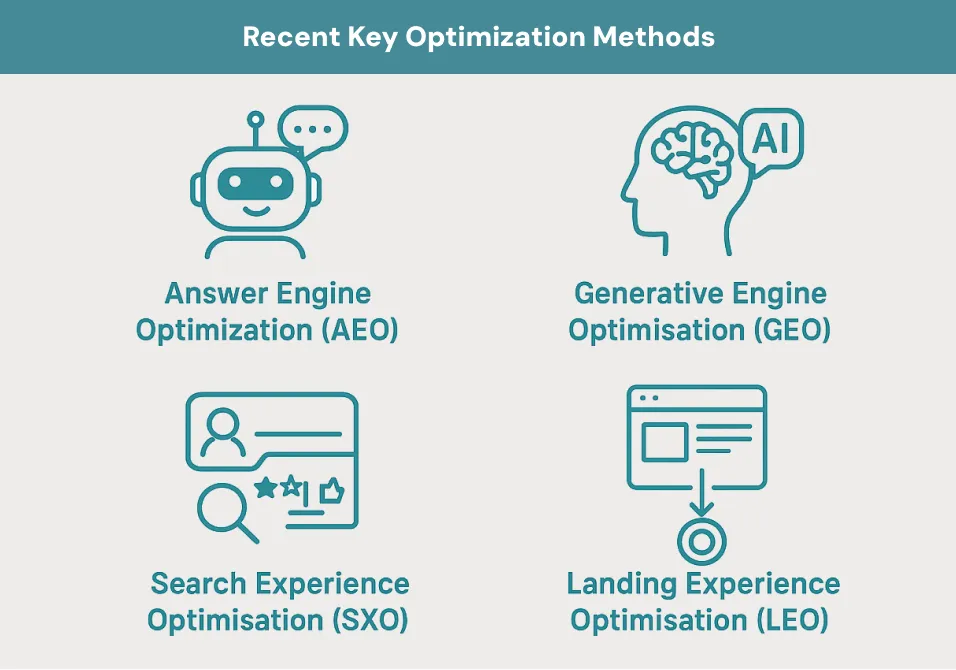
Recent Key Optimization Methods
-
Answer Engine Optimization (AEO)
-
Generative Engine Optimisation (GEO)
-
Search Experience Optimisation (SXO)
-
Landing Experience Optimisation (LEO)
Using all four methods boosts site reach and user trust. Together, they form a complete AI SEO approach.
-
Why Are Zero-Click Searches on the Rise?
Core Elements of Modern AI-Driven Optimisation
Search success today is based on five key pillars, each powered by AI. These work together to move beyond old tactics like repeating keywords and simple link-building. By weaving AI SEO into every step, from planning to maintenance, brands see steady growth, deeper engagement, and stronger rankings.1. Intelligent Keyword Discovery
-
Forecasting Emerging Trends
-
Mapping Semantic Clusters
-
Refining Intent Classification
2. Content Creation and Refinement
-
Synthesising Top-Ranking Insights
-
Optimising for Readability and Engagement
-
Leveraging Human Creativity
3. Automated Technical Optimisation
-
Predictive Issue Identification
-
Automated Schema and Structure
-
Internal Linking and Site Flow
4. Proactive Performance Monitoring
-
Real-Time Alerts and Baselines
-
Precise Attribution Analysis
-
Algorithm Impact Forecasting
5. Maximising Search Visibility in the AI Era
-
Targeting Featured Snippets
-
Structuring for Voice and Conversational Search
5.3 Enhancing Entity Visibility
Generative search features rely on clear entity definitions, who you are, what you offer, and how your content connects to broader topics. According to a 2024 SISTRIX study on SERP features, entity panels appear in over 30 percent of Google result pages. By giving each topic and author clear attributes like definitions, dates, and related terms, you help AI SEO systems trust your content and cite it in responses. This focus on entity clarity boosts your chance of being featured in emerging conversational platforms.Key AI SEO Tools Transforming the Landscape
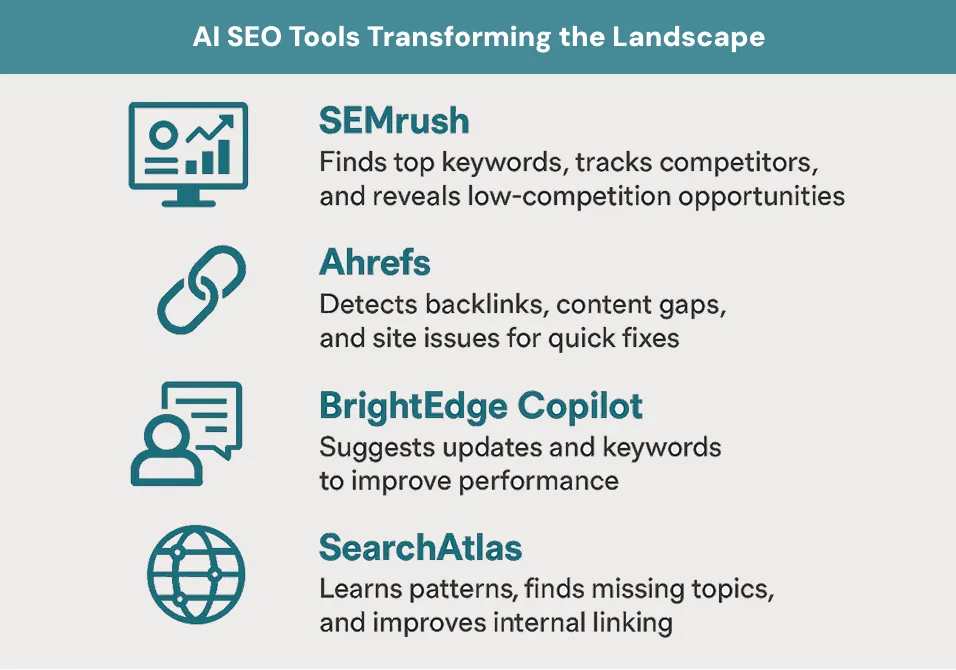
A growing ecosystem of AI-powered SEO solutions tackles every facet of optimization:-
SEMrush
-
Ahrefs
-
BrightEdge Copilot
-
SearchAtlas
These platforms give you clear steps to create a strong AI SEO approach. They guide you to meet visitor expectations and search engine rules in every update. With ai in SEO methods you spend less time guessing and more time improving the parts that matter most.
Adapting to Google’s Latest Updates
Google’s Helpful Content and Core Web Vitals updates underscore a single truth: user experience matters most. AI SEO aligns perfectly with these priorities, as it emphasizes clarity, speed, and trustworthiness.Core Web Vitals and AI
Google now measures page speed, interactivity and visual stability under Core Web Vitals. A good score means pages load quickly, respond instantly to clicks and do not shift unexpectedly as they appear. Using AI SEO tools helps you compress images, simplify code and fine-tune scripts so your largest page element loads in under three seconds. When visitors see content fast and without junk, they stay longer and your rankings improve.Helpful Content Update
With the Helpful Content update, Google rewards pages that offer real expertise and detailed answers. To meet this standard, write in-depth explanations and add concrete examples from your own experience. Include clear diagrams or charts and answer common questions in a dedicated FAQ section. By mixing practical advice with ai in SEO insights to fill any gaps, your pages stand out as reliable resources and earn higher placement.Looking Ahead: The Future of Search
The next frontier in AI SEO lies in real-time conversational search experiences. Google’s Search Generative Experience (SGE) already blends traditional results with AI-generated summaries. Soon, search may resemble interactive dialogue, users refining queries on the fly, with AI adapting content in milliseconds.
Voice search and visual search will further blur the lines between queries and answers. Marketers will need to optimize for spoken language patterns and image recognition tags. AI will play a central role in tagging visuals, transcribing audio, and predicting user needs before they type a single word.
If you’re ready to stay ahead of these trends, Xoomplus offers powerful AI in SEO solutions that automate conversational query optimization, visual tagging, and real-time content adaptation. Discover how Xoomplus can transform your search strategy and keep you visible in tomorrow’s AI-driven landscape.
Ready to make your SEO smarter?
Contact us to see how AI-powered insights can grow your traffic
FAQs
How can AI be used in SEO?
AI in SEO helps with keyword research, content optimisation, technical SEO audits, and performance analysis. It speeds up repetitive work and surfaces patterns around user intent, so pages can match what people actually want to know.
Will SEO be replaced by AI?
No. AI is changing how SEO works, not removing the need for it. SEO is evolving toward AEO and GEO, where clarity, trust, and usefulness decide visibility.
Which AI tool is best for SEO?
There is no single best AI SEO tool. Use research tools for keyword and competitor insights, on-page tools for content guidance, and AI writing assistants for drafts, briefs, and structured FAQs, with human review.
Can AI do SEO optimization?
AI can handle parts of SEO optimisation, like content suggestions, internal linking ideas, and technical issue detection. Strategy, accuracy checks, and brand voice still need human expertise to keep quality high.
How to transform SEO into AI SEO?
Shift from keyword-first to intent-first: build answer-focused sections (AEO), create citation-ready blocks (GEO), and strengthen entity clarity with schema, internal linking, and clean technical SEO.
What is the 80/20 rule in SEO?
The SEO 80/20 rule means a small set of actions, pages, or keywords often drives most results. Focus on the highest-impact content, technical fixes, and pages that already bring traffic and conversions.
What is the 30% rule in AI?
A common 30% rule says organisations can automate about 30% of tasks with AI, while keeping human control for the rest. It is a practical way to gain efficiency without losing judgement and accountability.
Can ChatGPT do SEO?
ChatGPT can support SEO by generating outlines, FAQs, meta descriptions, content drafts, and optimisation ideas. It still needs human checks for accuracy, intent fit, and real-world performance data.
What are 7 types of AI?
A common classification lists: reactive machines, limited memory, theory of mind, self-aware, narrow AI, general AI, and superintelligent AI. These are broad learning categories used to explain capability levels.
What is the 10 20 70 rule for AI?
The 10-20-70 rule says AI success is mostly change management: about 10% algorithms, 20% data and technology, and 70% people and processes. It highlights that adoption matters more than tools.