- June 15, 2026
- Categories: Digital Marketing
AI Tools Every Small Business Should Use to Grow
Businesses are using AI tools to save time, reduce costs and improve daily work. From customer support to marketing, AI tools now help companies to work faster and smarter.
Small firms and large brands are both investing in AI. It helps them to focus on important tasks.
The rise of AI has changed how businesses manage their operations. Teams can now create the content, analyse data and organise projects in minutes.
Research shows that businesses using AI save up to 20 to 40% of time on tasks like writing, reporting and data entry.
This is why many experts now consider AI as a key part of business growth and long-term success.
Key Takeaways
- AI tools are now essential for business growth, not optional. They help small businesses compete with larger companies by automating daily work and improving efficiency.
- The best AI tools for business can save significant time (around 20–40% on repetitive tasks) by handling writing, reporting, customer support, and data entry.
- Small businesses using AI tools are seeing faster growth, better decision-making, and improved customer experiences through automation and real-time insights.
- AI adoption is rapidly increasing, with most businesses already using at least one form of AI tools in marketing, sales, finance, or operations.
- Marketing teams benefit heavily from AI tools, improving content creation, SEO performance, lead generation, and campaign optimisation.
- Customer service becomes faster and more reliable with AI tools, thanks to AI chatbots, automated responses, and intelligent ticket routing.
- Finance and operations are more efficient with AI tools, reducing manual admin work like invoicing, bookkeeping, and reporting.
- The best AI tools for business help small companies scale without hiring large teams by automating repetitive and time-consuming tasks.
- Choosing the right AI tools depends on business goals, ease of use, integration, and long-term scalability.
- Successful businesses start small with AI tools, test performance, and then scale automation step by step for maximum ROI.
- The future of AI tools includes AI agents, deeper automation, and fully connected business systems that reduce manual effort even further.
- Businesses that adopt the best AI tools for business early gain a strong competitive advantage in productivity, cost savings, and growth.
Why AI Tools Become Important for Businesses?
Businesses often deal with large amounts of data, customer requests and admin work. This is where AI plays a key role.
It helps you to automate the tasks that take hours to complete manually. Teams are now using AI to manage the emails and to improve the customer support.
This helps you to spend more time on making strategy and business growth.
The demand for the best AI tools for business has grown rapidly. Companies now want best results with lower costs.
AI will transform every business, including manufacturing, healthcare, finance, and retail.”
— Jensen Huang , founder and CEO of Nvidia
The Demand for Business Automation
Automation has become very important for those companies that want to grow quickly. They use AI to reduce repetitive work and to improve their efficiency.
This helps teams to complete their tasks faster and with less mistakes.
Sales and marketing teams now rely on AI for lead and tracking. AI helps to analyse the behaviour of a customer. This allows you to improve your results without spending extra hours on manual work.
How AI Tools Improve Productivity and Reduces Costs?
One of the most common benefits of AI is time saving. You can now automate the routine work. Like invoice processing and report generation.
This reduces the workload on employees and helps them to stay organised.
Another benefit of AI is cost reduction. It helps businesses to complete their work without the need of large teams.
The best AI tools for business help to improve the decision-making stage. They help to analyse the data quickly and provide useful insights in real time.
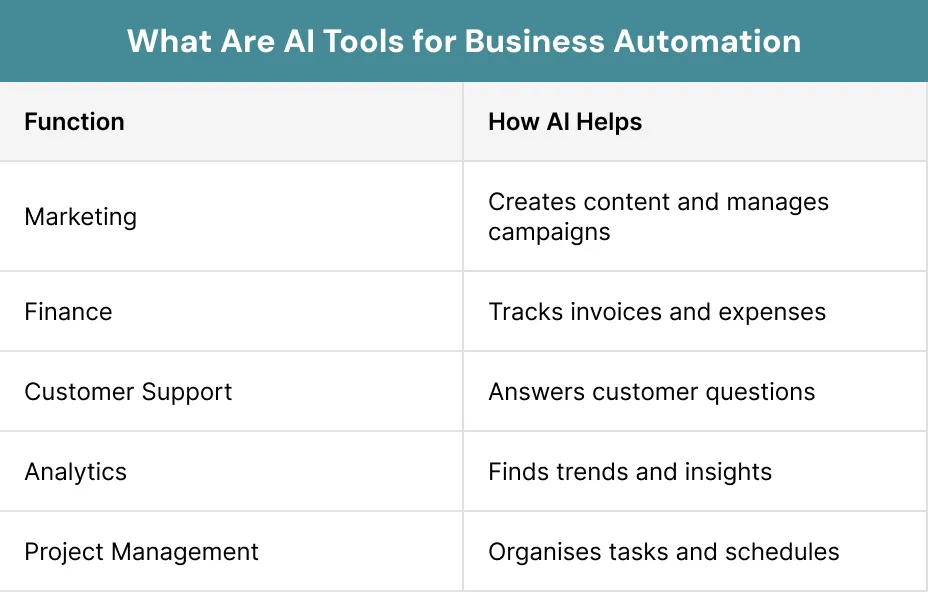
What Are the AI Tools for Business Automation?
AI tools for business automation are software systems that use AI to complete tasks automatically. These tools help to analyse data, create content and manage workflows.
The best AI tools for business are easy to use. Many AI systems work with CRMs and email tools.
Businesses use AI in many areas like marketing, HR and in customer support. The goal is to improve efficiency and reduce the time which is spent on repetitive tasks.
How AI Automation Help in Daily Operations?
In daily business operations, AI helps to collect and analyse the info from different systems. This helps you to save time and improves the speed of workflow.
For example, AI automatically sends follow-up emails after the enquiry of a customer.
It also helps to update CRM records, organise meetings and track the project deadlines. These simple tasks may seem small, but together they can save many hours.
Key Technologies Behind AI Business Tools
AI uses technologies like machine learning, natural language and predictive analytics. These systems help software to understand the info and improve it over time.
ML helps AI to study the patterns and make the right decisions. Natural language allows AI to understand the human language.
Many tools also use predictive analytics for trends. This helps you to make plans for the future.
Best AI Tools for Small Businesses in the UK
Small businesses in the UK are using AI to compete with larger companies. It helps smaller teams to complete their work at time.
The best AI tools for business are especially useful for startups. These tools help to reduce the admin work and improve customer support.
Following are the AI tools which help small businesses in the UK:
1. ANNA Money
ANNA Money combines both banking and admin support into one platform. It helps you to manage the invoices, expenses and taxes.
UK businesses now use this tool because it helps to save time. It also helps users to stay organised with reminders.
2. Shopify Magic
Shopify Magic helps online stores to automate the content creation. It creates the product descriptions, marketing emails and content of the store in the right way.
It also includes AI-powered insights which help you to understand the performance of your sales.
It is considered one of the best tools for business since it supports growth.
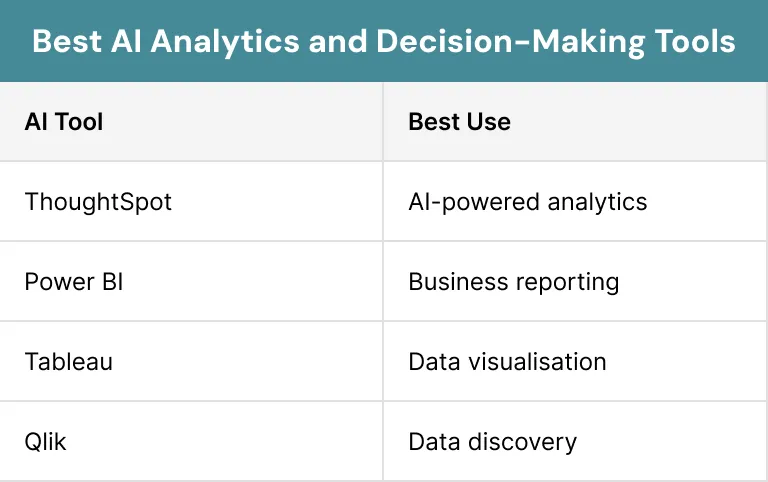
3. ThoughtSpot
It is an analytics tool. It helps users to search data using natural language queries instead of complex dashboards. It focuses on making data accessible for non-technical users.4. Power BI
Power BI is a Microsoft tool that turns raw data into interactive reports. It is widely used for reporting and integrating with other Microsoft services.5. Tableau
It is a powerful data visualisation tool that helps users to create interactive charts. It is known for its strong visual analytics.6. Qlik
Qlik is an analytics tool that uses associative data indexing to help users explore the data freely. It supports self-service analytics.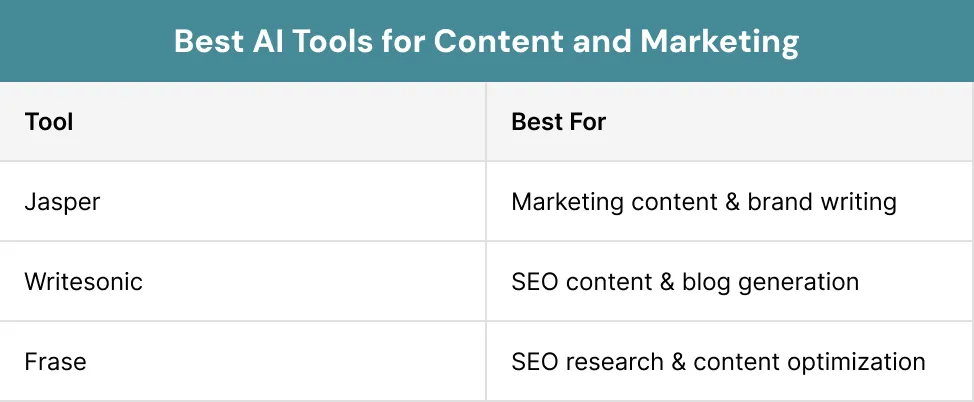
Marketing teams now depend heavily on AI. It helps them to create articles, emails, social media posts and ad copy.
7. Jasper
Jasper is one of the most popular tools for content creation. It helps you to write blogs, product descriptions and email campaigns.
Marketing teams use this tool to speed up the content production. It also supports SEO writing.
Read more: AI and SEO: How Search Engine Optimisation Is Evolving
8. Writesonic
It helps you to create long-form and short-form content. It supports blog writing, social media captions and ad campaigns. The tool also includes SEO features.
It is useful for companies that publish large amounts of digital content on a regular basis.
9. Frase
This tool focuses on SEO research and content optimisation. This tool helps you to analyse the competitors.
Content marketers use it to create the outlines, improve rankings and optimise blogs for search engines.
Pro Tip:
To get the most value from AI tools for business, use Frase to optimise existing content before creating new articles.
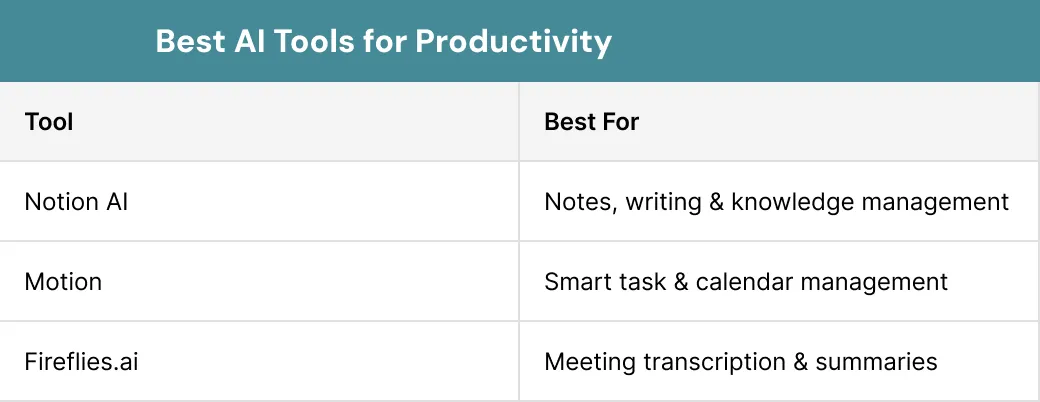
These tools help you to stay organised. These tools also help you to manage the schedules, meetings and automate daily workflows.
10. Notion AI
Notion AI combines note-taking and automation into one platform. This tool helps you to create summaries and organise your projects quickly.
Teams now use it for meeting notes and planning for documents.
11. Motion AI
Motion AI helps you to organise the schedules in a proper way. It adjusts the calendars based on the deadlines. Many people use it for scheduling issues.12. Fireflies.AI
Fireflies is one of the best AI tool for meetings. Its purpose is to record the conversations and create the transcripts.
Many businesses use it to avoid the missing important details.
Did you know:
This tool is especially helpful for remote teams.
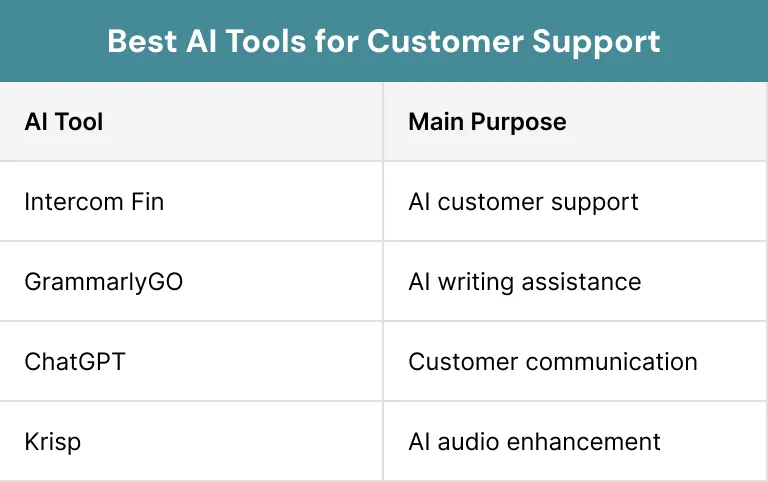
13. Intercom Fin
Intercom Fin is an AI tool which is designed to answer the queries of a customer. It helps you to reduce the workload of support staff.14. GrammarlyGO
GrammarlyGO is an AI writing tool. It helps you to generate, rewrite and improve the content. It enhances the clarity of your emails.15. ChatGPT
It can be used in the process of customer support to handle the queries of a customer. It helps you to provide 24 hours support to customers.16. Krisp
It helps to remove the background noise and echo from calls. It also improves the clarity of voice for online meetings.How to Choose the Right AI Tool for Your Business?
Choosing the right AI tool depends on your goals and business needs. Some businesses need AI for customer support, while others need tools for marketing and analytics.
Before investing in tool, you must identify which tasks take the most of your time. AI works best for you when it solves your entire problem.
The best AI tools for business should also integrate with existing software.
Here are some important points you should check before purchase an AI tools:
- Ease of use
- Integration with existing systems
- Security and data protection
- Scalability for future growth
- Cost compared to business value
- Customer support and training
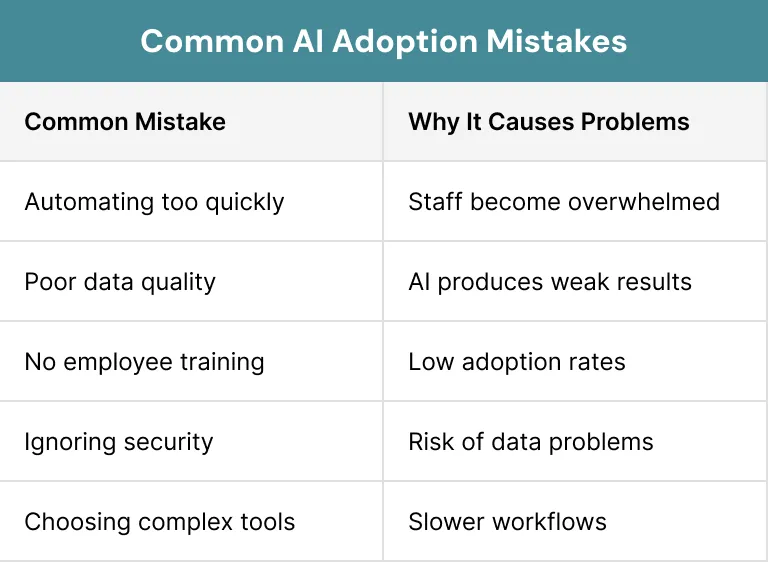
What Are the Common Mistakes in AI Adoption?
Many companies are using AI without proper planning. This often leads to waste of time and money.
One common mistake is relying completely on AI. It can improve workflows, but businesses still need human work to improve the quality of work.
Conclusion
The demand for AI tools is growing day by day because businesses want accurate results in less time. Today, AI is a part of every business across their marketing, finance and customer support blocks.
The best AI tools for business help you to automate repetitive tasks and make smarter decisions as well.
The key is to choose the right tool based on your goals and needs. Companies that adopt tools carefully are more likely to stay competitive in the future.
At Xoom Plus, we guide you on the best AI tools for your business needs and growth.
Are you struggling to choose the best AI tools for your business growth?
Don’t worry our professional team is here to help you. Feel free to contact us and grow your business to next level.
FAQs
What are AI tools for business?
AI tools for business are software systems that use artificial intelligence to automate tasks, improve workflows, and support decision-making. Businesses use them for marketing, customer support, finance, analytics, and productivity.
Which are the best AI tools for business in 2026?
Some of the best AI tools for business in 2026 include ThoughtSpot, Jasper, Motion, Notion AI, Shopify Magic, ANNA Money, and Intercom Fin.
How do AI tools improve productivity?
AI tools improve productivity by automating repetitive work like scheduling, reporting, content creation, and customer support. This helps employees focus on more important tasks.
Are AI tools expensive for small businesses?
Many AI tools now offer affordable pricing and free plans for startups and small businesses. Companies can start small and scale their AI usage over time.
Can AI tools replace employees completely?
No, AI tools are designed to support employees rather than fully replace them. Human creativity, judgement, and communication are still very important in business operations.