- March 18, 2026
- Categories: Digital Marketing
The Ultimate Guide to Brand Bidding in PPC
Have you ever searched your brand on Google and seen a competitor’s ad before your website appeared? That is a warning sign for your business.
Brand bidding in pay per click (PPC) is one of the most debated topics in paid search marketing. Some marketers think it is important. Because it protects visibility and brings more conversions.
Others think paying to generate traffic wastes the budget. They believe traffic from organic search is free. You can not support only one side.
Do you think brand bidding in PPC is the right strategy for every business? The answer is no. It depends on your business goals, budget and how competitive your market is. That is why brand bidding should always be planned carefully, especially when competitors are bidding on similar terms.
The UK advertising market is growing bigger. Today, advertising spend is expected to cross £50 billion in 2026. It shows how important paid search has become to attract customers online.
Brand bidding can be a powerful practice when used properly. If a company does not understand how to deal with competitors in paid search, it may lose:
- Traffic
- Visibility
- Potential customers
- What is brand bidding
- How modern search results influence brand bidding
- What are the key benefits of brand bidding
- What are the potential drawbacks of brand bidding
- What is the role of competition in brand bidding decisions
- What is the influence of resellers
- What is the importance of testing brand bidding strategies
What Is Brand Bidding?
Brand bidding is a kind of paid search advertising where advertisers bid on brand keywords. These keywords are related to their own brand name. They can also relate to brand names of competitors.
These keywords may include:
- The exact brand name
- Misspellings of the brand name
- Brand related product names
- Different ways people may search for the brand name
By using branded keywords in ads, businesses show in more places on the results page. It helps bring users straight to their website.
Branded search campaigns help businesses to appear in:
- Google search ads
- Google shopping listings
- Other paid places on search results pages
Does Brand Bidding Matter in Paid Search?
Have you ever noticed that when you search for a brand name, you already have some interest in that brand? You might have visited the website before or seen their ad earlier.
You may need more information about the product when you search for it. This is how brand bidding matters for a business.
Paid search has become very competitive as more businesses are advertising online. In the UK, over 200,000 businesses use Google search ads to reach customers. This shows that search results have become very crowded. This is why brands should stay visible when people search for their business online.
These searches are often called high intent searches because the user is close to making a decision. Branded search campaigns help businesses reach these users while they are actively searching. They also help companies to control what people see when they search for the brand.
Without branded search campaigns, users may first see competitor ads. They may see reseller listings or other results before the brand’s own website appears.
How Modern Search Results Influence Brand Bidding?
Search results pages have changed a lot over the years. Search engines now often show different types of results. The results may appear before organic listings.
For many searches, users may first see:
- Shopping results
- Several paid search ads
- Product listings
- Other search features
Many users may click on a paid ad before they reach the organic listing. Branded search campaigns can be useful for this issue. They also help ecommerce businesses. They keep brands visible and take a stronger position on a busy search results page.
What Are the Key Benefits of Brand Bidding?
Branded search campaigns support businesses running PPC campaigns. The impact varies. It depends on the industry and competition level. Several benefits commonly appear across successful campaigns.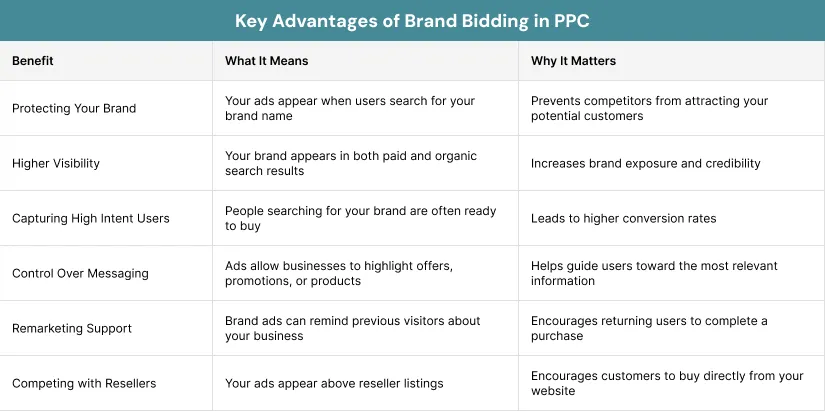
1. Protecting Your Brand From Competitors
Many businesses run branded PPC campaigns. The main reason is to protect their brand from competitors. Some customers are already interested in a product or service. Competitors take advantage of this chance. So they often bid on other companies’ brand names to target potential customers.
For example, when a user searches for a specific brand, a competitor’s ad might appear. It can appear at the top of the search results. The competitor’s ad may offer a similar product.
If a brand does not run ads for its own name, the competitor may capture that traffic instead. Branded ad campaigns resolve this issue by ensuring the brand’s ad appears first. It does not let the competitors divert interested users away from the site.
2. Increasing Visibility in Search Results
Some businesses already appear in the organic results for their brand name. Appearing in paid results can still improve visibility. It helps people become more familiar with the brand name. Users remember the brand name when it appears more than once on the search page.
Appearing as the same brand in both places builds trust. Users often link repeated visibility with trust and authority. When people keep seeing a brand in search results, they think this website has authority.
3. Capturing High Intent Traffic
People who search for a brand name are often closer to making a purchase. Branded searches are different from general searches. Branded searches usually come from people who already know the brand. They are also thinking about buying from this brand.
These users may be:
- Comparing products
- Returning after visiting the website before
- Looking for a specific product or service
Important
People searching for your brand are often closer to buying. Branded searches can bring stronger conversions than general keywords.
4. Controlling Brand Messaging
Another key benefit of branded keyword campaigns is control over messaging. Organic search results rely on static elements such as page titles and meta descriptions. While search ads allow marketers to create messaging that matches current campaigns and offers.
With PPC ads, businesses can show:
- Seasonal promotions
- New product launches
- Special offers
- Unique product features
5. Supporting Remarketing Campaigns
Branded PPC campaigns can also support remarketing strategies. For example, a user may visit your website but leave without taking action. Later, the same user might search for the brand again. When a branded ad appears at that time, it reminds them of the brand. It also supports the messages they saw before.
It can increase the chances of conversion if the message in the brand ads aligns with remarketing campaigns such as:
- A limited time offer
- A special promotion
Using Competitor Brand Bidding Strategically
Can you bid on competitor brand terms? Yes, a branded strategy does not only target your own brand name. Some businesses also bid on competitors’ brand terms. This strategy can present your company as an alternative. It helps when users are researching top brands.
With the right approach, competitor branded strategy can:
- Introduce the brand to new users
- Capture users comparing different options
- Highlight unique advantages such as price, features or customer service
What Are the Potential Drawbacks of Brand Bidding?
A branded PPC strategy can offer several advantages. On the other hand, it also raises important concerns. Businesses should carefully check these issues before deciding how much budget should be invested in branded campaigns.1. Increased Advertising Costs
One of the most discussed flaws of branded PPC strategy is the potential increase in advertising costs. When many advertisers compete for the same branded keywords, the cost per click (CPC) may rise.
Competitors bidding on the same brand terms can spark bidding competition. That raises spending over time. It does not work for businesses with low marketing budgets. In highly competitive industries, aggressive bidding on brand keywords may drive costs higher than expected.
2. Cannibalisation of Organic Traffic
Organic traffic cannibalisation is another common debate in branded keyword advertising. If a business already ranks first in the organic results for its brand name, people can click the paid ad instead of the free listing. In this case, the business is paying for visitors. It could have been free.
Organic traffic cannibalisation happens when people click a paid ad instead of the organic result for the same brand search. This can confuse search engines. It also weakens the site’s ability to rank well.
For example, when you search for a well known brand you may naturally click the first organic result. If a paid ad shows above that listing, you might click the ad instead.
Organic traffic cannibalisation simply moves the traffic from organic results to paid ads. It can raise marketing costs without bringing more users. This is why marketers think they do not need a branded PPC strategy for brands that already perform very well in organic search.
3. Attribution Challenges
Branded search advertising can also affect performance reporting in PPC campaigns. Users already know about the brand when they search for it. You may have seen the brand through other channels like:- Social media advertising
- Display campaigns
- Recommendations by others
This creates an attribution challenge. Brand campaigns may appear highly profitable in reports. Even though the demand was generated elsewhere. So marketers should check the entire customer journey when evaluating performance of brand bidding campaigns. Rather than relying on last click attribution.
4. Double Counting Conversions
Double counting conversions is another reporting issue. This can happen when both organic and paid search are active at the same time. The same conversion gets credited to more than one source. Without proper tracking, it can be hard to know which channel actually brought the result. Right tracking and a well organised analytics setup are key to avoid this problem.5. Budget Allocation Concerns
It can also make brands think about how they use their marketing budget. They must decide if the money is wisely spent on branded keywords. They should also think if the budget could be better used elsewhere.
For example, the same budget can be invested in:
- Expanding non brand PPC campaigns
- Improving search engine optimisation
- Enhancing website user experience
- Investing in other digital marketing channels
What Is the Role of Competition in Brand Bidding Decisions?
Competition is one of the most important factors affecting brand bidding decisions. If competitors are actively bidding on your brand name and you are not running ads for it, this can be risky. Users searching for your business may face competitor advertisements before they see your organic listing.
Pro Tip
If you are not running ads on your brand name, competitors may appear before you in search results.
In such situations, branded PPC strategy can act as a shield that protects branded search traffic. The need for a branded PPC strategy may be lower if there is less or no competition on your brand terms. Businesses with strong organic rankings and less competitor activity might find that organic listings have already captured most branded searches.
What Is the Influence of Resellers?
The presence of resellers is another factor to consider. In some industries, third party retailers sell products from multiple brands. These resellers may also run paid search campaigns to target branded keywords.
Although these sellers promote the brand’s products, businesses often prefer customers to buy directly from their own website. Direct sales can offer higher margins. They also offer better control over the customer relation.
Bidding on branded keywords helps companies to compete with resellers for branded search traffic and encourages customers to buy directly from the brand’s official website.
Should Brand and Non Brand Campaigns Be Reported Separately?
Many PPC experts recommend reporting branded and non branded campaigns separately.
This approach helps businesses understand the difference between:
- Capturing existing demand
- Generating new demand
Non brand campaigns mainly focus on reaching new users, who are not yet familiar with the brand.
By separating these campaigns in reporting, businesses understand how each part of the strategy works for overall growth.
Best Practices for Brand Bidding Campaigns
When businesses decide to run brand bidding campaigns, a structured approach is a must for achieving strong results.1. Separate Brand and Non Brand Campaigns
Placing branded keywords in separate campaigns improves clarity. It also helps improve control over results.
This structure allows marketers to:
- Monitor branded performance more accurately
- Adjust budgets more effectively
- Analyse campaign data without mixing traffic types
2. Choose the Right Bidding Strategy
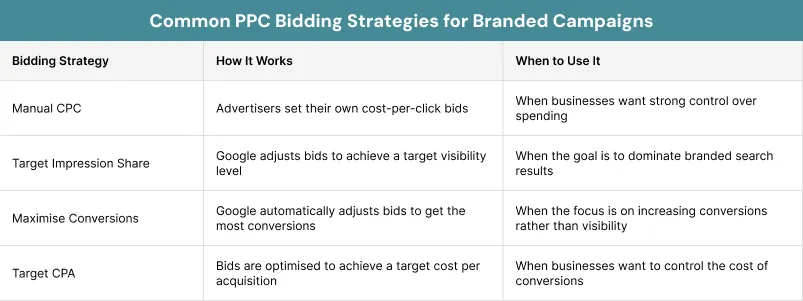
It is very important to choose the right bidding strategy. It should reflect campaign goals and competition levels. This is where PPC bidding choices matter most.
Two common options include:
Manual CPC
This strategy lets advertisers control their own bids. It is helpful for branded campaigns when businesses want to keep close control over their costs. Many teams use PPC bidding tests here to manage spend.Target Impression Share
Target impression share aims to keep your ads visible in search results by targeting a certain impression share. It can help brands appear more often for branded searches.
This strategy also increases costs. The best bidding strategy depends on the business goals. It also depends on competition in the market. A smart PPC bidding plan should match the campaign goal.
3. Create Strong Ad Copy
Ad copy plays a key role in brand bidding. When users search for a brand, the ad should clearly tell what makes the business unique.
This may highlight:
- Product quality
- Competitive pricing
- Unique features
- Exceptional customer service
4. Use Ad Assets to Improve Visibility
Ad assets are also known as ad extensions. They improve how your brand ads appear.
They include:
- Sitelinks
- Callouts
- Structured snippets
5. Monitor Competitor Activity
Regular monitoring of competitor behaviour is essential in brand bidding. If they start to target your brand keywords, you may need to adjust your bids or improve messaging. Learn more about maintaining visibility.
Tools like auction insights can help you compare your ad performance with competitors. Good PPC bidding decisions often depend on this data.
6. Measure Performance Carefully
Brand bidding performance should be measured using multiple metrics, including:- Click through rate (CTR)
- Conversion rate
- Cost per click (CPC)
- Impression share
What Is the Importance of Testing Brand Bidding Strategies?
Every business runs in a different competitive market. So brand bidding strategies should always be tested.
Testing allows businesses to check how a branded PPC strategy affects:
- Organic traffic levels
- Conversion rates
- Overall campaign performance
These tests help marketers identify the right balance between paid visibility and organic performance. This also improves PPC bidding over time.
How to Find the Right Balance?
In the end, branded search advertising is about balancing two key goals.- The first goal is to protect visibility in search results. Brand ads ensure the business appears at the top when users search for its name.
- The second goal is to avoid extra spending. Businesses should avoid paying for traffic that can arrive organically without the advertising.
Imagine a user searches for Nike running shoes on Google. They want to visit Nike but another sports retailer ad appears first at the top of search results. They offer similar shoes at a discount.
If Nike is not bidding on its own brand terms, that competitor ad may attract the user because of its top position in search results. The user may end up buying from a competitor store instead of Nike.
This is why many brands run brand bidding campaigns. It ensures their website appears first when users search for their brand.
Conclusion
Branded PPC strategy is one of the most debated strategies in paid search marketing. Some marketers think it is an important part of PPC campaigns. Others think it may only increase advertising costs. The truth lies somewhere in the middle.
Brand PPC can be a powerful strategy to protect your brand visibility. It helps capture high intent users and control messaging in search results. It also helps businesses protect against competitors and resellers. They might otherwise capture your branded traffic.
Branded ad campaigns also come with challenges such as:
- Potential organic traffic cannibalisation
- Attribution complications
- Increased ad spend
When done in the right way, it helps your brand appear first when people search for it online. Some brands bid on brand terms only when competition starts, while others keep bidding on brand terms all year.
Businesses can make brand bidding a useful tool of their wider digital marketing strategy by:
- Managing campaigns properly
- Looking at the data carefully
- Testing them regularly
Competitors showing up when people search for your brand?
Contact us today to protect your visibility with smart brand bidding strategies.
FAQs
What is the PPC bidding process?
The PPC bidding process works through an instant auction. Advertisers set the maximum amount they are willing to pay for a click. They also choose the keywords that trigger their ads. When a user searches for those keywords, the search engine runs an auction to decide which ads appear and in what order.
Is PPC better than SEO?
PPC is better for driving quick traffic because ads appear immediately in search results. SEO focuses on improving organic rankings over time and helps build long-term visibility. Many businesses combine both strategies so they can gain immediate traffic from PPC while building sustainable growth through SEO.
What is brand bidding?
Brand bidding, also called PPC brand bidding, is when advertisers bid on branded keywords. These may include their own brand name or a competitor’s brand terms. The goal is to appear in search results when users search for that brand and attract traffic that might otherwise go to another website.
What are the 5 steps in the bidding process?
A successful bidding process usually includes five steps:
- Find the right bid opportunity
- Conduct planning and research
- Set competitive pricing
- Write a clear and strong bid response
- Submit the final bid according to the requirements
What are common PPC mistakes to avoid?
Common PPC mistakes include targeting irrelevant keywords, choosing the wrong match types, writing weak ad copy, sending users to poor landing pages and running campaigns without proper tracking. Avoiding these mistakes helps improve ad performance and prevents unnecessary advertising costs.
Do brand affiliates get paid?
Yes, brand affiliates earn commissions when users take action through their referral links. When someone clicks an affiliate link and completes a purchase or action such as signing up, the affiliate receives payment. Commission models may include payment per sale, per lead or per click.
How can you bid successfully?
To bid successfully, businesses should research the market, choose the right opportunities, build a strong team, set a clear pricing strategy, write a persuasive proposal and review the bid carefully before submitting it. Preparation and strategy increase the chances of winning competitive bids.
Is PPC profitable?
Yes, PPC can be profitable when campaigns are managed properly. Businesses can generate strong returns if they target the right keywords, optimise ads and control costs. A well-optimised PPC campaign can sometimes produce two to five times the advertising spend in revenue.
What is brand bidding in affiliate marketing?
Brand bidding in affiliate marketing happens when affiliates bid on an advertiser’s branded keywords in search engines. This helps them show ads to users who are already searching for that brand and may be ready to buy. The aim is to capture high intent traffic and direct it through the affiliate link.
Should you bid on your own brand name?
Yes, in many cases you should bid on your own brand name. If competitors are bidding on it, you could lose traffic and conversions if you do not appear. If your website does not rank well organically for your brand name, bidding becomes even more important because it helps users find your business easily.