
- March 10, 2026
- Categories: Digital Marketing
What Is SEM? The Secret Behind Fast Online Visibility
Did you know that UK businesses spent more than £10 billion on Google Search advertising in 2024? More than 200,000 UK firms collectively made this investment. These stats show the significance of Search Engine Marketing (SEM).
SEM is a form of online marketing that helps businesses appear in search results through paid advertising. Businesses usually pay search engines such as Google or Microsoft Bing when someone clicks their ad. The main goal is to reach people who are already searching for a product, service or answer. This can help a business get visitors, leads and sales faster than waiting for organic rankings.
Unlike SEO, paid search can give a business visibility soon after a campaign goes live. However, results depend on the keywords, ad quality, landing pages, bids and budget you use.
In this guide, we will explain how you can create an SEM strategy, how to measure SEM success and how to improve your results.
“SEM is a powerful way to drive traffic, growth and conversions quickly.”
— Neil Patel
Key Takeaways
- SEM uses paid search advertising to help businesses reach people who are actively searching for their products or services.
- A strong SEM strategy starts with the right keywords and includes well-structured PPC campaigns, relevant ad copy, optimised landing pages, effective bidding and a clear budget.
- Tracking the right metrics is essential. CTR, CPC, conversion rate, CPA and ROAS help you understand whether your campaigns are delivering valuable results.
- Regular optimisation improves performance. Analyse audience behaviour, review competitors, update keywords and ads and adapt to changing search trends.
Creating an SEM Strategy in 7 steps
A good SEM plan starts with clear goals. You should know what you want from your campaign. This could be more sales, leads, phone calls or website visits. Here we explain the step-by-step method for creating a search engine marketing strategy.1. Keyword Research
The first step is finding the keywords your target customers use when searching online. For example, if you own an accounting company, your customers may search for keywords like:- Small business accountant
- Online accountant
- VAT accountant
- Business tax accountant
Next, analyse the search intent behind your keywords by categorising them as informational, commercial, or transactional. For SEM campaigns, commercial and transactional keywords can be particularly valuable because they often indicate a stronger intent to take action.
2. Set up PPC Campaigns
PPC (pay-per-click) is a common method used in SEM. It lets you show paid ads in search results and pay when someone clicks your ad.
After you shortlist your keywords, create a PPC campaign based on your business goal. In this process, set your target location, language, audience, budget and bidding method. Make sure to keep your campaign structure simple and group similar keywords together. This makes it easier to check the performance of each target keyword.
3. Create ad copy
Good ad copy can help you achieve your results faster because customers read your ad copy before making any decision. Your ad should quickly tell people what you offer. In this process, you should use:- A clear headline
- A useful benefit
- A strong call to action
- Accurate information
4. Optimise Landing Pages
A landing page is the page people reach after clicking your ad. To optimise a landing page, keep it simple, make your main offer clear and add a visible call-to-action button. In addition, make sure the page works well on mobile devices and loads quickly. Google states that landing page experience considers factors such as relevance and ease of navigation.
Pro tip:
Do not send every advert to your homepage. Send users to the page that best matches their search.
5. Manage Your Bid Strategy
Your bid strategy decides how much you are willing to pay for clicks or conversions from your ads. The best practice is to keep checking your results and adjust your bids according to your results. Increase spending on keywords that bring good results and reduce bids on those that waste your budget.6. Allocate Budget
Set a budget for SEM that your business can afford. Do not spend most of your money on keywords that bring clicks but no useful results. You should focus on campaigns, keywords and ads that generate conversions. You can then spend more money towards the areas that perform well.7. Refine and Optimise
Do not launch a campaign till all the important parameters are aligned. This includes target keywords, audience, ad copy and ad quality. If you have any doubts, you should check all the parameters again and refine them. You should also optimise your campaign by checking your search terms, clicks, conversions and costs on a regular basis. In addition to optimising, you should pause weak keywords, improve poor ads, test new headlines and update landing pages.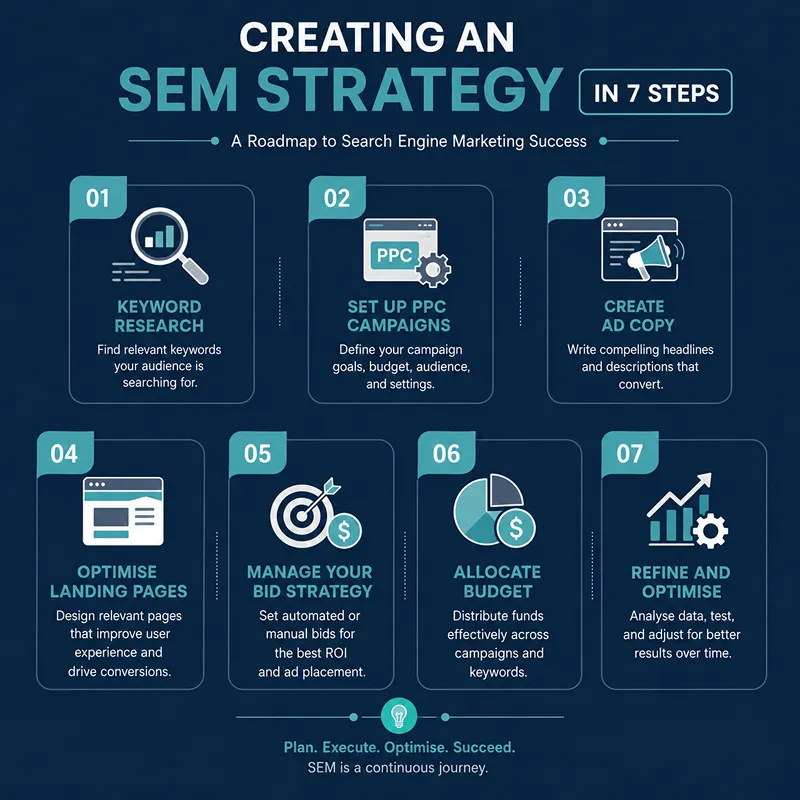
How Do You Measure SEM Success?
You cannot judge SEM success by traffic alone. The real question is whether your campaigns help you reach your business goals or not. A campaign with many clicks can still perform poorly if those visitors do not buy, contact you or complete another required action. Here we discuss some points that will help you measure SEM success.Key Metrics to Track
You should track important metrics, which include CTR, CPC, conversion rate, CPA and ROAS.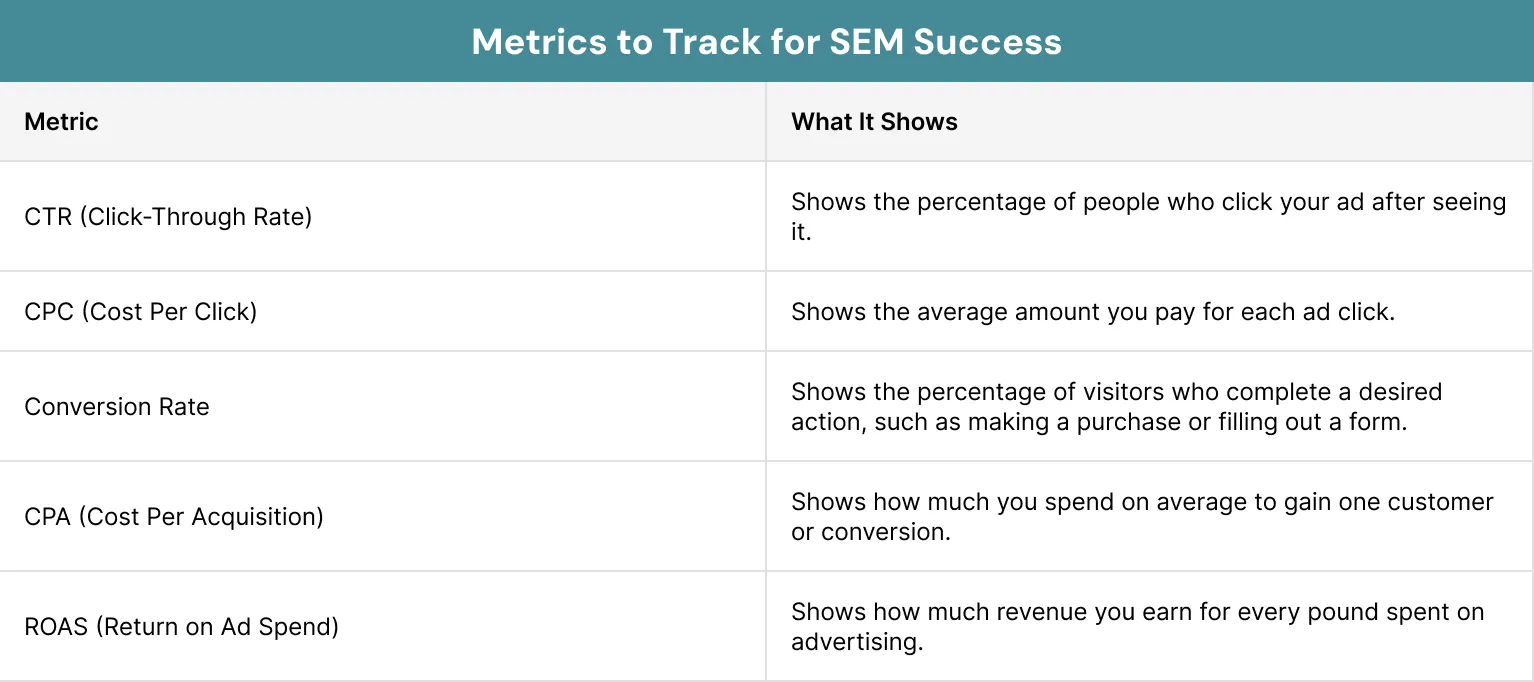
How Can You Improve Your SEM Results?
Better SEM results usually come from small improvements made over time. You should look at the data, find weak areas and then test better options.1. Understanding Audience Behaviour
You should understand the behaviour of your target audience. Focus on what your customers search for and what they do after clicking an ad. Ask yourself:- Which keywords bring conversions?
- Which pages get the most engagement?
- Which devices bring better results?
- Which locations perform well?
- At what stage do users leave?
2. Leveraging Competitor Analysis
Look at what your competitors are doing. Check their offers, messaging, keywords and landing pages. Do not simply copy them; instead, you should find gaps that your business can use. For example, a competitor may focus on low prices and ignore better services. So you could focus on better service, faster delivery or expert support.3. Adapting to Changing Search Trends
Search behaviour changes over time. New products, events, technology and customer needs can change what people search for. You should review your search terms on a regular basis. Add new useful keywords and remove terms that no longer bring valuable traffic. In addition, test new ads and offers.
This information can help you make better campaign decisions.
2. Leveraging Competitor Analysis
Look at what your competitors are doing. Check their offers, messaging, keywords and landing pages. Do not simply copy them; instead, you should find gaps that your business can use. For example, a competitor may focus on low prices and ignore better services. So you could focus on better service, faster delivery or expert support.3. Adapting to Changing Search Trends
Search behaviour changes over time. New products, events, technology and customer needs can change what people search for. You should review your search terms on a regular basis. Add new useful keywords and remove terms that no longer bring valuable traffic. In addition, test new ads and offers.
Other than these factors, there are more factors that help you improve SEM results, such as conversion tracking and search-term analysis.
Case Study: How SEM Can Improve Paid Advertising Performance
Marks & Spencer (M&S), a major UK retailer, wanted to improve the return from its paid advertising while controlling rising ad costs. In this process, the company tested Microsoft Advertising’s Performance Max campaigns along with SEM strategy and used automated optimisation, conversion-focused bidding and different creative assets to reach the right audience.
After that, their campaign increased revenue by 227% while advertising spend rose by only 32%. M&S also achieved a 185% higher ROAS compared with Smart Shopping year on year. Following the success of their campaign, the company also expanded Performance Max campaigns to other product categories and the campaigns later accounted for 30% of its total revenue.
This case shows how SEM campaigns can combine paid search advertising, automated bidding and optimisation to improve visibility and business results.
Conclusion
SEM can help businesses reach people when they are actively searching for products and services. It can provide fast visibility, but success does not come from simply paying for ads. Good keyword research, relevant ads, strong landing pages, careful bidding and accurate tracking all matter. The best approach for SEM is to start with a clear goal, monitor the results and keep improving the campaign because small changes can make a big difference when they are based on real data. At Xoom Plus, we make an effective strategy for your search engine marketing so you can achieve results with less spending.Are your paid ads getting clicks but not enough conversions?
Contact us and let Xoom Plus help you improve your campaigns and get better results.
FAQs
Is SEM the same as SEO?
No. SEO focuses mainly on improving organic search visibility. Paid search uses advertising to gain visibility in search results.
How much does search engine marketing cost?
There is no fixed price. Your cost depends on factors such as keywords, competition, bids, location and campaign settings.
How quickly can SEM produce results?
Paid search can start bringing traffic soon after ads are approved and campaigns are active. However, profitable results may take time to improve through testing and optimisation.
Is SEM suitable for small businesses?
Yes. Small businesses can use paid search with a controlled budget. The key is to target relevant searches and track conversions.
What is the most important SEM metric?
There is no single metric for every business. If your goal is sales, conversions, cost per conversion and conversion value may be more useful than clicks alone. Your main metrics should match your business goals.