- August 14, 2026
- Categories: Web Solutions
Progressive Web Apps vs Native Web App: How to Choose
Today, businesses rely heavily on mobile experiences in order to connect with customers.
Whether you run an online shop, a service company or a startup, having a mobile-friendly solution is no longer optional.
Research shows that Twitter Lite increased pages per session by 65% and reduced data usage by up to 70% while using progressive web apps (PWA).
Many businesses compare a progressive web app with a native app. Both options offer unique benefits. But the right choice depends on your goals, budget and needs of the user.
The debate around progressive web apps vs native app solutions continues to grow in 2026.
Key Takeaways
- A progressive web app combines the flexibility of a website with app-like features, while a native app is built specifically for one platform like iOS or Android.
- The choice between both depends on your business goals, budget and user needs, not just technology trends.
- A progressive web app is usually better for startups, small businesses and SEO-focused websites due to lower cost and faster development.
- A native app is ideal for high-performance apps, gaming, banking and platforms requiring deep device access.
- PWAs offer strong benefits like faster loading, offline access and single-codebase development, making them cost-efficient and scalable.
- Native apps deliver superior performance, better user experience and full access to device hardware such as GPS, camera, and sensors.
- Real-world data shows PWAs can increase conversion rates by up to 70% and significantly improve user engagement in many industries.
- Native apps still dominate in daily user engagement, with users spending the majority of mobile time inside apps rather than browsers.
- Maintenance and updates are easier with PWAs because changes are deployed instantly without app store approvals.
- Ultimately, the decision in progressive web apps vs native app comes down to whether you prioritise reach and cost efficiency (PWA) or performance and advanced features (native).
- Many modern businesses now adopt a hybrid strategy, using PWAs for reach and native apps for advanced functionality.
- Choosing the right solution ensures better user experience, scalability and long-term business growth.
What Is a Progressive Web App (PWA)?
A progressive web app is a web app that combines the best features of websites and mobile apps. It runs through a web browser but can look and behave like a mobile app.
Users can access a PWA through a URL and install it on their device without visiting an app store. This makes it easy for you to reach customers across the different devices.
A PWA is designed to be fast, responsive and reliable. It works on phones, tablets and desktop while using a single codebase.
How PWAs Work?
PWAs use modern web technologies such as service workers, responsive design and web app manifests. This helps the app function smoothly across different platforms.
When users visit a PWA, the browser stores the important resources locally. This allows pages to load quickly even when internet connectivity is limited.
Because the app runs through the browser, you can update features instantly.
Did you know?
A progressive web app can often be installed directly from a browser with just a few taps, removing the need for an app store.
Core Features of PWAs
PWAs include many features that help to improve user convenience including:- Responsive design
- Offline access
- Push notifications
- Fast loading speeds
- Secure HTTPS connection
- Home screen installation
What Is a Native App?
It is a mobile app developed specifically for a particular operating system such as iOS or Android. It is installed through the app stores and runs directly on the device.
Many businesses choose these apps when they need advanced features or highly interactive user experiences.
How It Work?
Native apps are installed from app stores and stored directly on the device. Once installed, users can launch them from their home screen.
The app communicates directly with the operating system. This gives developers access to hardware features such as cameras, GPS, BT and sensors.
Because the software is built for one platform, it can deliver faster responses.
Core Features of Native Apps
There are some core features including:- High-speed performance
- Full device hardware access
- Advanced security controls
- Better graphics
- App store distribution
Progressive Web Apps vs Native Apps: Key Differences
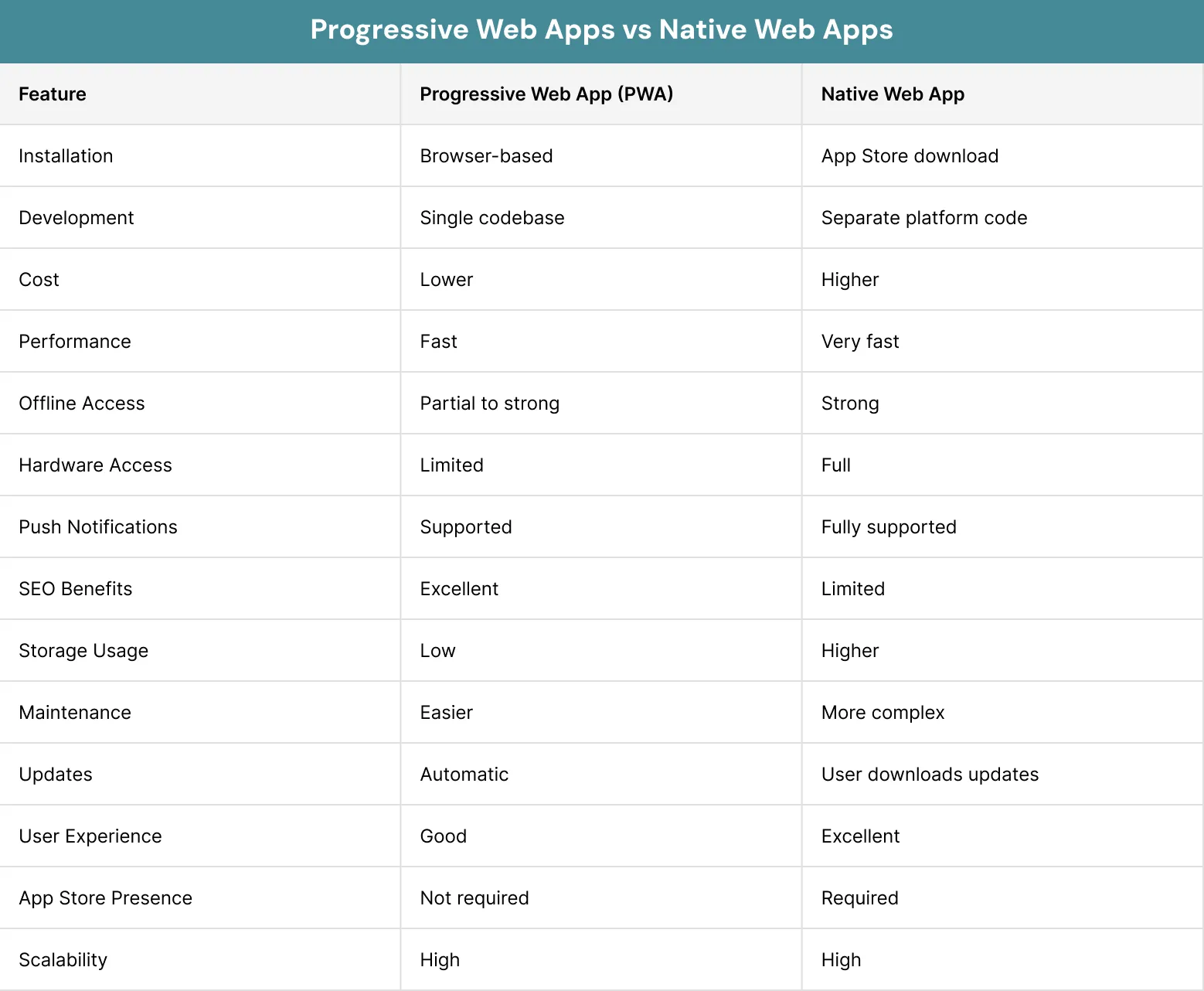
Both options help you to improve the customer engagement. However, each approach has different business goals.
The table given below explains the key differences in simple terms.
Pros of Progressive Web Apps
Today, businesses need digital solutions that are fast and easy to manage. PWA helps you to meet these goals.
Many businesses now choose PWAs. It combines the website accessibility with app-like functionality. This makes them a practical option for businesses of all sizes.
1. Lower Development Costs
One of the biggest benefits of a PWA is lower developmental costs. You can build a single app that works across multiple devices.
Instead of creating separate Android and iOS apps, developers maintain one codebase. This helps to reduce both development and testing costs.
For startups, this cost-saving benefit can make a big difference during the early stages of growth.
2. Single Codebase
A progressive web app works across desktops, phones and tablets using the same codebase.
This makes it easy for dev workflows. Teams spend less time on managing the separate versions.
3. Better SEO
Unlike many mobile apps, PWAs can be indexed by search engines. This improves online visibility and helps to attract organic traffic.
Customers find content through search results without needing to visit an app store first.
4. Faster Loading Speeds
PWAs use modern caching techniques that help pages to load quickly. Faster loading times improve the user experience and also reduce the bounce rates.
Users are more likely to stay engaged when content appears without any delays.
Did you know?
A smooth browsing experience can also contribute to higher conversion rates.
5. Offline Access
A progressive web app gives access to selected content even when internet connection is poor.
In this process, service workers store the files locally. It helps users to access the info offline.
This feature is useful for businesses that work in those areas where internet connection is poor.
Pros of Native Apps
A native app provides a highly optimised experience. Because it is built for one platform like iOS.
Many businesses choose them when their top priorities are security and advanced features.
1. Superior Performance
These apps are run directly on the operating system (OS). This allows them to use the resources of the device in a more effective way.
As a result, users will experience things like faster loading times and quicker responses.
2. Better UX
Native apps follow the platform-specific design guidelines. This helps to create a good experience for the users.
Patterns like menus, buttons, gestures and navigation must feel natural because they match the standards of the operating system (OS).
A strong UX can help you to improve the loyalty of the customer.
“Design is not just what it looks like and feels like. Design is how it works.”
— Steve Jobs
3. Enhanced Security
These apps add the extra layers for the security that are not always available to web-based solutions.
Features such as biometric and secure device-level storage to lock down the data. This is important for you when you handle the sensitive info of a customer.
Customers will trust more on your business when you protect their data in an effective way.
4. App Store Visibility
Publishing an app through official app stores helps to increase the trust and visibility. Many users feel more comfortable when they install the software from official app stores.
App store listings also give you an extra margin for reaching out to new customers.
Real-World Examples of Progressive Web Apps
Many global companies have adopted the PWA approach to improve their performance of a business.
Some real-world examples are given below which show the businesses work with PWAs.
- Twitter Lite
- Starbucks
- Flipkart
Real-World Examples of Native Apps
Many of the world’s most popular mobile apps use native dev because of its hardware capabilities.
These apps require advanced features and seamless user interactions.
- Uber
- Netflix
When Should You Choose a Progressive Web App?
Choosing a PWA can be a smart decision for businesses that want a cost-effective digital solution. PWAs help you to provide app-like features while it remains easy to access through a web browser.
Many companies select PWAs when they want to reach a broad audience without investing heavily in separate mobile apps.
1. Startups
Startups often work with limited budgets. Building a PWA allows them to launch quickly without the expense of separate Android and iOS apps.
A single codebase helps to reduce development costs and makes future updates easier to manage. This allows startups to focus more on growth.
2. Limited Budgets
Many smaller businesses need a strong digital presence. But they may not have the resources for full native development.
A PWA offers many app-like features. This makes it a practical option for businesses that are looking to maximise return on investment.
When comparing progressive web apps vs native apps, budget is often one of the first factors businesses consider.
When Should You Choose a Native App?
A native app is often the best choice when the performance and advanced functionality are the top priorities of your business.
These apps provide you greater control over the user experience.
- High-Performance Apps
2. Mobile Gaming
Gaming apps often require high graphics and rapid response times. In this case, native dev helps to provide the required needs to deliver the high-quality gaming experiences.
Many successful mobile games rely on native to ensure the smooth gameplay.
PWA vs Native App: Which Is Better for Your Business?
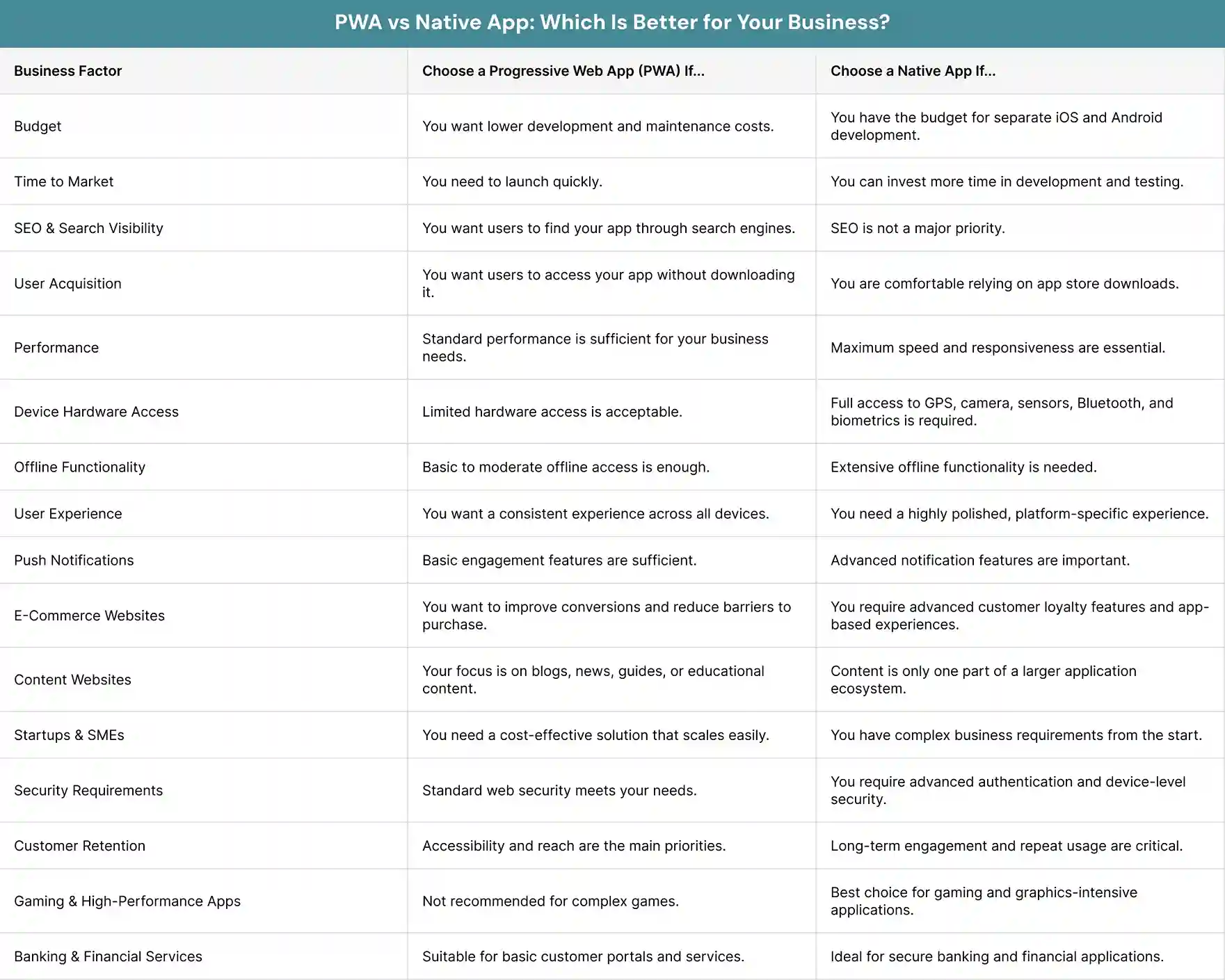
There is no universal answer to this question. The right solution depends on the goals of your business, customer expectations, technical needs and available budget.
The table below will help you to decide which solution is the better fit for your needs.
Conclusion
Both the progressive web app and the native app offer valuable benefits in 2026. The best choice depends on the goals of your business and customer needs.
A PWA is often ideal for you, if you are seeking affordability, broad access, faster deployment and strong search visibility. It allows you to reach users across multiple devices.
A native is generally better suited for you if you require high performance, advanced hardware access and strong security.
When evaluating progressive web apps vs native app solutions, focus on the value each option can bring to your customers. The right decision should support both your current goals and future growth plans.
At Xoom Plus, we help to choose and build the perfect PWA or native app according to the needs of your business.
Still confused about which one to pick?
Contact us today and let our experts guide you to choose the best option and help you throughout the process.
FAQs
What is the difference between progressive web app and native app?
A progressive web app runs through a web browser and can be installed without an app store, while a native app is built specifically for an operating system and downloaded from an app store.
Are PWAs cheaper to develop than native apps?
Yes, a progressive web app is generally less expensive because it uses a single codebase that works across multiple platforms.
Can PWAs work offline?
Yes, many PWAs support offline functionality by storing important content locally through service workers.
Do PWAs support push notifications?
Yes, modern progressive web app solutions support push notifications on many browsers and devices, helping businesses improve user engagement.
Which is better for my business: a PWA or a Native App?
Choose a PWA if you want a budget-friendly, fast-to-launch app that works on all devices. Choose a Native App if you require maximum performance, advanced offline features and full hardware access.