
- June 17, 2026
- Categories: Web Solutions
Website Features Customers Expect From Businesses in 2026
Have you ever left a website because of its slow speed and difficult design? It is often noted that most users leave websites because of their slow speed and difficult interfaces. It is predicted that as of 2025, the total percentage of traffic to websites through mobile phones will amount to about 58.5%. This clearly shows that in the year 2026, good features for websites cannot be overlooked by any means. The need to know basic website features to create trusted websites is important.
Before exploring trends in 2026, it is important to understand basic website features.
Key Takeaways
- Customers expect fast-loading websites that work smoothly on all devices.
- Mobile-friendly design remains one of the most important website features in 2026.
- Clear navigation, contact details, and strong calls-to-action help users find what they need quickly.
- Reviews, testimonials, privacy policies, and security features build trust with visitors.
- Features such as FAQs, search bars, and accessibility tools improve the overall user experience.
- AI chatbots and personalised content are becoming more common customer expectations.
- SEO-friendly website features can improve visibility and help businesses appear in SERP features.
- Small businesses should focus on speed, usability, trust signals, and lead generation features first.
- Regularly updating website features helps businesses meet changing customer expectations.
- A well-designed website can support engagement, enquiries, and long-term growth.
What Do Website Features Mean and Why Do They Matter in 2026?
Website feature refers to any feature in a website which enables the visitors to use the site in an easy manner. It can be anything ranging from a tool to a page, among many other things. The role of website features is to ensure that websites are user-friendly. Today, the idea of website features has gained greater significance in 2026.What Is a Website Feature?
Website features refer to any elements that are found in a website to help users access or navigate through the website. Some common examples include menus, search boxes, forms and buttons, among others. These are some of the elements that make websites user-friendly. Website features do not require much from the user.Why Are Customer Expectations Higher Than Before?
The standards are definitely much higher nowadays. Most of them are surfing on their cell phones. They need the site to load faster and be more user-friendly.
The faster internet connections only contribute to this process even further. Due to the development of new technologies, customers have become pickier and demand the same quality wherever they go. Moreover, there is much tougher competition, so users compare websites almost instantly and go elsewhere if the site isn’t working.
How Do Website Features Affect Business Growth?
The features of a website will impact the growth of businesses. Features of a website that are effective will create trust among the users. They will also enhance the user experience. This will increase the number of enquiries and sales made. They will ensure that visitors spend more time on the website.Which Website Features Do Customers Notice First?
Even before the user decides to read anything on the website or even make contact with the company, the first impression is formed within seconds. The following are the features of a website that user notices first:1. Fast Loading Pages
Webpages need to have high speeds to load quickly. Slow speeds lead to users leaving the site. High speed increases satisfaction and lowers the bounce rates.2. Mobile-Friendly Design
People prefer intuitive menu options with an easy-to-navigate layout. Finding relevant information should not require much effort from the user.3. Simple Website Navigation
Users want clear menus and simple layouts. They should find information without effort. Easy navigation improves user experience.4. Clear Contact Information
Contact details should be easily accessible. Users need to know how to reach the firm, such as through a phone number, address or email address.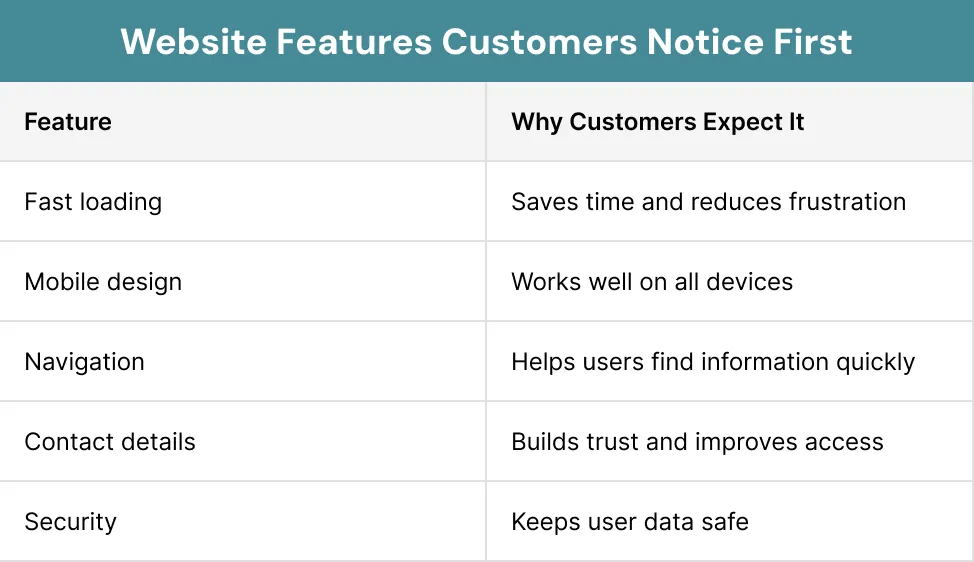
Read More: How to Choose a Website Development Company in the UK?
What Website Features Help Build Trust With Customers?
Trust forms the foundation of all online choices. Without trust, a user will simply leave a site or perform no further actions on it. Effective website characteristics provide the signs that assure a user that a company is safe and trustworthy.1. Customer Reviews and Testimonials
Reviews allow new customers to view first-hand experiences. Reviews can be seen as evidence that your product or service is exactly as you claim. Users usually go through reviews prior to doing anything else. Good reviews create trust better than any form of advertising.2. Privacy Policies and Cookie Notices
The privacy policy is meant to provide the user with an idea of how their data is being collected and used on your website. In this way, users will be more comfortable visiting your site. The cookie notice also demonstrates compliance with regulations.3. Secure Website Features
The security factors help both parties. HTTPS and SSL certificates safeguard information while surfing. The secure form will help to keep personal information, such as contact details. A user always wants to see the padlock symbol before they trust any website.4. Professional Branding and Company Information
Effective branding ensures that your site seems credible. The logo gives users a clear identity of the firm. The design conveys professionalism. Information about the firm, such as addresses, adds to credibility. When all seems professional and real, users are more confident.
Did You Know?
Many users check reviews, contact details, and security signs before they trust a website or make a purchase.
What Website Features Improve Customer Experience?
The experience of a user determines the amount of time spent by a visitor on a website. The simpler the experience provided by the site, the more time people spend using the website.1. Easy-to-Read Content
Clarity in content enables users to easily comprehend information. Short sentences make reading easier and less stressful for the reader. Headings help the users navigate through the page, while the simplicity ensures that the website is user-friendly.2. Search Functions
The search box helps users get information very quickly. It is helpful, especially when there are multiple pages on the website. One does not have to browse through all of them; rather, one just has to use the search box.3. Helpful FAQ Sections
FAQs help provide answers to questions fast. One does not have to get in touch with customer support for simple questions. This is time-saving for both the user and the organisation. FAQs help create confidence when making decisions.4. Accessibility Features
Accessibly designed websites ensure that they can be used by everybody. Alt texts provide a means for users with visual impairments to comprehend images. Use of readable font types benefits all users. The feature of keyboard accessibility helps users who cannot use a mouse.5. Error Pages That Keep Users Engaged
A custom 404 page keeps visitors within the site. Rather than leaving, the users are redirected to helpful pages. This makes it easier when you have lost your page. An effective error page creates a good user experience. It also ensures that users remain engaged with your content.
Read More: Why Many Business Websites Fail to Convert in 2026
What Website Features Increase Leads and Sales?
It is important that your website not only provides information. But your website should help the user to move forward. This could be completing a contact form, requesting a quote or placing an order. People who find what they are looking for quickly will be more likely to reach out or make purchases.
There are several web design features you can use to increase conversions and growth. These include:
1. Strong Calls-to-Action (CTAs)
CTAs show users what steps they need to take. It is best to use simple phrases such as “Contact Us” or “Request a Quote.” This helps reduce ambiguity and makes decision-making easier for users.2. Contact Forms That Are Easy to Complete
The use of short forms results in a high response rate. People like short forms more and are happy with quick filling. Short mobile-friendly forms help build better connections. Longer forms often result in drop-off.3. Live Chat and AI Chatbots
Live Chat provides immediate assistance to the user. AI bots assist users with any questions. This makes customers wait less. It also enhances customer satisfaction and trust in the system.4. Newsletter and Subscriber Forms
They help capture the interests of the users. It allows organisations to keep track of their visitors. The subscribers will be informed about their offers on a regular basis.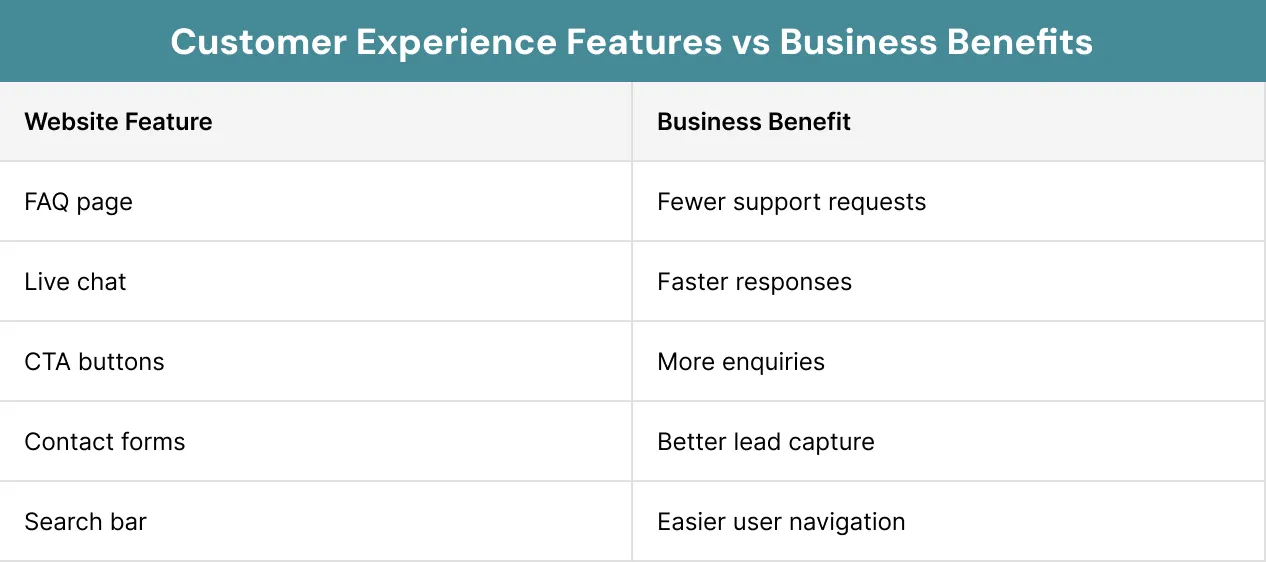
How Do Website Features Improve Search Visibility?
Website features are helpful when it comes to informing search engines about your website. These features can also be beneficial to the user in terms of providing them with answers more quickly. When everything works well, the ranking of the website increases as well.What Are SERP Features?
SERP features are unique elements that appear in search results. Featured snippets, FAQs, and review stars are examples of such SERP features. Local search results with maps are another type of SERP feature. SERP features help your web page get noticed.How Can You Add SERP Features to Your Website?
Structured data allows you to implement SERP features. The use of the FAQ schema will allow your questions to show up in the search results. With a review schema, you can have ratings directly on Google. Headings will make it easier for search engines to index your content.Why Do SEO-Friendly Website Features Matter?
By implementing SEO-friendly features, your website will be ranked higher by search engines. Your content will get more organic traffic. As a result, your brand will be more visible. In addition, user experience will be improved.
Quick Tip
A website can look good but still fail in search results. It needs strong structure and SEO basics to perform well.
Which Advanced Website Features Will Customers Expect in 2026?
Customer demands are rapidly changing. By 2026, customers will have high expectations from smart and slick websites. High-end technology will revolve around three main aspects: speed, customisation and user-friendliness.1. AI-Powered Customer Support
The responses provided by AI chatbots are immediate. AI chatbots make things convenient for customers at all hours. Thus, there is no waiting involved, leading to better customer support. They can help guide users on how to accomplish certain tasks.2. Personalised Content Recommendations
Recommendations would be generated by websites depending on how a user behaves on them. The recommendations may be for products or services. It becomes easy to locate what a user wants. There would be personalisation and increased conversions.3. Voice Search Readiness
Many users today have voice assistants. Thus, websites must be able to accommodate voice search queries. Clear language makes voice search more effective. In 2026, this trend is expected to increase further.4. Dark Mode Options
Dark mode is becoming more popular. Many users prefer it at night because it can be more comfortable to view in low-light conditions. It may help reduce eye strain for some users. It is preferred by many people at night. Dark mode increases accessibility. Websites become user-friendly.What Features Should a Small Business Website Focus on First?
Features for a small business website do not need to include everything at once. They should start with the most important parts like speed, mobile design, clear navigation and contact options. These will help create confidence and provide initial success.1. Start With Speed and Mobile Design
Fast-loading sites encourage users to stay. Sites that are slow lose users within a few seconds. The mobile layout is important too because most users access content via their mobiles.2. Add Trust Signals Early
Trust encourages users to make decisions faster. User reviews demonstrate genuine feedback from customers. Safety features keep users safe. Business information makes users trust a brand. All of these factors make a business trustworthy.3. Focus on Simple Lead Generation
Forms and calls to action capture leads from users. Such forms have to be brief and easy to complete. Easy-to-use designs ensure higher conversions. Clear CTA buttons lead to better conversion rates.4. Improve Features Over Time
There is no need for all functions to be implemented when launching a website. One feature at a time works best to save costs and effort. Websites may be gradually developed by businesses.Case Study – How Do Better Website Features Improve Customer Experience
The GOV.UK site has been improved upon through the efforts of the Government Digital Service. This process involved making online government services user-friendly. The pages had a clean layout and structure with concise information. This made the search for information easier for the users.
It also involved making sure that mobile usage was supported and tasks were accomplished more easily. This increased ease of use and reduced errors.
What Website Changes Improved User Experience in This Case?
The new interface made it easier for users to find what they were looking for since it was based on simple pages and headings. It allowed for a mobile-friendly design that increased task completion rates even though users did not have access to computers. Clear language and short sentences were used.
The new design was more accessible to screen readers and keyboards and so the users could complete their tasks easily.
What Website Features Businesses Should Not Overlook in 2026?
The key features of a website that a firm should not ignore include fast-loading pages, a mobile-friendly design, simple navigation and clear contact details. Security features like HTTPS are also very important. Trust signals such as reviews and professional branding are also needed. Together, these features help websites stay useful, safe and effective in 2026.
These features of a website are now mandatory for certain websites. These are no longer considered options by most companies that create websites today. They play an important role in helping users gain trust in a website.
Which Website Features Improve User Experience the Most?
The user experience design features are all about ease and quickness. Easy navigation will enable users to access information within seconds. Fast-loading sites will minimise drop-off rates. Mobile design will make the site navigable on all devices.
Such features will make users feel comfortable using the website. As such, users will spend more time on the site. This means increased satisfaction levels. In turn, this makes the site successful.
Which Website Features Help Build Trust Online?
The presence of trust signals makes users feel secure. User reviews reflect actual user experiences. The use of security measures such as HTTPS makes users’ data secure. Contact information builds the credibility of businesses.
With these signals, the level of skepticism decreases. Users become more willing to provide their information. Trust increases conversion rates. Without trust, users tend to exit a site very fast.
Which Website Features Support Business Growth?
To increase business growth, a website must act as a 24/7 sales engine. Key features of a website that support business growth include good CTAs that guide users to take action. Contact forms are a feature of a website that makes it easy for users to ask questions. Live chat improves response speed and support. Newsletters help businesses build long-term customer relationships.
These features generate more leads and conversions. They also contribute to retaining customers. Companies can grow fast using these features. They can also convert traffic into something else. That’s why they are important in 2026.
Conclusion
Customers in 2026 want fast, easy and simple websites. They want easy design and easy-to-use websites. Good website features include mobile support, simple navigation and strong security. These features help turn visitors into enquiries.
Small businesses should focus on what customers need. Simplicity is the key. Start with speed and ease of use. At XoomPlus, we can assist you in creating modern sites. Visit our services for website creation.
Is your website missing the features customers expect in 2026?
XoomPlus helps businesses create fast, user-friendly, and conversion-focused websites that support growth and customer trust. We have helped businesses improve their online presence through effective web design and digital solutions. Explore our website services or reach out to us today to discuss your requirements.
FAQs
What Is a Website Feature?
A website feature is any tool, function, or design element that helps visitors use a website. Examples include contact forms, navigation menus, search bars, live chat, and security features.
How to Add SERP Features to My Website?
Businesses can add SERP features by using structured data, creating FAQ sections, improving page content, and following SEO best practices. Features such as review stars, FAQs, and featured snippets can help improve search visibility.
Which Website Features Are Most Important in 2026?
Customers expect fast loading speeds, mobile-friendly design, secure browsing, simple navigation, reviews, and clear contact options. Many also expect AI-powered support and personalised experiences.
What Are the Best Features for a Small Business Website?
The most valuable features for a small business website include responsive design, strong calls-to-action, contact forms, customer reviews, security features, and SEO-friendly content.
How Do Website Features Affect Customer Experience?
Website features can make a site easier to use, faster to navigate, and more trustworthy. A positive experience can encourage visitors to stay longer and take action.