- May 21, 2026
- Categories: Digital Marketing
Why Many Business Websites Fail to Convert in 2026
Have you ever noticed that some business websites seem to be updated but still show lags in leads and sales? To make a site work well, you don’t only need to make its layout nice or its design clean.
The duty of a business website is not just to be online but it’s more than that. While making a website, you must keep in mind that it motivates people to take action. This action can be anything, such as contacting the company, filling in a form or buying a product.
However, most of the sites are just made to stay online and do not guide visitors to interact. Thus, when people visit that website and they don’t find any proper guidelines for taking any action, they leave. The reason is that they do not understand why this action matters and what makes this business trustworthy.
An audit of UK B2B websites was conducted in 2025. This showed that fewer than 4% of sites were scored as ‘Good’ on Google PageSpeed. As far as mobile scores are concerned, they’re even lower, with an average of 57 out of 100.
This means most websites frustrate users, so there is a low chance that they will take action. Thus, conversion becomes lower, especially on small screens.
In this blog, you will know the reason why most business websites fail to convert and what is the mistake behind this.
Key Takeaways
- A strong business website should explain the offer clearly, build trust fast, and guide users towards action
- Good business website design uses simple layouts, clear buttons, fast speeds, and mobile-friendly pages to reduce user drop-off
- A high-performing small business website should include trust signals, clear messaging, and easy navigation to increase enquiries
- To improve website conversion rate, businesses should focus on user needs, clear CTAs, and a smoother customer journey
- A better website conversion rate often comes from stronger trust, simpler content, faster loading times, and better user experience
What Is a Business Website?
You should not consider a business website like a digital brochure or online profile anymore. In 2026, the meaning of a site has totally changed. Now, it is a system of conversion that guides people, builds trust and explains value.
It makes a connection between awareness and action by linking them. Users land on the site, thoroughly read the offer and a trust is built. After this, they decide whether to contact or make a purchase.
So, a business website will fail in providing the purpose if any of these steps are not clear.
You might have seen older sites that were built only to educate people. In contrast, the recent ones are made in expectation of conversion.
This means:
- They must have an explanation about the business
- Should show its importance
- There is no confusion
- There are clear guidelines for further steps
A business website should not just look impressive; it should make visitors feel understood, confident, and ready to take action.
Donald Miller, Author & Business Storytelling Expert
What Is a Small Business Website?
The main online presence of a small business is its website only. In contrast to big companies, small businesses depend on their small presence to win clients, get questions and build trust. Each of these steps is important because you have to pay for mistakes.
If a business website is built well, it provides a clear picture of the business and builds trust quickly. It also transforms readers into customers.
The common issues are poor business website design, unclear messaging, difficult navigation and low income. You can lose your clients even if you make a small error.
A strong site means it is focused and simple. It has visible call to actions (CTAs), clear messaging and design for small screens. It also has proofs for trust like reviews and it can navigate easily.
Above all, if you apply all these strategies accurately, you can make growth via a small business website also.
Why Do Business Websites Fail to Convert?
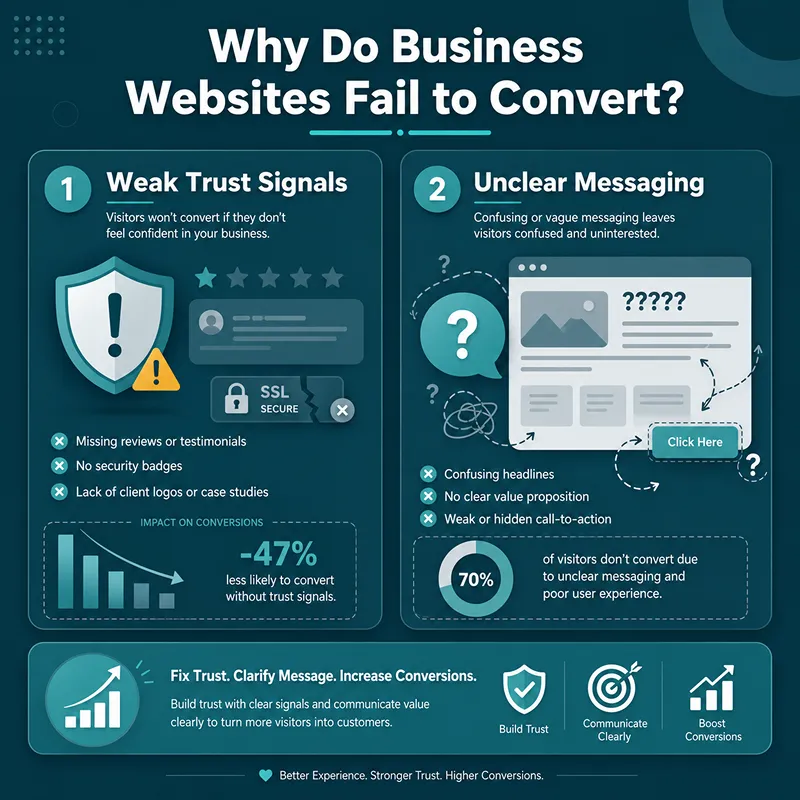
You can make your website great in terms of looks. However, if you have not focused on its trust, clarity and guidance, you might lose the interested readers. Let’s understand the reasons why it fails in conversion:1. Weak Trust Signals
When someone visits your website, naturally, they are hesitant. They become confused if they don’t find the proof that the business is reliable, experienced or real.
Many site owners miss the following things in providing the trust signals:
- Reviews of client logos
- Clear contact information
- Visuals about work or team
- Real-life examples
- testimonials
Before making any decision, most people compare many options. They search for reassurance, not just looking at the offers you provide.
Visitors will pick another site naturally if they find clear proof and strong credibility.
2. Unclear Messaging
When visitors don’t understand what you offer, they leave your site quickly. Due to confusion, many people go from your website without showing any interest.
Users leave within seconds if they don’t know the following:
- About the company
- Purpose of business
- It’s importance
If you make the messages simple, it will improve website conversion rate. The purpose of clear messaging is not to say too much. It aims to say less but it should be better.
When a site explains everything well, it means:
- The problem is described well
- Its solution is provided
- What is the outcome for the visitor
Quick Tip!
If a visitor cannot understand what your business offers within a few seconds, simplify your headline and explain the benefit more clearly.
3. Poor CTA
Most of the websites do not succeed because they do not provide proper guidelines for users. Maybe some people are interested in your business but they don’t know the next steps. When the direction is not clear, they hesitate and this confusion makes them leave the page.
Common problems with this are:
- Important actions are hard to find
- A lot of different actions
- No clear buttons to contact
Its examples include:
- Contact us now
- Get a quote
- Book an appointment
What to Avoid!
Avoid adding too many menus, pop-ups, long paragraphs, or multiple CTAs on the same page, as this often confuses visitors and lowers conversions.
4. Weak User Experience
In conversion, user experience matters a lot. You can destroy engagement with poor usability even if you have written strong messaging.
Some common problems are:
- Not fit for small screens
- The layout is cluttered
- Navigation is not easy
- Loading speed is slow
A simple site is easier to use and users are more likely to take action.
When pages are adapted to mobile devices, people can use them on any device. So, easy navigation helps users find what they need quickly.
Rapidly loading pages keeps people from leaving and a clean design makes content simple to read. When the site is simple and clear, visitors can pay attention to the message. This makes them more likely to take action.
5. Lack of Trust and Branding
Users immediately lose trust in a business if its website is unprofessional, inconsistent and outdated.
Sometimes, people judge credibility quickly according to the following:
- Overall polish
- Appearance consistency
- Typography
- Visual design
When visitors land on your site, they not only purchase services but also buy confidence.
Users feel more comfortable in interaction if the pages are clear, well presented and reliable.
Between two similar businesses, emotional trust often decides what to do next.
6. Lack of Storytelling
Some businesses only put features, technical details or services on their websites. However, the issue is that people connect with meaning, not with the lists of all the services and details. When you do not provide context, it looks like your message is forgettable and flat.
When you utilise storytelling in your website, it helps in understanding:
- What is the problem
- How it is solved
- What changes occurred
7. Lack of Clarity and Simplicity
When you overload a page with content, users get confused and find it difficult to focus. When people come across so lengthy paragraphs, several options and an unclear layout, they either leave or delay decisions.
This process is also called decision fatigue.
If you keep the structure simple, it will help visitors move naturally throughout the page. When you keep the content concise and organised logically, users will:
- Make decisions with less struggle
- Understand quickly
- Scan faster
8. Lack of Personalisation
A website that appears the same for all users usually isn’t relevant. People visiting have different needs, and generic messaging rarely speaks to anyone directly.
You can improve website conversion rate if you tailor messaging to certain audiences or issues.
It includes:
- Clear division of services
- Specific landing pages
- Specific industry pages
Related: Top marketing challenges businesses face today
What Happens When Business Websites Do Not Perform Better?
If your business website does not perform properly, it can be hard to know what is effective and what isn’t. Without clear information, decisions are based on guesswork. This often results in poor choices that hurt conversions and sales.
If you do not utilise analytics and tracking tools, you will not understand what works for your business.
Some professionals update content or alter business website designs without looking at the true effect on conversions.
You can fix this issue with the help of data. Many tools are available for this purpose, such as heatmaps and analytics. They tell us where people have clicked and where they stop. Besides this, it also shows what they ignored.
Business owners use this information to make accurate and more effective changes.
Why Are Business Websites Treated Like Static Brochures?
In this modern era, most of the website owners are still building their sites in a way that just shows information. This is the reason your site can’t become the place where people make a purchase.
A website created according to the latest updates should be in a way that it generates leads and books appointments. It should also support sales decisions and drive enquiries.
Your site is not performing well if it does not guide users well.
How to Boost Your Business Website to Conversions in 2026?
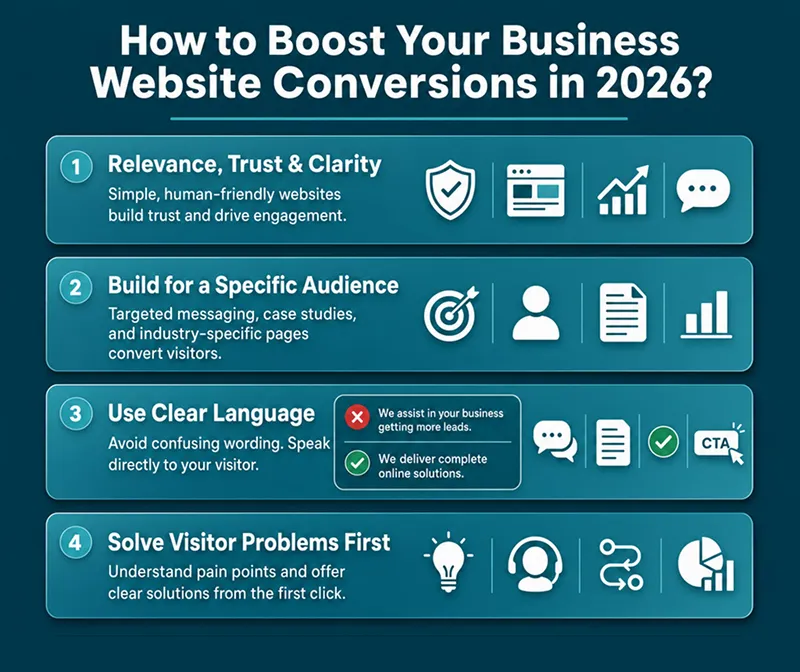
You don’t need to make flashy business website designs for your website to convert. The things to focus on are relevance, trust and clarity. The recent top-best websites are directly helpful, human and simple.
Instead of building your site for everyone, make it in a way that it is specifically for a certain audience. If you add case studies, targeted messaging and industry-specific pages, users will think you understand them.
So, if people do not get confused, they will stay for a long time and engage more.
Avoid difficult language and excessive formality. On a website, you must speak in a way that is direct and clear. You can consider “We help your company get more leads”. However, we can say it more clearly, like “We deliver complete online solutions.”
With the help of clear language, you can build trust and reduce friction.
While creating a website, you must understand the visitor’s problem and give the solution first. For example, the message “Feeling difficult to ask from your website” connects quickly.
Thus, when people feel that they are understood, there are more chances to convert. Besides this, they trust your site and stay engaged.
Case study: Turning Clicks into Conversion
If a website is not able to transform users into clients, its beautiful design is useless. A client from the UK paid so much for designing his site again. In spite of spending so much money, the site did not convert.
When it was launched, conversions fell and the prices of marketing became high. Also, the team was under stress about how to fix this issue immediately.
When the issue was brought to experts, they applied a data-driven strategy. They optimised the code of the site for speed and configured Hotjar and Google Analytics. They also monitored the user’s journey through the site.
With the help of this tracking, the professionals know where users navigated, clicked and left.
By analysing all this, they made improvements in the user experience. The place of the buttons was moved to spots that were more visible. Navigation was made clear and the checkout was made simpler.
In addition, the content was written again in a language that is simple and provides benefit to the business. They used targeted email campaigns to bring back lost users. The results were monitored and connected to their CRM data.
With the help of A/B testing, we came to know which pages work well. Specialists tracked every change according to real user behaviour. This made the results measurable and easy to understand. When all these methods were applied and monitored, the outcome was dramatic. Conversions of this UK business website jumped 61%. Also, the client’s best month ever outperformed previous sales by 37%.
Final Thoughts
In 2026, most business websites still fail in conversion. This is because they don’t focus on action, clarity, trust and user behavior but rather they pay attention to looks. No matter how modern your site looks, if it confuses people, they will leave without taking any action.
You can improve conversions by mobile optimisation, personalised communication and trust signals. In addition, you must make the navigation simple, CTAs clear and messaging strong.
Businesses that understand the mentality of the visitor and decide according to them can transform site traffic into customers.
At Xoom Plus, we know a website that truly drives conversions requires doing more than just staying online. We make sites in a way that provides a better user experience and build trust. Also, we help businesses to make real outcomes.
Contact us today if your current website lacks conversion. You will know how these strategies grow the business.
Is your business website getting traffic but failing to turn visitors into customers?
We build high-converting websites with clear messaging, strong UX, and conversion-focused design. We have helped businesses improve engagement, leads, and online growth.
Contact us today!
FAQs
What affects a website conversion rate?
A website conversion rate is affected by factors like page speed, clear messaging, mobile responsiveness, trust signals, and strong CTAs.
If visitors find the website confusing or slow, they are less likely to take action. A simple, user-friendly website usually leads to higher conversions and better customer engagement.
How do I create my own business website?
Google keyword stuffing detection uses advanced algorithms and AI systems to identify unnatural keyword repetition in content. Google now focuses more on user intent, readability, and helpful information instead of keyword frequency alone.
Can ChatGPT build a business website?
ChatGPT can help you plan website content, create layouts, write copy, and suggest design ideas for a business website.
It can also help generate code and improve user experience strategies. However, the final website still needs proper design, development, and testing before launch.
Can I create a free business website?
Many platforms allow you to create a free business website using ready-made templates and drag-and-drop tools.
Free websites are useful for starting, but they often have limited features and branding options. For better performance and credibility, businesses usually upgrade to a professional website later.
Do business website owners get paid?
Business website owners can get paid when their website generates leads, sales, bookings, or advertising revenue.
A website itself does not earn money automatically. It must be designed to attract visitors and convert them into customers.
Income depends on the business model, such as selling products, services, subscriptions, or affiliate programmes.