- June 18, 2026
- Categories: Web Solutions
Website Speed Optimisation: Why Fast Websites Rank Higher on Google
Have you ever explored a website, tried to find what you needed and quit before taking any action?
If this is the scenario, you are not alone in it. Most people want a site to load quickly and show the details they need right away.
That is why website speed optimisation is so crucial. It helps sites load more rapidly and work better for users. It is also one of the major website ranking factors that Google considers when deciding which pages should appear first.
Consider that only about 70% of websites in the UK qualify for an essential speed test. This means several sites are still extremely slow, which can affect both user experience and website ranking on Google.
However, website speed is not only essential for search engines. A slower site can annoy visitors, raise bounce rates and lower customer engagement.
A speedy website looks trustworthy, professional and easy to use. On the other hand, a slow site can frustrate people and make them leave before they even view what you offer.
In this blog, you will learn what website speed refers to and why it is so important. Also, you will look at how improving your website speed can assist both your audience and your search engine rankings.
Key Takeaways
- Website speed optimisation helps create faster, smoother websites that improve user experience and support stronger search visibility
- Ranking website success depends on keeping load times low, improving mobile performance, and reducing user frustration
- Website ranking factors now include Core Web Vitals, mobile usability, page stability, and technical site performance
- Website ranking on Google systems favours sites that load quickly, stay stable, and allow users to interact without delay
- How to rank a website fast often starts with image compression, caching, clean code, and reliable hosting
- Website speed optimisation matters in the UK because mobile-first browsing and fast user expectations make speed vital for UK businesses
What Is Website Speed Optimisation?
Website speed optimisation is defined as improving how fast a website is loading and how seamless it feels to use. It is not only about the time a page loads. It also involves how rapidly text is displayed and how fast buttons work. Besides this, it also looks at whether the page stays steady while it loads.
A site can seem to be ready but still work slow. A button may not respond, a menu may freeze, an image may appear late and a form may not open. These problems make people feel uneasy.
Good performance points out that the entire visit feels easy. The server provides responses quickly, the first content displays fast and the main section loads without a long wait. Also, users can click, scroll and browse without any issues.
People do not visit a website to assess its speed. They come with a specific target and expect the site to help them achieve it quickly and effortlessly.
Website speed optimisation helps develop a high ranking website by improving user experience and SEO.
Website speed directly affects how users experience your site and how Google evaluates it for rankings. Faster pages reduce bounce, increase engagement, and give search engines clear signals of quality.
Natalie Stubbs, Senior Technical SEO at Lumar
Why Does Website Speed Optimisation Matter?
Website speed optimisation is important because people are looking for fast results. When someone conducts searches on the web, they usually are seeking an answer now. If your page fails to respond to them, they can leave and select another site.
Speed affects how people view you. A fast page can make a business feel organised, updated and reliable. It clearly shows that the enterprise respects the user’s time.
On the other hand, a slow page can deliver a false message. People may think the business is unprofessional or outdated. Even a pleasing design may disappoint if the page takes too long to load.
Speed impacts outcomes as well. If visitors leave too soon, fewer people will engage with your content. A smaller number of users will complete a form, buy a product or book a service. In this way, slow pages can silently lower leads and sales.
Fast Facts!
Google research shows that 53% of mobile users leave a website if it takes longer than 3 seconds to load. This highlights why speed is now a major part of online user behaviour and business performance.
How Does Website Speed Optimisation Shape User Experience?
Website speed optimisation has a significant impact on visitor experience. A fast website makes the journey feel easy, while a slow site creates stress.
Customer satisfaction is not only about images, colours or fonts. Rather, it is also about how the website operates. You should make sure that it loads quickly and users are showing interest. Also verify that the layout stays still and people are moving from one page to the other without waiting.
When the interaction is seamless, people are more likely to come back. They may read more, look into services, investigate products or contact the company. When the experience is not good, they may leave without taking any required action.
Content, query intent, page layout, links, trust and usability also have significance. These elements are among broader website ranking factors.
1. Bounce Rate
Bounce rate is the percentage of viewers who depart after just reading one page. Slow sites often have greater bounce rates because users do not want to wait.
If the initial page takes too much time, people may never reach the core message. That indicates the website loses a chance to assist them.
Website speed optimisation can reduce this risk by displaying relevant content sooner. People have an excuse to stay when they can easily find what they want.
2. Dwell Time and Engagement
Dwell time defines how long somebody stays on a page. On the other hand, engagement means what they do as long as they are there.
People prefer to stay longer at quicker sites because they can move around more smoothly. The reason is that they can read, click, compare and learn with a lesser effort.
This allows your content more time to interact with the viewer. A visitor may begin with one blog and open a service page. After that, they may read reviews and fill out a form. If the speed is fine, it helps each step feel easy.
3. Trust and Brand Perception
Speed also impacts reliability. The reason is that people assess websites fast. They use minor signs to decide whether a business feels secure and professional.
If a website is fast, it can build confidence. While a slow one can lead to uncertainty. If the page freezes or jumps, people may think about whether the business is reliable.
For this reason, performance has a broader impact than traffic. It determines how visitors feel about your brand.
Why Is Mobile Website Speed Optimisation So Important?
Mobile website speed optimisation is necessary because many people surf the internet on phones. They search while commuting, buying things, working or relaxing. Mostly, visitors often want quick responses on smaller screens.
Mobile users may also have weaker internet signals and slower cellular devices. Pop-ups, YouTube clips, huge images and advanced code can cause pages to crawl.
A website that appears great on a PC might not work well on a smartphone. For this reason, mobile testing is highly significant. The mobile page must be readable, clear and easy to swipe.
Mobile speed helps users read text, browse menus, tap buttons and fill forms without pressure. It also helps firms serve people who are willing to act promptly.
Website speed optimisation benefits mobile consumers by making pages lighter and simpler. Mobile viewers need readable pages that load swiftly, fit the screen and react to touch.
Mobile speed also promotes a website ranking on Google. The reason is that mobile interaction is a major part of how users judge a page.
How Does Website Speed Optimisation Measure Performance?
Website speed optimisation involves a number of measurements. Only focusing on the speed score does not reveal the entire story.
A page may display text swiftly but finish loading afterwards. On the other hand, another page may complete loading but not react to clicks. In the same way, a third page may open fast but jump around while the visitor is reading.
Good testing evaluates different aspects of the experience. It includes:
1. Page Load Time
Page load time refers to how long the entire page takes to load. This factor is easy to understand but you cannot figure out all the details only with this.
A page can feel speedy if important content shows up early. While it can appear slow if people gaze at a blank screen, even for a few seconds.
Therefore, page load time is crucial but it should be seen with other speed signals.
2. Time to First Byte
Time to First Byte (TTFB) refers to how fast the server begins sending out data after a user asks for a page.
Think of it like a retail store worker responding to a customer. If the staff takes too long to respond, everything else is slowed down.
Insufficient hosting, crowded servers and poor setup can lead to slow TTFB. While better hosting and cleaner systems can speed it up.
3. First Contentful Paint
First Contentful Paint (FCP) indicates when the initial obvious content shows up. This might be text, a picture or a design section.
This is crucial because readers want proof that the page is functional. A blank screen creates a sense of uncertainty. Therefore, early content tells visitors that the site is loading.
Best Practice!
Focus on high-impact fixes first, such as image compression, browser caching, faster hosting, and reducing heavy scripts. Small speed gains can improve both user experience and website performance over time.
How Does Website Speed Optimisation Use Core Web Vitals?
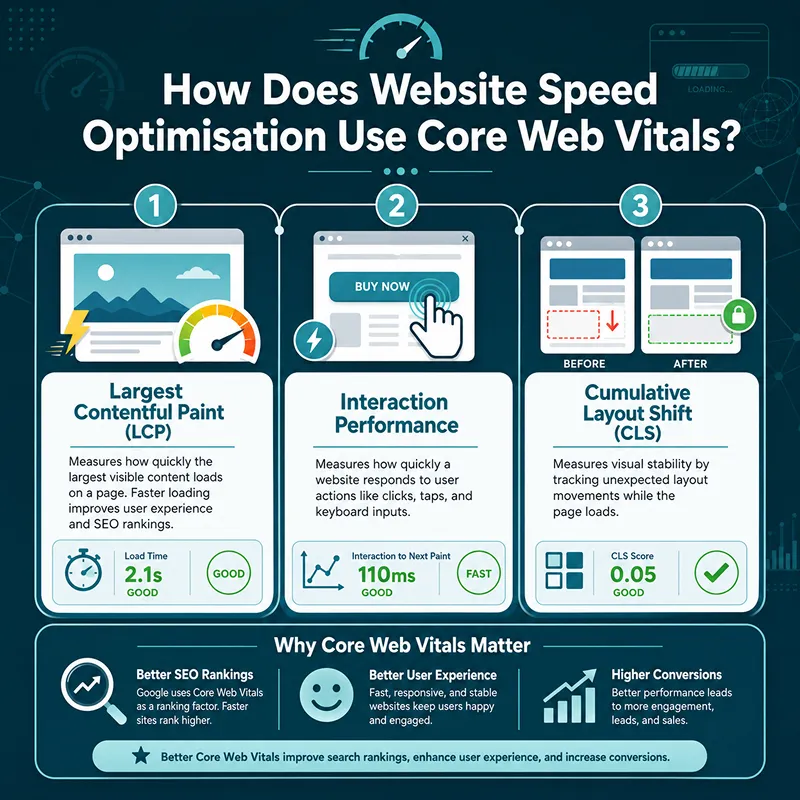
Website speed optimisation usually involves Core Web Vitals. These are Google measurements that concentrate on what people feel while a page is loading and responding.
They look at three simple ideas:
- How swiftly the main content loads
- How rapidly the page reacts
- How stable the layout is
1. Largest Contentful Paint
Largest Contentful Paint (LCP) monitors how long the main content takes to show up. This could be a huge image, a title or a main section of text.
The whole page will be slow if the primary content is slow. Large documents, weak servers and heavy code can all damage LCP.
2. Interaction Performance
Interaction performance measures how quickly the webpage reacts when users click, tap, type or open something.
A page that appears to be loaded but does not respond feels broken. So, good website speed optimisation helps icons, menus and forms work fast.
3. Cumulative Layout Shift
Cumulative Layout Shift (CLS) determines whether the webpage moves around during loading.
Perhaps you have already noticed this. Sometimes, when you try to tap one thing, the page moves and you tap the undesirable thing. This situation annoys users and they never come back to that site.
Stable structures make websites less difficult to read and use.
How Does Website Speed Optimisation Affect Website Search?
Website speed optimisation can assist search platforms in reaching and understanding pages more easily. Search engines need to go to pages, review content and notice updates.
This is especially significant for large sites with many pages. Digital shops, blogs and service websites may add additional pages often. Therefore, a slow site can make this process less effective.
Success cannot be ensured only by speed. It aligns with a ranking website plan when the site also has useful content, simple pages and a sturdy structure.
A quicker website removes obstacles and helps vital pages stay easier to access.
What Problems Does Website Speed Optimisation Solve?
Website speed optimisation addresses many problems that develop over time. Most websites do not get slower in one day.
A company may add more plugins, graphics, videos, forms, tracking tools and visual effects. Each one may appear small but when combined, they can make the site heavy.
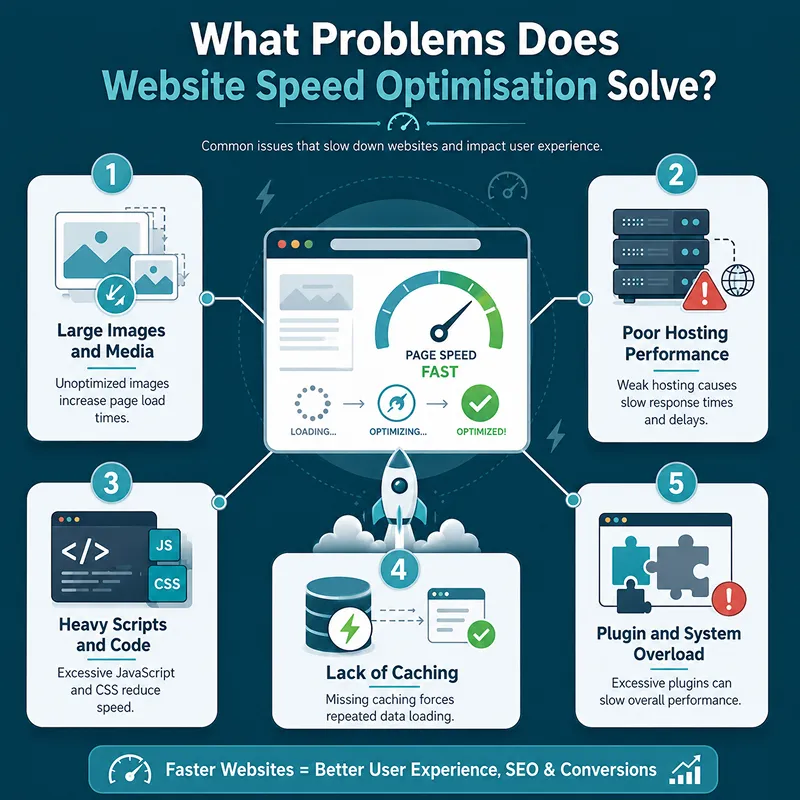
Here are common reasons for poor performance of websites:
1. Large Images and Media
Huge images are one of the primary causes of slow pages. Many people post photos that are much larger than required.
Pictures should be resized, compressed and saved in latest formats whenever possible. On the other hand, videos should be used carefully, specifically on mobile pages.
If you keep the media files smaller, it will help the page load faster without affecting the message.
2. Poor Hosting Performance
Your website is running on hosting. Therefore, if hosting is poor, the website may be slow even if the design is basic. Besides this, poor hosting can lead to slow response times, downtime and unstable pages.
On the other hand, strong hosting gives the site a more stable base. Hosting is one of the crucial website ranking factors because it impacts speed, stability and user experience.
3. Heavy Scripts and Code
Code and scripts make websites operate. However, too many of them can slow down the page.
Heavy scripts may originate from sliders, ads, tracking tools, chat boxes, visuals and additional features.
Therefore, it is important to understand that too much code and scripts can overload the page, while a few are useful. If the code is cleaner, this will help the browser create the page faster.
4. Lack of Caching
Caching stores parts of a site so they do not need to reload from the beginning every time.
With no caching, redirected users may download the same documents again and again. This situation wastes so much time.
Caching makes repeated visits quicker and reduces the normal load on the server.
5. Plugin and System Overload
Plugins can provide beneficial features. However, a lot of plugins can slow a website down and old plugins can also cause mistakes or add extra code.
Regular inspections help remove tools that are no longer required. This keeps the website clean and less risky.
How Can Website Speed Optimisation Measure Performance?
Website speed optimisation should be assessed with appropriate tools. It is insufficient to make assumptions based on page loading speed.
Your site may appear quick on your own laptop because your browser has already stored files. However, it may feel slow for new visitors, mobile users or people in another region.
Testing a website reveals what is actually happening. It can point out large text files, slow hosting, poor mobile speed and unreliable layouts.
1. Performance Testing Tools
Many tools are available to test the performance of the website. Helpful tools include the following:- Google PageSpeed Insights
- Lighthouse
- GTmetrix
- Pingdom
- WebPageTest
Do not try to achieve a flawless score blindly. Put an emphasis on upgrades that make the site better for real users.
2. Why Monitoring Matters
Websites often go through changes. A fast site can become slow after recent images, plugins, design alterations or software upgrades.
Regular inspections help identify problems ahead of time. They also take care of the work already completed.
Website speed optimisation should be a component of routine site upkeep.
What Does Website Speed Optimisation Improve?
Website speed optimisation fastens many sections of a site at once. The best results usually come from multiple simple solutions working together.
A site may want lighter graphics, better caching, cleaner code, more powerful hosting or fewer plugins. Each upgrade makes the site simpler to use.
1. Image Optimisation
Image optimisation is the process of making images smaller while keeping them readable. This can involve compression, size changes, WebP documents and lazy loading.
Lazy loading is a process where visuals load only when users are about to see them. This technique improves the performance and speed of the page a lot. This helps the top of the page seem more responsive.
2. Browser Caching
Browser caching stores documents on the visitor’s device. When they come back, the browser can save some files instead of downloading all of them again. This makes repeat visits quicker and more comfortable.3. File Compression and Minification
Websites use coding languages such as HTML, CSS and JavaScript. These data files can often be made a bit smaller.
Minification takes out excess spaces and unneeded parts. Compression makes files smaller while they transfer to the browser. In addition, more compact files load faster.
Why Does Website Speed Optimisation Need Better Hosting and Delivery?
Website speed optimisation relies heavily on reliable hosting and careful delivery. Even a neat site can struggle on a slow server.
On the other hand, fast hosting helps pages react quickly. If the delivery is good, it will help files reach visitors sooner, even when they are far from the primary server.
1. Fast Hosting Solutions
Good hosting gives you higher speed, uptime and support. It may consist of quicker storage, more powerful server power, built-in caching and greater security.
Cheap hosting may work at the initial stages but expanding websites often need stronger resources.
Hosting is also associated with website ranking on Google. This is because slow server response can damage the visitor experience that search engines want to support.
2. Content Delivery Networks
A Content Delivery Network (CDN) keeps copies of site documents in different locations. Thus, people can get files from a spot closer to them.
This minimises delay and can help the site stay secure during busy times. A CDN is beneficial for websites that support users in many different places.
What Is the Future of Site Performance?
Site performance will keep evolving as technology advances. Tools are becoming smarter and some can already find slow factors and suggest solutions.
AI may help compress pictures, forecast user needs and enhance content delivery. Faster networks and better devices may also increase demands.
Still, the main idea will continue to be the same as before. That is, people want websites that are fast, simple, and helpful.
The next generation of website ranking factors will keep emphasising the full experience. Speed will be important because people care about it.
Faster loading pages make your site a significantly higher ranking website in Google search results.
Case Study: How Government Digital Service (GDS) Made GOV.UK Faster
The staff at GDS made GOV.UK load faster for all users. They did this by using a new web tool called HTTP/2 (H2).How H2 Helped
H2 made websites faster by:- Reduced repeated data by 70% (less content to send)
- Sent many documents at once (faster than one at a time)
- Put important things first (the page displayed quicker)
The Problem
At the beginning, H2 made some devices a bit slower. On the other hand, some files, such as CSS and JavaScript were getting stuck. Due to this, the pages were slowed down.How They Resolved It
GDS altered the way the site dealt with CSS and JavaScript. They let the browser use the same network for larger files. Now everything comes together as planned without delays.The Results
When GDS fixed the issues, the following results were obtained:- Old mobile devices (2G): pages run 5.5 seconds faster
- Medium phones (3G): pages open 1.1 seconds quicker
- Computers: pages process a little faster, about 0.1 seconds
Final Thoughts
Your website’s speed is highly important because it operates similar to a physical store on the internet. People trust websites that load faster and are less likely to become frustrated by them. They will stay longer and carry out your requests, like pressing buttons or making orders.
To make a site more effective, you can:
- Test it frequently
- Make it load quicker
- Use smaller pictures
- Select a good host
- Keep it clear and clean
Contact us today to make your website better for everybody who visits.
Is your slow website hurting rankings and losing leads?
We help businesses improve website speed, user experience, and SEO performance with tailored optimisation solutions.
Trusted to improve site performance and digital results, we have helped with 100+ website projects. Reach us today.
FAQs
How to rank a website fast without harming SEO?
If you want to know how to rank a website fast, focus on improving page speed, mobile usability, and content quality. Fast-loading websites create better user experiences, which supports stronger engagement and long-term search visibility.
Why website speed optimisation UK businesses should prioritise?
Website speed optimisation UK businesses invest in can improve user experience, reduce bounce rates, and support mobile performance. With most UK users browsing on smartphones, faster websites help businesses stay competitive online.
Does site speed affect Google ranking?
Site speed affects Google ranking because search engines consider user experience and page performance. Slow websites may increase bounce rates and reduce engagement, which can impact visibility in search results.
How do I optimise my website speed?
You can optimise website speed by compressing images, enabling caching, reducing heavy scripts, and choosing reliable hosting. Regular speed testing and mobile optimisation also help improve overall performance.
Why is website speed optimisation important?
Website speed optimisation is important because it improves user experience, supports mobile browsing, and helps visitors stay engaged. Faster websites can also improve conversions and build stronger trust with users.