- August 5, 2026
- Categories: Web Solutions
Best Ecommerce Integrations for Growing Online Stores
Do you still spend a lot of time copying the same data into many business tools? This can waste your time and cause big errors. Studies show that companies use over 1,000 apps on average, but just 30% of them are integrated.
This is where the best e-commerce integrations can help you get started. Your e-commerce website can easily get connected with payment, shipping, marketing and account software. So, choosing the right e-commerce integration will make it easier for you to choose the right tools to automate tasks. This helps keep the data right and also helps in business growth.
Key Takeaways
- Ecommerce integrations help different business tools work together.
- They reduce manual work and save time.
- Real-time data updates help keep records accurate.
- Integrations can improve customer experience and order management.
- The best e-commerce integrations support business growth and efficiency.
What Are Ecommerce Integrations?
An e-commerce integration links your online store with other business tools. It is useful for businesses that want to automate daily work and scale faster. This may include stock, payments, shipping and accounts.
For instance, when a customer places an order, the stock gets updated, payment can be easily made and shipping details can also be sent. This saves time and reduces manual work. Many of the best e-commerce integrations also help businesses work faster each day.
Integration is a very important step in the digital transformation journey because it allows organisations to connect applications, data and processes across the business.
Ross Mason
Which Are the Best Ecommerce Integrations for Growing Online Stores?
The list of the best ecommerce integrations for your online store includes CRM, ERP, Payment Gateway, Marketing Ecommerce, Logistics and Shipping Module, Ecommerce, Inventory and management tools, site search, email marketing and finance integrations all in one place. The best one to go for will depend on your business size and growth goals.
Below is the list of the best ecommerce integrations that can help your small business grow:
1. CRM Integrations
CRM integrations connect your store with customer data. They help you track leads, sales and customer activity. You can also use them to send emails and manage support. This makes CRM a useful best e-commerce integration for growing businesses.Cost and Best For
HubSpot offers free CRM tools. Its Starter plan starts at $20 per seat per month when paid monthly. It is best for businesses that want to manage customer data, sales and marketing in one place.2. ERP Integrations
ERP integrations connect your store with key business systems. They can link sales, stock, orders and finance data. This helps reduce manual work and repeated data entry. ERP is a useful best e-commerce integration for businesses with complex needs.Cost and Best For
ERP costs vary by software and business needs. Many tools use custom pricing, so you need a quote. ERP integrations are best for growing businesses that need to manage many areas from one system.3. Payment Gateway Integrations
Payment gateway integrations let customers pay online. They can support cards, digital wallets and other payment methods. This gives customers more ways to pay at checkout. Payment tools are a key best e-commerce integration for online stores.Cost and Best For
Stripe has no monthly fee on its standard UK plan. It charges 1.5% plus 20p for standard UK cards. Payment integrations are best for businesses that want simple online payments with pay-as-you-go costs.4. Marketing Integrations
Marketing integrations connect your store with email and other marketing tools. They can help send abandoned cart emails and track campaign results. You can also use customer data for targeted campaigns. Email marketing tools help businesses send targeted messages to customers. You can use them for welcome emails, cart reminders and product offers. They can also automate follow-up emails after a purchase. This makes them a useful tool for increasing repeat sales. This makes them a useful best e-commerce integration for growing sales.Cost and Best For
Klaviyo offers a free plan for up to 250 profiles and 500 emails per month. Paid costs increase with your contact list and email use. These integrations are best for businesses that want email automation and targeted marketing.5. Logistics and Shipping Integrations
Shipping integrations connect your store with delivery tools and carriers. They can help create labels, track orders and send delivery updates. This can reduce manual work and make order fulfilment easier. A HubSpot ecommerce integration can also help manage customer data and follow up after a sale.Cost and Best For
ShipStation UK has a free plan for up to 50 shipments per month. Paid plans start at £10 per month for 50 shipments. It is best for stores that want to manage orders, shipping and tracking from one place.6. Platform Integrations
Ecommerce platforms help businesses build and manage online stores. They can handle products, orders, payments and customer data in one place. They also connect with other tools through apps and integrations. This helps businesses manage their online sales more easily.Cost and Best For
Shopify plans start at $29 per month when billed yearly. WooCommerce is free, but you still pay for hosting and other services. These platforms are best for businesses that want to build and grow an online store.7. Inventory Management Integrations
Inventory tools help businesses track stock across different sales channels. They can update stock levels when a customer places an order. This helps reduce overselling and out-of-stock issues. It is useful for stores with many products.Cost and Best For
Brightpearl uses custom pricing based on the business and its needs. It is best for growing and larger retailers that need advanced stock and order management.8. Site Search Integrations
Site search tools help customers find products faster. They can use filters and smart search features to show more relevant results. This makes it easier for customers to find the right product. Good site search can also improve the shopping experience.Cost and Best For
Algolia offers a free plan with limited usage. Paid plans are based on search use and features. It is best for stores with large product catalogues and complex search needs.9. Accounting and Finance Integrations
Finance integrations connect ecommerce stores with accounting tools. They can send sales and payout data to accounting software. This helps reduce manual data entry and makes financial records easier to manage. A2X is designed for this type of ecommerce accounting.Cost and Best For
A2X plans start at $29 per month for Shopify stores with up to 200 orders. Higher plans support more orders. It is best for ecommerce businesses that want to automate sales data in accounting software such as Xero and QuickBooks.10. Mobile App Integrations
Mobile App Integration allows you to integrate your mobile application with your store’s core systems. You can do that by integrating your products, inventory, order and customer management. Moreover, mobile app integration allows you to link payments and delivery options.Cost and Best For
Tools available through the Shopify App Store could assist you in developing mobile apps for your business. The fees will be based on the choice of the application and the features selected. There are tools that provide both free and paid versions, where the paid version comes with a monthly fee.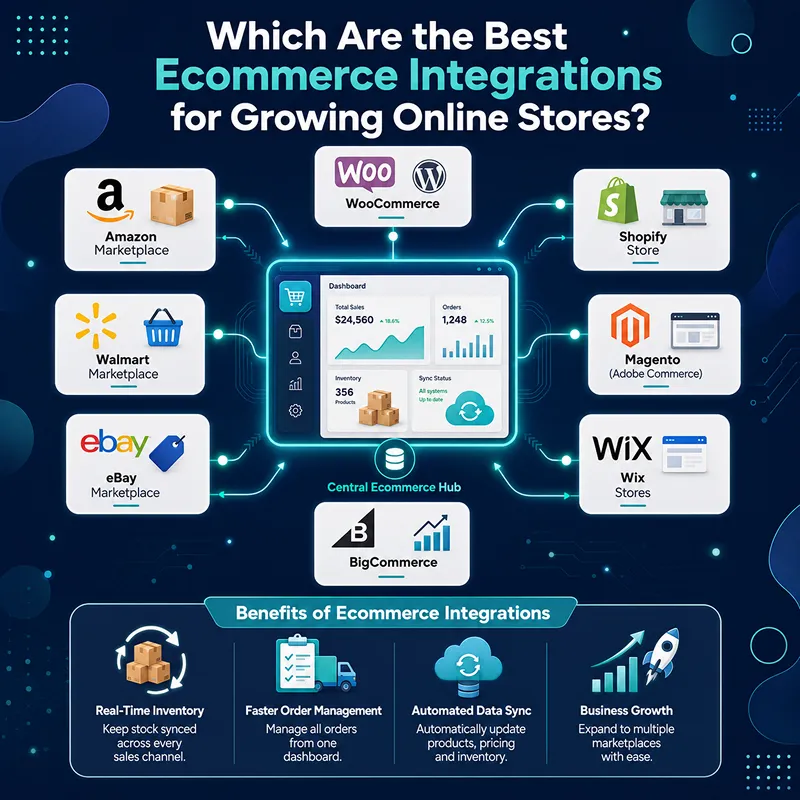
Quick Tip
Start with the integrations you need most, such as payments, shipping and accounting. You can add more tools as your business grows.
Why Do Ecommerce Integrations Matter?
E-commerce integration helps different business tools work together by sharing data. As a result, it saves time and reduces errors. Some of the best e-commerce integrations may help in managing orders, stocks and customer service. It also makes daily tasks easy. B2B ecommerce integrations help manage bulk orders, custom prices and business customers.
Below are some of the key benefits:
1. Real-Time Stock Updates
Stock levels change automatically once a product is sold. This ensures that the business does not oversell its stock.2. Faster Order Handling
Order details go directly into your shipping or storage system. This makes it easier for your team to pack and ship your orders.3. Automated Accounts
Sales data can be sent directly into the account software. This makes the job easier and faster.4. Higher Productivity
Many daily tasks run automatically. Your team spends less time on manual work and more time growing the business. This also helps reduce running costs.5. Easy to Grow With Your Business
Most ecommerce integrations can handle more orders and data as your business grows. This means you do not need to change your systems as often. It makes it easier to scale your online store.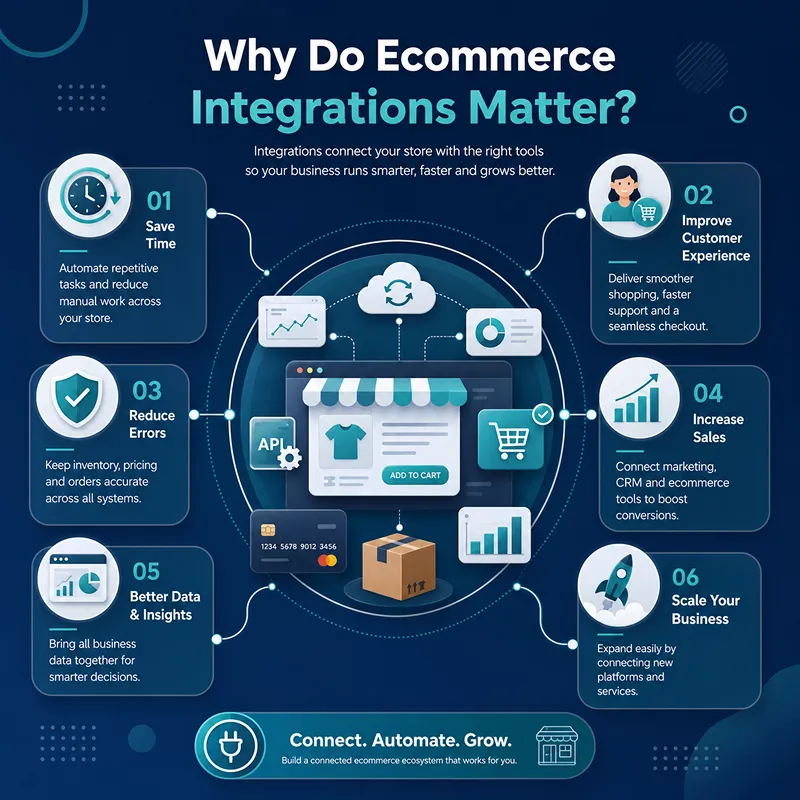
Case Study: How Gymshark Uses Ecommerce Integrations to Increase Sales
Gymshark is a UK fitness brand. It sells sportswear online. The brand uses WooCommerce to run its store. It also uses e-commerce integrations for email messages.
Sometimes shoppers add items to their cart but do not buy them. When this happens, an email is sent to remind them. The email may also show other products or a special deal.
This helped Gymshark bring customers back to the store. It also helped increase sales. This shows how ecommerce integrations can help online stores grow.
Quick Tip
The best ecommerce integrations do more than save time. They automate daily tasks, reduce errors, keep your data up to date and help your online store grow without adding extra manual work.
Conclusion
Choosing the best ecommerce integrations starts with understanding your business needs. Think about the tasks you want to automate and the tools you already use. Pick integrations that are easy to manage and can grow with your business. The right setup will help your online store run more smoothly today and support future growth.
At XoomPlus, we offer the best e-commerce integration services. Our services can help you integrate your e-commerce solutions into your business tools. Reach out to us if you need any help with your online store.
Need help choosing the right ecommerce integrations for your business?
Our team can help you find solutions that improve efficiency, reduce manual work and support growth. Contact us today to get guidance on the best ecommerce integrations.
FAQs
What are ecommerce integrations?
Ecommerce integrations connect your online store with other business tools, such as payment, shipping, marketing and accounting software. They allow data to move between systems automatically and help reduce manual work.
Why are ecommerce integrations important?
Ecommerce integrations help save time, improve accuracy and streamline daily tasks. They also help businesses manage orders, inventory and customer data more efficiently.
How to integrate ERP and ecommerce systems?
To integrate ERP and ecommerce systems, you need to connect the two platforms so they can share data automatically. This often includes product details, stock levels, orders and customer information. Businesses can use direct connections, integration tools or ready-made connectors.
What are some common ecommerce integration examples?
Common ecommerce integrations include Stripe, PayPal, Mailchimp, Klaviyo, ShipStation, Gorgias, Xero and QuickBooks. These tools help automate payments, marketing, shipping, customer support and accounting tasks.
Which ecommerce integrations should growing businesses use?
Growing businesses often benefit from integrations for payments, email marketing, shipping, customer support and accounting. The right choice depends on the business size, goals and daily needs.