- August 4, 2026
- Categories: Web Solutions
Common Ecommerce Website Mistakes That Reduce Conversions
Running an online store sounds exciting. But turning visitors into buyers is harder than most people think. Many businesses spend a lot on products and ads yet shoppers still leave without buying. 57% of internet users say they will not recommend a business with a poorly designed website. The reason is often ecommerce website mistakes that quietly hurt your sales. Bad ecommerce websites don’t just annoy shoppers. They send them straight to your competitors. Slow pages, confusing checkouts and missing trust signals all add up. Each one gives a shopper a reason to leave, these are classic ecommerce website mistakes that are easier to fix than most people think.
This guide covers the most common conversion killers across UX, SEO and technical issues. This also shows you exactly how to fix them.
Key Takeaways:
- Fixing ecommerce website mistakes such as slow loading pages, poor mobile usability and complicated checkout processes can significantly improve conversions and customer satisfaction
- Avoid common ecommerce website SEO mistakes by writing unique product descriptions, optimising metadata, implementing structured data and strengthening internal linking to increase organic visibility
- Regularly audit your store for website ecommerce mistakes across UX, technical performance, security and payment functionality to prevent revenue loss before it affects your business
- Many bad ecommerce websites lose customers because they lack trust signals, clear navigation, quality product pages and transparent delivery information, all of which influence purchase decisions
- Understanding what makes a bad ecommerce website helps you prioritise improvements that build trust, simplify the buying journey and encourage shoppers to complete their purchases
- Whether you’re reviewing an existing store or launching a new one, avoiding every major ecommerce website mistake UK businesses commonly make will create a stronger shopping experience and support sustainable ecommerce growth
What Are the Common Ecommerce Website Mistakes That Reduce Conversions?
There are more ways to lose a sale online than most store owners realise. These ecommerce website mistakes happen at every stage of the customer journey from the first page load to the final checkout step.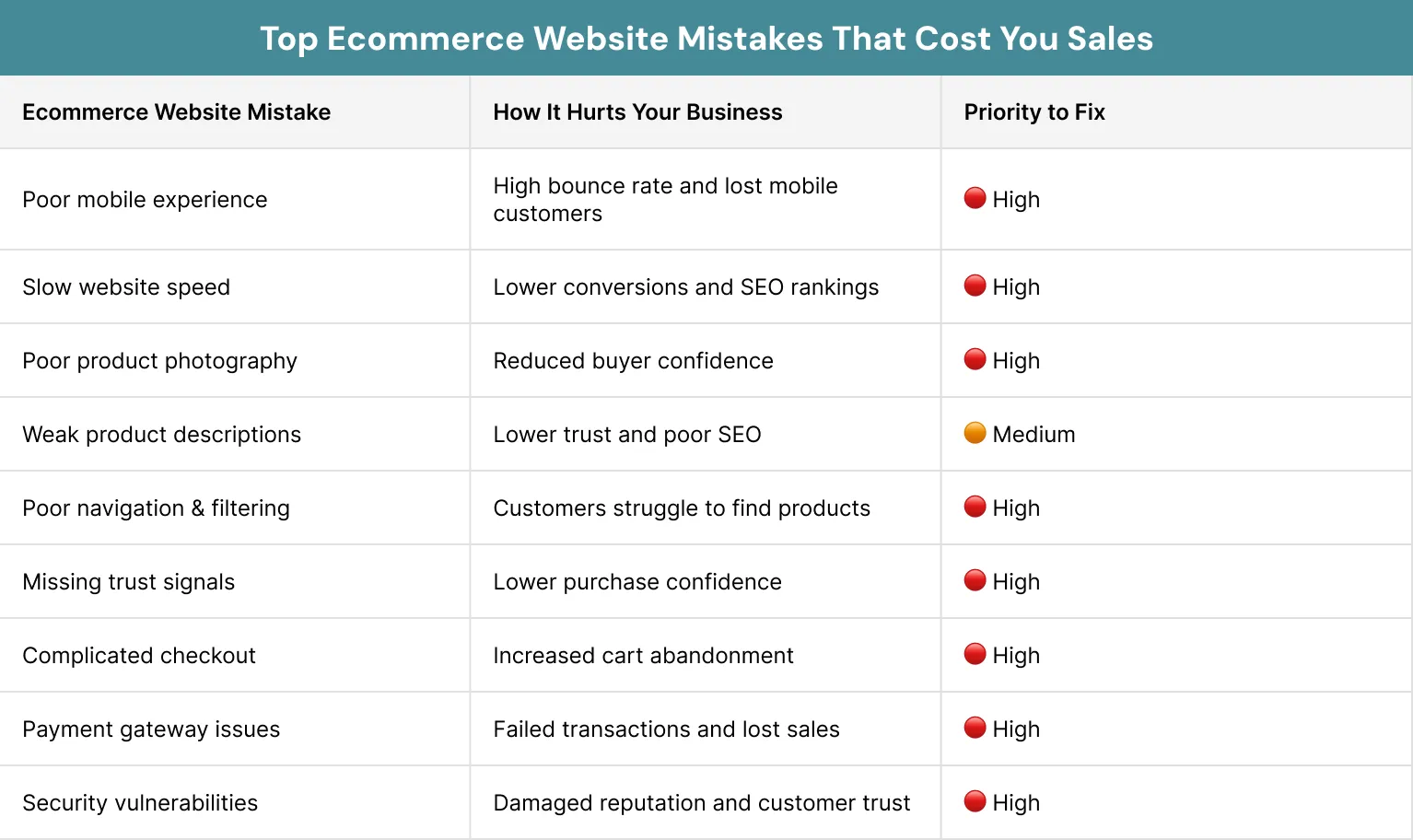
1. Poor Mobile Shopping Experience
More than half of all ecommerce traffic comes from mobile. Yet poor mobile design remains one of the most damaging ecommerce website mistakes store owners make. But many stores still treat mobile phones as an afterthought. Small buttons, horizontal scrolling and oversized images frustrate mobile shoppers.
Google found that 53% of mobile users leave a site that takes more than three seconds to load. A poor mobile experience also hurts your search rankings. Google uses mobile first indexing, which means your mobile site is what gets ranked. Start designing for mobile first. Use a 375px screen width as your base. Make all buttons at least 44×44 pixels. Test your store on real Android devices over a 4G connection.
2. Slow Website Loading Times
Slow pages lose sales. The average ecommerce site takes five to eight seconds to load on mobile which is far too long. Even a one second delay cuts conversions by 7%. Slow loading is one of the most costly ecommerce website mistakes and one of the easiest to overlook.
Unoptimised images, too many scripts and cheap hosting are the usual causes. Slow sites also rank lower on Google. Additionally, compress your images using the WebP format to reduce file sizes without sacrificing quality. Next, remove any scripts that do not add value and use a content delivery network (CDN) to improve loading speeds. Finally, if you are still on a shared hosting plan, switch to managed cloud hosting for better performance and reliability.
3. Poor Product Photography
Your images do the selling online. Poor visuals are among the most underestimated ecommerce website mistakes. Shoppers cannot touch or try your products. So your photos need to do all the work. Blurry images, cluttered backgrounds and single angle shots all reduce buyer confidence. Research shows that 93% of consumers say visuals are the key factor in a purchase decision.
58% of shoppers say products with multiple quality images get higher conversion rates. Use a white background for main shots and include multiple images per product. Add lifestyle shots showing the product in use. A short video can boost conversions by up to 80%.
4. Incomplete Product Descriptions
Good photos bring shoppers in but missing information sends them away. If a shopper cannot find the size, material or care instructions, they will go elsewhere.
Many stores copy descriptions straight from suppliers.This is one of the most common ecommerce website mistakes that hurts both SEO and sales. This creates duplicate content issues and fails to connect with customers.
Write your own descriptions. Focus on benefits, not just features. Answer the questions your customers actually ask. Keep the language simple and natural.
Did You Know?
Returning customers are far more valuable than first time buyers.
5. Ineffective Product Search Functionality
Even with great pages, shoppers need to find products quickly. A search bar that gives wrong results or cannot handle typos frustrates users fast. Make your search tool fast and accurate. Add filters so shoppers can narrow results. Use auto suggestions to point them in the right direction.6. Poor Navigation and Site Structure
Search helps shoppers start. Navigation problems are frequent ecommerce website mistakes that quietly push shoppers away. A messy menu makes it hard to explore. Unclear labels and broken menus make it hard for shoppers to find what they need. Keep categories clear and consistent. Make sure your menu looks the same on every page. Add a visible search bar. Test your site with real users to find problems you might not notice yourself.7. Poor Filtering and Sorting Options
Good navigation sets the scene. But filtering helps shoppers find exactly what they want. Stores like Amazon invest heavily in filters because they directly affect sales. Unclear or missing filters push shoppers away. Use dropdowns, checkboxes and sliders to make filters easy to use. Keep the group related filters together. For clothing, that means size, colour and brand. Always add a ‘clear all’ option.8. Lack of Product Availability and Delivery Information
Once a shopper finds the right product, uncertainty can still stop them buying. They want to know if it is in stock and when it will arrive. Show live stock status on product pages. Display estimated delivery dates clearly. If an item is out of stock, add a ‘notify me’ button so you keep their interest.9. Limited or Unsuitable Payment Methods
A shopper who reaches checkout should not leave over a missing payment option. People expect choices like cards, PayPal, Apple Pay, Google Pay and buy now pay later options like Klarna or Clearpay. If their preferred method is not there, many will just leave. Show accepted payment methods early in the checkout process.10. Unclear Returns Process
Payment options are just part of the picture. A confusing returns policy also stops people buying. Many shoppers check the returns policy before they even add something to their basket. Make yours easy to find and easy to understand. A simple ‘30 day hassle free return’ promise reduces anxiety and can actually increase sales.11. Inadequate Shipping and Delivery Options
Even a good returns policy will not save you if your shipping options are poor. Some shoppers need next day delivery. Others want click and collect or the cheapest option available. Offer a range of choices. Be upfront about costs early in the checkout. Hidden shipping fees at the last step are one of the top reasons shoppers abandon their carts.
Interesting Fact
Free shipping often matters more than faster shipping.
12. Missing Trust Signals
At every stage of the journey, trust matters. Bad ecommerce websites fail to reassure shoppers. Missing trust signals are ecommerce website mistakes that affect every stage of the buying journey. Around 17% of people abandon their cart because they do not trust the site with their card details. Add an SSL certificate. Display genuine customer reviews with photos. Show trust badges near your add to cart button. Make your contact details easy to find. Tell your brand story on your About page.13. Checkout Friction and Complicated Processes
Checkout friction is one of the most revenue damaging ecommerce website mistakes a store can make. Trust gets shoppers to checkout but friction stops them finishing. The average cart abandonment rate is 70.19%, according to the Baymard Institute.
The top reason? The process is too complicated. Forcing account creation, using multiple pages and asking for unnecessary details all push people away. Keep checkout on one page and offer guest checkout. Use address auto fill. Show the full total including shipping and tax as early as you can.
14. Payment Gateway Issues
Even when a shopper is ready to pay, things can still go wrong. Payment problems are serious ecommerce website mistakes that destroy trust at the worst possible moment. Slow processing, wrong charges and missing confirmation messages all damage trust at the worst moment. Research shows that 62% of customers who experience a failed payment do not come back. Use encryption and tokenisation to protect card data. Add 3D Secure authentication. Use fraud detection tools to catch problems before they reach your customers.15. Technical and Integration Problems
Technical failures are ecommerce website mistakes that often go unnoticed until they start costing real money. Poor syncing between your store and warehouse causes wrong stock counts and failed orders. Use good API management, version control, rate limiting and strong security to keep everything running smoothly.16. Security Issues in Ecommerce
Reliability and security go together. A security breach does not just risk customer data. Security vulnerabilities are ecommerce website mistakes with consequences that go far beyond a single lost sale. It destroys your reputation. Run regular security audits. Choose a trusted Certificate Authority for your SSL. Use HTTP Strict Transport Security (HSTS). Keep your platform updated and run penetration testing as part of your routine.17. Poor UX Elements (Pop ups and Layout Issues)
Even a fast and secure website can frustrate users with bad UX choices. These UX issues are ecommerce website mistakes that are easy to miss but hard for shoppers to ignore. Pop ups that are hard to close or cover key content do more harm than good. Broken layouts and overlapping elements also erode trust. Use behaviour triggered pop ups instead of timed ones. Optimise them for mobile. Test your layout across browsers and devices regularly.
Interesting Fact
Colour psychology can influence online buying decisions.
What Are the Common Ecommerce Website SEO Mistakes That Reduce Conversions?
UX problems are not the only issue. Ecommerce website SEO mistakes also limit your visibility and reduce the quality of traffic reaching your store.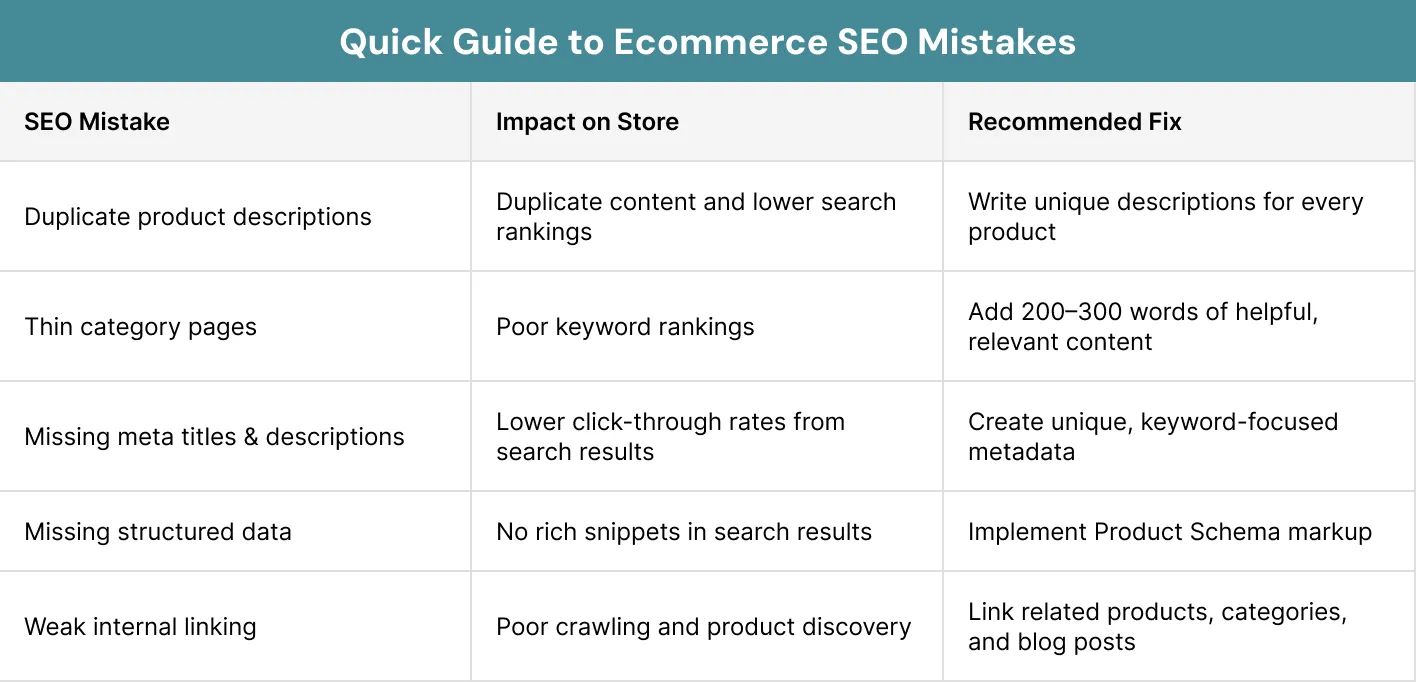
1. Duplicate Product Descriptions That Reduce Trust and Rankings
Copying supplier descriptions creates duplicate content. Search engines penalise it and shoppers distrust it. Write a unique description for every product.2. Thin Category Pages That Fail to Convert Visitors
Add about 200 to 300 words of original content to your key category pages. Content less category pages have nothing valuable to offer visitors. They also rank poorly and do not perform well.3. Missing or Poor Meta Titles and Descriptions That Lower Click Through Rates
Every product page needs a unique title tag under 60 characters. It also needs a compelling meta description of 150 to 155 characters. These are among the most common website ecommerce mistakes in SEO. They directly affect how many people click through from search results.4. Missing Structured Data That Reduces Search Visibility and Rich Results
Without Product schema markup, your listings will not show star ratings, prices or stock status in Google results. Add structured data to unlock rich snippets and improve click through rates.5. Weak Internal Linking That Hurts Product Discovery
Poor internal linking means search engines cannot fully crawl your site. Buyers also have problems finding related products. Link between product pages, category pages and blog posts must be consistent.
The Web does not just connect machines; it connects people. – Sir Tim Berners Lee, Inventor of the World Wide Web & British Computer Scientist.
How to Fix Ecommerce Conversion Problems?
Most of these ecommerce website mistakes are fixable. These are the changes that make the biggest impact.1. Improve Website Speed and Performance
Compress images to WebP and add caching. Use a CDN and Upgrade to cloud hosting. Aim for a Largest Contentful Paint score under 2.5 seconds to meet Google’s Core Web Vitals benchmarks.2. Strengthen Mobile Shopping Experience
Design for mobile first. Make tap targets bigger and test on real devices. A better mobile experience improves both your conversion rate and your search rankings at the same time.3. Improve Product Pages and Visual Content
Use professional photography and write original descriptions. Add video where you can. Include size guides and compatibility details. Remove every last barrier to purchase on your product pages.4. Improve Navigation and Product Discovery
Make sure you have a simple menu, filters and sorting options that work well. Searches should be instant and accurate. Include breadcrumbs and use consistent layouts for the benefit of the shopper.5. Simplify Checkout and Payment Process
Use guest checkout. Keep checkout to one page. Auto fill address fields. Show the full total early. Support as many payment methods as possible. Make buying as easy as possible.6. Improve Trust Signals and Credibility
Show your SSL certificate. Display customer reviews. Add trust badges. Make contact details easy to find. Publish a clear returns policy. Every trust signal you add reduces the hesitation that loses you sales.7. Fix Technical and Security Issues
Audit regularly and keep integrations up to date. Use 3D Secure for payments. Deploy fraud detection tools. A technically sound website protects both your customers and your bottom line.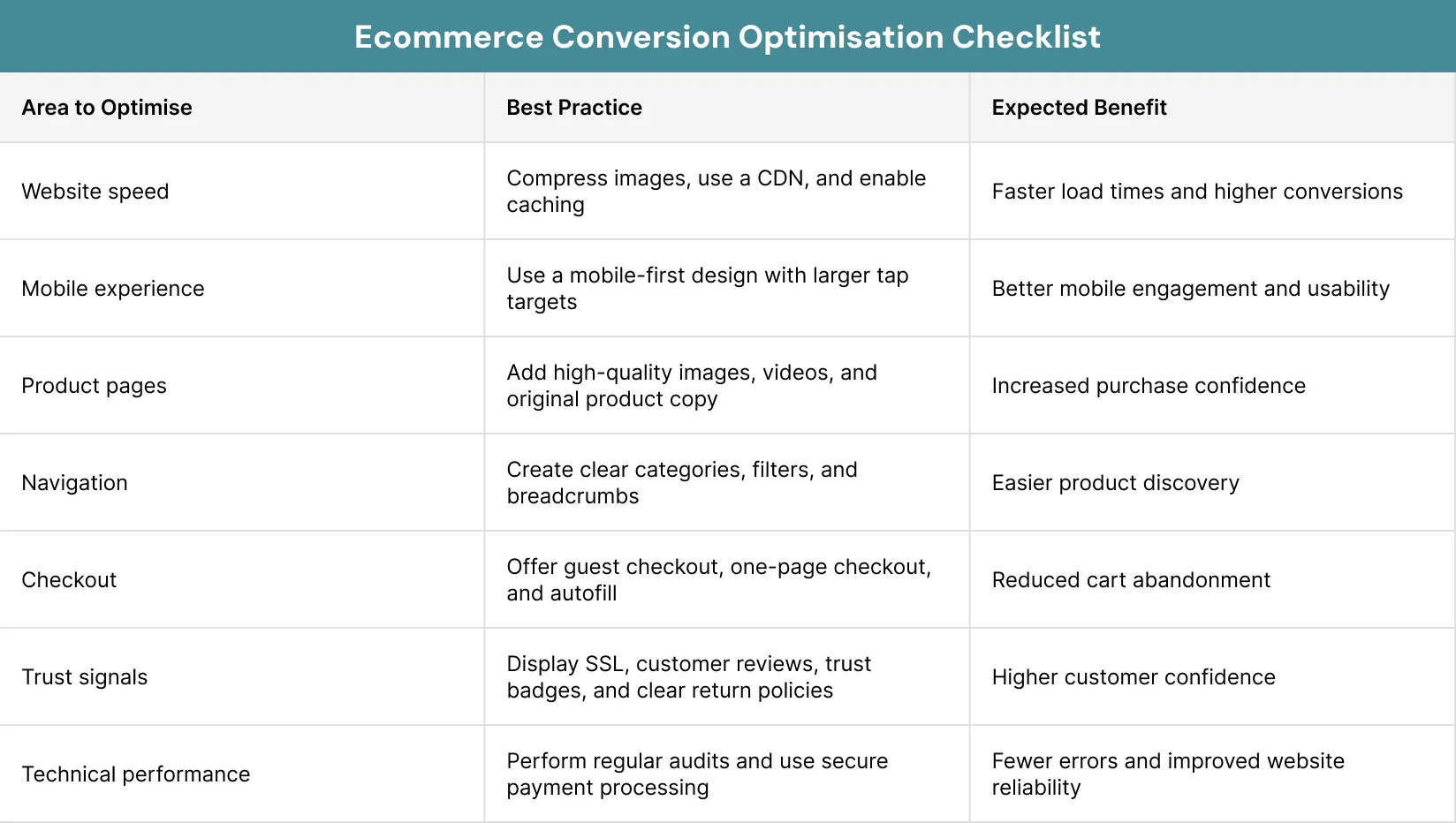
Case Study
ASOS is one of the online fashion retailers in the United Kingdom. This company is an example of how fixing ecommerce website mistakes can really increase revenue. ASOS has been working to improve its mobile website by making pages load faster and improving the checkout process. All of these things have an impact on how many people actually buy things from the website.
ASOS added a one-click checkout for returning customers. They also gave people ways to pay, like Klarna, PayPal and major cards. If you live in the United Kingdom, you can even return things for free. The company has a clear policy on returns, which is one of the best in the UK when it comes to ecommerce. When you look at a product on the ASOS website, you can see lots of quality pictures, catwalk videos and detailed size guides. This helps people feel more confident when they are shopping so they are more likely to buy things.
In their annual reports, ASOS has pointed to site performance and mobile improvements as key drivers of customer retention. Their approach shows that conversion optimisation is not a one-time fix. It is an ongoing process.
Final Thoughts
Great products alone will not grow your ecommerce store. Every ecommerce website mistake you leave unfixed is a reason for a shopper to leave without buying. Slow pages, poor checkout flows, weak trust signals and bad SEO all hurt your conversions.
The good news is that most of these ecommerce website mistakes are fixable. Start with an audit. Find the issues causing the most drop offs. Then work through them one by one.
Xoom Plus understands that a high performing website is the foundation of ecommerce growth. Get in touch today and let us help you turn more visitors into loyal customers.
Is your ecommerce website costing you valuable sales?
Xoom Plus creates high performing ecommerce websites that improve speed, UX and conversions. Speak to us today to deliver measurable results.
FAQs
What are the most common ecommerce website mistakes?
The most common ecommerce website mistakes include slow loading pages, poor mobile usability, weak product pages, confusing navigation, complicated checkout processes and missing trust signals that discourage customers from completing a purchase
How do ecommerce website SEO mistakes affect online sales?
Ecommerce website SEO mistakes such as duplicate content, missing meta tags, weak internal linking and lack of structured data reduce search visibility, resulting in lower organic traffic and fewer conversions
What makes a bad ecommerce website?
What makes a bad ecommerce website is a poor user experience, slow performance, limited payment options, unclear shipping information and difficult navigation that frustrate shoppers and increase bounce rates
How can I improve my ecommerce website conversion rate?
Focus on improving website speed, optimising for mobile devices, creating detailed product pages, simplifying checkout and adding trust signals such as customer reviews and secure payment badges
Why is mobile optimisation important for ecommerce websites?
Most online shoppers browse and buy using smartphones, so a mobile-friendly website improves user experience, supports higher search rankings and increases the likelihood of completing a purchase
How do bad ecommerce websites impact customer trust?
Bad ecommerce websites create doubts through outdated designs, broken pages, poor security and unclear policies, making shoppers less likely to trust the brand or complete a transaction
How often should I audit my ecommerce website for performance issues?
Review your ecommerce website at least every quarter or after major updates to identify technical issues, UX problems and ecommerce website mistakes before they affect traffic and sales
What is the biggest ecommerce website mistake UK businesses should avoid?
One of the biggest ecommerce website mistake UK businesses make is neglecting mobile performance and checkout optimisation, as these directly influence customer experience, conversions and long-term revenue