- October 1, 2025
- Categories: Digital Marketing
How to Build a High-Converting Social Media Funnel in 2026?
Social media is now a full-scale commerce engine that accounts for 17.11% of the total sales, as reported by a few studies. However, conversions are difficult to achieve, whereas exposure is not. The real challenge for marketers is turning passive scrollers into loyal customers. This is where a social media funnel becomes important. Instead of relying on random posts or hoping that users will eventually make a purchase, a funnel gives your social media strategy a clear path to follow. It guides people from the moment they discover your brand to the point where they take action, whether that means signing up, making a purchase, booking a service, or becoming a repeat customer.
In this guide, we explain step-by-step strategies to build a high-converting social media funnel in 2026.
Key Takeaways
- A strong social media funnel guides people through five stages: awareness, consideration, conversion, loyalty and advocacy.
- Use engaging content to attract new audiences, helpful content to build trust, and reviews, demos and UGC to encourage conversions.
- Research your target audience and choose the social platforms they use most. You do not need to be active on every platform.
- Keep customers engaged after a purchase through special offers, exclusive content, reviews, UGC and online communities. Happy customers can help bring in new customers.
What Is a Social Media Funnel?
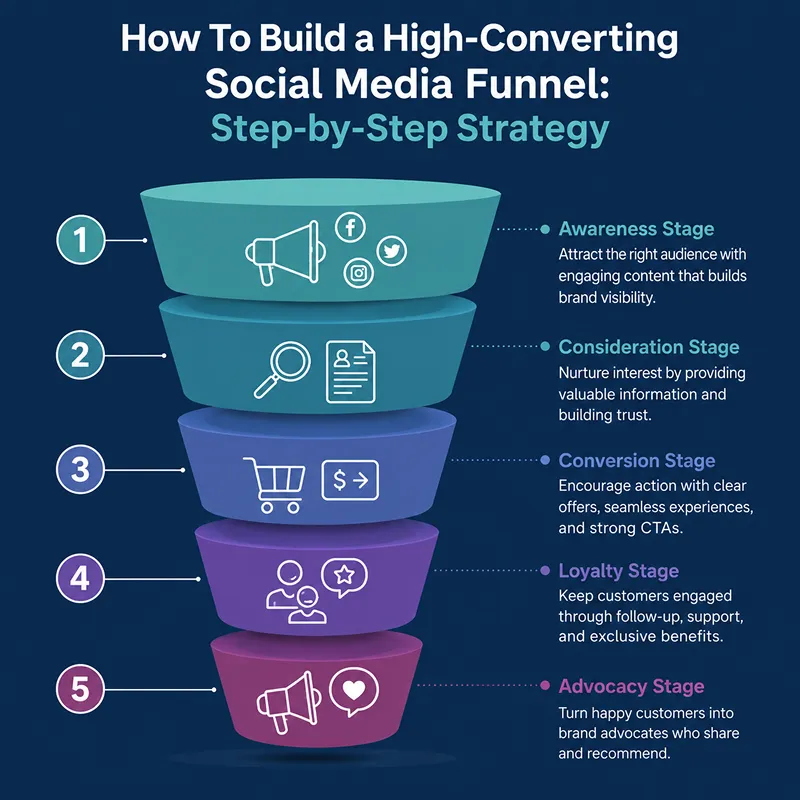
A social media funnel is a simple process that takes people from first seeing your brand to becoming paying customers. At each of these steps, the social media funnel uses unique messaging and content that resonates with the audience as they move forward in their journey. The end goal is that your audience doesn’t just turn into your followers. They should turn into your greatest advocates who recommend your brand to others as well.How to Build a High-Converting Social Media Funnel: Step-by-Step Strategy
A good funnel usually has five main stages: awareness, consideration, conversion, loyalty and advocacy. Each phase of the funnel serves a specific purpose and you should know what results you want from these stages. Here we explain every stage in detail.1. Awareness Stage (TOFU – Top of Funnel)
The awareness stage is where people first discover and know about your brand. At this point, they probably don’t know who you are or what you offer. Your job here isn’t to sell, but to capture attention. So now you think, how will you capture their attention? The answer is that you will have to make content that is engaging and memorable.
In 2026, the best way to do it is to show content native to each platform. For instance, Insta Reels will capture the most attention. Video posts will get you the most traction on Facebook, while Instagram Stories will highlight your business the best at this stage. Similarly, you should use high-capturing visuals for Pinterest and LinkedIn. Now, what content would you show on these platforms? The answer is to create content that your audience can easily understand and engage with.
2. Consideration Stage (MOFU – Middle of Funnel)
After you have created awareness about your brand, the next step is to build trust and interest in your audience. At this stage, they should be asking questions like “Do I really like this brand?” “Will this be safe for me?”. You should intend to satisfy these questions with answers to them. This can be done by providing them with relevant content that solves their major problems they want to solve. You have to satisfy curiosity and guide them to intent. Here is the content format that will help you to satisfy your audience and gain their trust.- How-to videos and tutorials that show your product in use
- Webinars or live sessions with Q&A
- Case studies
- Customer success stories
- Polls and quizzes
- FAQs to create two-way engagement
- Carousel posts that break down features or benefits in a visual way
3. Conversion Stage (BOFU – Bottom of Funnel)
Great, you’ve reached the stage of the social media marketing funnel where all your previous efforts pay off. By this point, your audience are aware of your brand and you have gained their trust. Now you have to convince them to take action. This action can be signing up for a demo, making a purchase or booking your service. Your content at this stage needs to be persuasive. It should be clear and aimed at building the confidence of your audience. You have to show them what they are getting. The content should also demonstrate how it works and why others should trust you. Social proof is key because people have to see others benefiting from your business. They will then convert themselves.“Good salespeople sell value and social media is the best place to find this value because of its transparency.”
— Gary Vaynerchuk
4. Loyalty (Post-Purchase Funnel)
Your work doesn’t end when a customer becomes a client. The goal of the loyalty stage is to convert one-time purchasers into recurring clients. The most successful businesses continue to interact with their customers even after the sale. You can offer special bundles for returning customers. Another way is to give them an early preview of new products. You have to show them you value their loyalty. You can invite them to be a part of your brand story. They can share their experience via your hashtag and you can post them in your highlights. This helps others trust you as well.
To measure success at this stage of the social media marketing funnel, you can check the following:
- Repeat purchase rate
- Customer lifetime value (CLV)
- User-generated content submissions
5. Advocacy (Happy Customers)
The advocate stage is when your happy customers become supporters of your brand. They have already used your product or service and had a good experience with it. Now, they are willing to tell others about it. This makes social media a great place to turn happy customers into new leads.
You can also work with influencers, industry experts and other businesses to promote your brand. They can become advocates of your brand and share your products or services with their own followers.
Here are some simple ways to build advocacy into your social media marketing funnel:
- Work with loyal customers and fans to create natural and useful content.
- Share customer-created content on your social media pages and use paid promotion to reach more people.
- Post genuine customer reviews and positive feedback.
- Work with affiliates and give them a commission for bringing new customers.
- Create a private online group where customers can connect, share their experiences and help each other.
Best Practices to Build Your High-Converting Funnel
Here are the six tips to build your high-converting social media marketing funnel:- Know Your Audience: Before you start building your social media funnel, research your audience
- Choose Platforms That Work for You: You don’t have to use all social platforms. You just have to show up on the ones that your audience uses the most.
- Plan Content by Funnel Stage: Different kinds of material are required for different phases. To attract attention, put entertaining or interesting content at the top.
- Implement Tracking: You need to track your content to know what is working. To discover which campaign generated the most traffic, tag your URLs with UTM links. For tracking user purchases and sign-ups, use Meta Pixel or TikTok Pixel.
- Run Sound Retargeting Strategy: People don’t immediately convert once they see your content. This is okay. You can use retargeting ads to reach people who have interacted with your content in some way.
- Test Creatives: Your funnel is never perfect the first time. What you have to do is test multiple creatives to check which one works best for you.
Case Study: How Argos Used a Full-Funnel Social Media Strategy to Increase Conversions
Argos, a leading UK retailer, used TikTok for its 2024 Christmas campaign. The goal was to attract new customers, build interest and increase sales. The campaign used creative TikTok content, creator partnerships and measurement tools to reach both new and existing customers. At the awareness stage, Argos used engaging content to reach new audiences and increase ad recall. It then used content designed to move interested users further towards a purchase. This helped Argos connect different parts of the customer journey instead of focusing only on sales. After that, the campaign delivered strong results:- 4.2% increase in purchases
- 3.3% increase in content views
- 5.5% increase in ad recall
Conclusion
A high-converting social media funnel is not just based on great content. It is driven by data-based decisions, smart automation and continuously optimising your strategy. The key is to create the right content for each stage, from building awareness to encouraging purchases and gaining customer loyalty. Most importantly, focus on actions that support your business goals, such as leads, sales, repeat purchases and customer referrals. Xoomplus can help you construct your funnel. We help you map each funnel stage so you can track your performance with precision. Our goal is to deliver the right message to the right audience at the right time.Ready to Turn Scrolls into Sales?
Contact us today and let our expert team help you build a high-converting social media funnel with smarter tracking, better targeting, and real-time optimisation, so every post moves your audience closer to action.
FAQs
A social media funnel is a customer journey that takes people from discovering your brand to becoming customers and, eventually, loyal advocates.
Start by understanding your audience, choosing the right platforms, creating content for each funnel stage, tracking results and testing different strategies.
There is no single best platform. Choose the platforms where your target audience spends the most time. Instagram, TikTok, Facebook, LinkedIn, YouTube and Pinterest can all support different funnel goals.
Short videos, engaging images, educational posts and other easy-to-understand content can help attract new audiences and increase brand awareness.
Build trust with useful content, testimonials, reviews, demonstrations and clear calls to action. Retargeting can also help reach people who have already interacted with your brand.