- December 18, 2025
- Categories: Digital Marketing
What Is a Marketing Funnel? A Beginner’s Guide to Conversions
Nearly 84% of customers buy from brands they know or trust. This explains why brands focus on marketing to gain the attention and trust of potential customers. However, such customers rarely buy when they first hear about a brand. It is only the first step in their purchase journey. They may discover a brand through social media posts, which prompts them to visit the website and compare it with other options. Only after this research do they decide to buy.
A marketing funnel provides a framework for understanding and guiding this journey. A marketing funnel helps brands understand customers’ needs at each stage of their journey. It also helps them create the right content, offers and calls to action to guide potential customers towards a conversion.
In this guide, you will learn what a marketing funnel is, its main stages, types of marketing funnels and how to create one for your business. You will also learn how a well-planned funnel can turn interest into conversions.
Key Takeaways
- A marketing funnel shows how potential customers move from discovering a business to becoming customers and returning.
- The four main stages are awareness, consideration, conversion and loyalty.
- Different types of marketing funnels can support goals such as lead generation, sales, e-commerce purchases and email engagement.
- A successful funnel starts with a clear target audience and conversion goal, followed by relevant content and clear calls to action.
- Businesses should measure, test, and improve their funnels to identify where potential customers drop out and increase conversions.
What Is a Marketing Funnel?
A marketing funnel shows how a person moves from the first stage of brand discovery to the last stage of being a loyal customer. This model helps brands understand various steps customers take before they make a decision.
Just like a funnel, a marketing funnel has many customers enter the first stage but only a few reach the end to buy. For example, thousands of people may see a social media post, and some might visit the website. From those visitors, only a small number enquire or make a purchase. Each marketing funnel often moves through four stages called AIDA, also referred to as awareness, consideration, conversion and loyalty:
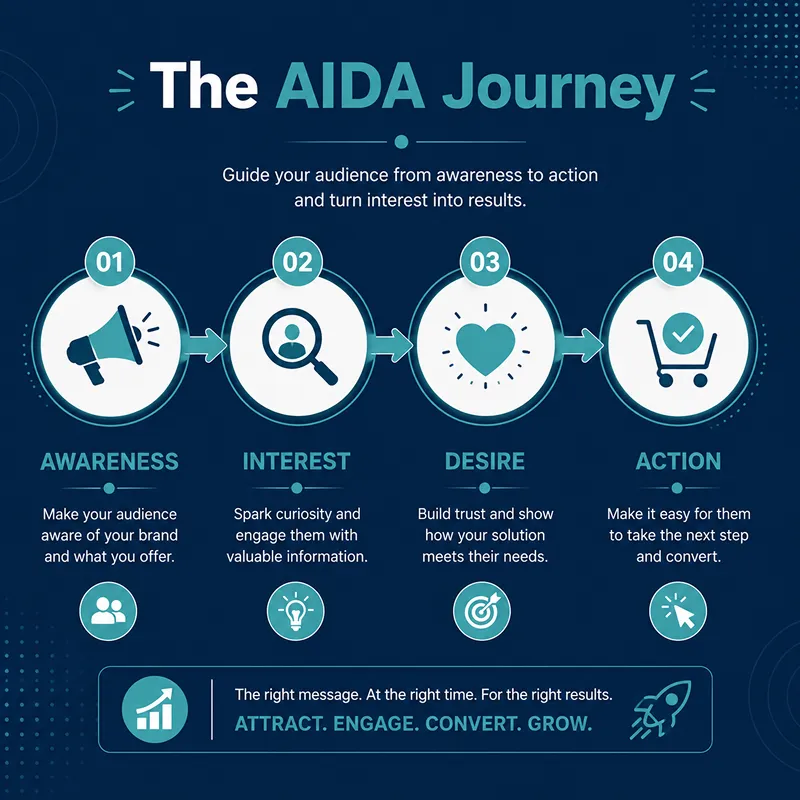
The four AIDA stages are mapped across three funnel levels. Awareness lies at the top of the funnel (TOFU), while interest and desire fall in the middle of the funnel (MOFU). Action is the last stage and falls at the bottom of the funnel (BOFU).
The goal is not to push every person straight to sales. Instead, brands use relevant information and support potential customers to move smoothly through each stage. This makes every stage of the marketing funnel crucial for brands. A well-planned funnel also shows where potential customers have left their journey. This makes it easier for brands to find problems, improve the customer journey and increase conversions. The key to a smooth customer journey through each stage is to use the right type of funnel.
“To be successful and grow your business and revenues, you must match the way you market your products with the way your prospects learn about and decide to buy them.”
Brian Halligan
What Are the Different Types of Marketing Funnels?
The type of marketing funnel depends on what a brand wants a customer to do. A brand that sells products online would use a different funnel from a brand that wants to generate leads and bookings. Some common types of marketing funnels are listed in the following table: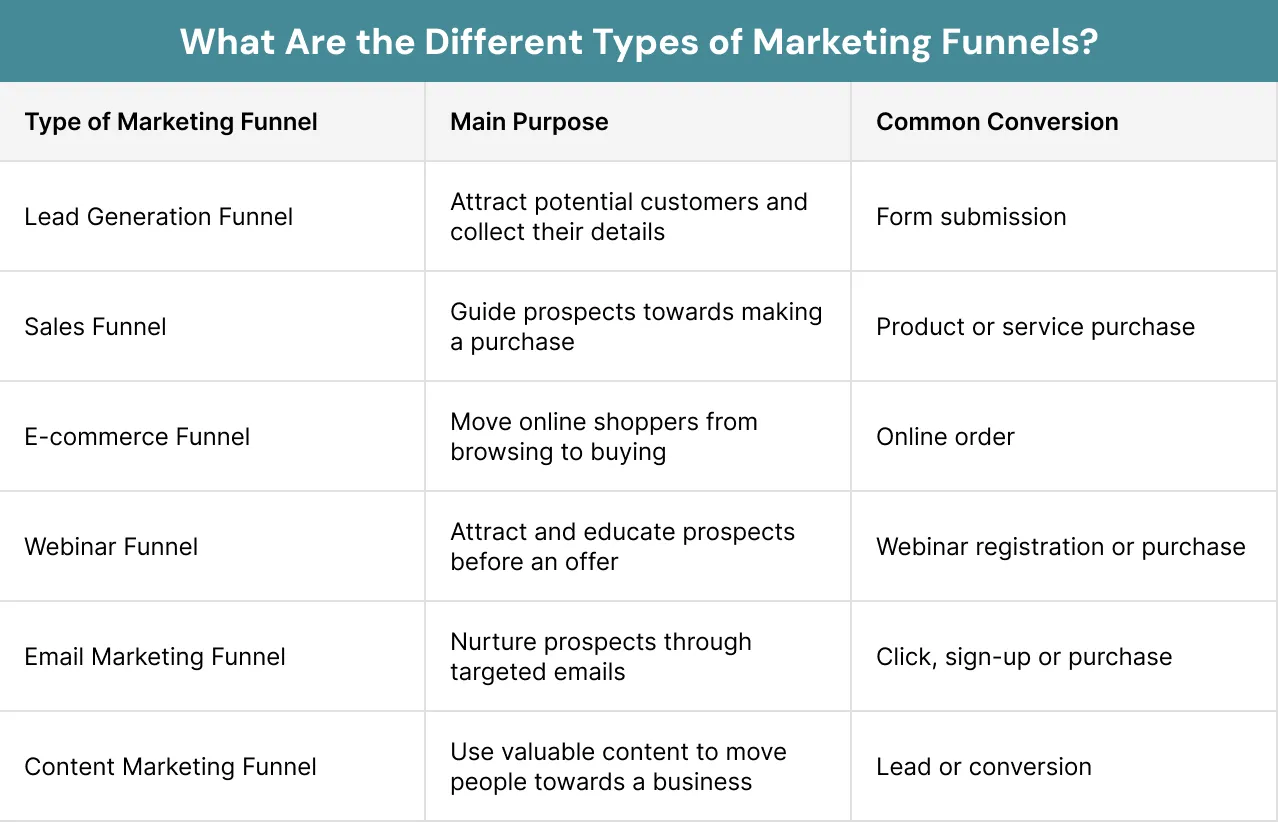
Each funnel uses distinct channels and content, but they share the same basic purpose. They guide potential customers to a desired action. The right funnel depends on the brand, its audience and its conversion goal. When brands understand these differences, it makes it easier for them to see how their marketing funnel works in practice.
What Are the Stages of a Marketing Funnel?
The four main stages of a marketing funnel are awareness, consideration, conversion and loyalty. Each stage reflects a distinct level of customer interest and requires a different approach that leads to the next stage. When a brand understands the role of each stage, they provide the right information at the right time.Stage 1: Awareness (TOFU)
The first stage of a marketing funnel is awareness. This is where potential customers first discover a brand, product or service for the first time. Customers at this stage are not yet ready to buy or make a decision. They simply have a problem, question or need that they want to understand. In this stage, brands can use multiple channels to build their presence.- Search engines
- Social media
- Blog posts
- Videos
- Online advertising
- Podcasts
For example, customers looking for ways to improve their website may discover a web development company through an educational blog. Even though they may not contact the company right away, this interaction informs the customer of a viable option. This is how the first stage lays the foundation for the rest of the funnel.
Stage 2: Consideration (MOFU)
Consideration is the middle stage of the funnel where potential customers have a clear understanding of their needs. At this stage, they explore possible solutions and compare different options. Here, they would visit a company’s website, read reviews, compare services or look for more details. These are all actions they take before they form a purchase decision. A brand can capitalise on this stage through:- Product or service guides
- Case studies
- Reviews and testimonials
- Comparison content
- Demonstrations
- Detailed landing pages
- Pricing information
- FAQs
Stage 3: Conversion (BOFU)
This is where the potential customer takes the action the brand wants them to. This could either be a product bought, a service booked, a quote requested or a form completed. This forms the final stage of the customer’s journey, where their decision is in favour of the brand or against it. Brands need to be careful about barriers and problems that can make customers leave without a favourable action. Hence, it is vital to make the last step clear and easy to complete. Useful methods include:- Clear pricing
- Simple forms
- Strong CTAs
- Easy checkout process
- Relevant offers
- Trust signals
- Clear information about next steps
Did you know?
The global cart abandonment rate is close to 70%.
Stage 4: Loyalty and Retention (After Conversion)
For brands, the customer journey does not end after a conversion. Instead, it leads them to a stage that forms loyalty and retention. Brands build a strong relationship with people after they become customers, which translates into loyalty. This is done through methods like helpful emails, customer support, loyalty programmes or personalised offers. These methods turn a one-time customer into a loyal customer who returns to the same brand. In the long term, the same customer becomes a brand advocate.How Do You Create a Marketing Funnel?
The key to creating the right marketing funnel is for the brand to ask itself a few questions first. The brand should know who they want to reach, what they want them to do and what information the customers need before they make a decision. A simple funnel can be built by following these steps.1. Define Your Target Customer
The first step is to know the audience that you want to attract. Clarity here helps you create content and offers that match the needs of your target audience. You consider factors such as:- What problems are they trying to solve?
- What do they need from your brand?
- What questions might they have?
- What could stop them from buying?
- Where do they usually look for information?
2. Set a Conversion Goal
The next step is to decide what you want your audience to do with your content. It is crucial to set a goal that is specific and easy to measure. Examples of your conversion goals can be:- Buy a product
- Book a service
- Request a quote
- Submit an enquiry
- Sign up for a newsletter
- Book a consultation
3. Map the Customer Journey
The next step is to map the journey of a customer from the first stage to the last. This is how a potential customer moves through your marketing funnel and decides in favour of your brand or service. A customer might: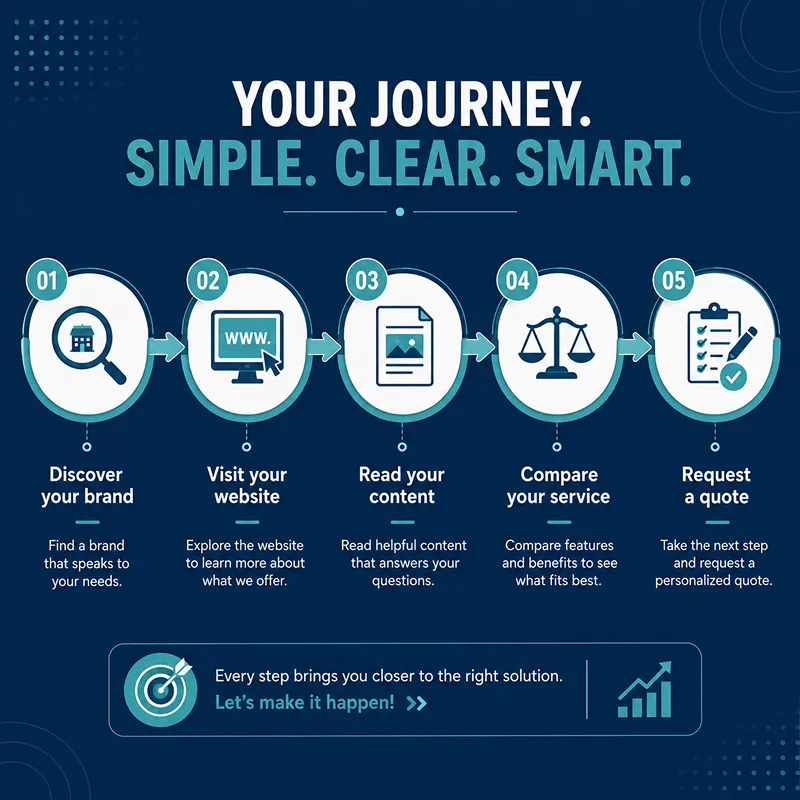
A clear map of this journey will help you identify the information and support a customer will need at each stage. It can also show you areas to improve where people might lose interest.
4. Create Content for Each Funnel Stage
Each stage requires distinct content to match the interest level of customers. Customers in the first stage would need more educational content. Customers in the second stage would need case studies, reviews or details of services and products. While customers who are ready to act would need clear pricing and a simple process to move forward. The content for each stage should align with what the customer wants and needs. This keeps you from using the same message for everyone.5. Add Clear CTAs
A call to action (CTA) tells the customer what to do next. This phase is crucial to ensure it does not confuse or distract the customer from their journey. Hence, it should be clear, relevant and easy to find. A good CTA can look like:- Read the guide
- Download the report
- Book a consultation
- Request a quote
- Buy now
6. Measure, Test and Improve the Funnel
A common mistake brands make is to treat a marketing sales funnel as a one-time project. This makes the funnel ineffective over time. You should constantly monitor how people move through it and improve areas that need work. Some useful metrics can be:- Website traffic
- Engagement
- Leads generated
- Conversion rate
- Customer retention
Case Study: How Viessmann Improved Its Marketing Funnel
Viessmann is a heating and air-conditioning solution manufacturer. The company wanted to improve how it attracted and converted potential customers. Before it adopted a marketing automation platform, the company relied on basic tools and limited visibility into its customers’ journey.
After it identified the gaps, Viessmann developed a customer-focused content strategy. This strategy was based on buyer personas and the customer journey for their brand. Blog content became part of their strategy to attract their audience, while improved landing pages convert visitors into leads. The automated workflow helped the company nurture those leads and support their journey throughout the funnel. They also tracked their performance and regularly reviewed the results.
This approach helped bring visible results for the company. They reported a 57% growth in conversion rate, a 16% increase in new leads and a 15% rise in revenue.
This case study shows how a marketing sales funnel works as a connected journey. Attracting visitors is only the first step. Brands also need relevant content, clear CTAs and continued improvement to turn interest into a purchase decision.
Conclusion
A marketing funnel is a method that helps brands understand how people move from their first engagement to becoming a customer. With this knowledge, brands develop a clear plan for their content, messaging and CTA centred around the customer journey. A customer’s journey begins with awareness, leads to consideration and finally to a decision. The entire method is about giving the right information and support to customers as their interest develops.
The best marketing funnel understands the audience, has a clear goal and uses the right content at the right stage of the customer’s journey. The right experts bring these elements together to create funnels that are simple, relevant and customer-focused. This approach can turn initial interest into a conversion and, eventually, a loyal customer.
Are customers engaging but not converting?
You are not only losing budget, but also valuable customers. We understand how marketing funnels can save you from such loss. Contact us to make every visitor count.
FAQs
A marketing funnel is a model that shows the journey a person takes from first discovering a business to becoming a customer. It helps businesses understand what potential customers need at different points before making a decision.
The four main stages are awareness, consideration, conversion, and loyalty. Awareness attracts attention, consideration builds interest, conversion encourages action, and loyalty focuses on retaining customers.
The main purpose of a marketing funnel is to guide potential customers through their buying journey. It helps businesses provide relevant information and create opportunities for people to take the desired action.
Common types include lead generation funnels, sales funnels, e-commerce funnels, webinar funnels, email marketing funnels, and content marketing funnels. The right type depends on the business goal and desired conversion.
To create a marketing funnel, define your target customer, set a conversion goal, map the customer journey, create content for each stage, add clear CTAs, and measure the results. You can then test and improve each part of the funnel.
A conversion occurs when a person completes a desired action. Depending on the business, this could mean making a purchase, submitting an enquiry, requesting a quote, signing up for a service, or booking a consultation.
Calls to action tell potential customers what to do next. A clear CTA can guide them towards actions such as reading more information, requesting a quote, signing up, or making a purchase.
Businesses can measure funnel performance using metrics such as website traffic, engagement, leads, conversion rate, and customer retention. These figures can help identify where potential customers leave the funnel and where improvements are needed.