- May 6, 2026
- Categories: Digital Marketing
A Complete Guide to Keyword Research for PPC Campaigns
Want to understand why some PPC ads get tons of clicks and others don’t?
The ads that work really well are because of the right choice of keywords.
Even the best ad copy or offer cannot rank due to incorrect keywords. This wastes your finances and you miss so many valuable clients.
Search advertising accounted for 44% of all UK digital ad costs in 2025. However, every year, the money spent on search ads continues to increase. This shows the importance of keywords and paid search in the UK’s advertising industry.
If you want to drive relevant traffic and increase sales for your business, go for pay-per-click (PPC). However, remember, a successful ad campaign depends a lot on good PPC keyword research.
When efficient keyword research for PPC is not done, you waste both your time and money. The reason is that your ads start showing up for irrelevant searches.
So, do you want to know what is keyword research for PPC? In short, when people search online, they use these terms. They are accountable for your ads showing up in the search results. When you opt for the proper keywords, the right audience will reach your ads at the suitable time.
However, you must understand that selecting only a few famous terms is not keyword research for PPC. You must focus on several factors, like continuously refining your strategy, understanding search intent and identifying keyword types. For instance, you can enhance your conversion rate if you consider high commercial intent and target long-tail keywords.
This blog will help you learn the steps on how to do PPC keyword research. Thus, you will identify the right keywords to optimise your campaigns for lasting progress.
Key Takeaways
- PPC keyword research is essential for the success of your ad campaigns, ensuring they reach the right audience at the right time
- When doing keyword research for PPC, focus on understanding search intent and using match types that align with your goals
- Knowing how to do keyword research for PPC involves using the right tools, like Google Keyword Planner and competitor analysis, to identify the best keywords
- Keyword research tools for PPC, such as SpyFu and Semrush, help you discover high-performing keywords and track your campaign’s success
- Google PPC keyword research is an effective way to find relevant search terms with high search volume and low competition
- Common PPC mistakes in keyword research include ignoring negative keywords, not refining keyword lists, and targeting overly broad terms
- What is keyword PPC research? It’s the process of finding keywords that will trigger your ads and attract the right customers
- Do PPC landing pages need keyword research? Yes, landing pages must align with your keywords for better ad relevance and higher conversion rates
- Knowing how to conduct keyword research for your Amazon PPC campaign is key to finding the right keywords that drive sales and improve ROI
What Are PPC Keywords?
For the campaigns of the advertisers, they choose some phrases or words, which are called PPC keywords. When a user types a search that matches the ads, these keywords activate them. When this happens, the ad will be visible on platforms or in search results.
Keywords are the base of any PPC campaign. These terms specify where and when your ads should be visible. So, doing the proper PPC keyword research will help to make sure your ad is noticed by the right audience. These are the people who show interest in your services or products.
Not doing thorough PPC keyword research before starting an ad campaign is one of the most common PPC mistakes.
Effective PPC keyword research helps you increase ROI, reduce wasted ad spend, and create more relevant ads by focusing on keywords with the right intent and relevance to your campaign goals. Rachel Handley, Content Lead and Search Marketing Expert at Semrush
Why PPC Keyword Research Matters?
PPC keywords have a direct impact on the success of your ad campaigns. This is the reason that they are so crucial for your ads.
You can show your ads to the people who are looking for them by performing the right PPC keyword research. This is how you can grow the chances of conversion and engagement.
Your ads can be shown to irrelevant users if you pick the wrong keywords. This will result in the waste of money and you will get fewer conversions.
If you target the proper PPC keywords, this will help in lowering charges and optimising your ad performance. It will also enhance the return on investment (ROI) of your campaigns.
Brand bidding protects your position in search results. It pays attention to attracting traffic from people who are ready to take action. Proper PPC keyword research will increase your chances of relevance and conversions.
Skipping proper PPC keyword research and targeting irrelevant terms with ads is one of the most common PPC mistakes.
What Are the Elements of PPC Keyword Research?
You must understand the essential elements of PPC keyword research if you want to create a successful ad campaign. Its main parts are keyword types, search intent and keyword match types. Let’s learn these:1. Understand Keyword Types
When conducting PPC keyword research, you will explore different types of keywords:Brand Terms:
These keywords are trademarked terms or brand names. If you own the store “ShoeHub,” keywords such as “ShoeHub store” or “ShoeHub shoes” would be relevant.Generic Terms
These are the keywords that describe your services or products, like “wedding photography” or “running shoes”. These terms usually have stronger competition but you can drive a larger traffic volume.Related Terms
These terms may not directly describe your services or products but are relevant to your business. If you are selling natural skincare items, the keywords related to them might be “eco-friendly skincare” or “natural beauty”.Competitor Terms
These terms involve your products or competitors’ names. To attract the audience of the competitors’ terms, bidding can be an excellent way.2. Identify Search Intent
Search intent means what is the reason behind the search of the user. To do the right PPC keyword research for your ad campaign, grasping search intent is vital. Search intent is further divided into four primary types:Informational Intent
People might be interested in searching for information. When users search for something, it does not mean they want to buy something. To understand this, consider this keyword: “how to remove stains from white shoes”. This intent is informational.Navigational Intent
This intent implies that the user is looking for a specific website or page. For example, the term “ShoeHub official website” tells a navigational intent.Commercial Intent
The user is still exploring options and is not ready to take action. For example, “best laptops for graphic designing” indicates commercial intent.Transactional Intent
In this intent, the user is prepared to buy something. You can understand transactional intent from the keywords such as “book photography services” or “buy sports shirts online”. These keywords are the most valuable for PPC ad campaigns.
It is important to focus on keywords that signify transactional and commercial intent to drive conversions. Maximising your ROI is also key.
3. Select the Right Type of Keyword Match
Match types determine how closely the search term needs to match your keyword in order for your ad to show. Google Ads offers various match types, each with a different level of flexibility:Broad Match:
Broad match is the most versatile match kind. It triggers ads for searches that are related to the keywords, such as synonyms, variations and misspellings. Think about how the term “high-quality shoes” might match with “best shoes for running”.
Common PPC mistakes, like using broad match keywords without refining them, will result in low-quality traffic.
Phrase Match
Phrase match type is a little rigid. In the search term, you must cover the keyword in the right order. However, there can be extra words before or after. To understand this, think, “sports shirts” can match “best sports shirts for ladies” or “sports shirts for marathons”.Exact Match
This is the most rigid type. It only activates ads for searches that precisely match the keywords or are very closely related. For example, the “walking shoes” term will only represent ads for that precise keyword.
Selecting the correct match type relies on your campaign objectives. Broad match is best for maximum reach. On the other hand, a precise match gives the highest relevance.
Pro Tip:
Regularly revisit your keyword research and refine it based on performance data to avoid wasting ad spend on underperforming keywords.
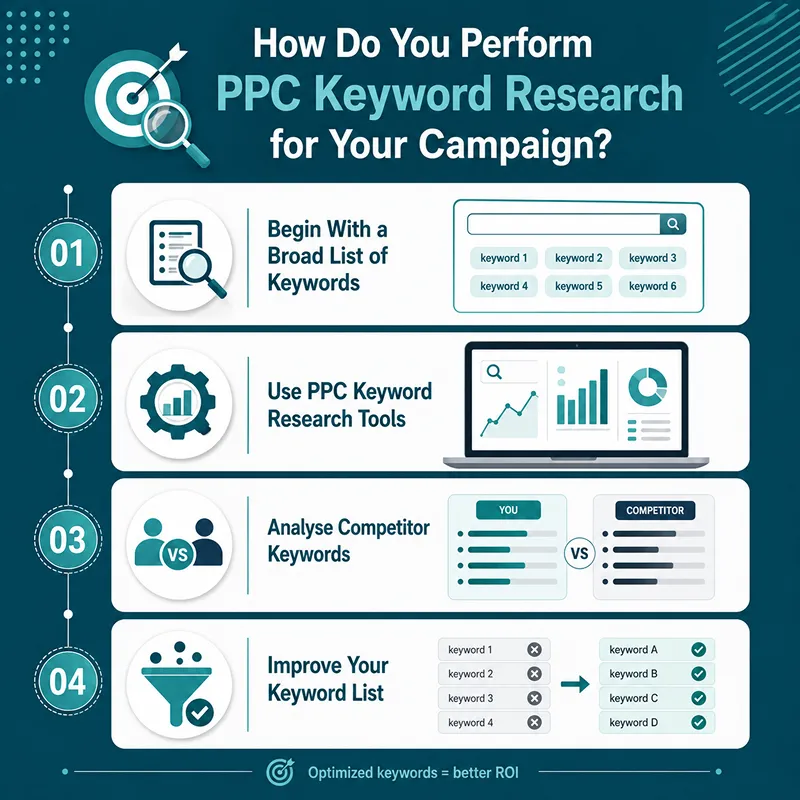
How Do You Perform PPC Keyword Research for Your Campaign?
After understanding the basic details of PPC keyword research, I will explain the steps involved in carrying out this research:Step 1. Begin With a Broad List of Keywords
You have to begin brainstorming a broad list of keywords that match your business to start your keyword research for PPC. Consider what terms potential customers use when they search for services or products like yours.
For this purpose, you can generate keyword ideas by using tools such as WordStream, UberSuggest or Google Keyword Planner.
Step 2. Use PPC Keyword Research Tools
You can expand your list by using PPC keyword research tools. In addition, these keywords help evaluate the potential of each keyword. I have given below some of the most famous tools:- Google Keyword Planner
- SpyFu
- Semrush
- Keywords Everywhere
Step 3. Analyse Competitor Keywords
In PPC keyword research, competitor analysis is a vital step. Keyword analysis shows what your competitors are targeting. Besides this, you can reveal valuable opportunities that you might have neglected.
You can track your competitors’ keyword approaches with the help of tools like Ahrefs and SpyFu. They also assist in identifying gaps in their strategy.
Step 4. Improve Your Keyword List
When you have generated a broad list of keywords, the next step is to refine it. You can perform this by paying attention to the terms that have low competition and a high search volume.
More specific and less competitive keywords are the long-tail ones. They can be especially useful for PPC campaigns.
You can target more specific long-tail keywords like “high-quality wireless mouse” instead of targeting a broad keyword such as “mouse”.
Quick Tip:
Use exact match for high relevance and better conversion rates, but consider broad match for wider reach in the awareness phase.
How to Organise Keywords for PPC Keyword Research?
The next task is to organise the keywords into ad groups after identifying and refining them. This step is core for improving quality score and ad relevance. This way, you can enhance your ad positioning and lower your CPC.Gather Keywords by Theme
Based on similar themes, combine your keywords into tightly focused ad groups. This will improve the effectiveness of your PPC campaign.
If you are a business owner of different types of shoes, you can create separate ad groups for each type. “Heels,” “casual shoes” and “walking shoes” are some of its examples.
This verifies that your ads are more related to the search queries. It enhances the quality score and CTR of your ad.
Use Negative Keywords
You can use negative keywords to help stop your ads from being visible on irrelevant searches. For instance, you can use “free” as a negative keyword if you don’t offer free products. This strategy ensures that your ads are not activated by searches that have less chance of conversion.Optimise Landing Pages
You must confirm that your landing pages match your ad copy and keywords. You can achieve a smooth user experience with the help of this. In addition, it can enhance quality score and result in better ad positioning.
Your landing pages should focus on displaying the perks and features of running shoes if you are advertising “running shoes”.
How to Optimise Your Keywords for PPC Keyword Research?
It’s not enough to do keyword research for PPC once. Continuous optimisation is important for improving and maintaining performance when you select keywords and launch your PPC campaign.1. Track Keyword Performance
Keep checking the performance of your keywords. To identify low-performing keywords, monitor metrics such as ROI, CPA and conversion rate. For the keywords that are not giving the desired outcomes, adjust or pause your bids for them.2. Refrain from Keyword Cannibalisation
When many landing pages or ads target the same keyword, keyword cannibalisation happens. This can result in competition between your own ads. Keep your keyword tasks clean and unique by ad group to protect your money from being wasted.3. Regularly Refine Your Keywords
Enhance your keyword list by eliminating poor-performing keywords and adding new ones as you collect more data. To improve your PPC campaigns and maximise your ROI, this continuous optimisation process is vital.Why Is Continuous Keyword Refinement Core for PPC Keyword Research?
Once your ads are live, it does not mean that your PPC keyword research is finished. You must continually refine it to ensure your PPC campaign remains effective. Thus, it is an ongoing process.
One of the key strategies to avoid common PPC mistakes is to regularly refine your keyword research. This guarantees your ads reach the ideal audience.
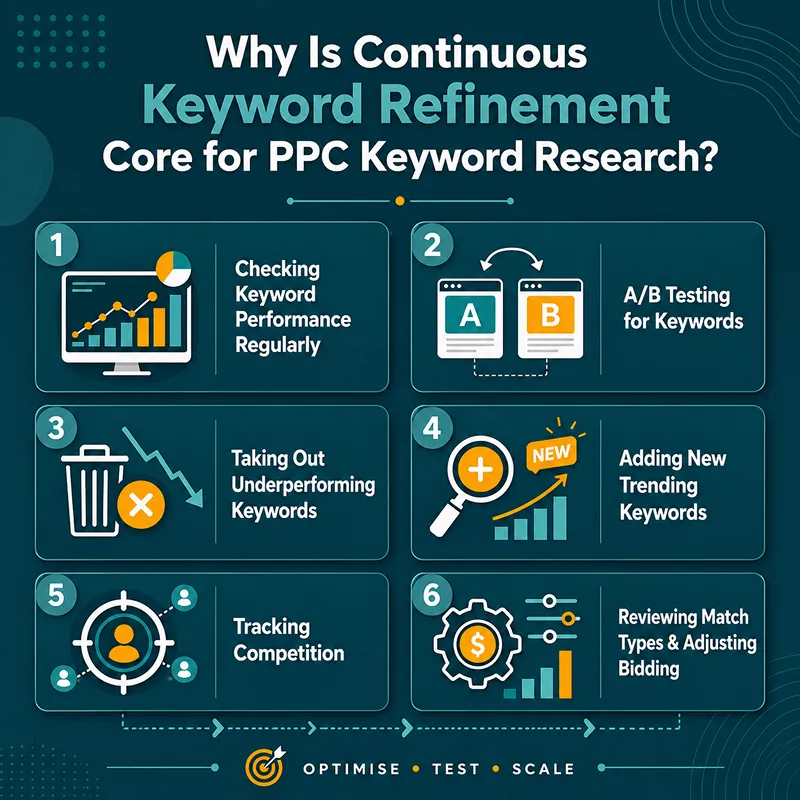
Ongoing keyword refinement is core to enhancing your overall ad performance and keyword targeting. Let’s explore the main reasons why continuous keyword refinement is vital:
1. Checking Keyword Performance Regularly
It is important to track keyword effectiveness frequently after launching your PPC campaigns. To evaluate each keyword’s performance, use KPIs such as CTR, conversion rate, CPA and ROI.
If you notice a specific keyword is not performing as expected, you must think about solutions. For example, if it is generating low conversion or CTR, it’s time to take immediate action.
You can identify which keywords are not producing outcomes with the help of tracking performance data regularly. To increase the overall success of your campaign, you can pause or modify it.
2. A/B Testing for Keywords
Another excellent way to improve your PPC keyword strategy is through A/B testing. You can make several different versions of an ad with different keywords and see how they do. You can find out which keywords are more effective with the help of A/B testing. In addition, it also results in higher conversions and engagement.
You can also find the best landing pages and ad copy by testing them with different keywords. In this way, you can get maximum impact by optimising your ads.
3. Taking Out Underperforming Keywords
With time, you will notice that some keywords are not generating the expected results. Your advertising budget may drain and ROI may be reduced due to these low-performing keywords. By removing or pausing such keywords from your ads, you invest in the keywords that are giving better results.
Regular review of your keyword list is vital. Also, take out the ones that have high CPC with low returns or have a low conversion rate.
4. Adding New Trending Keywords
Over time, PPC campaigns need to be modified. Search behaviours and trends change with time. This results in new keywords that are more relevant to your audience. Search for new keyword opportunities by staying up to date on industry trends and customer interests.
What’s more, you’ll want to consider trending topics or product launches in your keyword strategy.
Use PPC keyword research tools and data to check how well your competitors are doing to find new opportunities. You must also keep your keyword list up to date.
5. Tracking Competition
Your competitors’ tactics can help you gain valuable insight into your own PPC campaigns. You can identify gaps in the approach of your competitors’ keyword choices if you monitor them. It will also help in finding the areas where you can gain a benefit.
The tools that can help you find out what your competitors are bidding on are SpyFu and Ahrefs. This data helps refine your own PPC keyword research strategy. This also targets keywords that your competitors might have ignored.
6. Reviewing Match Types and Adjusting Bidding
When and how your ads display rely on the kinds of keyword matches you use, such as phrase and exact match. It also depends on broad match. It is core to check your match types over time. Also, you must adjust them according to the campaign’s effectiveness. For instance, if you notice a broad match keyword is generating good results, think about changing it to a phrase. You can also change it into an exact match to improve targeting.
Furthermore, to optimise your PPC campaigns, it is important to adjust your bids based on the effectiveness of the keywords. In case of low-performing keywords, decrease the bid and if the performance is high, increase it.
Proper keyword research can avoid common PPC mistakes, such as bidding on highly competitive or pricey keywords that don’t convert.
What Is the Role of Negative Keywords in Improving PPC Keyword Research?
To refine your PPC campaigns, negative keywords play an important role. When you add negative keywords, you can stop your ads from being visible to non-converting or irrelevant searches
Ignoring negative keywords during keyword research is another common PPC mistake that can negatively influence your campaign’s success.
In this way, you can save your money and enhance the entire performance of your PPC strategy. Let’s learn how negative keywords improve ads:
Remove the Irrelevant Traffic
Negative keywords help stop irrelevant traffic. They verify your ads don’t appear for searches that are unlikely to result in conversions. For instance, if you are a business owner of premium shoes, you must add the negative keyword “cheap shoes”. It will ensure that your ads will not be influenced by searches relevant to low-cost shoes.Improve CTR
Your CTR will likely enhance if your ads are visible to a more relevant audience. Negative keywords verify that your ads will appear only in searches of interested people.
If the CTR is higher, it will result in an enhanced quality score. This will lead to lower CPC and improved ad positions.
Optimise Ad Spend
Negative keywords are helpful in optimising your ad spend by cutting out wasted clicks on irrelevant searches. You can pay attention to the budget on keywords that have high chances of making meaningful sales and engagement. Instead of spending money on clicks that are unlikely to convert.Grow Keyword Reach
Negative keywords can help boost the quality of your PPC campaigns and, indirectly, expand your reach by removing unrelated visitors. You can make your ads visible to more related search queries by removing irrelevant traffic.
In this way, you can grow your targeting accuracy to a high level. It also ensures that every ad impression is considered.
What Are the Best Tools for PPC Keyword Research?
You can make your PPC keyword research more effective and efficient by using many tools. You can measure keyword performance, analyse competitor approaches and determine high-performing keywords with these tools. I have given some of the best tools for PPC keyword research:Google Keyword Planner
For PPC keyword research, Google Keyword Planner is the most commonly used tool. This is a free tool that gives insights into CPC, search volume and competition estimates. It is important for any PPC campaign as it explores keyword ideas directly from Google.SpyFu
This is a tool that helps in knowing what keywords your competitors are bidding on. You can find valuable keyword opportunities with this intelligence tool. Also, you can achieve insights into ad spending and keyword performance through it.
This way, you can discover useful keywords that you might have missed. According to your target audience, SpyFu also provides keyword suggestions.
Semrush
You can use this tool for detailed PPC keyword research that gives all the information on competition and search volume. Semrush is also helpful in identifying the keyword difficulty.
It helps uncover the best opportunities for your PPC campaigns as it gives competitor analysis and keyword suggestions.
You can also track the performance of your campaign with the help of Semrush. Also, you can monitor your keyword rankings through it.
Ahrefs
For competitor analysis and PPC keyword research, Ahrefs is a powerful tool. If you use it, you will explore that it offers insights into potential traffic, competition and keyword volume.
With the help of Ahrefs, you can analyse your competitor’s PPC strategies and track your campaign performance over time. You can also identify beneficial keywords with it.
UbberSuggest
You can find competition data, search volume and keyword ideas without any cost because it is a free tool. You can also get content ideas and SEO analysis through it. It helps in refining your PPC keyword strategy.
For the small businesses that cannot afford high PPC budgets, UberSuggest is the best option.
Keywords Everywhere
You can install this extension on your browser. It gives immediate keyword data directly on search engine results pages (SERPs).
These tools will represent metrics such as CPC, competition and search volume. Thus, they will help in assessing the potential value of each keyword.
To gather keyword insights quickly without leaving the search engine, this tool is so useful.
How to Perform PPC Keyword Research to Optimise Landing Pages?
To improve your PPC campaign performance, optimising your landing pages is vital. People will get a seamless user experience if you have optimised your landing pages effectively. It will also help in transforming visitors into clients. Some effective tips are given below in this regard:Match Landing Pages with Keywords
You must align your landing pages with ad copy and keywords for better results. In case of bidding on the keyword “running shoes”, your landing page should show your running shoes and their perks. If you match this, you will be able to enhance relevance. Also, it will be helpful in boosting your quality score.Use Clear CTAs
There should be compelling and clear CTAs in your landing pages. It should be easy to find whether it is “Explore more”, “Create an account” or “Book an appointment”. Also, it must be written in a way that motivates people to take the action.Upgrade Page Loading Speed
You will encounter low conversion rates and a rise in bounce rates if your landing page loading speed is slow. Make sure it can load immediately. You can do this by minimising unwanted scripts, using caching and optimising images.Test Landing Page Elements
You must perform A/B testing for elements on your landing pages, like images, CTAs and headlines, regularly. This way, you can find out which versions show the best performance. You can also optimise the landing pages’ style for higher-quality conversions.Real-Life Example
Sarah Raven is a garden supplier based in the United Kingdom. They wanted to improve their PPC and shopping income. They intended to grow their earnings by 10% yearly and get 15% more new clients. Also, they wished to reactivate unused accounts.
As their products are life-sustaining and seasonal, they had to make flexible keyword targeting.
They got the following results after applying keyword targeting:
- From shopping and search campaigns, 344% expand in PPC sales
- In cost per order, 15% reduction occurred
- 49% rose in ROAS
Challenge
It was a challenge to manage more than 20,000 keywords across seasonal products. Some of these terms had a minimal search volume. This is why they had to target keywords carefully and handle campaigns.Strategy:
They performed the following strategies:- Included both common search terms and particular niche products
- Served to target previously unidentified products through dynamic search ads
- Planned outstanding products for peak buying times with seasonal targeting
- Created a share of voice (SOV) tool and a specialised crawler for monitoring visibility and handling PPC and organic search
- Targeted different audience types, such as new customers, slow converters and high-value buyers
Final Thoughts
In summary, for any successful ad campaign, PPC keyword research is the backbone. You can generate a specific PPC strategy by grasping the concepts of match types, search intent and keyword types. If you apply all these, you will make sure that it reaches the right audience at the right time.
The key to improving your ad performance is through constant fine-tuning and competitor analysis with negative keywords. This allows for efficient, cost-effective campaigns.
However, keyword research for PPC isn’t something you do once. For this, you need ongoing struggles, regular checks and optimisations based on performance data.
In short, you can maximise outcomes and stop wasting money by staying alert and adjusting to trends.
Xoom Plus understands that the success of your ad campaigns depends on PPC keyword research. If you work with specialists who can refine your approach, your campaign will drive qualified traffic. This will also be helpful in achieving your business objectives.
Contact us today if you are ready to take your PPC campaigns to a higher level.
Struggling to get the right clicks and conversions from your PPC campaigns?
We help businesses optimise their keyword strategy to drive relevant traffic and maximise ROI. With years of experience, we’ve helped companies just like yours. Contact us today to get started.
FAQs
How to do keyword research for PPC?
To do keyword research for PPC, start by brainstorming relevant terms, then use keyword research tools for PPC to expand your list. Focus on high-intent keywords that align with your business goals and match user search intent. Refine the list regularly based on performance data.
What are the best keyword research tools for PPC?
Some of the top keyword research tools for PPC include Google Keyword Planner, SpyFu, and SEMrush. These tools help identify high-volume keywords, analyse competition, and refine your strategy. Using the right tools ensures you select the most relevant keywords for your campaigns.
How does Google PPC keyword research work?
Google PPC keyword research involves identifying search terms that trigger your ads when users search on Google. It’s important to focus on keywords with high search intent, competitive analysis, and aligning them with your target audience. Google Keyword Planner is essential for gathering data on search volume and cost.
What is PPC keyword research and why is it important?
PPC keyword research is the process of finding and selecting keywords that will trigger your ads in paid search campaigns. It’s crucial for targeting the right audience and maximising your return on investment. Proper research ensures your ads are shown to those most likely to convert.
Do PPC landing pages need keyword research?
PPC landing pages need keyword research to ensure the content matches the search intent of your audience. This alignment improves ad relevance, boosts quality scores, and helps with higher conversion rates. Ensure the keywords on your landing pages reflect those targeted in your ads.
How to conduct keyword research for your Amazon PPC campaign?
To conduct keyword research for your Amazon PPC campaign, start by using Amazon’s search bar to find popular terms related to your products. Then, use keyword tools to identify high-conversion keywords and analyse competitor strategies. Continuously refine your list based on Amazon’s performance metrics.