- May 7, 2026
- Categories: Digital Marketing
Conversion Rate Optimisation (CRO): The Missing Growth Lever
Do you want to know why most firms focus on creating traffic but fail to convert visitors into clients? When you run your website, you get more visitors, more views and more clicks. However, at times, it all leads to no useful results.
The reason is that only getting more traffic is not enough if people are not taking the required action.
This is the point where you need the help of conversion rate optimisation (CRO). CRO can grow the number of users on your site who are willing to act. These actions can be anything, like making an account, buying now and exploring more.
Driving more traffic is crucial but CRO makes sure that you are turning users into customers. For instance, most businesses lose the chance to maximise their digital visibility if the conversion rate is about 2-3%.
Also, with the help of a CRO strategy, you can deliver a smooth service to people. This is how they convert from passive users into fully engaged buyers.
In this blog, you will explore how to improve your web page ranking with a CRO strategy. Also, multiply your income and grow within your current audience.
Key Takeaways
- Conversion rate optimisation helps turn more visitors into customers by using data, testing, and a better user experience
- A strong CRO strategy focuses on user behaviour, clear value, and running structured experiments instead of guesswork
- Growth levers like better CTAs, faster pages, and simple checkout flows can quickly improve results
- ‘Growth levers marketing’ means using existing traffic better to increase revenue without raising ad spend
- What is conversion rate optimisation? It is the process of improving your website so more users take action, such as buying or signing up
What Is Conversion Rate Optimisation?
Conversion rate optimisation is a way of raising the percentage of traffic on your website that wants to take action. These tasks include:- Getting a useful tool
- Looking for a cost estimate
- Buying something
- Signing up for a service
Firms can refine the user experience to drive more conversions through data analysis, testing and research. They do not need to spend more money on this.
To become the best in your CRO strategy, you must know your website’s users and their behaviour. When you figure out the turning points in the visitor’s journey, you can improve your business. However, after finding these friction points, you must make changes if necessary.
Conversion optimisation is not about getting more traffic; it’s about getting more value from the traffic you already have.
Peep Laja, Founder of CXL and conversion optimisation specialist
What Are the Main Types of Conversion Rate Optimisation?
Grasping conversions is a crucial factor for successful conversion rate optimisation. For this purpose, you must understand two core terms in CRO:- Macro Conversions
- Micro Conversion
Macro Conversions
The major objectives of your site are macro conversions. In general, they are high-value actions that directly impact your business growth, like:- Making a purchase
- Subscription to a service
Micro Conversions
Micro conversions are the minor actions that show the user’s intent and help move the site closer to its target. The following examples demonstrate this clearly:- Set up an account
- Inserting items into the cart
- Registering for emails
Why Is Conversion Rate Optimisation Important?
With the increase in digital marketing prices, businesses should make plans to get more revenue from their current traffic. The cost of paid ads is getting so high that it is becoming unaffordable.
On the other hand, it is a challenge to get organic reach nowadays. This is the reason that getting more traffic on your site is not the only thing you need to grow your business.
Conversion rate optimisation pays attention to enhancing the return on investment (ROI) from current users. If you improve the conversion rate, you will be able to produce more sales or leads for your business. Also, you can build a winning digital marketing strategy without spending more on it.
Today, the competitive digital landscape has changed a lot. First, businesses were looking for strategies to get more visitors. Now, you should search for approaches to get more value from the current traffic.
The following points will make it clear why CRO is so important for today’s businesses:
Better ROI
You can increase your sales or leads without a high investment in it. You can do it simply by increasing its conversion rate only. This shows that for every amount you invest in marketing, it grows more effectively. This strengthens the total ROI.
Related: Developing a content Strategy that produces actual ROI
Lower Cost to Acquire Customers
The more clients you convert, the lower your price per acquisition will be. With the help of this strategy, you will no longer rely on costly advertising media for your business success.Higher Revenue Performance
You can create huge income gains even if you do minor boosts in conversion rates. If you make an increase of 2% to 3% in your conversion rate, this can lead to hundreds of extra leads. You can do this without raising the traffic further.Predictable Development
If your conversion rates are higher, you will be able to make your business revenue more predictable. This growth lever is helpful for businesses to establish financial plans and predict progress more precisely.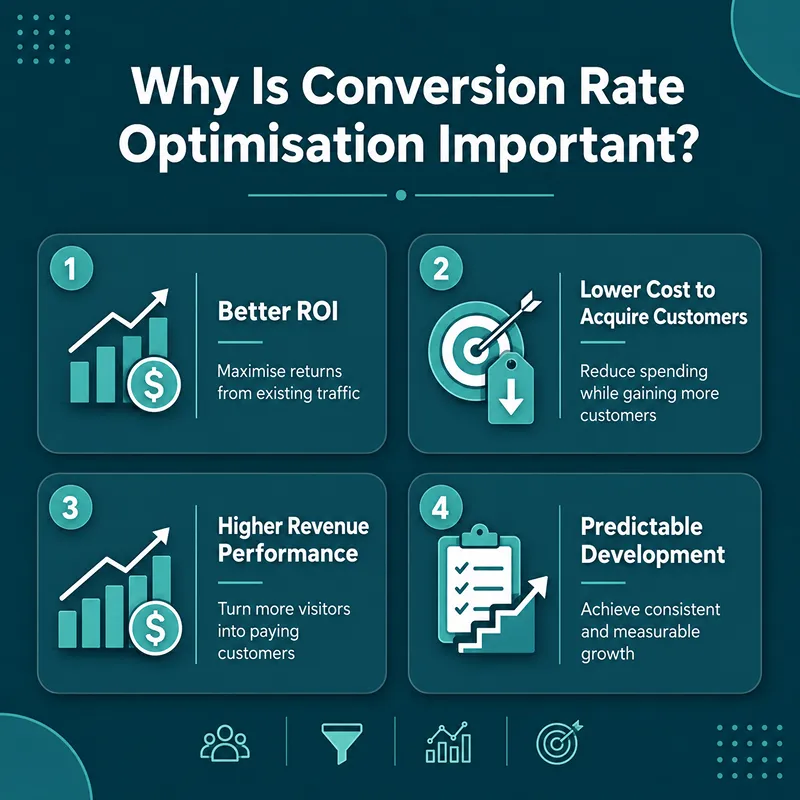
What Makes Conversion Rate Optimisation Different From Traffic Generation?
You can understand how different conversion rate optimisation is from traffic generation with the help of the following points:Focuses on Quality
To drive users to your site, traffic production techniques like paid advertising and SEO are necessary. However, they mainly emphasise quantity.
In contrast, CRO pays attention to quality. This approach makes sure that the people you bring to your page are ready to perform any activity.
Pays Attention to Converting Traffic into Customers
You can understand another difference between CRO and traffic generation with the help of the following points:- Attracting more visitors is the main goal of traffic generation (paid ads, SEO, etc.)
- The goal of CRO is to convert that traffic into clients
Emphasise Data-Driven Decisions
A CRO strategy is not a guessing game or random tweaks. It refers to making decisions depending on data. The backbone of a successful CRO is to test upgrades according to real data and identify fault points.
Making assumptions about what works is a thing of the olden days. To guide improvements, CRO depends mainly on both qualitative and quantitative data.
Which Data Is Essential for Successful Conversion Rate Optimisation?
The two primary categories of data that drive conversion rate optimisation are:1. Quantitative Data
With the help of this data, you get precise information about user actions. This approach gives you answers to the questions such as the following:- Which pages are people directed to
- How much time have they spent on a page
- Where are they clicking and where do they disappear
Qualitative Data
You can find what is happening with the help of quantitative data. On the other hand, qualitative data helps figure out why it is happening. You can gather this type of data by understanding the following:- User evaluation
- Feedback forms
- Customer surveys
Hence, if you combine both data types, you can make informed decisions for your business. This helps in optimising your site for conversions.
What Are the Common Mistakes in Conversion Rate Optimisation?
Most businesses don’t understand conversion rate optimisation well and use it inaccurately. Thus, they are unable to get benefits from it. The following are some common mistakes to stay away from:Depending on the Estimation
Instead of using data to make decisions, if you use intuition, it results in unsuccessful changes. You have to use careful testing and analysis for CRO to make informed selections.Imitating Competitors
What is effective for one company might not be acceptable for another. Since every company has a different audience, it’s vital to develop a strategy specific to your traffic.Following Best Practices Blindly
You should not follow best practices as guaranteed solutions but rather use them as starting points. This is because best practices give valuable guidelines only. You should always test and adjust according to your data.Emphasis Only on Metrics
If you try to improve conversion rates without knowing visitor behaviour, this will result in temporary gains. Instead of development, you will achieve lasting issues. Aim to improve the overall user experience by focusing on the CRO growth lever.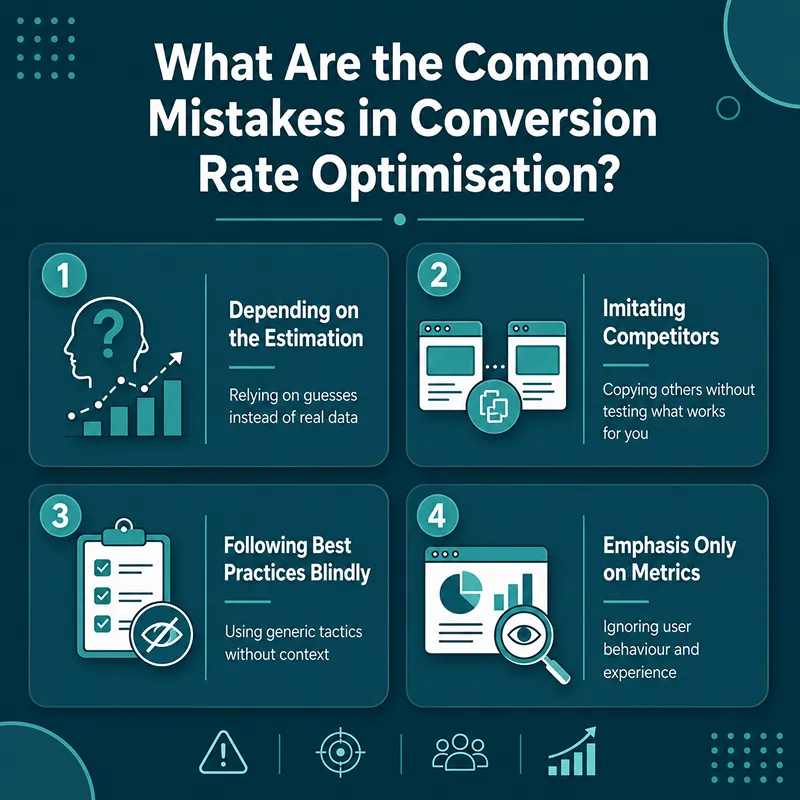
What Are the Benefits of Conversion Rate Optimisation Besides Conversions?
The main objective of conversion rate optimisation is to grow conversions. However, it also provides more perks besides this main advantage. Some extra pros of CRO are given below:1. Improved Knowledge of Customers
You can recognise your desired customers and know what they need with the help of CRO. In this way, businesses can develop more precise methods by examining user behaviour and feedback.2. Enhanced User Experience
When you optimise your site, it becomes faster to load and easier to navigate. Also, your site becomes simpler to use. After focusing on a better user experience, you can get higher conversion rates naturally.3. Greater Trust
If a website is constructed properly, it builds its reputation soon. With the help of this, people are more relaxed when sharing sensitive or payment details.4. Upgraded Engagement
There are more chances for people to stay longer on and engage more on your site when they find value. This way, overall engagement can be increased.5. Higher Ability to Scale
When you convert more of the current audience, your business can progress without any need to attract new traffic.
Why It Matters!
Even a small rise in conversion rate can lead to big gains in revenue without increasing your marketing spend.
How Does the Conversion Rate Optimisation Process Operate?
The main factor that makes conversion rate optimisation effective is that it must follow a repeatable and structured process. To make a CRO successful, it must be constructed on continuous learning, data analysis and experimentation.
The model that all the businesses should follow is the CRO flywheel. The main steps of this model are given below:
1. Gather Evidence and Data
The initial step in CRO is not only to collect raw data but rather to produce useful evidence. In this process, include both qualitative and quantitative data to know the behaviour of the visitor on your site.
Both types of data work as an effective growth lever. Also, it helps you in understanding the opportunities and difficulty points for progress in the user journey.
2. Build Solid Hypotheses
After grabbing evidence, the next step is to transform findings into testable hypotheses. It should be:- Clearly define the problem
- Offer a fix that solves the issue
- Specify an expected result
3. Run Organised Experiments
A/B testing is the most common approach of CRO. In this strategy, a page or an element of a page is taken and its two versions are compared. In this test, it is checked which one has better performance.
Consider an example of assessing two versions of a landing page. Take one page with lengthy content and one with a little less length. By comparing both, you will check which one brings in the required action.
When you run experiments, ensure the following:
- Identify the main success measure
- Create extra metrics
- Calculate the test duration
- Check for a suitable sample size
Pro Tip!
Focus on testing one change at a time. This helps you clearly see what improves conversions and avoids confusion in results.
4. Analyse Outcomes and Learning
After completing the experiment, you must pay attention to asking deeper questions, such as:- What alterations took place in user behaviour
- Why did visitors show up like this
- Did the new friction points emerge that were earlier undetected
Where to Implement Conversion Rate Optimisation?
You can apply conversion rate optimisation to many elements of your site and client experience. Some of the most crucial areas to pay attention to are the following:1. Home Page
It is so important that you get your homepage right. This is because it is the first interaction of people with your brand. Make sure your home page concisely conveys your value offering. It must direct people to relevant sections of the site.
Besides this, it must promote curiosity and active participation.
You can gain a huge effect on user engagement and conversion with even minor tweaks. These changes can be fixes like strengthening visual elements and optimising headlines.
2. Landing Page
The design of the landing page is made by keeping a specific objective in mind. This makes the site ideal for conversion rate optimisation. To optimise landing pages, their design must be simple to avoid distractions.
You must also point out the key benefits in a clear way and keep the call to actions (CTAs) noticeable.
As landing pages focus on one idea, sometimes they gain more conversions compared to the other pages on the site.
3. Pricing Page
For people, the pricing page is a crucial decision point. You must consider making the pricing structure simple to optimise this page. So that it becomes easy to understand for visitors.
Also, in each pricing tier, explain the features well. Besides this, add industry certifications and customer testimonials to build trust.
When you perform these small changes on the pricing page, it will result in a big boost to conversions.
4. Blog
Often, blogs are a neglected source of conversions. If you focus on adding effective CTAs to your blog, you can convert the traffic of your blog into valuable leads. You must consider adding appropriate CTAs that are related to the content.
To encourage sign-ups, you must think about content upgrades such as templates or free guides. Besides this, according to the user actions, add specific deals.
If you optimise your blog with the right content and promotions, you can drive high-quality conversions.
5. CTA
One of the most crucial factors of CRO is CTAs. An excellent CTA should be clear and focused on action. It should be written in a way that highlights the advantage to the visitor, such as “get started for free”.
Besides this, write in a way that it stands out visually on the page to draw attention.
You can create big improvements in conversion rates even with minor tweaks to your CTAs. For example, small changes like wording or placement.
What Are the Tools and Technology Used for Conversion Rate Optimisation?
The success of the conversion rate optimisation depends on using the right tools to collect data. Also, its accuracy is based on carrying out experiments and assessing effectiveness. The main tools it uses include the following:Analytics Tools
These tools are used to monitor the behaviour of the user and conversion indicators.Behavioural Tools
Such tools are used to check how people are interacting with the website. For example, session recordings and heatmaps.Experimentation Systems
These are tools that are used to run and analyse tests. Its examples are A/B testing tools.Feedback Tools
These methods are used to gather information and user views.
If you utilise these tools, your business will be able to make sound decisions. Besides this, you can also test new ideas and regularly optimise your website for better results.
Case Study: Conversion Rate Optimisation Increases Online Sales
To improve online sales, a UK insurance firm, Ageas, engaged with a digital agency. They paid attention to conversion rate optimisation, which turned more site visitors into clients.Challenge
At the pricing page, most people left the website. The company wanted to lower the cancellation and make the purchase system easier.CRO Actions
The changes that CRO brought to the website are:- To point out major perks, different page designs and messaging were tested
- Navigation was made simple by improving the user interface
- To find the most effective versions, A/B tests were carried out
Results
When all these tweaks were made, the result was as follows:- Annual revenue increased by an additional £2.6 million
- Conversion rate rose by 3%
Takeaway
By applying effective strategies, CRO fixed all the areas where Ageas needed support. This way, the company was able to get more value from current users.
This indicates that when you optimise conversions, you can grow revenue without paying more money on traffic.
Final Thoughts
In the online age of technology, a lot of businesses focus on driving up their traffic. However, the actual reward comes from converting your existing users to take action.
With conversion rate optimisation, you can gain additional value from your existing audience. This growth lever helps raise conversions and enhances ROI.
You can make your business progress fast by finding user behaviour and testing different ideas. In this way, you can get improved results and optimise your site.
We have learnt that CRO is an ongoing process. You can grow your business with the help of CRO without requiring more traffic. This is the main factor for long-lasting success in today’s tough market.
At Xoom Plus, improve your website and raise conversion with effective CRO strategies. Contact us today to check how we can help your business progress.
Struggling to turn website visitors into real customers?
Our team helps you improve conversion rate optimisation with data-led strategies that drive results.
We have helped businesses increase leads and revenue through proven CRO methods.
Contact us today.
FAQs
What is conversion rate optimisation?
Conversion rate optimisation is the process of improving your website so more visitors take actions like buying, signing up, or enquiring. It focuses on using data, testing, and user behaviour insights to remove friction and increase results without needing more traffic.
What are growth levers in marketing?
Growth levers in marketing refer to key areas you can improve to grow business results, such as conversion rates, user experience, messaging, and website performance. CRO is one of the strongest growth levers because it helps you get more value from the traffic you already have.
What is CRO vs SEO?
CRO (Conversion Rate Optimisation) focuses on improving website performance so more visitors take actions like buying or signing up. SEO (Search Engine Optimisation) focuses on bringing more visitors to your website through search engines. SEO drives traffic, while CRO turns that traffic into customers.
What are conversion rate optimisation tools?
Conversion rate optimisation tools are platforms that help you understand user behaviour and improve website performance. They include analytics tools, heatmaps, A/B testing tools, session recording tools, and feedback tools. These tools help identify issues, test changes, and increase conversions.
Why is conversion rate optimisation important in digital marketing?
Conversion rate optimisation is important because it helps you get more value from your existing traffic. By improving user experience, testing changes, and removing friction, it increases leads, sales, and overall return on marketing spend without needing to invest more in traffic.