- May 5, 2026
- Categories: Digital Marketing
SEO for AI Engines: A 2026 Guide to AI Search Engine Optimisation And GEO
How Is AI Search Engine Optimisation Changing Online Visibility?
Search behaviour has changed a lot over the last few years. People are no longer typing only a few disconnected keywords and hoping for the best. They are asking full questions in a more natural way. They want quick answers, clear explanations and less effort.
AI tools are designed for exactly that kind of search experience. They do not rely only on keyword matching in the same way traditional search once did. They pay more attention to meaning, context and intent. In simple words, they try to understand what the user is really asking, not just the exact words they typed.
That changes the way content competes online. A page is no longer just trying to rank higher than another page. It is now also trying to become the source that an AI system chooses when building its answer.
Take a simple example. A user searches for ‘best digital marketing strategies for small businesses.’ In the past, they might have seen ten blue links and visited two or three of them. Now, AI search engine optimisation may give a direct summary before the user clicks anywhere. If your content is not clear, structured and useful enough, it may not appear in Have you noticed some clear changes while searching over the internet? Yes, the search results are now more accurate and to the point. This is because AI has taken over.
Users are now relying more on AI generated answers rather than browsing multiple links. This shift has changed how visibility works across the web.
Research from Gartner suggests that traditional search volume could drop by 25% in 2026 as AI driven search becomes more common.
This shift has made it no longer about ranking pages only. It is about being included in AI generated answers.This creates a new challenge. Content must now be written in a way that both humans and systems can understand clearly. Here arises the need for AI search engine optimisation.
Key Takeaways
- AI driven search is changing how visibility works, shifting focus from rankings to inclusion in answers. Strong AI search engine optimisation is now essential for maintaining online presence.
- Traditional SEO is still important but it must work alongside AI search optimisation to ensure content is both discoverable and usable in AI generated responses.
- Content should be structured for clarity, with direct answers, headings and FAQs, as this improves how effectively AI systems interpret and use information.
- Trust and authority signals, such as data backed insights and credible sources, are central to successful AI and search engine optimisation strategies.
- Businesses that optimise for AI search early gain a competitive advantage, as AI systems increasingly prioritise well structured and reliable content.
- Working with a generative AI search optimisation agency can help businesses adapt faster, especially when internal expertise or resources are limited.
- Long term success depends on combining SEO foundations with AI focused content strategies, rather than treating them as separate disciplines.
that summary at all.
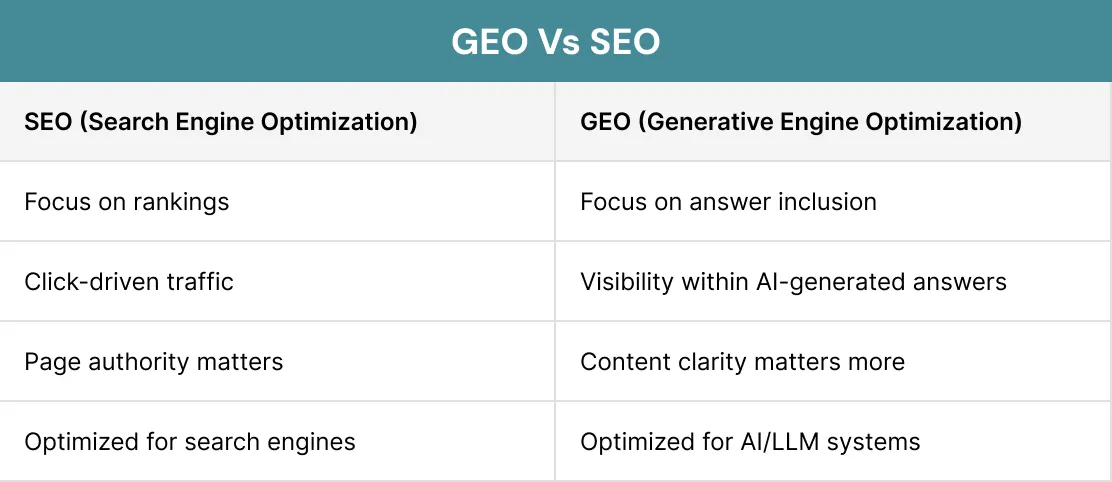
That is the real difference. Traditional SEO has largely been built around traffic and clicks. AI search engine optimisation is increasingly built around selection and inclusion.
What Is AI Search Engine Optimisation?
AI search engine optimisation is the process of writing and structuring content in a way that makes it easier for AI systems to understand and use. It is about making your content more extractable, more reliable and more useful in answer based search environments.
This does not mean that keywords no longer matter. They still matter. But repeating a phrase again and again is no longer enough and in many cases, it can make the content worse. The stronger approach is to focus on answering real questions in a direct and readable way.
That is important because AI systems do not simply display pages in a ranked list. They often gather information from several sources, pull out the most relevant points and present them as one response. If your content is unclear, vague or poorly organised, it becomes much harder for an AI system to use it confidently.
So, the goal is not only to be found. The goal is to be understood. That’s how AI search engine optimisation works.
How Do AI Search Engines Work?
Modern AI search engines usually work through a mix of retrieval and generation. First, they retrieve information from indexed sources. Then they generate an answer based on what they have found. That answer may quote, paraphrase or summarise information from different websites.
Because of that, content needs to be easy to process. A page filled with long, unclear paragraphs, weak structure and generic statements is less likely to be useful to an AI system. Contrary to that a content is clear, answers questions directly and follows a logical flow has a much better chance to be considered useful.
In practical terms, good content for AI search usually shares a few qualities. It is clearly written. It is factually reliable. It is well organised and avoids unnecessary fluff.
This is one reason structure matters for AI search engine optimisation. The clearer the content is, the easier it becomes for an AI system to identify what is useful and so include it in a response.
AI Search System Pipeline Overview
To optimise well, you need to understand how AI search works. Most systems follow two main steps: retrieval and generation.
In the first step of retrieval the system looks for useful content. It scans many sources and tries to find the best match for the user’s question. It does not just look at keywords. It looks at meaning and intent. Content that is clear and focused is easier to find.
In the second step, generation, the system builds an answer. It picks key points from different sources and combines them. It may rewrite that information.
Hence, the clarity matters. If your content is hard to find it will not be used. If it is not easy to get then it may be ignored. You need to perform well in both steps to stay visible.Thus is crucial for AI search engine optimisation.
Chunk Level Retrieval Optimisation
AI systems do not read a full page at once. They break it into small parts like chunks. This changes how you should write. Long and mixed sections can confuse the system. Clear and short sections work better.
Every part of your content should focus on one idea. Use clear headings with short paragraphs. Avoid putting too many ideas in one place.
Also state your main point early. If the key idea comes too late, the system may miss it. Every section should be useful on its own to ensure your AI search engine optimisation.
Citation Engineering
AI systems prefer content which they can trust and refer to. This is where citation engineering comes in. It means writing content in a way that is easy to quote and verify. Your points should be clear and supported by facts.
Adding data, research or examples helps. But it must be easy to understand. Do not make the reader or the system guess what you mean. Consistency should also be kept in mind. If your content says different things on the same topic, it can reduce trust. Clear and reliable content is important for AI search engine optimisation.
Entity Graph Strategy
AI systems understand topics through entities. An entity can be a person, brand or idea. An entity graph strategy means connecting related topics across your content. Instead of writing isolated pages you build a network.For example, a page about AI search should connect with SEO, content strategy and user intent. These links help AI systems understand your topic better.
Internal links also help but so does clear and consistent wording. When your content covers a topic well, it builds trust over time.
AI Visibility Testing Framework
AI search engine optimisation is harder to measure than traditional SEO. That is why you need a clear framework. It helps you track how your content performs and where it should improve.
A strong AI search visibility framework is built on a few key pillars:
1. Clarity
Your content should be easy to read and easy to understand. Avoid long and complex sentences. Answer questions directly. If the meaning is not clear, AI systems may skip your content.2. Structure
Well structured content is easier to process. Use headings, short paragraphs and logical flow. Each section should focus on one idea. This helps both users and AI systems find key points quickly.3. Authority
Trust matters a lot. Use accurate information, reliable data and clear explanations. Content that looks credible is more likely to be selected in AI generated answers.4. Retrieval Optimisation
Your content should be easy to find in smaller parts. Write short, focused sections. Keep each part useful on its own. This improves your chances of being picked during the retrieval stage.5. Measurement
You must also track your visibility. Search for common queries and review AI generated answers. Check if your content shows up and how it is being used. Monitor changes over time to see what is working.
These pillars give you a clear idea of how to improve and measure AI search visibility. Instead of guessing, you can focus on what actually helps your content get selected.
Why Is Ranking No Longer Enough?
Lots of businesses considered page one rankings as the main goal of SEO. That made sense because ranking high often meant more clicks, more traffic and more visibility but search is no longer working the same way.
Now a page can rank well and still miss out on visibility if it does not appear in AI generated answers. That is a major shift and it changes what success looks like. Ranking is still important because it helps search engines discover and trust your content. But ranking alone is no longer enough for AI search engine optimisation.
Content also needs to be usable. It needs to be written in a way that makes extraction easier. It needs to answer questions clearly enough that an AI system can confidently include it in a generated response. If it does not do that, it may still exist on page one but remain invisible in the places that users are actually looking first.
That is why businesses now need to think beyond rankings. Visibility today is not only about where you appear. It is also about how your content gets used.
How Do AI and SEO Work Together?
Some think about AI as if it has replaced SEO. That is not really the case. What is happening is more of an overlap between the two. SEO still matters a great deal but the expectations around content have increased. .
Traditional SEO still lays the foundation. It helps search engines crawl your pages, index your content and know that your site is relevant and trustworthy. Without that base, it becomes much harder for your content to perform anywhere, including in AI driven search environments.
AI search engine optimisation then builds on that foundation. It adds another layer. It asks not only whether your content is trustworthy enough to rank but also whether it is clear enough to use.
So this is not really a case of AI versus SEO. It is more a case of AI changing what effective SEO looks like.
Does SEO Still Matter?
Yes. Search engines still rely on many familiar signals. Backlinks still matter. Domain authority still matters. Topical relevance still matters. These elements help search engines judge whether a source is worth trusting.
That trust becomes even more important in AI generated search. If a page looks weak, thin or unreliable, it becomes less likely to be selected as part of an answer. In that sense, traditional SEO is still doing an important job behind the scenes.
A strong technical base, relevant content and trusted signals still help build the reputation that content needs for AI search engine optimisation.
Get an insight into the ultimate local SEO checklist for 2026.
How GEO Builds on SEO?
Generative Engine Optimisation, often called GEO, takes this one step further. While SEO helps content appear in search results, GEO helps content appear inside AI generated answers.
That is the key distinction. SEO helps users find your page. GEO helps AI systems use your page.
This matters because many users now get what they need without clicking through to a website at all. If your content is not showing up in those generated answers, then part of your visibility is already being lost, even if your rankings look strong on paper.
How to Measure Success in AI Search?
For years, success in search was often measured through clicks, rankings, impressions and traffic growth. Those metrics still matter but they no longer tell the full story.
In AI search engine optimisation, visibility is becoming more complex. A brand might be influencing the search journey even when users do not click through in the traditional way. For that reason, businesses now need to pay attention to other signals as well.
These can include brand mentions in AI generated answers, visibility across AI platforms and traffic patterns that suggest AI assisted discovery. In some cases, a business may notice stronger brand awareness or more qualified visits even if raw traffic numbers do not rise sharply.
That is because the nature of search is changing. People are not always browsing in the same way they once did. They are reading summaries, comparing answers and forming opinions earlier in the journey.
So, success needs to be measured with a wider lens.
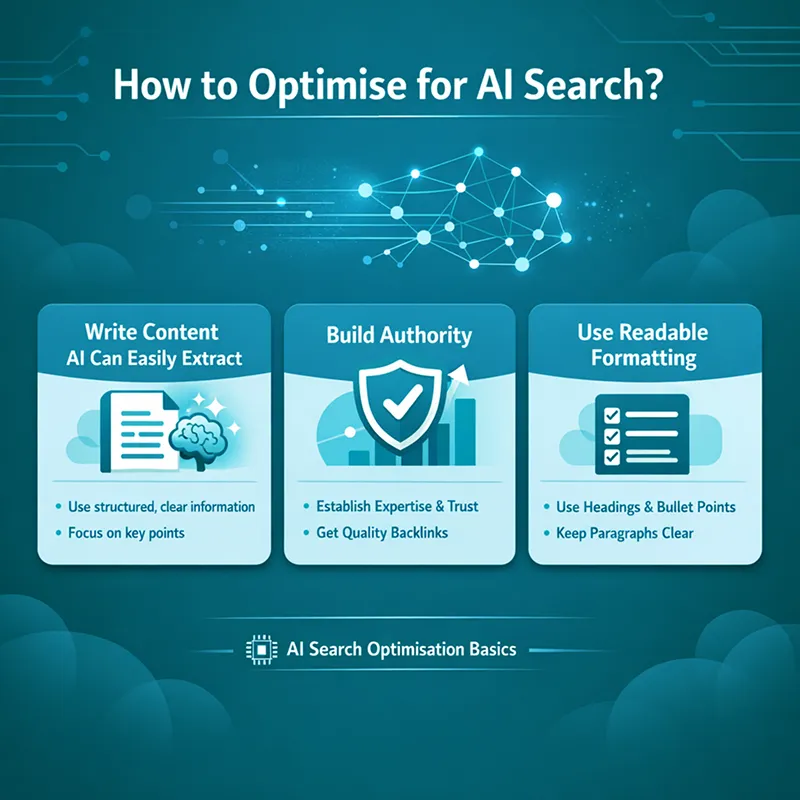
How to Optimise for AI Search?
AI search engine optimisation is not about tricking the system. It is about improving clarity, usefulness and structure. In many ways, it pushes content towards better quality rather than gimmicks.
The first step is to answer questions clearly. Content that circles around the point for too long is harder to use. Then it adds richness to it.
The second is to simplify the structure. Good headings, clear formatting and brief explanations are all positives to make the readability better. They assist human readers as well as AI systems to navigate the page more conveniently.
The third one is to build trust. Credible content is supported by reliable facts, evidence and expert input and correct explanations. That improves the likelihood of it being picked up and recycled.
To put it simple, content is not supposed to simply sound good. It ought to be beneficial.
1. Write Content AI Can Easily Extract
AI systems work better with content that is direct and well organised. That means short paragraphs, clear explanations and sections that stay focused on one main point.
It also means avoiding filler. A long introduction can seem refined but when it takes too long to get to the point, it can diminish the utility of the page. In most situations, one should respond to the main question at the beginning and proceed to the details afterwards.
This is one of the effective ways for AI search engine optimisation. .
2. Build Authority
Authority has always mattered in search and it matters even more in AI driven environments. AI systems are more likely to draw from content that appears reliable, well supported and credible.
That can come from strong sourcing, accurate information, expert backed explanations and consistency across a website’s content. A page that makes big claims without support is less persuasive. A page that explains a point clearly and backs it up well is more likely to be trusted.
Authority is not just a technical signal. It is also something the writing itself communicates.
3. Use Readable Formatting
Formatting plays a much bigger role than many businesses realise. Clear headings make sections easier to understand. FAQ sections reflect the way people naturally search. Bullet points can sometimes help with quick scanning when used properly.
The goal is not to force a formula. The goal is to make the page easier to navigate and easier to interpret.
A well formatted page usually feels clearer to the reader and that same clarity can help AI systems understand the content better hence leading to effective AI search engine optimisation.
What Is Generative Engine Optimisation?
Generative Engine Optimisation is about improving the chances that your content will appear in AI generated answers. It focuses less on being one of ten links and more on being part of the response itself.
Generative Engine Optimisation focuses on how content is used inside AI generated responses. According to an article published by Oxford College of Engineering:
“By integrating GEO into your content strategy, you position your brand for success across the full spectrum of search.”
Robyn MacMillan
That is a meaningful difference. In a traditional search result, users might compare several pages. In an AI generated answer, they may see only a few selected ideas pulled from a smaller set of sources. Being included there can shape visibility, trust and even conversions.
GEO is growing because user behaviour is changing. More people want quick summaries and direct explanations. They do not always want to open five tabs just to understand a basic topic.
That makes answer level visibility increasingly valuable.
Read more about Generative Engine Optimisation (GEO) and how it is done.
Content Strategies for AI Search Engine Optimisation
a Content remains at the centre of a strong AI search engine optimisation strategy. The difference is that content now needs to be more intentional in how it is written and organised.
One useful approach is to create answer focused content. That means each section should respond to a real user question or concern instead of simply filling space. Readers should feel that each paragraph is helping them move forward.
Another important approach is to build topical authority. One isolated blog post is rarely enough. Stronger visibility often comes from covering a topic properly across several related pieces of content. This helps the AI systems understand that the website has depth, not just surface level information.
FAQs are also valuable because they match modern search habits. People increasingly search in question form and FAQ style sections can fit naturally into that pattern.
Does Technical SEO Still Matter for AI Search?
Yes. Even though AI search feels content heavy, technical SEO still matters a lot. If the technical foundation is weak, even strong content can struggle.
Structured data helps search engines understand the page more clearly. Also the crawlability matters. It is because content cannot be used if it cannot be indexed properly. Page speed also needs to be considered because it affects both user experience and overall quality signals.
So, while AI search engine optimisation introduces new priorities, it does not remove the need for technical discipline. It simply adds more layers to what good AI search engine optimisation involves.
What Are the Common Mistakes in AI Search Engine Optimisation?
One common mistake is overusing keywords. Some businesses still fall into the habit of repeating a phrase again and again because they think it will improve visibility. In reality, it often makes the writing feel unnatural and less helpful.
Another mistake while doing AI search engine optimisation is weak structure. Even good information can get lost if the formatting is poor, the headings are vague or the paragraphs are too dense.
Credibility is the third error. Non-trusted statements in content are unlikely to be utilized in an AI generated answer.
These errors do not necessarily need to be dramatic but they can subtly make your content less visible over time.
Also, take a look at common SEO mistakes to avoid in 2026.
Future Trends in AI Search Engine Optimisation
It is still developing, so the landscape will keep changing. Search is becoming more conversational, which means content will need to match natural language more closely. Personalisation is likely to grow, which means different users may see different styles of answers. Multimodal search is also becoming more important, with voice, images and video playing a bigger role.
These changes suggest that businesses need to stay flexible. What works today may still work next year but it will probably need refinement.
That is why long term success depends less on hacks and more on building genuinely useful content systems. It’s the key for AI search engine optimisation.
How to Build a Long Term AI Search Optimisation Strategy?
a A strong long term strategy begins with clarity. Businesses need to know what they are trying to achieve. That might be more visibility, better qualified leads, stronger authority or a better presence across AI driven platforms.
From there, the focus should stay on quality. High quality content remains the strongest asset in any search environment. It should be clear, useful, relevant and updated often enough to stay accurate.
Regular updates matter because search technology is changing quickly. A page that was going good last year might require revision to continue working the same way.
It also works when the content, marketing and technical teams are on the same page. AI search engine optimisation search is no longer the responsibility of one team. It lies between content strategy, SEO, user experience and brand authority.
How to Choose an AI Search Optimisation Agency?
As AI search becomes more important, many businesses find it difficult to manage everything internally. The challenge is not only technical. It also affects content planning, site structure, reporting and ongoing strategy.
That is where a specialist agency can help. A good agency should understand both traditional SEO and newer AI search behaviour. It should know how to improve content not just for rankings but also for answer inclusion.
External support often becomes useful when businesses see visibility dropping despite ongoing SEO work or when their content performs reasonably in rankings but still does not appear in AI generated results.
In many cases of AI search engine optimisation, the problem is not that the business has no content. It is that the content has not been adapted to this newer search environment.
AI Search Engine Optimisation in Practice
Real examples help make this easier to understand.
A UK based retailer may have strong blog content but if the articles are unstructured, too long winded or unclear, AI systems may skip over them. By improving the layout, adding clearer headings and making answers more direct, the same content can become much more usable.
A financial services company might improve its visibility simply by adding verified data, clearer evidence and more trustworthy explanations. That stronger authority can make its content more attractive to AI systems.
A marketing agency may also see gains by shifting from isolated blog posts to topic clusters. When related content supports each other, it becomes easier to signal expertise and depth.
These examples show an important point. Better AI search engine optimisation does not always require starting from scratch. Sometimes it comes from improving clarity, structure and trust.
How to Measure Success in AI Search?
Measuring success in AI search engine optimisation is still developing but that does not mean it cannot be tracked at all.
Businesses can monitor mentions in AI generated answers, observe how branded search changes over time and look for shifts in traffic quality rather than traffic volume alone. Manual testing can also help. Searching common queries and reviewing what kinds of sources appear in AI generated results can offer useful insights.
This is not as neat as traditional rank tracking but it still gives direction. Over time, businesses can build a clearer picture of whether their content is becoming more visible in AI environments.
Challenges in AI Search Engine Optimisation
AI search also comes with challenges. The technology moves quickly, so strategies need regular review. There is limited transparency around why some sources are chosen and others are not. That makes testing and refinement more important.
There is also the challenge of balance while doing AI search engine optimisation.. Some businesses treat SEO and GEO as separate tasks but they work better together. Strong results often come from combining good SEO foundations with content that is clearly written and easy for AI systems to use.
So, the issue is not just to adapt. It is to become adapted without forgetting the basics, which are still required.
The Future of AI Search Engine Optimisation
The connection between AI and SEO will continue to change. Search engines are resembling answer engines. Users are seeking faster, less complex and clear answers. That changes the manner in which websites are supposed to communicate.
Search is also likely to be influenced by personalisation. The results may vary depending on intent, past behaviour or context based on different users. It would imply that content will require being clear and flexible.
Meanwhile, search is going beyond text. Voice search, image based search and video led discovery are on the rise.
Conclusion
Search has changed in a meaningful way. Today, businesses cannot afford to treat this as a passing trend. This is a real shift in how content is discovered. How content is selected and presented is totally different today.
The good thing is that this shift creates new opportunities for you. Businesses that focus on clarity, trust, structure and genuinely helpful content got some benefits. You will be in a better position to stay visible if your content has these attributes.
Xoom Plus helps businesses adapt to this new reality. It understands that with practical strategies built around long term growth, you get your goals. From stronger AI search optimisation to clearer content structures, we help you at every step. With our smarter search planning, the goal is not just to chase change but to respond to it properly.
Don’t you think AI search Engine optimisation should not be seen only as a problem to solve? The best thing is it can also be a chance to build better content and stronger authority. It offers you sustainable visibility in the way people now search so why not take a chance. Contact us today to get introduced to an entirely new thinking of how you can take the max out of these upgrades.
Take the next step with Xoom Plus.
Get in touch today to explore how your business can improve visibility in AI driven search.
FAQs
What is AI search engine optimisation?
AI search engine optimisation is the process of structuring content so that AI systems can understand and use it in generated answers. It focuses on clarity, structure and relevance rather than only rankings.
How is AI search optimisation different from traditional SEO?
AI search optimisation focuses on inclusion in AI generated responses, while traditional SEO focuses on ranking in search engine results pages.
Why are AI and search engine optimisation used together?
AI and search engine optimisation work together because SEO builds authority and visibility, while AI determines how content is used in responses.
How can businesses improve AI search performance?
Businesses can improve performance by creating clear, structured and data supported content that is easy for AI systems to interpret.
Do businesses need a generative AI search optimisation agency?
A generative AI search optimisation agency can help businesses adapt faster to AI driven search systems, especially when in house expertise is limited.