- March 26, 2026
- Categories: Digital Marketing
Building Effective Email Marketing Strategy from Scratch
Do you ever wonder why many people still think email marketing strategy is old? Some people even think it stopped working years ago. Social media may look louder, faster and more exciting to you. But when you step back and look carefully, it is not what it seems. Email marketing still works very well.
Note:
Email is not outdated; it is underused.
Today, there is a lot of noise online. Email is a place where a message goes straight to a person. There is no algorithm. There is no need to compete for reach. It simply arrives in the inbox. That is the power of email marketing strategy.
Data shows that 392.5 billion emails are expected to be sent daily in 2026. This shows how effective email marketing strategy is in daily communication.
Many people forget that a business owns its email list. While social media can change its rules anytime, it does not affect email marketing campaigns. The email list still stays with the business.
That is why smart marketers still depend on email marketing strategy. Its purpose is not just sending emails. It builds trust and relationships. It also helps in steady growth over time. This is why businesses continue to invest in email marketing strategy even today.
You need to know that email marketing strategy only works well when it is done in the right way. Random emails, bulk messages and general content do not work like they did in the past. People get a lot of emails every week. They will ignore or delete a message if it does not feel useful or relevant.
You cannot build an effective email marketing strategy by sending more emails. It is built when you send better emails.
In this blog, you will learn:
- Why email marketing strategy still matters today
- How understanding your audience improves email marketing
- How to set clear goals for the success of email marketing campaigns
- Why segmentation is important in email marketing campaigns
- How to create email content that people actually read
- Why mobile optimisation is important in email marketing campaigns
- How email automation helps you reach people at the right time
- How to test email campaigns and improve results over time
What Is Email Marketing
Email marketing is a form of marketing that uses emails. It is the process of sending emails to subscribers on your email list. It keeps the user aware of new products, discounts and other services. It helps to build relationships and drive sales.What Is Email Marketing Strategy
An email marketing campaign is a plan to send emails. It sends the right emails to the right people at the right time. It helps to achieve clear business goals. It avoids blasting generic messages to everyone.Why Email Marketing Strategy Still Matters Today
It is important to understand why email still matters before building a strategy. Email was there even before the modern internet. That is why people used early systems to send messages before websites became common.
Now marketing and email have grown into something much bigger and better. Today, email is a key part of communication for businesses, customers and teams.
Billions of emails are sent globally every day. That number continues to grow. It also shows one thing clearly that the inbox is crowded. So the real challenge is not just sending emails. The challenge is standing out.
At the same time, email has some strong advantages:
- It allows direct communication with users
- It helps build long term relationships
- It supports both sales and education
- It is measurable and trackable
- It works across industries
How Understanding Your Audience Improves Email Marketing
You should know who you are talking to. This is the first step in building an email marketing strategy but often ignored.
Many email marketing strategies fail because they speak to everyone in the same way. But people are different. They have different needs, behaviours and expectations. That is where knowing your audience becomes important.
A good starting point is building customer personas. These are simple profiles of your ideal audience.
To do this, think about:
- Age, location and income
- Interests and goals
- Problems they want to solve
- How they interact with your brand
- How they behave in emails
Understanding your audience is not a one time task. It is something that improves over time as more data is collected. When you know your audience well, your emails start to feel more relevant. And relevance is what drives results.
How to Set Clear Goals for the Success of Email Marketing Campaigns
| Key Elements of an Email Marketing Strategy | ||
|---|---|---|
| Element | What It Means | Why It Matters |
| Audience | Knowing who you are emailing | Helps you send relevant messages |
| Goals | Deciding what you want to achieve | Gives direction and makes results easier to track |
| Email list | Building a list of people who agreed to hear from you | Improves trust, engagement and deliverability |
| Segmentation | Dividing your audience into smaller groups | Makes emails more targeted and useful |
| Personalisation | Tailoring emails to user interests and behaviour | Helps emails feel more human and relevant |
| Content | Writing clear and helpful email copy | Keeps readers interested and encourages action |
| Timing | Sending emails when people are likely to engage | Improves opens, clicks and conversions |
| Automation | Sending emails based on user actions | Saves time and improves relevance |
| Testing | Checking what works best | Helps improve results over time |
| Metrics | Tracking performance like opens, clicks and conversions | Shows what is working and what needs to change |
Once the audience is clear, the next step is to define goals. Without goals, email marketing strategies become random. You send emails but you do not know if they are working or not. This is where the smart ideas help.
Goals should be:
- Specific
- Measurable
- Achievable
- Relevant
- Time based
This small change makes a big difference. It gives direction and makes tracking easier. Email goals should also match business goals. Every email should serve a purpose.
If a business wants more leads, email campaigns should focus on sign-ups. These campaigns should also focus on awareness. Emails should promote products and offers if the goal is revenue. If the focus is retention, emails should build relationships and loyalty.
How to Build a Strong Email List the Right Way
An email marketing strategy cannot work without sending emails to people. That is why building an email list is a key step. It should be a quality list not just any list.
The best email lists are built with permission. People choose to join because they find value in offers.
You can grow a list by:
- Adding sign-up forms on websites
- Offering lead magnets like e-books or checklists
- Running contests or giveaways
- Using pop-ups carefully
- Promoting sign-ups on social media
People should know what they are signing up for. They should know how often emails will come. They should also know what type of content they will receive.
There is a legal side to email marketing strategy. Rules like GDPR (General Data Protection Regulation) and CAN-SPAM (Controlling the Assault of Non-Solicited Pornography and Marketing) require:
- Clear consent
- Transparency
- Easy unsubscribe options
Another key point is that buying email lists may look like a shortcut but it usually fails. These users do not choose to hear from you. So they ignore emails or mark them as spam. This affects deliverability. It also damages trust.
A smaller but active list is always better than a large but inactive one.
Why Segmentation Is Important in Email Marketing Campaigns
Segmentation is the next step after a list is built. At this point, many campaigns improve or fail. Segmentation means dividing your audience into smaller groups. This division is based on certain factors.
These factors include:
- Demographics
- Location
- Interests
- Purchase history
- Behaviour
It depends on:
- How often someone opens emails
- When they last engaged
- How quickly they click
For example, instead of sending one email to everyone, you can send:
- A welcome email to new users
- Product recommendations to active users
- Re engagement emails to inactive users
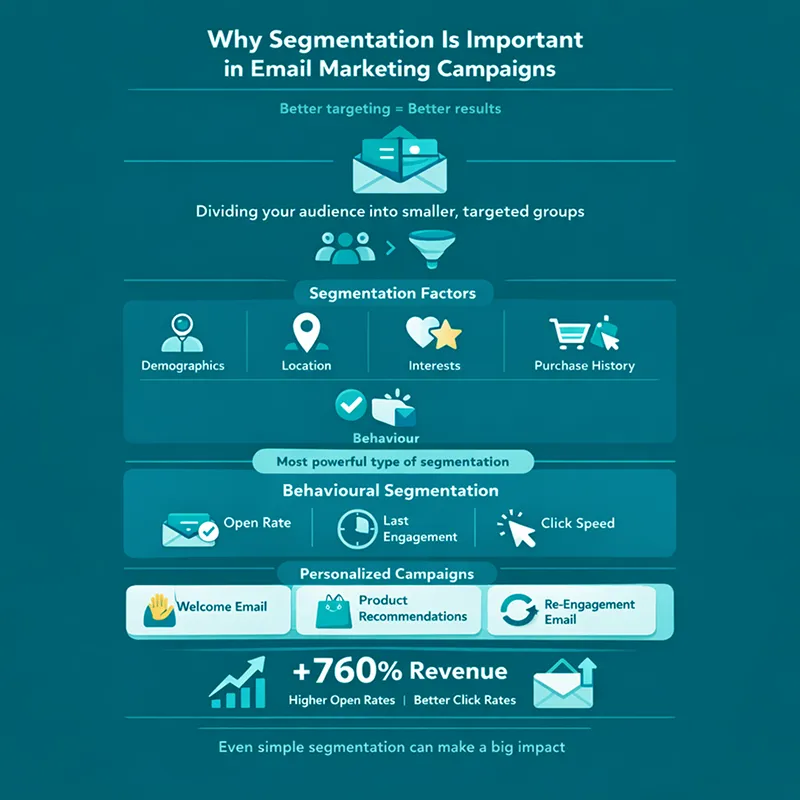
Segmented emails perform much better than generic ones. Research shows that segmentation can lead to a 760% higher revenue. It also improves open rates and click rates. Even simple segmentation can make a big impact.
Remember:
Sending the same email to everyone is the biggest mistake
Yet many marketers still do not use it properly. This creates an opportunity for marketers. Those who segment well can stand out easily.
How Personalisation Makes Email Marketing More Effective
Personalisation speaks to the audience once segmentation divides them in an email marketing strategy. Personalisation is not just about using a first name. It is about making the email feel relevant and real.
A personalised email should reflect:
- User preferences
- Past behaviour
- Interests
- Stage in the journey
One strong insight shows that personalised subject lines alone can increase open rates by around 50 percent. That is a big improvement for a small effort.
Another example can help explain this better. Instead of writing, ‘Thank you for attending our event,’ it feels more natural to say, ‘Great meeting you at the event last week.’
The second one feels more personal. It feels like a real conversation. That is the goal of personalisation.
There is also a balance. Sending too many emails, even personalised ones, can annoy users. It may lead to spam complaints or unsubscribes. So personalisation should always focus on value. It should not just focus on frequency.
Every email should also guide the reader towards one action. This is where a clear call to action becomes important.
How to Create Email Content That People Actually Read
Good email content is simple. It does not try too hard or confuse the reader. It respects the reader’s time. Most people do not read emails fully, they just scan them. So, the structure of the email matters a lot.
A good email usually includes:
- A clear subject line
- A short introduction
- Useful or interesting content
- One clear action
Email has an ability many channels don’t: creating valuable, personal touches at scale. – David Newman
Emails should feel like a conversation. Not like a formal announcement. Writing as if speaking to one person often works better than writing for a crowd. Sometimes, adding a small story or real example can make the message more relatable. It helps the reader connect with the content.
How to Write Subject Lines That Get More Opens
The subject line is one of the key parts of any email marketing strategy. It decides whether the email is opened or ignored.
Many studies suggest that nearly half of email opens depend on the subject line alone. At the same time, people may mark emails as spam simply by reading the subject line.
A good subject line should:
- Be clear and specific
- Show value
- Create a little curiosity
- Stay short, especially for mobile
Simple formats work well, such as:
- Quick tip to improve your results today
- Still interested in this
- You might be missing this benefit
How to Design Emails for a Better User Experience
Design is not just about making emails look good. It is about making them easy to read and act on. A clean layout helps readers understand the message quickly.
Email marketing strategy includes simple practices:
- Using headings and spacing
- Keeping paragraphs short
- Using bullet points when needed
- Adding relevant images
- Maintaining brand consistency
Why Mobile Optimisation Is Important in Email Marketing Campaigns
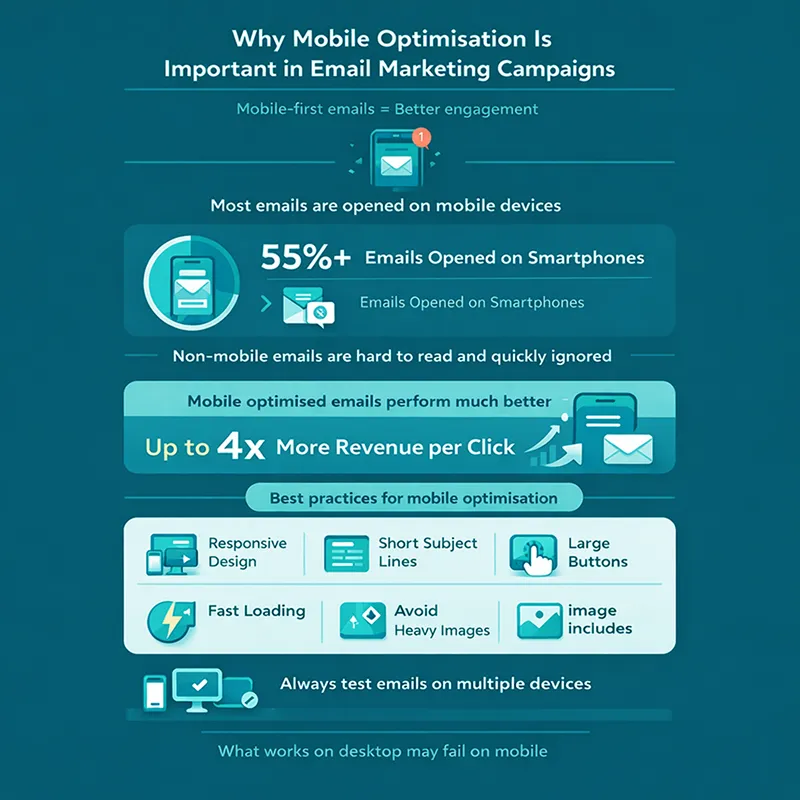
Today, a large number of emails are opened on mobile devices. This changes everything. If an email is not mobile friendly, it becomes hard to read. The user may close it quickly.
Research shows that 55% or more emails are opened on smartphones. It shows the importance of designing mobile friendly email campaigns.
Mobile optimised emails can give much better results. Some reports show that they can drive up to four times more revenue per click compared to poorly designed emails.
To improve mobile experience:
- Use responsive design
- Keep subject lines short
- Write concise content
- Use large and easy to click buttons
- Avoid heavy images that slow loading
Why Email Timing Matters More Than You Think
Even a well written email can fail if it arrives at the wrong time. Timing plays a big role in email marketing strategy. There is no single perfect time for everyone.
It depends on the audience such as:
- Business professionals may check emails in the morning
- Freelancers may check them in the evening
- Decision makers may engage more during midweek
So instead of following general rules, it is better to:
- Observe audience behaviours
- Test different timings
- Adjust based on results
How Email Automation Helps You Reach People at the Right Time
Automation is one of the most powerful parts of email marketing campaigns. It helps send emails based on user actions. It does not rely on fixed schedules. This makes emails more relevant.
For example:
- A welcome email when someone signs up
- A reminder when someone leaves items in a cart
- A follow up after a purchase
- A message when a user becomes inactive
Welcome emails are especially strong in email marketing strategy. They can produce much higher transaction rates and revenue compared to standard promotional emails.
Automation also saves time. Once set up, it continues to work in the background. But it should not feel robotic. It should still feel personal and relevant.
How to Test Email Campaigns and Improve Results Over Time
An email marketing strategy is not perfect from the start. That is why testing is important. A/B testing is a simple way to compare two versions of an email. It helps to know which works better for you.
Things that can be tested include:
- Subject lines
- Email layout
- Call to action
- Images
- Send times
Testing is not a one time task in email marketing strategy. It should be on a regular basis. What works today may not work tomorrow.
Which Email Marketing Metrics Matter the Most
| Important Email Marketing Metrics and What They Show | ||
|---|---|---|
| Metric | What It Measures | What It Tells You |
| Open rate | How many people opened the email | Helps you send relevant messages |
| Click-through rate | How many people clicked a link or button | Shows whether the content and call-to-action were effective |
| Conversion rate | How many people completed the desired action | Shows the real business result of the email |
| List growth rate | How fast your email list is growing | Shows whether your list-building efforts are working |
| Unsubscribe rate | How many people left your list | Shows whether emails feel irrelevant, too frequent or unhelpful |
| Bounce rate | How many emails were not delivered | Shows the quality of your email list |
| Spam complaint rate | How many people marked the email as spam | Shows trust and relevance problems |
| Email sharing or forwarding | How often people shared the email | Shows whether the content was useful enough to pass on |
Many people look only at open rates. But open rates alone do not show the reality. To better understand the performance of an email marketing strategy, you need to track:
- Click rate
- Conversion rate
- List growth rate
- Unsubscribe rate
- Email sharing
For example:
- Open rate shows interest
- Click rate shows engagement
- Conversion rate shows actual results
Real-Life Example
A simple example helps explain how email guides the reader towards an action.
Tesco uses its clubcard data to send personalised emails to customers. It uses purchase history (such as tailored discounts or product suggestions) through the clubcard program and online accounts to drive effective marketing.
These emails are based on what people usually buy. This makes the message feel more useful and relevant. As a result, customers are more likely to engage and shop again.
Conclusion
An email marketing strategy does not stop working. It still gives strong results because it is direct and personal. It is also easy to track. These results do not happen by chance but come from:- Relevance
- Timing
- Consistency
- Learning from data
At first, the process of an email marketing plan may feel slow. Building a list, understanding users and testing ideas all take time. It becomes powerful once it starts working.
Once the system is in place, an email marketing strategy becomes strong. Emails stop feeling like simple messages. They start to feel like real conversations that build trust, loyalty and steady growth over time.
XoomPlus understands that working with an experienced email marketing strategy consultant can make this process easier and help achieve better results faster.
Contact us today to start work from scratch to build an effective email marketing strategy.
Struggling to get results from your email marketing strategy?
We help build data-driven campaigns that improve engagement and growth.
Contact us today to build an effective email marketing strategy for your business.
FAQs
What is the most effective email marketing strategy?
The most effective email marketing strategy starts with understanding your audience. Segment users based on behaviour and preferences, then send tailored messages that feel relevant and drive engagement.
What is the 3-3-3 rule in marketing?
The 3-3-3 rule focuses on 3 key messages, 3 audience segments and 3 marketing channels. It improves clarity, consistency and ROI by keeping marketing efforts focused and effective.
What are the 5 Cs of email?
The 5 Cs of email are: complete, correct, concise, clear and courteous. Emails should include all needed information, be accurate, easy to understand, brief and polite.
What are the 4 Ps of email marketing?
The 4 Ps are product, price, place and promotion. In email marketing, these help shape clear offers, pricing value, delivery strategy and promotional messaging.
What are the 4 pillars of email marketing?
The four pillars are personalisation, content, deliverability and optimisation. Together, they ensure emails reach the right audience, engage users and improve performance.
What is the 7 times 7 rule in marketing?
The Rule of 7 states that a customer should see a brand’s message at least seven times before taking action or making a purchase.
What is the golden rule of marketing?
The golden rule is to understand customer needs and clearly show how your product or service solves them, creating a direct connection with your audience.
What are the 3 Ms of marketing?
The 3 Ms are Market, Message and Media. First understand the audience, then craft the message and finally choose the right channel.
What are the ABCs of email?
The ABCs focus on clear, concise emails with strong calls to action, the right tone and messaging that reflects the brand well.
What are the 4 types of email marketing?
The four types are Transactional, Promotional, Retention and Newsletter emails. Each serves a different purpose in the customer journey.