

- January 16, 2026
- Categories: Digital Marketing
What’s Generative Engine Optimisation (GEO) & How To Do It?
Did you know that a lot of individuals now use AI to get answers. They don’t go to websites directly. ChatGPT and other tools like Gemini and Preplexity provide quick answers. Also, Google AI Overviews show up the answers and summaries in a few seconds. This is why webpage clicks are decreasing.
According to Google, AI Overviews share main themes and answers. Links are only there for more information. This Google update affects website visibility. Even when your SEO ranking is still high. That means AI overviews might not include your brand. Thus, you lose visibility of your brand. And this may lead to fewer clicks to your website.
This guide tells you what is generative engine optimisation. It shows how GEO is different from AEO and SEO. It also tells you what to do. These steps will assist AI tools give credit to your work.
What Is Generative Engine Optimisation (GEO)?
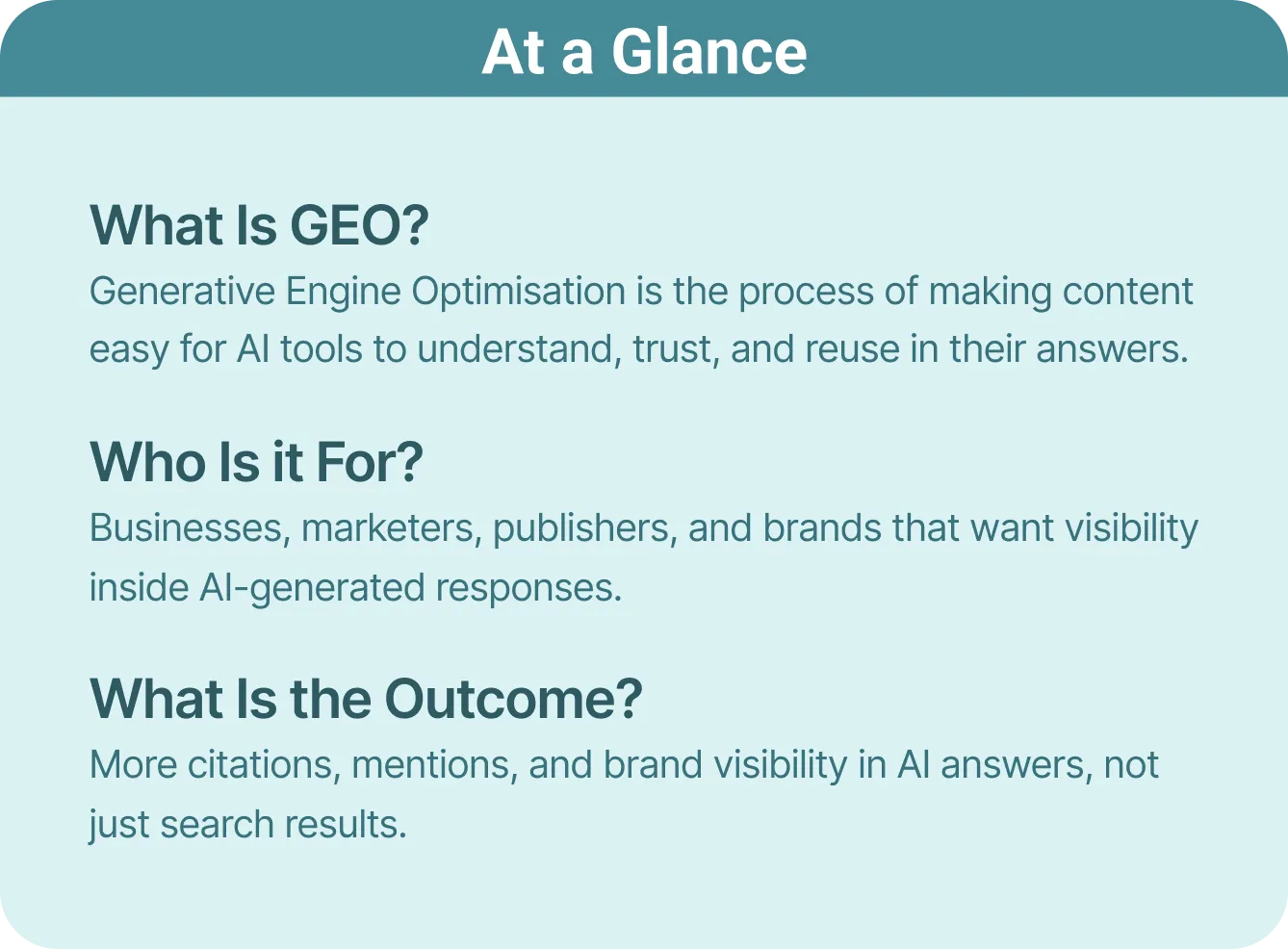
When you do generative engine optimisation (GEO), you help AI tools identify, trust, and use your content in their answers. Instead of just aiming to obtain “blue links” to show up higher in search results, you want to be cited, referenced, or acknowledged in AI-generated comments.
These technologies don’t work the same way as traditional search alone. A lot of them get information from more than one page and then put it all together. They generally provide sources as citations so that readers can check what they read. Perplexity, for instance, asserts that its answers have numbered citations that lead to the original sources.
This is a helpful way to think about optimising a generative engine.
- SEO helps you get a link on a list of links.
- GEO lets you get a spot inside the answer itself.
Comparison Table SEO Vs AEO Vs GEO
SEO is no longer the only optimisation layer. As search shifts from links to answers, businesses now need to understand how GEO, SEO, and AEO work together and where each one differs.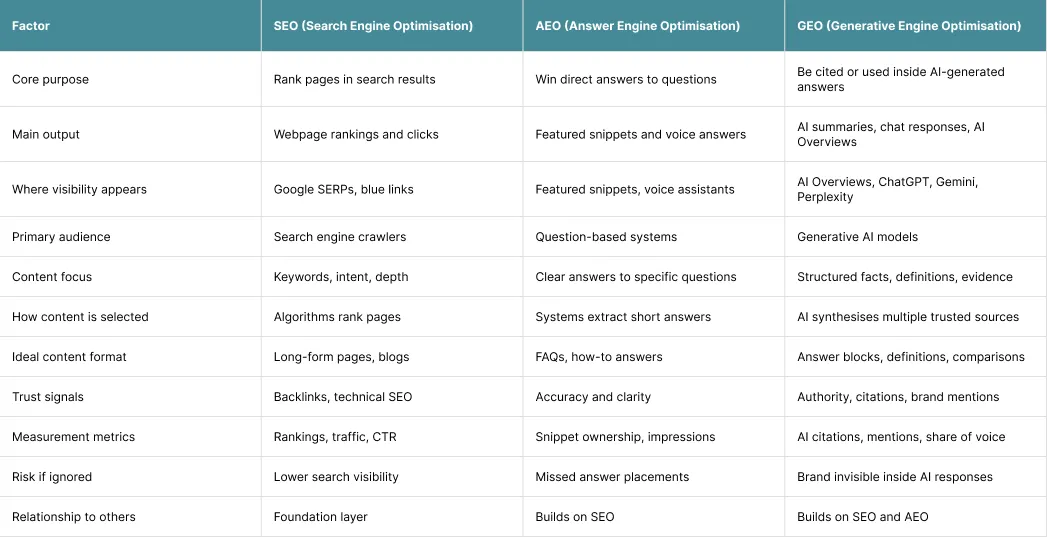
Why Is Generative Engine Optimisation (GEO) Important?
GEO provides value beyond “extra visibility”. You can appear in AI answers and gain trust faster. Below are the main reasons businesses are focusing on GEO.1. Increases Visibility In AI Search
AI search surfaces are now a normal part of searching. AI Overviews are meant to give a brief summary and then send you to other sources for more information. If your site isn’t being pulled in as a source, you could miss out on the most “top of page” visibility in a lot of queries. That’s what generative engine optimisation is trying to fix.2. Boosts Credibility
When an AI tool links to you, it’s like a public sign that your content is reliable. This is important for generative engine optimisation because users usually trust the first summary they see. The generative engine optimisation study also found that adding citations and statistics can make your work much more visible. This shows how much “evidence” affects choice.3. Improves User Engagement
You can still get people to pay attention to your brand and remember it, even if AI answers lower clicks. Also, when people do click, it’s usually after they’ve read a summary, which means they know more and are closer to making a choice. In other words, generative engine optimisation can get you fewer clicks, but the ones you do get will be more effective. This is because people who click have already read a summary and know what they are looking for.4. Future-Proofs Online Strategy
Search is going in the direction of “answers without clicks.” Research and studies in the field show that a lot of searches don’t lead to an external click. SEO is not dead, though. It means you need both SEO and generative engine optimisation to keep your content visible in both places.
If you’re a local business, your Google Business Profile still matters a lot for visibility. Read our blog Essential Tips for Google My Business Optimisation.
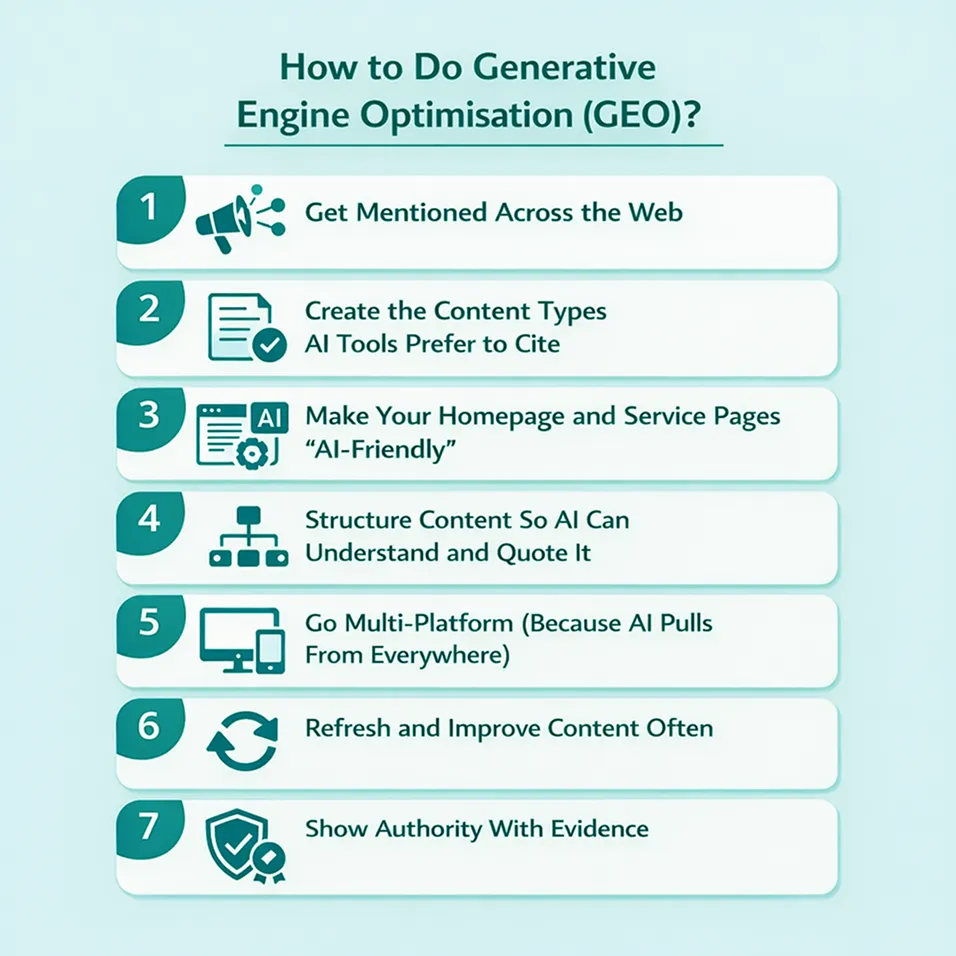
How to Do Generative Engine Optimisation (GEO)?
This is the practical playbook. It is based on generative engine optimisation strategies that can be measured and used again. It combines fundamental SEO with brand marketing, public relations, and distribution.Tactic 1: Get Mentioned Across the Web
A lot of brands fail here. They just care about their own site. But off-site presence is quite important for AI solutions.
The goal of generative engine optimisation is to get mentions in articles, get included in industry lists, get expert quotes, get reviews from customers, and be listed as a partner on the web. This is what you need to do:
- Industry lists and roundups: get on “best of” lists and tools pages in your field.
- PR and media: become featured in periodicals and expert digests.
- Reviews: Ask customers to review your brand on Google, Trustpilot, and other industry sites.
- Partnership pages: vendors, platforms, and communities list their partners.
- Case studies: working with clients and platforms to co-market can lead to high mentions.
- List 50 high-ranking sites on your topic.
- Choose sites with comparison lists, templates, and “best tools” sections.
- Present new data, a case result, or a valuable template to pique their interest.
- Track mentions, citations, and referral traffic.
- Brand mentions per month.
- “Share of voice” in AI answers (how often you show up compared to your competition).
Tactic 2: Create the Content Types AI Tools Prefer to Cite
Not all content works the same in AI search. Ahrefs’ study of AI traffic suggests that there are some patterns across several sites.
Some of their main trends are:
- “Best” pages: 7.06% of AI traffic.
- How-to guides: 6.35%.
- “Top” lists: 5.5%.
- “Vs” comparisons: 4.88%.
- Product and Service Pages: also do well.
A content mix that works for most businesses is:
- Definition pages: “What is GEO?” “What is AEO?” “What is AI search visibility?”
- How-to guides: step-by-step processes with checklists.
- Comparison posts: “X vs. Y,” “GEO vs. SEO,” and “Best tools for…”.
- Data studies: even modest studies with only 50 to 200 data points might get cited.
- Service pages: concise service descriptions that are easy to quote.
Tactic 3: Make Your Homepage and Service Pages “AI-Friendly”
A lot of brands only work on their blogs, which is a mistake. A lot of AI traffic goes to a few important pages. Ahrefs states that more than 80% of the AI referral traffic they get goes to three categories of pages:- Homepage
- Product pages
- Free tools
Checklist for the homepage:
- At the top, write one phrase about what you do.
- Add three to six bullet points that explain the results and who the program is for.
- Make a short “How it Works” section.
- Add trust cues (logos, reviews, numbers, certificates).
- Make it easy to find contact information.
- Use simple headings that are the same as real questions.
- With bullets, add a short “What you get” section.
- If you can, include price ranges (even “from” ranges are helpful).
- Include proof, like case findings, short samples, and testimonials.
Tactic 4: Go Multi-Platform (Because AI Pulls From Everywhere)
If your brand is exclusively on your website, you’re not reaching as many people.
In generative engine optimisation, you should make material and visibility where people are currently asking enquiries.
A simple Reddit approach:
- Look for conversations that are ranked high in Google for your core topic.
- Give useful responses (but don’t try to sell anything).
- If it makes sense, use your brand name naturally (for brand recognition).
- Make short videos that each answer one question.
- Make sure the titles are clear and fit the question.
- In the first 15 seconds, give your main answer.
- In the description, add links to your service or guide.
- This is “search everywhere.” It is also GEO.
Tactic 5: Refresh and Improve Content Often
AI search changes quickly, and so does your topic. That’s why generative engine optimisation is never “done.”
To refresh content:
- Adding new examples and fixing old ones
- Adding clearer answers where people are having trouble
- Getting rid of broken links and missing pages
- Making the structure better so that important facts are easier to find
A Good Rhythm For Refreshing
Every 60 to 90 days, update your most important pages. First, update your homepage, service pages, and definition pages. Then, refresh pages that are already showing up in AI search results.
Tactic 6: Show Authority With Evidence
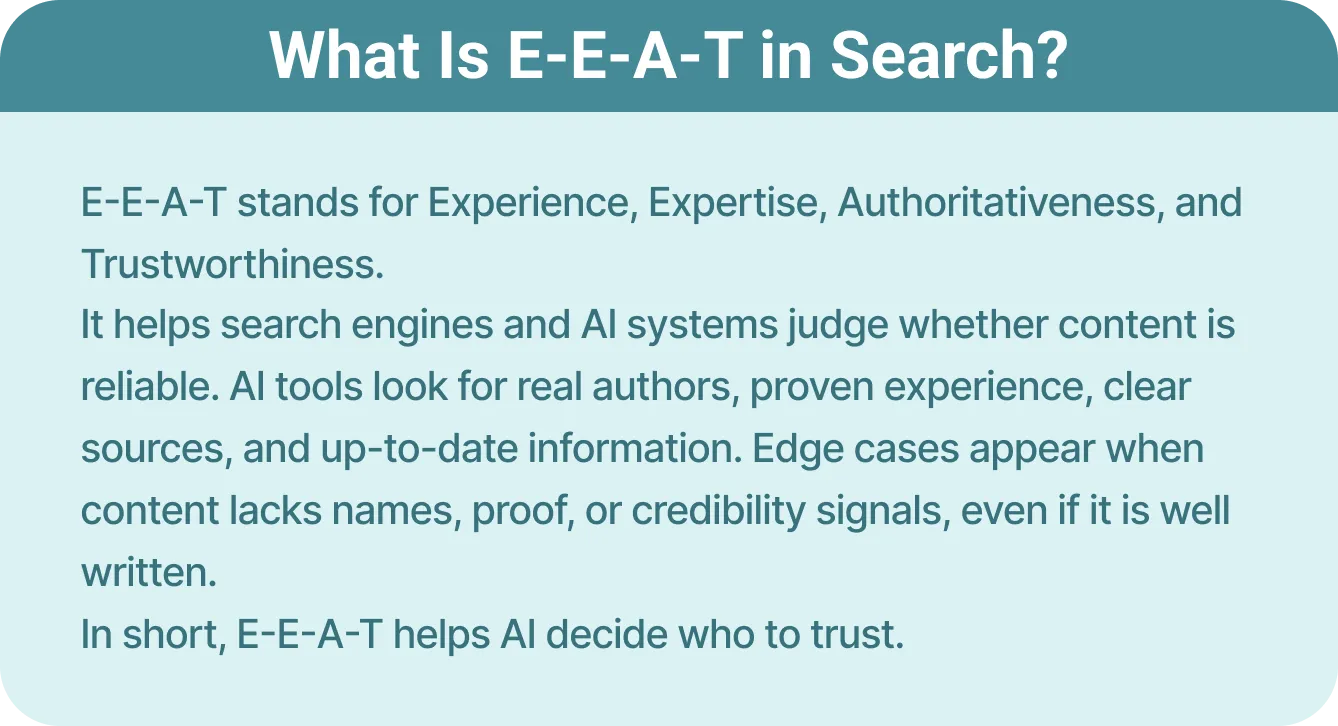
A big part of generative engine optimisation is showing that you know what you’re talking about in a way that machines can understand.
Ways to do that (easy but effective):
- Include an author box with real credentials and experience.
- When you refresh the page, add “Last updated” dates.
- Link to reliable sources for important information
- Add real-life examples, screenshots, or short case studies.
- Use clear definitions and don’t make vague claims.
Case Study: LLM AI Visibility (A GEO Outcome)
The SEO Works With 20x AI Referrals
The case study is of a UK based company ‘The SEO Works’. The goal was to increase visits from AI assistants. ChatGPT only sent 3 to 5 sessions at first. And all those visits landed on service pages.
The team made structured data and schema better. LocalBusiness, FAQ, and Organisation were added. Business NAP was created to be the same. Important pages got stronger internal links. Direct FAQs were used to rewrite the copy. There was less “marketing speak.” Listings and reviews made trust signals stronger. They also deployed digital PR.
Results got better in less than a year. More than 100 AI referrals came in each month. That means it went up 20 times. ChatGPT sends most people to other sites. Next came Perplexity and Gemini.
Conclusion
Generative engine optimisation is about being clear, useful, and trustworthy where AI looks for answers. AI tools are more likely to use your content if it is clear and has proof to back it up. This makes your brand show up in answers, not just in search results.
You can’t win generative engine optimisation just by trying to get higher rankings. You win by using your content to help AI explain things clearly and with confidence. That trust is what makes people talk about you, cite you, and see you.
First, do this:
- Make sure your important pages address real questions clearly.
- Add evidence, examples, and a clear structure to your writing.
- Get people to talk about your brand on other websites.
Want your business to show up in AI answers, not just in search results?
That’s exactly what we help with at XoomPlus. Explore our Digital marketing services to improve your content structure, strengthen your authority, and track your AI visibility over time.
FAQs
GEO stands for Generative Engine Optimization. It means creating and improving content so AI tools like ChatGPT and Gemini can easily understand it and use it while answering user questions.
You improve GEO by writing clear and helpful content that answers questions directly. Your content should be well structured, easy to read, accurate, and focused on real user intent rather than keyword stuffing.
Generative AI Engine Optimization is another name for GEO. It refers to optimising content for AI-powered search engines that generate answers instead of only showing website links.
GEO is used to make your content visible inside AI-generated responses. It helps your brand get mentioned, quoted, or summarised by AI tools and supports long-term online visibility beyond traditional search engines.
Generative Engine Optimisation is done by writing simple, factual, and well-organised content that AI systems can trust. The focus should be on answering questions clearly, using natural language, and providing useful information without unnecessary complexity.