


- February 27, 2026
- Categories: Digital Marketing
How to Design a Social Impact Report That Drives Real Engagement
Many UK charities struggle to show the real difference their work makes. A well designed report helps your donors see measurable change. Designing a social impact report builds trust. It also supports you to drive engagement and donations.
Ever thought what actually drives engagement in a social impact report? It is when your reports focus on serving your audience rather than the company. It supports you to build trust with sponsors. Because they want to see the impact your company makes.
A typical annual report provides financial and operational updates. However, a social impact report shows how it contributes to the benefit of the people.
Research shows that 75% of leaders experienced social issues their business seeks to address. A good social impact report helps them deal with the issues.
This guide explains how to design a social impact report. It will cover two main areas for you. These are:
- Purpose and storytelling
- Structure and distribution.
What Is an Impact Report?
An impact report is a document that shows a company’s social, environmental and corporate impact. It goes beyond financial results. Impact reports also talk about the outcomes and stories of change.
Did You Know?
UK social enterprises employ 2.3 million people and contribute £78 billion to the economy.
impact. It goes beyond financial results. Impact reports also talk about the outcomes and stories of change. Impact report is the company’s annual report. It shows its performance and the impact of its input. It talks about how it improves people’s lives, communities and environment.
What Is the Purpose of an Impact Report?
Social impact reports briefly explain the difference your company makes. The goal is to study how a company improves lives, communities, or environments.
It focuses on change and outcomes. It brings together data, stories, outcomes and insights. Impact reports answer the questions stakeholders want to know. These concerns are:
- What problem did you address?
- What actions did you take?
- What changed as a result?
Fast Fact
A good impact report highlights who benefits, how, and to what extent.
Benefits of Social Impact Reporting
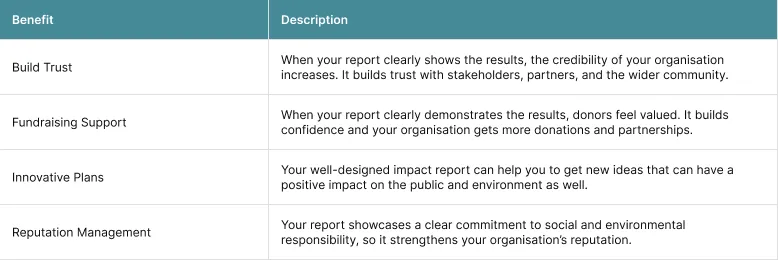
Your impact report is a powerful tool for nonprofit organisations. It shows your commitment to social responsibility. It also builds trust with investors and supporters.
Following are the key benefits of impact reporting:
How to Get a Real Engagement on Impact Report?
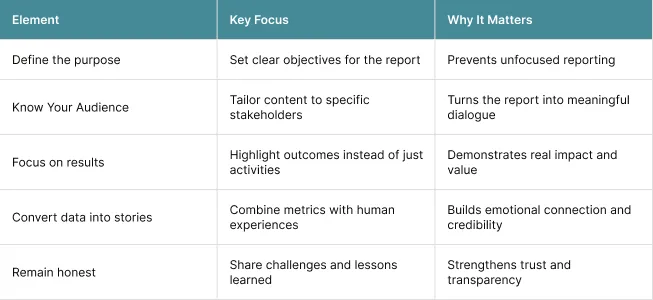
Engagement on impact reports play an important role. The best way to get desired engagement is by converting your data into stories. Clearly define the purpose and focus on outcomes.
You should also know your audience and always be honest about the challenges. It will attract your stakeholders. Table below shows the key elements to get real engagement:
Let’s explore these key elements in more detail below:
It helps you shape your content strategy. You can also read our blog on how to build your content strategy.
Your audience may include:
Your activities describe what you did. For example:
Focusing on results shows true value and builds donor confidence. It also proves long term impact. Activity on the other hand just lists numbers and short term actions.
Investors care less about how much you do and more about the difference your work makes. Good reporting links actions to results. It shows how specific initiatives led to meaningful change.
A helpful way to check this is the ‘so what?’ test:
Humanising your data means pairing numbers with real experiences such as:
A useful outline for storytelling is in the 4 Ps:
The way you design and visualise information makes your report persuasive. It convinces the sponsors to read, trust and act on your report.
The table below shows the principles and its impact:
1. Define the Purpose
The first step is to define the purpose. It gives you clear results because without a clear purpose reporting becomes unfocused. An effective impact report serves five key purposes.- It builds trust with donors and shareholders
- It supports fundraising
- It guides internal reflection and strategy
- It strengthen contacts with donors
- It shows liability to board members
2. Know Your Audience
Knowing your audience helps to add clarity in your report. Impact reports are effective when they are tailored to a target audience.It helps you shape your content strategy. You can also read our blog on how to build your content strategy.
Your audience may include:
- Donors and funders: They want to see real impact.
- Board members: They care about strategy and influence.
- Partners: They want to see shared results.
- Beneficiaries: They want recognition and a voice.
3. Focus on Results
The most common mistake you make in reporting is focusing on activities. Your focus should be on the results of these activities. Focus on results because they drive change.Your activities describe what you did. For example:
- We distributed 2,000 books.
- We delivered 70 training sessions.
- Literacy rates improved by 30% in the district.
- 80% of participants gained employment.
Activity vs Results in Impact Reporting
There’s a difference between activity and real impact. Activities are what you do, while results are the changes those activities create.Focusing on results shows true value and builds donor confidence. It also proves long term impact. Activity on the other hand just lists numbers and short term actions.
Investors care less about how much you do and more about the difference your work makes. Good reporting links actions to results. It shows how specific initiatives led to meaningful change.
A helpful way to check this is the ‘so what?’ test:
- What changed?
- Why does it matter?
- Who benefited and how?
4. Convert Data into Stories
Your report combines evidence and emotion. Data gives credibility but stories create connection.Humanising your data means pairing numbers with real experiences such as:
- Beneficiary stories
- Testimonials
- Case studies
- Quotes from staff or partners
A useful outline for storytelling is in the 4 Ps:
- People: Who is involved or affected?
- Places: Where is the change happening?
- Purpose: Why does this work matter?
- Plot: What changed over time?
5. Remain Honest About Challenges
Truth is central to effective reporting. Sponsors understand that meaningful change is complex. When you are honest about your challenges, it helps you in following ways:- It builds transparency and credibility
- It shows accountability
- It helps you improve
What are the Principles of an Impact Report?
The principles provide you the framework of the best practices. It helps you continuously improve.The way you design and visualise information makes your report persuasive. It convinces the sponsors to read, trust and act on your report.
The table below shows the principles and its impact:
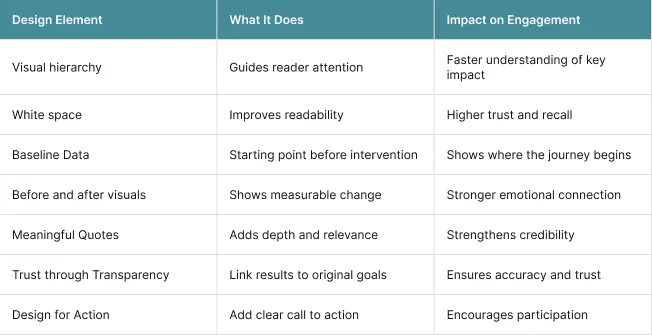
Your inspiring stories can fall flat if the design of your report does not support them. The following discussion explains how these principles make your impact report attract investors.
How to apply visual hierarchy:
White spacing is one of the some common mistakes that make your report less appealing. Want to know how to avoid graphic design mistakes in your report? Read our blog on graphic design mistakes.
Most of the companies feel pressured to fit everything. It results in layouts that overwhelm readers.
The following are best practices for white space:
To show real change, your impact report should include the following:
Without context, numbers feel abstract. With it, they become evidence.
This approach works well for:
Strong quotes should:
Your design choices should bring clarity by:
1. Visual Hierarchy
It shows what the reader notices first, second and third. It helps them decide if they want to read the report.How to apply visual hierarchy:
- Use larger font sizes and bold styling for key results
- Highlight critical figures
- Group related content together
- Make section headings clear
2. Strategic White Space
Strategic white space means a clear message. It is about less or more content. White space is often underlooked in impact report design. The design and graphics of any report matters.White spacing is one of the some common mistakes that make your report less appealing. Want to know how to avoid graphic design mistakes in your report? Read our blog on graphic design mistakes.
Most of the companies feel pressured to fit everything. It results in layouts that overwhelm readers.
The following are best practices for white space:
- Use separate sections
- Avoid overcrowding pages with text and visuals
- Let key data points breathe so they stand out
- Use margins and line spacing
3. Baseline Data
Presenting numbers without context is one of your biggest weaknesses. Metrics alone do not prove impact but comparison does.To show real change, your impact report should include the following:
- Baseline data: where you started
- Trend data: how things evolved
- Benchmarks: how performance compares externally
- School attendance increased from 72% to 81% over 11 months
- Carbon emissions reduced by 28% compared to last year
- Programme reach doubled compared to the pre-intervention baseline
Without context, numbers feel abstract. With it, they become evidence.
4. Before and After Visuals
Before and after visuals make your report appealing. It also makes your report emotionally appealing. They clearly show how your company’s work created change over time.This approach works well for:
- Development projects for the public
- Initiatives for education and health
- Environmental and social programmes
- Capacity building efforts
- Pair short reports with visuals
- Clearly add before and after
- Emphasise results, not effort
- Keep the data realistic
5. Meaningful Quotes
Sharing quotes helps add more meaning to the reports. You can use the quotes for impact not just for praising. The common praise adds little value and can reduce integrity.Strong quotes should:
- Explain why something is important
- Provide vision into lived experience
- Add context to data and results
- Highlight the changes
6. Trust Through Transparency
Trust is the central key to reporting. Your stakeholders want that data is accurate. It should acknowledge the challenges. Your report progress should be honestly reported.Your design choices should bring clarity by:
- Clearly linking results to original goals
- Including sections on lessons learned
- Avoiding inflated visuals or misleading scales
- Presenting data consistently across the report
Quick Tip
Always link every visual or chart back to your goals. Clarity comes from showing how each result matters.
7. Design for Action
Your impact report should drive engagement. It does more than just sharing the information. It helps to invite participation.To support this, include the following in your report:
- Place clear calls to action throughout the report
- Use visuals to guide next steps
- Link to deeper content, case studies, or donation pages
- Design digital reports with easy navigation in mind
Why Design Matters
Your impact report design is your strategic tool. Visual order, white space, contrast and storytelling work together to:- Increase readability
- Build trust
- Improve knowledge
- Drive stakeholder action
Conclusion
The true value of the impact reporting is what your company is doing. The change it creates matters the most.You can build a trusted relationship with stakeholders with the help of your report. It leads you towards a long term relationship with them.
XoomPlus understands the importance of the social impact report for companies and non profit organisations. If you want a perfect, observed, shared and acted upon report, contact us today.
Is your impact report failing to capture attention or drive real action?
We have been helping companies transform data heavy reports into clear, engaging impact stories that build trust and inspire stakeholders.
Contact us today to turn your impact report into a tool people actually read and act on.
Faqs
Ans. An impact report is the company's annual Journal that shows its performance and the impact of its input on people's lives.
A strong impact report should be accurate, consistent, and visually well-structured. Using clear branding, accessible layouts, color-coded sections, and high-quality visuals helps communicate your message effectively and keeps readers engaged from start to finish.
Any company looking to measure and communicate the results of its initiatives can create an impact report. This includes nonprofits, corporate CSR teams, foundations, and social enterprises across all sectors.
Impact report design plays a vital role in engaging stakeholders and informing decision-making. By presenting complex data in a clear, visual, and accessible way, a well-designed report builds understanding, trust, and confidence among investors, funders, and key audiences.
A professional impact report designer can transform your report from a basic document into a compelling and persuasive communication tool. Whether you are a charity, corporate company, or social enterprise, expert design helps present your impact clearly, strengthen credibility, and increase stakeholder engagement.