
- May 8, 2026
- Categories: Digital Marketing
Modern Content Audit Guide for SEO-Driven Growth
Do you want to maintain current and relevant content on your website?
Posting content on a website in today’s modern online world is more complex than simply publishing it and moving on. It needs proper attention and is a continuous process.
You can see that the AI algorithms and search engines are constantly changing and developing. Therefore, businesses should make sure that their content stays relevant, useful and consistent with what people are looking for. This is what an SEO content audit can help you with.
In 2025, zero-click searches were responsible for about 58–60% of all searches on Google. These are queries where people get answers directly on the search page. This implies that they don’t click any links. As a result, old organic traffic is declining.
An SEO content audit shows the importance of structuring your content properly. Without a good structure, your content will not rank.
It’s more than a simple evaluation of your website. In addition, it’s a complete process of analysing and enhancing your content. So your site can perform better and support your lasting growth.
In this blog, you will understand what an SEO content audit is and its importance for modern SEO. You will also know how to perform this process in a structured and practical way.
Key Takeaways
- An SEO content audit helps you review all pages, find weak areas, and improve content to bring better traffic and results
- A content audit SEO process should start with clear goals, a full content list, and key data like traffic, bounce rate, and conversions
- Understanding what a content audit is means knowing it checks quality, relevance, and how well content meets user needs and business goals
- Regular content audits help keep your site fresh, remove outdated pages, and improve user experience over time
- Using expert content audit services can help you find gaps, fix issues faster, and build a strong, long-term content plan
- A proper content audit also includes checking search intent, fixing technical issues, and updating pages to match what users expect
What Is an SEO Content Audit?
When you upload any content to a website, an SEO content audit is used to thoroughly review that material. This can be in the form of product pages, landing pages, blog posts and any other visual or written information.
The main focus of this system is to look at the major factors, such as the following:
Effectiveness
This process checks the performance of the content by analysing whether it is generating engagement, conversions and traffic.Quality
This factor assesses the depth, precision and value of the content.Relevance
It makes sure that the content matches the business goals, audience demands and latest trends.Matching With User Intent and Business Objectives
This factor determines whether the content is properly fulfilling both your business missions and the audience.
When you conduct content audits, you understand what is working well and what is poor. It also finds out what areas need enhancement. With the help of this, you make informed decisions that can optimise your content approach.
However, content audits are more than simple checks in today’s SEO. It finds out the ways to rank your content by determining how AI systems and search engines interpret it.
Some key factors help figure out how well your content can be found and viewed by search engines and readers. These elements are usefulness, authority, structure and clarity.
This is the reason that a detailed audit looks at more than just the content quality. It also focuses on its ability to work well in an ever-more highly competitive online setting.
Content audits are no longer optional. They are essential for understanding what truly adds value to your audience and what holds your site back. The real growth comes from refining what you already have, not just creating more. Dixon Jones
Why SEO Content Audit Matters?
Content audits have become more important than ever in today’s digital world. It’s not enough to just create additional content. The reason is that there is an increase in the amount of AI-generated content and the number of web pages.
In reality, your website’s performance can fall if your content overlaps which has too much low-quality material.
However, if the content audit is carried out correctly, it corrects these shortcomings. It does so by enhancing the quality of the content and streamlining methods. It also keeps your website up to date with the most recent SEO trends.
The following paragraphs show how a content audit can improve the SEO quality of your site:
Manage Content Overload
A website can have hundreds or thousands of web pages as it grows in rank. Over a period of time, issues like duplicate content or stale data can crop up. You may also run into issues, such as the likelihood that your website contains unneeded pages.
If you are handling a large website, your content can become disorganised easily. This will result in a drop in user experience and search engine crawlability.
An SEO content audit will help you plan and refine your content. It assures that every page is accurate, helpful and useful to meet the goals of your site.
Once you find the duplicate and outdated pages, you can reduce the clutter. In this manner, search engines will find it easier and more efficient to crawl your website. You will improve your rankings when you do all of this.
Identify Underperforming Content
All pages of a website are not created equal. Some pages may have difficulty trying to achieve high visibility or result in conversions. On the other hand, some may receive a considerable amount of traffic.
The pages that are not performing well can:
- Waste resources of crawling
- Take the total quality indicators off your website
- Whether to upgrade them
- Combine them with higher-performing pages
- Remove them completely
A content audit SEO helps you detect which pages on your website are poor and need tweaks for top rankings.
Improve Content Quality
All content does not deliver the actual value to your audience. Some pages may be shallow, thin or unable to provide in-depth answers to visitors’ queries. A blog post might just touch on a subject. This will upset the people and they might leave your page.
In such situations, an SEO content audit is helpful. Its reason is that it can improve the quality of your content by finding the areas that need growth.
Adding more info or providing current data, an audit confirms that your content delivers real value. It also enhances the page’s structure when necessary. To rank higher in search results and attract your audience, optimised content is very important.
A content audit SEO is a must so that you are sure you have quality content that’s relevant and optimised.
Related: Quality SEO content guide
Prevent Keyword Cannibalisation
Cannibalisation is when two or more pages on your site are focused on the same keyword or search intent. This confuses search engines and leads to a lower ranking.
In short, when you have multiple pages competing for the same keyword, they will cancel each other out in ranking. This causes a decline in the visibility of your content.
An SEO content audit can figure out these cases of keyword cannibalisation. With the help of this, you relocate and combine pages holding the same keyword. This way, you focus on fewer but more authoritative pages for each keyword. This will finally improve your website’s performance.
Find Content Gaps
If you want to enhance the quality of your content, it is important to improve the existing one. Sometimes, the most significant opportunity is found in what needs to be added more. You can find gaps in your content strategy with the help of an SEO content audit.
There might be some questions or topics that are missing in your material. Once you determine these gaps, you will make fresh content that will fulfil the needs of your audience. This will also fulfil a specific need in your industry.
By doing this, you will be able to beat the competition and give your users more value.
When the search intent develops, it’s good to be active in content creation. This assures that your website stays relevant and trustworthy.
Support AI and Modern Search
AI tools and search engines, such as Google’s RankBrain, have shifted towards clear and concise content as tech has developed. These platforms also choose authoritative content.
They pay attention to offering results that give a direct answer to people’s searches. This makes it mandatory for sites to keep up with these expectations.
For this process, an SEO content audit is an integral part. It makes sure that the structure of your content is good with bullet points and headers. Also, it provides clear answers to the queries of visitors.
Moreover, if you focus on reliability and quality, the chances of ranking increase in search engines. This allows for the integration of AI-powered tools with the content.
Why It Matters!
content audit helps you focus on quality over quantity. It ensures your website stays useful, relevant, and aligned with what users are actually searching for.
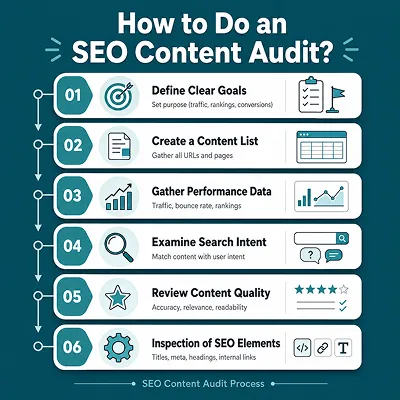
How to Do an SEO Content Audit?
A planned strategy assures that the content audit is both reliable and practical.
At first, you will explore that conducting an SEO content audit is complex. However, if you break down this process into different steps, it will become more successful and easier to handle.
The steps to do an SEO content audit are explained below:
1. Define Clear Goals
Every successful SEO content audit starts with a specific purpose. When there are no clear aims, assessing success or assigning importance to actions is difficult.
So, you must ask these questions of yourself:
- Do you want to improve search rankings
- Are you trying to increase the engagement
- Are you interested in refreshing the outdated content
Learn how to develop an SEO content plan that fits in with your goals and produces real results.
2. Create a Content List
After defining your objectives, you have to combine all the current content somewhere. This includes:- Types of content (product pages, blogs, landing pages)
- Page titles
- Meta description
- URLs
3. Gather Performance Data
After preparing your inventory, add performance metrics to it. This is where data starts to impact your decisions. This includes:- Time on page
- Bounce rates
- Conversion rates
- Traffic
- Engagement rates
4. Examine Search Intent
The next step is to decide whether your content matches up with user intent after looking at its performance. You must consider:- Is the answer relevant to the query of the user
- Is the format according to the search type
- Does it deliver proper value and depth
5. Review Content Quality
Now, you must focus on the quality of the content. For this purpose, go through each page for:- Depth of information
- Structure and formatting
- Quality and relevance
- Clarity and readability
6. Inspection of SEO Elements
To make sure your content is properly optimised, you must review the main on-page SEO parts at this stage. These checks include:- Internal linking
- Use of keywords
- Header layout (H1, H2, H3)
- Meta Descriptions and page titles
Detect Technical Issues
The factors that affect the performance need to be checked. Thus, as part of your audit, you must look for:- Crawl and indexing Issues
- Mobile usability problems
- Broken links
- Slow page speed
Organise and Prioritise Content
Once you have done your analysis, you should tag the content with the action that is required. Here are a few examples:| Keep | Update | Merge | Remove |
|---|---|---|---|
| High-quality, relevant | Content that requires revisions | Overlapping or similar pages | Outdated or poor-quality content |
Setting priorities for each task will help you focus on the changes that will yield the best results.
After you’ve done the audit, a content audit checklist can help you arrange your findings. It also aids in determining which pages need the highest level of care.
Create an Action Plan
Organise and prioritise tasks, then create a step-by-step plan to carry out changes. This must include:- Deadlines
- Specific tasks
- Assigned duties
Execute and Track Changes
You have done all the steps and the last one is to act and watch the results. When you implement updates, you must:- Adjust your strategy where required
- Observe performance metrics
- Track progress in engagement and rankings
When you have done a content audit SEO, you will be able to optimise your website. Its purpose is to meet the needs of both user intent and search engines.
Perform a content audit checklist to monitor each step and ensure you cover all the bases.
Pro Tip
Don’t try to fix everything at once. Start with high-impact pages that already get traffic, then improve low-performing pages step by step for better results.
When to Do an SEO Content Audit?
It is vital to do an SEO content audit in order to maintain and protect the health of your website. However, you have to realise that it’s a continuous process.
This is an ongoing task to ensure your content is updated and relevant. This audit also makes sure that your content is consistent with your SEO goals.
When an SEO content audit should be conducted is described below:
Initial Audit
The first step in any SEO campaign is a thorough audit of your current content. It gives you a clear basis to help you know what’s working well and what needs to be improved.
It lays the foundation for your content creation and SEO strategy. The main focus during this initial audit is to identify high-quality and low-performing pages. The purpose of finding these underperforming pages is to remove or optimise them.
Regular Audits
Regular audits are necessary to keep your content fresh and optimised. An audit is necessary after the following:Every 3 to 6 Months
To identify quick wins and enhancements, it is important to conduct light audits. The pages that need minor revisions require the attention of the audits. For instance, you might refresh outdated information, improve readability or optimise the meta-tags.Every Year
If you are going to do a thorough audit, it should be done annually. This audit addresses all the details, such as looking for content gaps and assessing the effectiveness of internal linking.
It also reviews the performance of pages from the viewpoint of SEO.
Reactive Audits
Often, content audits are vital in response to specific issues or major external changes affecting website performance. These include:Traffic Decline
In case you noticed a rapid drop in traffic, an SEO content audit can be very helpful. It looks for the pages that might be influenced and need quick attention.Ranking Changes
When major alterations in keyword rankings occur, it shows that some of your content is no longer optimised. It also indicates that your material is no longer consistent with the best practices of SEO.Algorithm Updates
Algorithms of the search engines change from time to time. So, whenever any update happens, it is important to audit your content. This guarantees that the content is according to the latest guidelines.User Behavior Changes
If any change in the behaviour of the visitors occurs, you can take help from a content audit. This change can be a greater bounce rate or less engagement.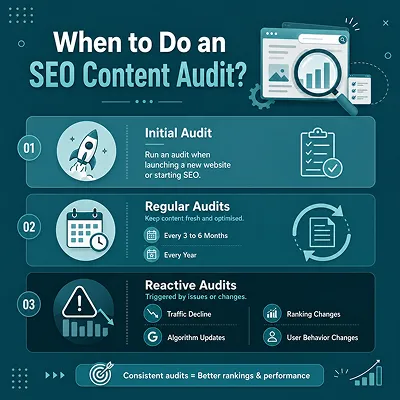
How to Collect Data for a Successful SEO Content Audit?
You must have accurate performance data to assess content properly. This evaluation can provide a clear picture of how each page is working.
It is difficult to make informed decisions without this information. Also, without this, you will not be able to figure out where changes are required.
When an audit checks the metrics of the content, it does not provide only numbers. It describes a story about how visitors engage with your content.
These important metrics are the following:
Traffic and Impressions
Traffic and impressions tell how much visibility your content has. On the other hand, clicks mean whether your descriptions and titles are appealing enough to draw in people.Engagement Rate and Time on Page
Time on page and engagement rate assist in grasping whether people are exploring value in your content.Bounce Rate
A high bounce rate tells us about the pages where visitors lose interest quickly.Conversion Rate
Conversion rate directly ties content performance to business results. It shows whether your content is generating significant actions.
Patterns start to develop when you analyse this data together. If the traffic is high but the engagement is low, this shows that the content is attracting the wrong audience. It also indicates that the content is unable to fulfill the expectations.
Also, when you notice strong engagement but low conversions, this shows problems with the CTA or the user journey.
With the help of this information, you can identify which pages are working well and where attention is needed. After the audit, you focus on significant revisions and give priority to updates.
Once you conduct the audit, you can make smart decisions that support ongoing SEO-powered success.
A content audit checklist can help you gather the vital data. For example, traffic, engagement data and keyword efficiency can be used to assess the performance of your content.
Case Study: Enhancing Website Performance With a Quality SEO Content Audit
A marine company located in the UK was looking for an SEO content audit to enhance its site’s performance. They wanted this because their content was old and it was not ranking higher. The main thing that they aimed for was to upgrade the user experience and raise qualified traffic.
They were looking for a way that can provide greater marketing results through high-quality content.
To understand the issues thoroughly, a full SEO content audit was conducted. All the pages were examined carefully. The site was also compared with the top-ranking competitors to check gaps in the keyword targeting and content.
The audit mainly focused on the quality of the content and keyword opportunities. Besides this, the process also included checking the internal linking structure and technical SEO issues.
After this, a step-by-step content plan was carried out. This plan focuses on filling content gaps, creating new blog content and updating existing pages.
Furthermore, some editing was done to make it repurposed for social media and email to achieve reach.
After fixing all the issues with the help of the SEO content audit, the results were amazing. Within six months, it started showing a positive outcome. Ranking keywords increased by 96% and organic traffic rose by 180%.
People started spending more time on the site and user engagement also grew. Due to the newsletter, more traffic was achieved and was spread broadly on LinkedIn. It helped expand audience reach.
This real-life example indicates how an SEO content audit provides growth when combined with clear action.
Final Thoughts
A modern SEO content audit is not just about reviewing the pages. It’s more than that. It is a step-by-step method to improve user experience and enhance the quality of the content. You can also achieve lasting SEO performance with this audit.
You can make smarter decisions that result in growth by looking at what is performing well and what’s not.
With the help of this, you can gain trust with your audience, improve relevance and fix technical problems. Meanwhile, it focuses on new opportunities, whether it’s creating something fresh or updating the old content.
An SEO content audit becomes a vital component of your whole digital approach if you do it regularly. It verifies that your content is aligned with user intent and stays useful. Also, it makes sure that your material is consistent with your business aims.
At Xoom Plus, we know how to plan and carry out an efficient SEO content audit. We understand the value of the content that results in real SEO outcomes.
If you have to enhance the performance of your site and grow efficiently, contact us now.
Struggling to keep your content relevant and performing well?
We help businesses improve SEO and content through clear, data-led audits.
We have helped many brands boost traffic and engagement with proven strategies.
Contact us today.
FAQs
What are content audit services?
Content audit services involve a detailed review of your website content to assess its quality, relevance, and performance. These services help identify weak pages, content gaps, and opportunities to improve SEO and user experience.
Why is a content audit important for SEO?
A content audit helps you understand which pages are performing well and which need improvement. It allows you to update outdated content, fix issues, and ensure your website stays relevant, useful, and aligned with user intent.
How often should you do a content audit?
Most websites should do a content audit every 3 to 6 months. Large or fast-growing sites may need more frequent checks. Regular audits keep your content fresh and effective.
Can ChatGPT do an SEO content audit?
ChatGPT can support an SEO content audit by analysing content quality, structure, keyword use, and readability. However, it cannot access live website data like traffic, crawl errors, or rankings. For a complete audit, you should combine ChatGPT with SEO tools such as analytics platforms and audit software.
Which tool is best for a website SEO content audit?
There is no single best tool, but some of the most effective ones include Screaming Frog SEO Spider for technical audits, Ahrefs Webmaster Tools for backlinks and site health, and Google Search Console for real search performance data. These tools together give a complete view of your website’s SEO performance.