
- March 31, 2026
- Categories: Digital Marketing
Voice Search SEO: A Complete Beginner’s Guide
Hey Siri, find me the best pizza shop nearby.
This is how people search information online in today’s world using voice search SEO. If your business is not part of that answer, you are already behind.
Voice search is not something new and is now a normal part of daily life. This is used every day by people to interact with technology. They speak instead of typing into a search bar. They speak to their cars, smart speakers, phones or home kits.
Voice search is not something new and is now a normal part of daily life. This is used every day by people to interact with technology. They speak instead of typing into a search bar. They speak to their cars, smart speakers, phones or home kits.
This change is not limited to how people search but also to how businesses share their information online. Voice search SEO is increasingly crucial for businesses to stay visible in this new search environment.
Voice Search SEO is the process of adapting your website and content. They can be easily found and used when someone performs a voice search. It looks at how people speak instead of typing and applying SEO for voice search ensures your site is optimised for these queries.
In this guide, you will learn:
- An understanding of voice search technology and how it works
- The benefits, characteristics and importance
- The growth of voice search and how it varies from traditional search
- The role of artificial intelligence and content
- New trends and the future of voice search
What Is Voice Search and How It Works?
The user can perform searches by speaking instead of typing using voice search. It works through a system called Automatic Speech Recognition (ASR). This ASR technology converts the voice queries into a text. Search engines check the text and find the best match, making voice search and SEO integration critical for content visibility.
This whole process happens within seconds. A user asks a question, the system reads it and the tool gives an answer and often reads it aloud.
Google Assistant, Siri and Alexa are voice assistants that play a crucial role in the entire process. These systems are designed to understand how we speak in real life. This means they can interpret full sentences instead of just keywords.
The Growth of Voice Search
In the past few years, there has been a rapid increase in voice search. Now, millions of people use voice assistants daily.Increasing Adoption Worldwide
The number of voice enabled devices keeps going up across the world. Billions of these devices are set to be in use. This growth is due to better voice recognition technology. A major role in the growth of voice search is played by the extensive use of smartphones and smart speakers. The implementation of voice search SEO makes sure that businesses remain easy to find on all devices.Common Daily Uses of Voice Search
Voice search is used for many day to day tasks, such as:- Finding information
- Getting directions
- Checking business hours
- Making purchases
- Playing music or setting reminders
Voice search is mostly used by people who cannot type. It is also used when they are busy, such as driving, walking or cooking. An important reason for the growth of voice search is its ease of use.
How Voice Search Differs from Traditional Search
The traditional search and voice search are different based on the following points:1. Natural Language vs Typed Keywords
The key difference between voice search and traditional search is how people ask queries.
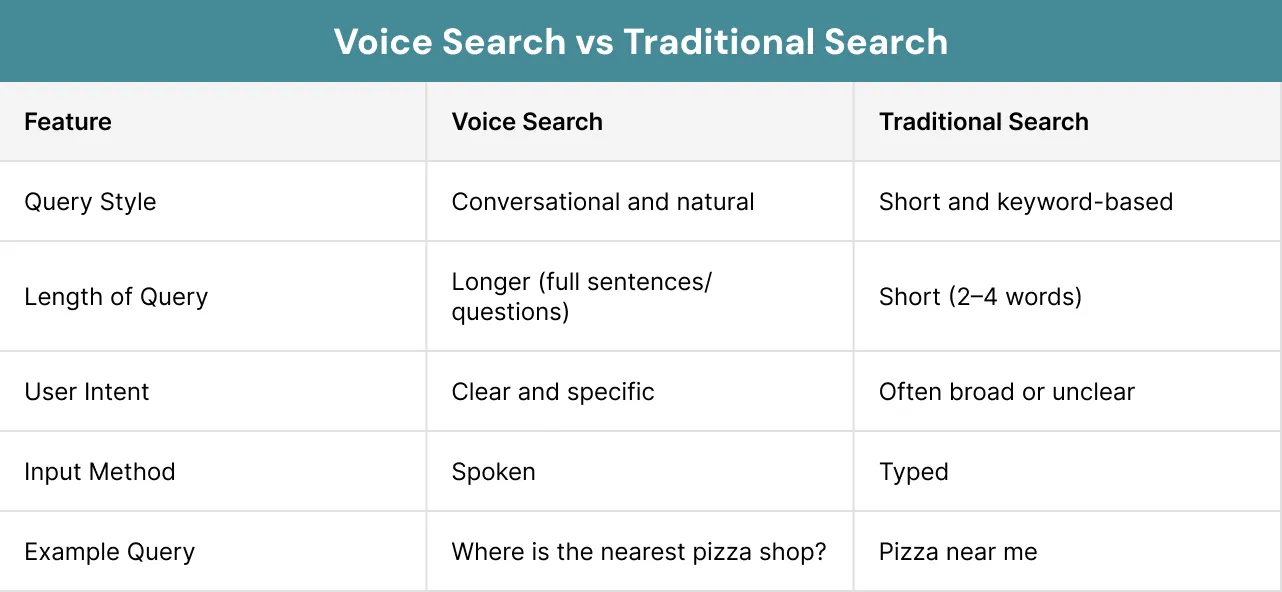
People use short and broken phrases when they search by typing. For example, someone may type “pizza near me.” But when they speak, the same user is more likely to ask, “Where is the nearest pizza shop?” This explains the importance of SEO voice search in spoken queries.
Voice searches are:
- Longer
- More conversational
- Often asked as questions
- Clearer and more accurate
Ask Yourself
Is your content easy to understand when read aloud? If not, it may not perform well in voice search results.
2. Clearer User Intent
Voice searches often show clear intent. When users ask full questions, it becomes easier to know what they actually want. For example:- “What is voice search?” means the user wants information
- “Find a plumber near me” means the user wants a local service
- “Order a large pizza” shows a person wants to make a purchase
Voice Search vs Traditional Search: Key Differences at a Glance
Key Characteristics of Voice Search Queries
The basic characteristics of voice search are mentioned below:1. Conversational Nature
Voice search questions sound like real conversations. People speak to their devices as if they are talking to a person. This shows why voice search and SEO are important for content. This means content needs to reflect natural speech patterns.2. Use of Questions
Most voice searches begin with question words such as:- Who
- What
- Where
- When
- Why
- How
3. Long Tail Queries
Voice searches are mostly longer than typed searches. These longer sentences are known as long tail keywords. They may have lower search volume but they often show clear intent.How Artificial Intelligence Shapes Voice Search
The smarter search engines and changing search behaviour plays an important role for implementing artificial intelligence in voice search.1. Smarter Search Engines
Today’s search engines use Artificial Intelligence (AI) and Natural Language Processing (NLP) to read what people ask. They do not just match keywords. Voice search SEO helps websites stay aligned with these AI powered search results.
AI systems can now:
- Understand complex queries
- Interpret conversational language
- Provide direct answers and not just links
2. Changing Search Behaviour
Traditional search is becoming more similar to voice search with improvements in AI. Users now type longer and more natural queries. This means the gap between voice and text search is slowly decreasing.Voice Search SEO Benefits
After learning voice search and its basics, it is now important to know benefits of voice search SEO.1. Increased Visibility
Voice search helps firms to target users who do not use traditional search methods. Implementing voice search SEO increases visibility and makes it easier to find your content.2. Improved User Experience
The optimisation of your website for voice search can work as a better tool. Using SEO for voice search strategies can help deliver faster, clearer and mobile friendly content. A strong presence can also boost brand authority and accessibility.
Key Point
Voice assistants usually give only one answer, not a list—so your content needs to be clear, direct and highly relevant to win that spot.
3. Stronger Brand Authority
When your content is selected as an answer by a voice assistant, your brand appears to be a more trusted source of information. This helps in building trust and a good name.4. Better Accessibility
Voice search makes the content easier for users with disabilities. It also makes it easier for those who prefer spoken interaction over typing.Content Strategy for Voice Search SEO
The content for voice search plays an important role for voice assistants to choose against queries. It starts with building a good strategy for voice queries instead of typed ones.1. Writing for People, Not Machines
Content for voice search should sound natural and easy to read. Using comprehensive voice SEO guides can help businesses create content that matches conversational queries. It is better to avoid complex and technical words where possible.
A good way to write is like you are answering a question directly in a chat.
2. Clear and Short Answers
Short and direct answers are preferred by voice assistants. Ideally, answers should:- Be easy to understand
- Provide immediate value
- Avoid unnecessary detail
3. Understanding User Intent
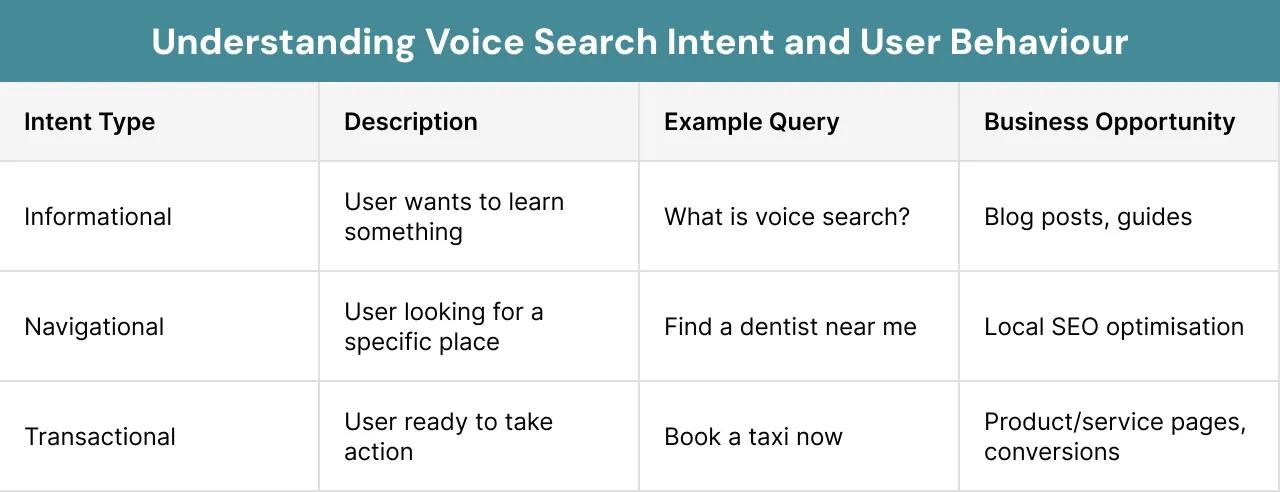
User intent is at the heart of voice search, which refers to the reason behind a query. This helps you create content that matches what users are looking for.
The basic types of intent are:
- Informational (seeking knowledge)
- Navigational (finding a specific place or website)
- Transactional (ready to take action)
Understanding Voice Search Intent and User Behaviour
4. Using Natural and Simple Language
Content should sound like everyday speech, written in a chat style. The proper use of voice search and SEO helps content match the way people ask questions.
The aim is to make it sound more natural when spoken out loud. A readability level similar to normal talk works best.
5. Structuring Content Clearly
Well organised content is easy to read and understand. A good approach for voice search SEO is:- Ask a clear question
- Give a short and direct answer
- Follow with additional explanation
6. The Role of FAQ Content
FAQ sections are highly useful for voice search. They present information in a question and answer format which closely matches how users ask queries.
A short and direct answer is required for each question. The layout used should make the voice search SEO content clear and easy to read.
Keyword Planning for Voice Search SEO
A good keyword planning is required to answer what people are asking in voice queries.1. Long Tail and Conversational Keywords
Keyword research for voice search is different from normal SEO. It relies on voice search SEO, long tail and conversational phrases. A large portion of voice searches are asked as questions, making SEO for voice search particularly effective.
For example, instead of “CRM software,” a voice search query may be “What is the best CRM software for small firms?”
These longer searches show clear intent even if fewer people use them. This means users are more likely to act after they find the answer.
2. Question Based Keywords
A large portion of voice searches are asked as questions. These searches usually start with “how”, “what”, “where”, “when” and “why.” Making content that answers these questions helps match how users use voice assistants.
Question based headings and clear answers should be used in your voice search SEO content. This helps search engines to find and use your content more easily.
3. Know Different Search Behaviours
Search behaviour can change with age. Some users prefer detailed queries while others use short and quick searches.- Older users tend to use longer and more specific queries
- Middle aged users combine detailed and general searches
- Younger users often use shorter, conversational or even fragmented queries
- The youngest users increasingly rely on voice and quick interactions
Technical SEO for Voice Search
If the website is not technically optimised then the best content can fall short. A strong technical foundation is very essential to get full benefit from voice search.1. Page Speed and Performance
The users of voice search expect immediate answers. A slow website can lower the chances of your content being used. Optimising for voice search SEO helps pages load faster, improves mobile friendly use and keeps users happy.Technology is best when it brings people together. — Matt Mullenweg
The loading speed of a website page is an important factor. Websites must load quickly and content should appear without any delays.
Heads Up
Slow-loading pages are less likely to be used for voice search results. Speed directly impacts visibility.
2. Mobile Optimisation
Mobile phones are used by most people for voice search. For a smooth experience, a website must be mobile friendly.
This includes:
- A responsive design
- Navigation across the website must be easy
- The content should be readable without zooming
- Very few interruptions, such as pop ups
3. Secure and Accessible Websites
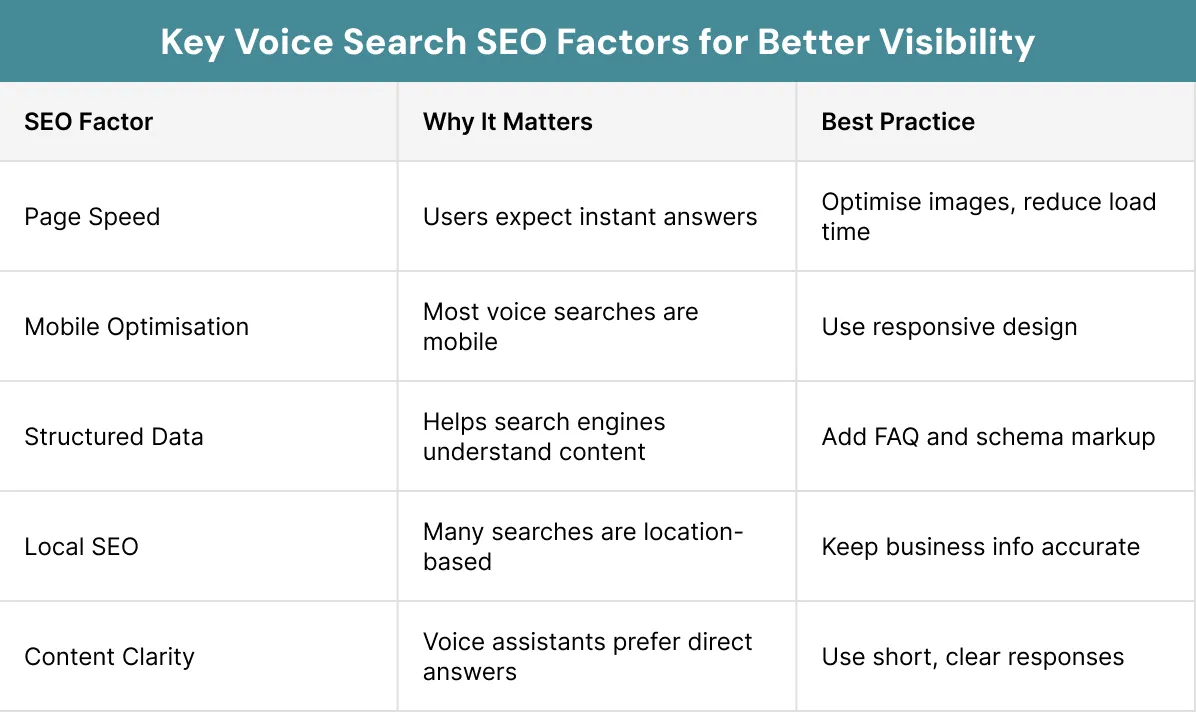
Security is key. Websites should use HTTPS to keep browsing safe and content must also be easy for search engines to read and translate. This helps in finding your pages and using them as answers.Key Voice Search SEO Factors for Better Visibility
Structured Data for Voice Search
A well structured information is used by voice assistants to provide clear and accurate answers to voice queries.1. What Is Structured Data
Structured data refers to a type of code on your website. It helps search engines to understand your content better and shows what your content means.2. How It Supports Voice Search
This data helps search tools pull out key details to show as direct answers. It is useful for voice search where quick replies are needed. Examples are:- FAQ details
- Business info
- Step by step guides
Local SEO and Voice Search
A large number of voice queries are made with local intent, making local voice search SEO an important part for how your business appears in results.1. Importance of Local Optimisation
Voice search is tied to local intent. Users look for nearby shops or services. These searches often lead to fast actions, like visiting a shop or making a call.2. Key Local Elements
Firms should provide correct and consistent details to support local voice search. Using voice search SEO raises the chance of showing up in local voice results. This includes:- Name
- Address
- Phone number
- Opening hours
3. Business Listings and Reviews
Local directories and business profiles are key for voice search results. Tools like Google Business Profile and Yelp give data to voice assistants. Reviews and good feedback also shape user choices. They build trust and help users pick your business. More than 58% of users use voice search to find nearby businesses. This makes local SEO important for visibility.Image and Multimedia Optimisation
The content is not just about words. Visuals can play an important role in how search engines understand your website.1. Importance of Visual Content
Search engines also look at images and videos. A well set up image helps the system grasp content better.2. Key Elements
A clear file name and alt text give context to images. This helps search engines read visual content.Multi Language Voice Search
A multi language voice search is very essential to reach the larger audience.1. Searching in Native Languages
People mostly use voice search features in their own language. Optimising for voice search and SEO in different languages helps reach more users. It also helps to keep them engaged.2. Key Considerations
- Keyword research for each language is required
- Do not translate directly without adaptation
- The proper language targeting methods must be used
- The content must remain natural and like real talk
Monitoring and Continuous Improvement
After the implementation of voice search SEO in your website, continuous performance tracking and updates are required to stay effective.1. Tracking Performance
Voice search optimisation is not a one time job. It needs ongoing monitoring and updates.
Important areas are:
- Keyword performance
- Search visibility
- User engagement
2. Adapting to Change
Voice search keeps changing. New devices, features and user habits appear all the time. Businesses must stay updated and adjust plans according to changes in technology.The Future of Voice Search SEO
Voice search keeps growing with the improvement in technology. Future changes may include:- More accurate understanding of voice
- More use of AI generated answers
- Increased use of voice across devices
- More personalised search results
Real Life Example
An example of voice search SEO implementation is done by Domino’s pizza. They allow users to order through Google Assistant and Alexa. For example, a person simply says: “order my favourite pizza from Domino’s”.
The system understands the request, connects it with the past order of a user and finishes the process quickly. This works because Domino’s has well structured data and uses conversational queries. They also integrated their services on different voice enabled platforms.
Conclusion
Voice search has changed the way users find things online. It makes search feel more natural and like real talk where users want fast and clear answers.
New users should know that voice search SEO is different from traditional search. It looks at how people speak, what they want and how to keep content simple. Sites must also work well, load fast and be easy to use on a phone.
Local search matters a lot as many voice queries are about nearby places. So, it is vital to provide correct business details and have a strong online presence.
As technology grows, voice search will become part of daily life. Firms may have a higher chance of showing up in search results by making helpful, clear and easy to use content.
Voice search is not just a trend. It is a shift from traditional search to how people find information now. Long term online success highly depends on understanding and adapting to this shift.
Xoom Plus helps you improve your visibility with simple and effective voice search SEO strategies. Stay ahead by making your content easy to find and use. Contact us today to grow your online presence.
Ready to capture more traffic from voice search? Xoom Plus helps optimise your content for better visibility and smarter search performance.
Start optimizing your content today and stay ahead of the competition. If you need expert guidance, get in touch with our team to build a voice search strategy that delivers real results.
FAQs
How to do SEO for voice search?
Optimise your content with natural, conversational language, use question based keywords, improve page speed and focus on local SEO to ensure quick and accurate answers.
Is voice search better than typing?
Voice search is faster, hands free and uses conversational queries, making it ideal for quick answers, local searches and on the go users.
Does voice search use AI?
Yes, voice search relies on artificial intelligence and natural language processing to understand queries and provide accurate, contextual answers.
How does voice search SEO work?
The 4 Ps are product, price, place and promotion. In email marketing, these help shape clear offers, pricing value, delivery strategy and promotional messaging.
Which type of SEO is best?
For voice search, local SEO and conversational content optimisation are most effective, combined with technical SEO and fast, mobile friendly pages.