- November 3, 2025
- Categories: Digital Marketing
NLP in SEO: How Is It Reshaping the Future of SEO Content Strategy?
Did you know Google reported that natural-language (NL) queries increased by more than 60%?
People now use full questions, longer phrases and natural language when they are looking for information. Search engines also need to understand what those searches mean. This is where NLP in SEO becomes important in today’s world. Natural Language Processing (NLP) helps computers process and understand human language. In search, it can help systems understand the meaning, context and intent behind queries. Google has mentioned that understanding language is at the core of Search.
For SEO teams, this means content strategy needs to move beyond simple keyword use. A good page should answer the user’s needs, cover the topic clearly and use language that feels natural.
Key Takeaways
- NLP helps search engines understand meaning, context and user intent, moving search beyond simple keyword matching.
- SEO content should focus on search intent and semantic relevance, rather than repeating exact keywords throughout a page.
- Natural, clear and well-structured content matters more than keyword stuffing. Cover the main topic and related ideas in a way that genuinely helps readers.
- NLP-driven and AI-powered search is changing content strategy. Content should answer the main query while also addressing relevant questions and context users may need.
- The future of SEO is people-first. Businesses should combine keyword research with user intent, natural writing, strong content structure and useful information to stay competitive as search evolves.
What Is Natural Language Processing?
Natural Language Processing, or NLP, is a branch of AI that helps computers work with human language. People do not always write in the same way. They use short forms, questions and different sentence styles. We may also use one word with several meanings. NLP helps computers process these differences. For example, someone may search for ‘best accountant for a small business’. Another person may ask, ‘Which accountant should I use for my small company?’. The words are different, but the purpose is very similar.
In addition, Google introduced BERT into Search in 2019. Google explained that BERT helps its systems understand how words relate to each other in a query, especially in longer and more natural searches.
What Is the Role of NLP in SEO?
The role of NLP in SEO is closely linked to how search engines understand queries and web pages. In the past, search engines could rely more on matching words between a query and a page. Modern search uses more advanced language systems to understand combinations of words, meaning and context. Google has explained that BERT helps search engines understand how a combination of words can express a complex idea. This is why NLP in SEO should not be treated as a keyword trick. It is better understood as a way to think about how search engines process language and how content can meet the user’s real need.How NLP Is Reshaping the Future of SEO Content Strategy
The biggest change is the move from matching words to understanding meaning. Keywords still have a place in SEO. They help show what a page is about, but content should not be built around keyword repetition. Instead, writers need to understand the topic, the user’s question and the information needed to answer it. This makes NLP in SEO more important.1. From Keyword Matching to Understanding Search Intent
A keyword tells you what a person typed, while search intent gives you a better idea of what that person wants. Consider a user’s search for ‘VAT registration UK’; the user could want a basic explanation, the registration process, the current threshold or help with registration. A useful content strategy should explore the likely need behind the search. This does not mean adding every question to one page. It means choosing the right purpose for the page and answering it clearly. For content teams, this means the first question should be ‘What does the user want to achieve?’ Once that is clear, the writer can choose the right format, depth and examples.2. From Keywords to Semantic Search
Semantic search looks at the meaning and context of a search instead of relying only on exact words. It helps search systems understand that different words or phrases can relate to the same topic. For example, if a user searches for ‘Apple store near me’, the word ‘Apple’ could mean the fruit or the technology company. The rest of the query provides context to the search system.
This is another important part of NLP in SEO. Content should have enough context for readers and search systems to understand what the page is about.
3. Understanding Context and Entities
Words have meaning because of their context. Take the word ‘Apple’; it could mean a fruit or the technology company. The words around it help explain which meaning is intended. Search engines need to deal with this type of problem at a very large scale. Google’s explanation of BERT shows how its systems can use words around a term to better understand its meaning.
Entities are also important. An entity can be a person, company, place, product or organisation. For example, content about ‘Manchester’ could discuss the city, Greater Manchester, transport, football, universities and local businesses. These are different entities and topics that can be connected.
How to Adapt Your SEO Content Strategy for NLP-Driven Search
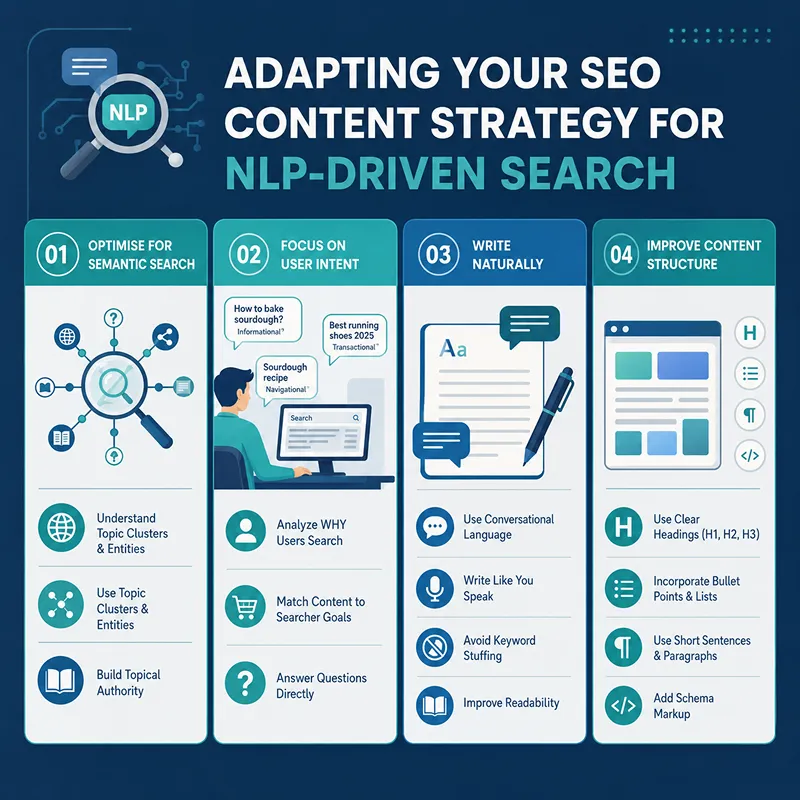
Adapting to NLP in SEO does not mean throwing away traditional SEO. It means using keywords as one part of a wider content plan. The process should start by understanding the user’s search intent and what they want, then build content that gives a clear answer. Below we explain how to adapt your SEO content strategy for NLP-driven search.1. Optimise for Semantic Search
You should start with one clear topic and then think about the main ideas that help explain it. If you are writing about UK business insurance, for example, you may need to explain different types of cover, who may need them and how businesses can choose suitable cover. The related ideas should support your main topic. They should not be added simply to make the page longer or to fill space. Google recommends creating content that is useful, original and satisfying for visitors. Its guidance also warns against producing content mainly to attract search traffic.2. Focus on User Intent
Before writing, ask why someone would search for the topic. Look at the search results and see what type of pages appear. If most results are guides, the query may have an informational purpose. If most results are product pages, the user may be closer to making a purchase. This does not mean copying the pages that already rank; instead, it means understanding the need behind the search. After that, create something that answers that need clearly and adds useful value.3. Write Naturally
Natural writing is easier to read and easier to follow for visitors. You should avoid forcing the same phrase into every paragraph. Use related words when they fit in the sentence. Use short sentences and keep your tone clear. Writing naturally also makes it easier to explain complex topics to readers who may not know the subject well.4. Improve Content Structure
A clear structure helps readers find information quickly. Use descriptive headings and keep paragraphs focused on one idea. Put the most useful information where readers can find it easily. In addition, tables can help when you need to compare two or more things. They should not be added just to make a page look different. Internal links can also connect related pages. This helps users move from one useful resource to another. Google’s Search guidance says websites should make content accessible to their systems so pages can be crawled, indexed and considered for search. It also highlights the importance of a good page experience.“High-quality content is something I’d focus on.”
– John Mueller
Example: Google AI Mode and Complex Search Queries
In May 2026, Google announced its new updates to AI Mode and AI Overviews that help users explore websites, get deeper details and find original content. Google mentioned that AI Mode can handle more complex questions and use advanced reasoning to break a question into multiple searches. This is important for your main topic because users are no longer limited to short keyword searches. They can ask detailed questions and continue with follow-up questions. Google’s AI Search systems then work to understand the meaning behind those questions and find relevant details from across the web.
For SEO content writers, this changes how content should be planned. Instead of creating a page around one exact keyword, content should answer the main question and the related questions a user may have next.
Conclusion
NLP has changed the way search systems can understand human language. The future is not about removing keywords; instead, it is about using them naturally while focusing more on meaning, context and intent. For businesses, NLP in SEO should be viewed as a change in the way content is planned. You should start with the user’s needs, understand the topic, cover the important ideas, use simple language and make the page easy to read. Google’s current guidance supports this approach. Its systems are designed to prioritise helpful and reliable information created for people, rather than content made mainly to manipulate search rankings. At Xoom Plus, we create content built around search intent, context and real user needs that support your goals.Are you still focusing only on keywords while your audience searches in natural language?
Contact us and let our experts guide you about a better SEO approach.
FAQs
NLP in SEO means understanding how Natural Language Processing affects the way search engines process queries and content. It encourages marketers to focus on meaning, context and search intent rather than relying only on exact keyword matches.
No. Keywords are still useful. They help marketers understand what people search for and how they describe a topic.
NLP encourages writers to create content that is clear, natural and connected to the user's intent. Instead of repeating one phrase, writers should explain the topic and cover the information readers need.
Yes. Google has publicly discussed its language-understanding systems, including BERT. Google says BERT helps Search understand how combinations of words express meaning and intent.
The future of NLP in SEO will continue to focus on better understanding of language, context and user needs. As search becomes more conversational and AI-powered, clear and useful content will remain important.