
- May 22, 2026
- Categories: Web Solutions
Website Development Process Explained: What UK Businesses Should Expect
You have an elegant and pleasing website but not generating enough leads? A website development process is a step by step method for planning, building and running a site.
It should be built in a way that supports specific objectives instead of just being a digital platform.
For plenty of UK firms, a website is the initial place where users deal with a brand. In addition, it is a highly effective growth tool and a crucial revenue channel. However, the creation process is just as vital as the final result.
A reliable website cannot be built in just a single step. It must be a clear process that includes studying business goals, looking into users and designing formats. It also includes making content, coding specs and verifying results. After these steps, the website is set up and refined over time.
When a website development process is planned well, it can help users locate what they need quickly. On the other hand, a poorly run website development process can result in a confusing website and lost sales.
According to research by Forbes, UK online retail sales exceeded £127 billion in 2024. This shows that the online systems are so vital for the success of a business. Without a properly organised process, firms sometimes suffer poor performance, higher expenses and delays.
In this blog, you will learn about the step by step website development process. Also, you will explore what UK companies should expect at every step.
Key Takeaways
- A clear website development process helps UK businesses build websites that support sales, leads, user experience, and long-term growth
- A step by step website development process reduces delays, lowers risk, and keeps every stage organised from planning to launch
- A strong website design and development process focuses on user needs, branding, mobile support, performance, and business goals together
- A structured web development process includes research, planning, design, coding, testing, launch, and ongoing updates after the site goes live
- A website development process flowchart helps teams understand project stages clearly and keeps designers, developers, and business owners aligned
- Understanding what is website development process allows businesses to make better decisions, avoid costly mistakes, and improve website results over time
What Is the Website Development Process in UK Businesses?
To turn a business idea into a fully working website, the website development process is a logical step. In this process, tech, content, design and planning are all merged into a single system. The intent of blending these elements is to ensure every decision aligns with a clear business target.
This process makes sure that sites are not built randomly for UK firms. Rather, they align with brand identity and client objectives. This focuses on specific outcomes such as generating leads, enquiries or sales.
This process ensures that firms focus on more than just how they look. At the initial stage, several key factors are considered. These elements can be user experience, performance and features.
A website is more than just a digital platform if it is set up well. It becomes a business asset that boosts marketing and improves client interaction. Also, it grows as the company expands.
Many UK firms operate in highly crowded sectors where bad website performance or long delays can directly affect profits. A planned process helps teams stay on track.
It also stops confusion and makes sure each stage builds properly on the one before.
It is expected of today’s sites to support customer service, handle orders, produce leads and develop brand trust.
All of these aspects are taken into account early on rather than being added later as fixes. This is possible through a proper web development process.
A successful website is not built by design alone. It comes from a clear process where planning, user needs, performance, and long-term growth all work together.
Emma Clarke, Web Development Consultant
Why Website Development Process Matters for UK Businesses?
If a website development process is carried out without a clear outline, it results in poor user experience, costly changes and unclear goals. Digital competition is high for UK firms. Hence, these concerns can impact conversion rates and clients’ trust in no time.
These errors can be avoided by creating a clear structure from the first step.
Each party at play knows what is being created, why it is being developed and how its success will be viewed.
Firms often face design errors, delays and coding bugs if there is no clear process. Poorly laid out sites may also fail to align with business goals.
Following a clear and defined process boosts user interaction, prevents revisions and improves design quality. It also makes sure that the final site works well technically and financially.
Quick Insight!
A website with poor planning can increase costs, delay launch dates, and create user issues that affect sales and trust.
Step by Step Website Development Process
A step by step website development process helps take a project from concept to launch and beyond. Each step is vital in making sure the site is easy to use, efficient and aligned with business aims. The main steps include:Step 1: Need to Collect and Research
This is the initial step where the base of the project is created. In this stage, firms outline their aims, target audience, competitors and general website mission.
This stage helps all parties figure out what the website is expected to achieve.
Step 2: Planning and Strategy Design
In this phase, the team creates a sitemap, defines user experience, selects hosting, picks a domain and prepares designs. This stage shapes the overall website structure and how people will get around it.
Related: Top website designing trends
Step 3: UX and UI Design
In this step, the visual design and user journey are built. To ensure an easy to use and uniform interface, drafts are made into complete design sketches. This includes layout structure, text, colours and branding. Read more: Modern UI/UX value in web designStep 4: Content Structuring and Creation
This stage focuses on preparing, organising and writing content for the website. So, this step calls for images, search engine friendly structure, page structure and headlines. This makes sure that your content has engagement and clarity.Step 5: Front end and Back end Creation
What people see and interact with is the duty of front end design. On the other hand, back end coding manages system logic, databases and servers. Together, they turn the design into a fully useful site.Step 6: Testing and Quality Review
Your website is verified for speed, safety, reactivity, bugs and ease of use across devices and web browsers. With the help of all this, you can attain a smooth user journey.Step 7: Website Launch and Setup
Once the testing phase is done, your site goes live. This covers setting up the hosting, linking the domain, doing quick checks and making the website publicly open.Step 8: Tracking and Optimisation
After launch, the website is monitored, updated and improved. Optimisation, bug fixes and performance tracking make sure the site keeps offering quality over time.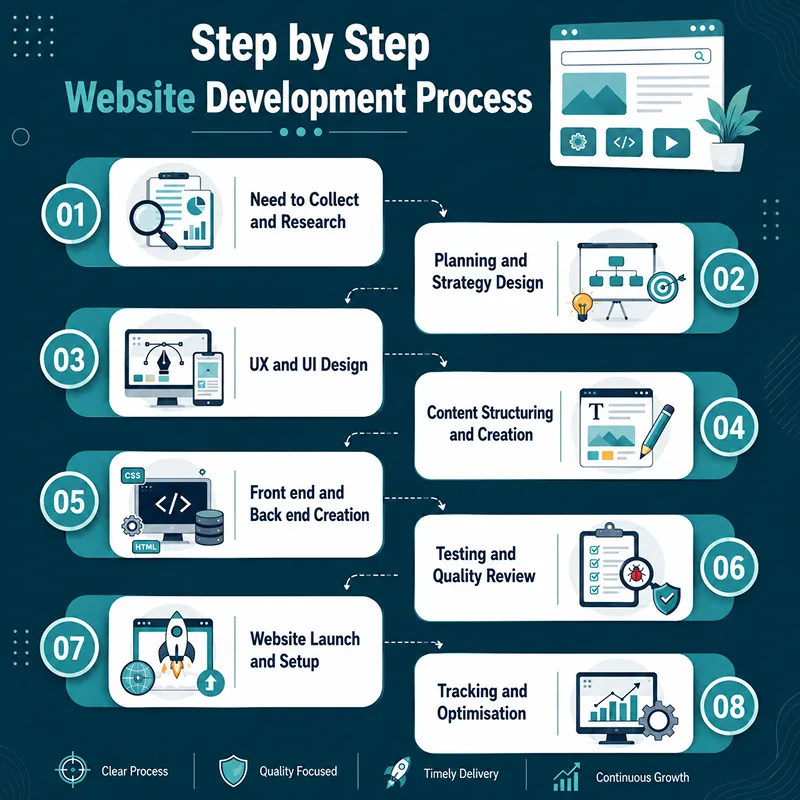
Best Practice!
UK businesses should test their website on mobile, desktop, and different browsers before launch to avoid usability problems later.
How to Plan a Quality Website Development Process?
Planning sets the path for the entire process, so it is one of the most vital steps. Even the sites with good designs cannot fulfil business goals without it.Set Goals and Success Metrics
Firms define whether success means more traffic, more sales, better engagement or increased brand status.Know the Target Audience and User Demands
The site is built around real customer needs by analysing their behaviour, habits and demands.Define Scope, Timeline and Budget
Delays can be avoided and the project can be kept realistic and practical. This helps keep the project on track with careful planning of time, money and outputs.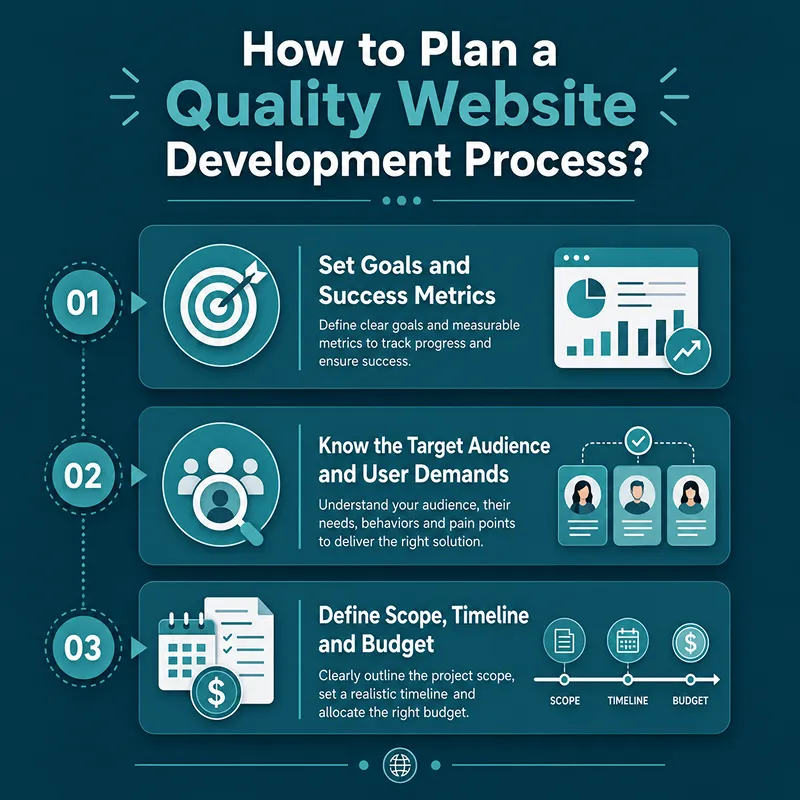
How Does the Design Shape the Website Development Process?
The focus of UX and design is to turn planning into an engaging and visual task. With the help of this, you verify that the site is easy and pleasant to use as well as useful.Site Design and Wireframes
Before visual design starts, wireframes act as guides that define page layout and flow.Branding and UI Design
To offer a refined look, UI design uses colour, text, logos and visual consistency.UX Assesses User Satisfaction
A good user experience ensures that users can locate data easily, access pages quickly and finish tasks without any hassle.How Is Coding and Website Development Done?
In the tech stage of the website design and development process, layouts are changed into a real site. All this is done using coding models.Front End Design
Front end design creates all that users see, such as layouts, buttons, visuals and speed.Back End Design
Behind the scenes, back end coding powers the website by dealing with user accounts, databases and server side tasks.
Together, front end and back end design form a fully working website.
Why Is Testing Important in the Website Development Process?
Before your website goes live, testing makes sure that the site is ready for real users, safe and stable.Functional and Usability Testing
Every feature, such as billing systems, forms and routes, is tested to make sure it works as intended.Performance and Mobile Testing
It is essential to test your website to achieve the ideal speed. It is also checked for ease of use across browsers and mobile devices.Security and SEO Testing
While SEO checks make sure your website is correctly organised for search engines, security checks protect user data.What Happens After Website Launch?
A website launch does not mean the process has ended. In fact, it is the start of the ongoing success tracking and progress.Website Setup and Go Live Process
When you launch a website to a live server, you have to link the domain and carry out the final steps.Tracking Progress and Analytics
To learn how people deal with the website, usage data, user conduct and site traffic are tracked.Ongoing Upgrades and Optimisation
Updates are made to improve conversions, design and speed over time according to the real data.What Website Development Process Should Firms Choose?
After launching the website, you must decide how you want to handle the site. It should be done either via the CMS platform or through a fully managed service.Fully Handled Website Services
With a teamwork approach, the building staff takes care of hosting, safety, updates and upkeep.Client Managed CMS Websites
You can get full control of your website development process and can modify content yourself. However, these sites also handle routine care duties.
Managed services are right for firms looking for ease of use. On the other hand, CMS platforms are best for those looking for total control.
What Tools Support the Website Development Process?
To improve tracking, creation and design, various tools are used.Design and Testing Tools
To fix visual designs and outlines, different tools are used, such as Adobe XD and Figma.Setup and Version Control Tools
To handle and monitor code changes, some platforms are used, such as GitHub.Analytics and SEO Tools
With the help of analytics apps, you can track multiple factors, such as website traffic, user actions and performance.How to Choose a Website Development Process Partner?
It is vital to find the right partner because it has a huge impact on business results, timeline and quality.Qualities to Consider in a Project Agency
When you have to pick a growth agency, you must look for clear interaction, organised systems and experience.Things to Consider Before Hiring
Before hiring, you must ask some vital questions, like how success is defined and what type of support is provided. Besides this, you must also find out how tasks are run.What to Prepare Before Starting the Website Development Process?
When firms prepare properly, they get a smooth execution and fewer delays in your project.Business Goals and Website Mission
When the goals are clear, you are able to design and develop decisions from the beginning.Branding Assets, Ideas and Content
Companies should create reference websites, texts and images to guide the design process.Case Study: SafeStyle Windows Website
After taking over Safestyle Windows in 2023, ASHI Group Limited requested a complete website redesign. They wanted the redesign because the old one was hard to manage, slow and outdated.
To achieve this, a step by step website development process was carried out to rebuild, design and plan the site. In the initial step, the team examined the competitor websites, old systems and user behaviour to identify the main problems.
In the next step, they built better layouts, UX designs and wireframes according to real user demands. When the approval was done, the new design had a quicker, updated site with a flexible CMS.
Next, the website was tested carefully and went live in steps to lower the risk and monitor performance.
When it was launched, the new website brought a 21% rise in conversions and 19% improvement in navigation performance.
This real-life example reveals that a step by step web development process can grow your business.
Final Thoughts
A clear website development process helps businesses build sites that are consistent and concise. This strategy helps a lot in making your site aligned with real business aims.
It helps reduce confusion at the time of development. Also, it makes sure that each step leads to a better final product.
You must not consider your website a one-time duty. Rather, it involves multiple steps and should be treated as an ongoing digital investment.
Planning, development, design and optimisation help improve website performance.
At Xoom Plus, we understand how a clear website development process supports businesses. It builds solid digital bases and improves overall performance.
Contact us now if you are planning a new website or want to enhance your current one.
Struggling with a website that feels outdated or fails to bring results?
We help UK businesses build clear, high-performing websites through a structured website development process.
We have helped businesses improve user experience, website performance, and conversions. Reached us today.
FAQs
What is a website development process?
A website development process is a structured method used to plan, design, build, test, launch, and maintain a website. It helps businesses create websites that are user-friendly, goal-focused, and technically reliable. A proper process also reduces delays, confusion, and costly changes during development.
Why is a website development process flowchart important?
A website development process flowchart helps teams understand each stage of the project clearly, from planning to launch. It improves communication, keeps tasks organised, and makes it easier to track progress. For businesses, it also helps avoid missed steps and keeps the project aligned with business goals.
What are the 7 stages of web development?
The 7 stages of web development usually include information gathering, planning, design, content creation, coding, testing, and maintenance. Each step helps build a website that is functional, user-friendly, and aligned with business goals. Following a clear process also reduces delays and technical issues.
How much does it cost to develop a website in the UK?
Website development costs in the UK depend on the size, features, and complexity of the project. A basic business website may cost a few hundred pounds, while custom websites with advanced functions can cost several thousand. Ongoing costs like hosting, maintenance, and updates should also be considered.
What website builder is best for beginners?
Website builders like Wix, Squarespace, and Shopify are popular choices for beginners because they are easy to use and require little coding knowledge. They offer ready-made templates, drag-and-drop tools, and built-in support features. The best option depends on your business needs and website goals.