

- December 23, 2025
- Categories: Digital Marketing
How Google’s Algorithm Has Evolved Up To 2025
Have you ever wondered why certain pages rise to the top while others fade away? What makes a page rank? At the core of it lies one secret force. Google Algorithm. There is only one constant in digital marketing. That is, the algorithm always evolves. Back in the days of keywords stuffing, you can rank with just matching the right keywords. Then came techniques such as link farming. The web was smaller. Competition was thin. Whoever could match the keywords would rank at the top. Over the years however, algorithm of google search never stayed still. It always evolved. Through constant Google algorithm updates, it learned how humans thought and searched. It caught up to techniques used to rank and evolved to value authenticity and expertise in content.In 2025, it has become way more than a code. It’s a system that listens, predicts and interprets human intentions. It not only is restricted to one type. With every update new google algorithm types are created. Each adding more to the understanding of how users search, trust and value.In this blog we will explore the evolution of google algorithm through the years. What each google algorithm update means and how it has impacted the search.
What is Algorithm of Google Search
Before we delve into the evolution of algorithm. We should first explain what it is. Google uses a system that is a combination of multiple algorithms, that are designed to rank pages based on their quality and relevance to the query. The entire system is about intent. It tries to get at users’ intent and then offers results based on that intent.The system evaluates various parameters in a content. This includes, keywords, backlinks from credible sites, page speed and users’ location to give the most relevant result. This system is designed to understand intent through NLP. Natural language processing, helps the system identify intent by understanding the language of the query. You can learn more about NLP and SEO through our blog on how NLP is shaping the future of SEO.How Google Search Algorithm Works
Every time you type a query. Algorithm gets to work. It sifts through billions of pages in its index and rank them based on hundreds of factors. These can include anything from page quality, backlinks and user experience. You can learn more about these factors by checking out our SEO checklist. Google’s algorithm is really a system of algorithms. Its ranking system involves lots of factors. It also keeps updating to stay ahead of the curve. Here are some of the ways it operates.- Crawling: Google gets pages by following links and sitemap.
- Indexing: The system analyses the page. It looks at the content quality. If the content holds up, it is added to the index.
- Ranking: When a query is entered. Google ranks pages based on a number of factors. The ones with the highest ranking are sent to the top.

Evolution of Algorithm of Google Search
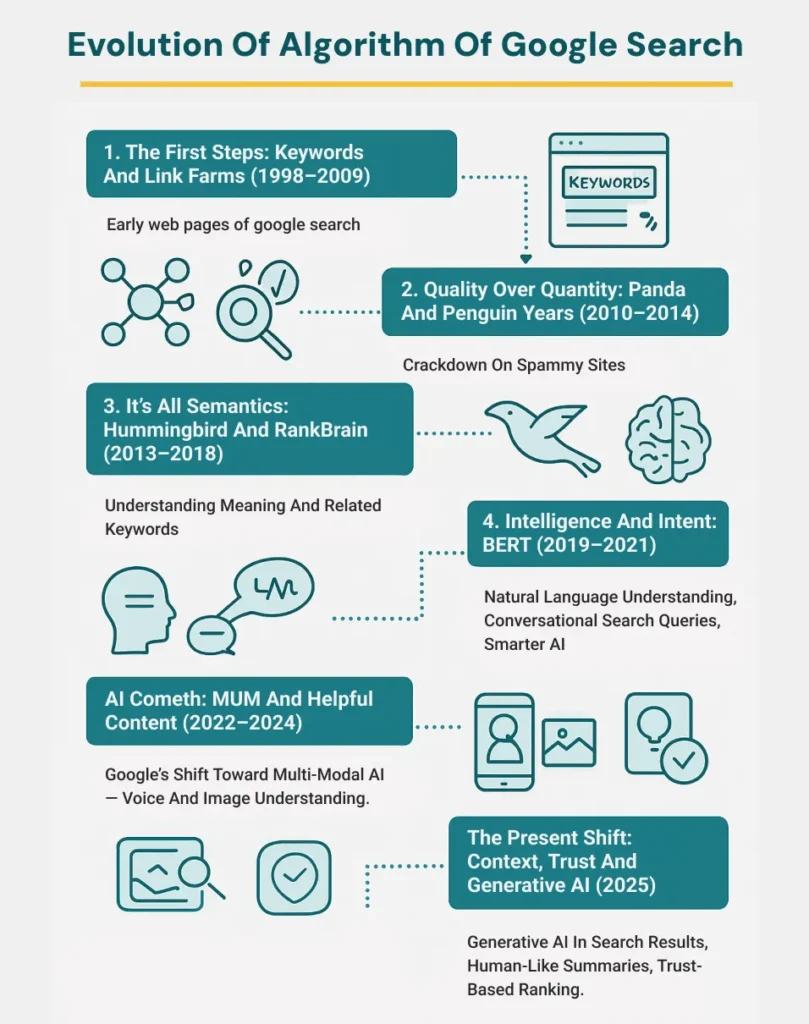
Google’s algorithm evolved over time to enhance user’s experience and curiosity. The object of the entire process was to give the most suitable answer to the user’s query. Here we will explore the entire itinerary of the process. From the first steps to modern times.1. The First Steps: Keywords and Link Farms (1998-2009)
In the early days of Google, it had a formula called PageRank. This was on the google algorithm types that relied on backlinks. It ranked based on the number and quality of backlinks. Links were treated as votes. The more of it a site had, the more it ranked. Keywords also played a major role. The more a keyword appeared in the content the higher it ranked on that keyword.This led to a problem however. This reliance on backlinks and keywords led many to game the system. Keyword stuffing and link farming became the dominant practices. Marketers would fill the content with keywords and backlinks. This abuse led Google to evolve. Thus began the journey towards intelligence.To learn more about proper use of keywords and how to use them intelligently, check out our guide for keyword mapping2. Quality Over Quantity: Panda and Penguin Years (2010-2014)
The 2010s were spent by Google on quality control. New Google algorithm types were introduced- Panda (2011) got rid of thin and spammy content. It swept through the web like a storm. When it came out it affected nearly 12% of the search queries. Removing hundreds of low-quality sites from page one overnight. It made content creators focus on the user’s intent, quality and utility..
- Penguin (2012) was the Google algorithm update that targeted link farms. It penalized link schemes, link networks and keyword stuffing. The results were stark. Websites that were built on link schemes crumbled overnight.
3. It’s All Semantics: Hummingbird and RankBrain (2013- 2018)
As the scope of the search grew, Google realized it can no longer rely on stiff keywords to get user’s intent. Mobile changed everything. Now people were typing quick phrases as queries. In 2013, about 15% of search queries were new. New Google algorithm types had to deal with this change.- Hummingbird was a Google algorithm update that arrived in 2013. It introduced semantic search. This allowed Google to understand the meaning and context of the query. This was far cry from the practice of just matching words.
- RankBrain (2015) was Google’s attempt at machine learning. It allowed the algorithm of Google search to understand complex queries, understand user intent and improve with feedback.
4. Intelligence and Intent: BERT (2019-2021)
Google again decides to shake things up a bit. Enter BERT (2019). BERT is an AI that uses deep-learning natural language processing, to read sentences as humans do. It can understand subtle aspects of communication. Things like meaning, tonality and phrasing.Now Google can reward content that was most relevant to the query. BERT allowed it to pick nuance and context. This was not possible with the older system. This meant that intent decided the ranking. If your content satisfies the user’s intent then it is deemed useful. It wasn’t just enough to have the right keywords anymore. You have to have the right message.In 2021, the algorithm of Google search went further. With the advent of passage ranking. Now it was not just about ranking pages. Even paragraphs that provided the best answer would outrank the pages that don’t.Each new update made search more about intent.5. AI Cometh: MUM and Helpful Content (2022-2024)
The Multitask Unified Model (MUM) signalled Google entering advanced AI. MUM is one of those Google algorithm types that can understand complex queries across text, information and languages. It used this understanding to provide better answers. Now search was no longer about just finding answers. It was about finding meaning across contexts. MUM is able to connect the dots across multiple contexts and give you the desired result.Then along came another Google algorithm update. The Helpful Content Update (2022-2023) called for more value in the content. It pushed creators to focus on content that genuinely helped users. The algorithm of Google search was now looking for content that was “written by people for people”.This update made expertise the new standard for ranking. With each one of the new Google algorithm types, the algorithm of Google search came closer to human intent.6. The Present Shift: Context, Trust and Generative AI (2025)
In 2025, Google has gone beyond mere understanding. It now values trust. The new Google algorithm types include AI-driven ranking systems, spam detection networks and contextual scoring. Each system is connected to the other, creating a matrix of scoring and ranking.EEAT (Experience, Expertise, Authoritativeness and Trust) is the name of the game now. Now it’s not just about content. It’s about reputation as well now. It checks.- Who wrote this content?
- What’s their track record?
- Is the content updated, accurate and consistent?
Key Takeaways for 2025:
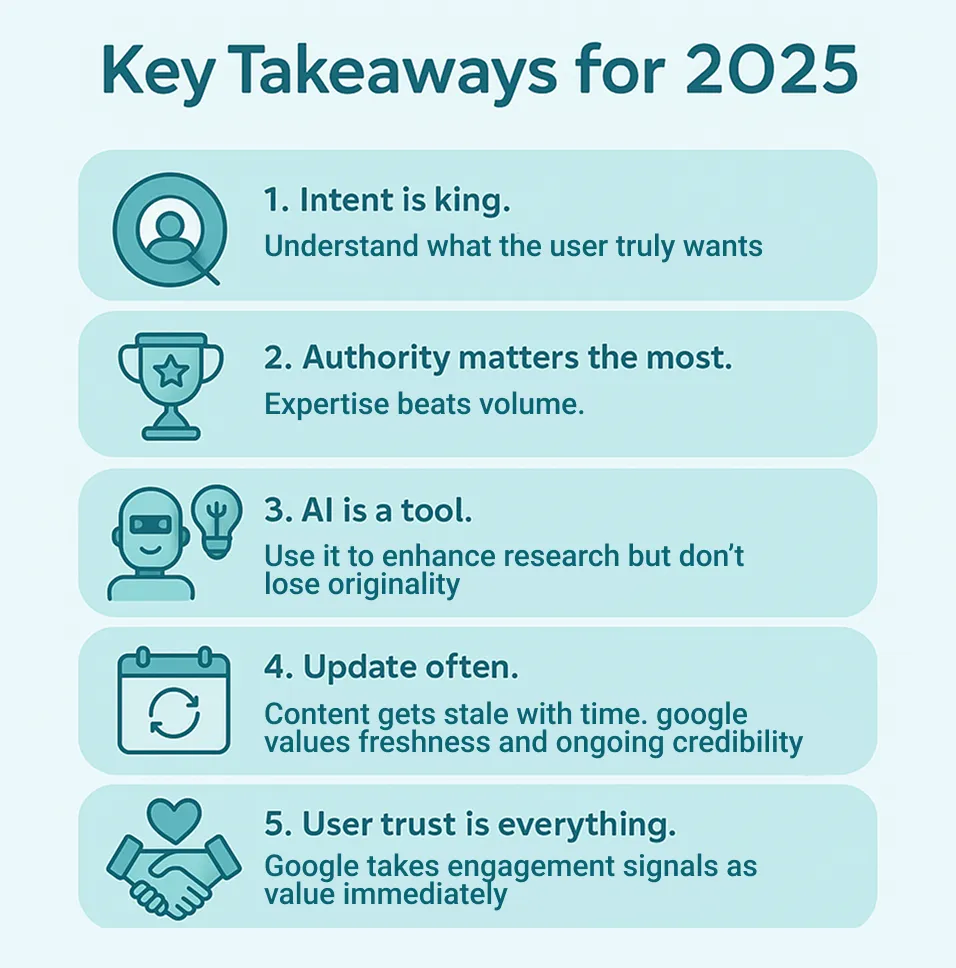
Here are some key concepts about algorithm as of 2025:- Intent is king. Understand what the user truly wants.
- Authority matters the most. Expertise beats volume.
- AI is a tool. Use it to enhance research but don’t lose originality.
- Update often. Content gets stale with time. Google values freshness and ongoing credibility.
- User trust is everything. Google takes engagement signals as value immediately.
What the Future Holds?
The future will bring even more predictive algorithms. Google is looking to suggest instead of search. The new Google algorithm types will likely look at user’s history, preferences and behaviour to predict content before it’s asked for. This will be a paradigm shift. However one thing that will remain constant is trust. Content is no longer just about mechanical input. Now it has to be humanly intuitive. This will directly impact SEO strategies of the future. SEO will be about trust building and reputation. Businesses that treat it as such will thrive.The future is for brands that bring real voice to the table. This is what the Google values as expertise.Automation will not replace creativity. Machines can give information fast but it’s only human expertise that can build trust. That’s what the future holds for algorithm.Final Thoughts
From the dark ages of PageRank in 1998 to modern AI-driven engines of 2025, Google search has come a long way. It’s no longer just matching words. It is understanding intent. A search engine is no longer just a library of links. It has become an ecosystem of ideas. The ones that are most useful to the user will be trusted and ranked in this system. We at XoomPlus understand this reality. Our SEO services will make sure that you stay in the algorithm where you belong. At the top. Through our expert content generation, you will never lack for valuable content. This will help build trust, both with Google and users. SEO is constantly changing. Evolution of the algorithm is proof of that. With us you stay ahead.Ready to take the top spot in algorithm ranking?
Contact us to not only get valuable, trusted and authentic content but to make sure it gets the ranking it deserves. Always at the top.
Faqs
The June 2025 Broad Core Update is a major refresh of Google’s main ranking system. It began on June 30 2025 and will roll out worldwide over about three weeks. Instead of punishing specific sites, it tweaks many ranking signals at once to reward helpful, well-written content.
You’ll now see interactive summaries and chat-style panels at the top of search results. These let you expand answers or ask a quick follow-up without leaving Search. The page also highlights video, image cards, and a built-in dark-mode toggle for easier reading.
SEO today focuses on user experience and topic depth. Write clear, in-depth articles that cover the full context of a subject. Pay attention to mobile speed, page layout, and semantic clusters of related terms. Keep your main pages fresh by updating them often.
Yes. Google issues broad core and spam updates every few months. These updates adjust how it ranks pages and weeds out low-value tactics. The goal is to keep search results accurate, relevant, and easy to use.
Google tests small changes on real traffic. It watches clicks and bounce rates to see if results help. Human reviewers rate search quality and send feedback. Google uses that feedback to tweak ranking signals. It also trains models on patterns from actual searches. When a tweak works well, Google rolls it out to everyone.
SEO shifted from stuffing keywords to giving clear answers. Mobile speed and smooth page layout became must-haves. Search now rewards content with images, videos, or polls that keep users engaged. Voice search and featured snippets shape how we write. Fresh content and real user feedback keep pages in view. Trust comes from showing author details and genuine reviews.