- April 14, 2026
- Categories: Digital Marketing
Best Practices for Answer Engine Optimisation (AEO) Marketing Teams Can’t Ignore
The days of people scrolling through search results for answers have changed. Instead, they now seek direct answers through AI-powered search tools like Google AI Overviews, ChatGPT, Perplexity and others. This means that viewers get answers to their questions without the need to open any link. As a result, this has increased the rate of what marketers call ‘zero-click’ searches. A recent stat revealed that the top search result loses 58% of its clicks when an AI overview appears. This shows how vital this concept has become.
The shift has created a new challenge for brands who want to increase their clicks and visibility. For them, it is no longer enough to create content that ranks on SERPs. Your content now also needs to align with the AI systems. This is what is called Answer Engine Optimisation (AEO)
AEO is the way to create content that clearly answers user questions and provides the right information through an answer-based search experience. It helps businesses create content that is more likely to be understood, surfaced and cited by AI-powered search engines.
This guide will explain the best AEO practises marketing teams should follow. It also explores how to apply these practises without losing sight of the target audience.
Key Takeaways
- AEO helps content appear in answer-based search experiences by making information clear, useful and easy to understand.
- Start with real user questions and search intent instead of focusing only on keywords.
- Use clear content structure, HTML, schema markup and JSON-LD to give search engines better context about your content.
- Build trust through expertise, evidence and external brand mentions, rather than relying on content volume alone.
- Keep improving existing content by reviewing accuracy, updating information and making answers clearer.
What Is Answer Engine Optimisation?
AEO is a way to create and structure content to give clear answers to questions in search engines and AI-based responses. Unlike traditional SEO, which focuses on ranking a page in search results, AEO focuses on content that answer engines can easily understand and use to provide direct answers. This method makes page content more useful and easier for answer engines and AI-powered tools.
Take a regular search as an example: ‘What is the difference between SEO and GEO?’ SEO will help you rank in the search results for this keyword alongside other relevant pages. A GEO would instead use the information from one or more sources to create a clear answer. It also cites the sources that have been used for the answer. This means that AEO needs more than just the right keyword. It needs to answer the question clearly and provide enough context for the information to stand on its own. This makes AEO quite distinct from SEO. The table below briefly states the core differences between SEO and AEO.
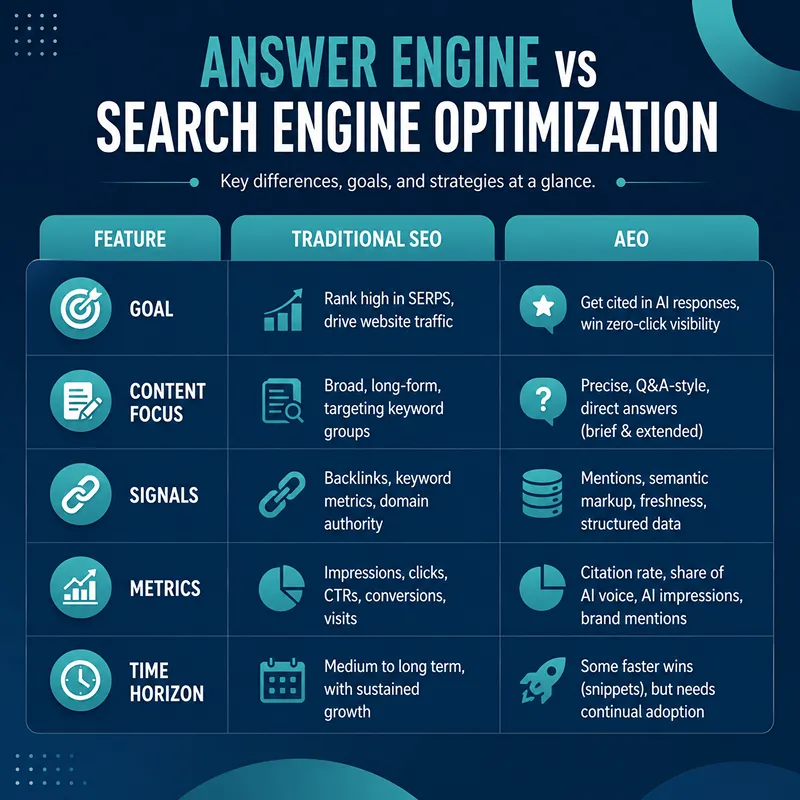
Therefore, AEO requires marketers to focus on several core areas:
- Understand the questions people ask
- Provide direct and useful answers
- Structure information clearly
- Show expertise and experience
- Support claims with reliable evidence
- Use accurate structured data
- Build trust around the brand
- Keep information updated
‘AEO is the practice of structuring content so AI-powered search engines select it as the direct answer to a user’s query.’ Salesforce
What Are the Best Practices for AEO?
A clear and immediate answer to users’ questions is the foundation for AEO visibility. However, visibility in answer-based search results needs more than just FAQs and placing questions throughout the content. Marketers need a clear approach to how they research, create, structure and maintain their content.
The following practices create a practical base for AEO.
Did You Know:
‘42% of buyers use AI search as part of their evaluation process, and it’s a top predictor of purchase intent.’
1. Start With Real User Questions and Search Intent
The first step of AEO is to know what people actually want to know. Instead of keyword-stuffed content, identify the questions your audience really wants answered to make a decision. These questions can come from various sources, such as search queries, the sales team, support requests and forums.
Marketers also need to grasp their users’ search intent to optimise their content. This helps them differentiate between what their audience asks and what they really want. At times, even two searches about the same subject require two distinct answers. For example, a search about ‘what is email marketing?’ needs a simple explanation, while a search for ‘how to create an email marketing campaign’ needs practical steps.
Did You Know:
‘79% of those who already use AI for search believe it offers a better experience than traditional search.’
2. Give Direct Answers Before Adding Details
Answer engines need to understand the main point of a page quickly to extract information from it. To make your content easier for AI systems to understand, start every section with a clear and direct answer to the question being asked. After this, add examples, explanations and evidence to support your answer. For example, if the question is ‘What is Topical Authority?’, the first sentence should clearly define it. The rest of the section can go into detail to explain how it works and why it matters.
Marketers should know that this not only helps in AEO but also benefits human readers. This lets them find answers quickly and continue to read the content for more details. The immediate answer often works as a hook, which results in more traffic and a lower bounce rate. However, the aim should not be to make every section extremely short. It should be to make the main answer easier to find.
3. Structure Content for Easy Extraction
Clear, structured content is a key part of AEO best practices. It helps make the entire content easier for AI tools to understand and reference. In order to create a clear structure, use descriptive headings, short paragraphs, bullet points and numbered steps. You should also keep related information in a single section and avoid placing vital facts in complicated sections. Your page should also have a logical heading hierarchy, where each section answers a clear part of the main topic.
Bing’s current guidance suggests logical headings, semantic HTML and clear content structure as vital parts of a strong AEO. While a clear structure makes it easier for AI tools to extract information from your page, it also helps human readers find quick answers. Such practice helps marketers boost their visibility in AI Overviews and AI-generated answers.
4. Demonstrate First-Hand Experience and Expertise
Since AI systems already have access to a large amount of information, generic content has little reason to stand out. First-hand experience can make your content more useful and distinctive. This gives readers information that they are less likely to find in generic content. This means you need to have original examples, expert data, case studies and practical insights. This adds genuine value to your content and increases visibility through AEO.
For example, a digital agency can tell the readers how it handled a difficult campaign with practical examples. This is better than general advice found across many websites. Such first-hand information gives an edge to your content that cannot be achieved by simply rewriting other sources. This also helps marketers build trust in their brands among readers and gives the audience a reason to engage with your brand again.
5. Strengthen Content With Accurate and Trustworthy Evidence
Use reliable sources to support key claims in your content. This makes your claims easier for readers and search systems to verify. For this, you should use trusted sources for stats, research, regulations and technical information. Where it helps, link back to the source to build authority. Such original data and examples make your content more trusted by AI tools. As a result, it improves the credibility of your content and help appear in AI search results.
However, this does not mean that marketers add citations to every sentence. The right way is to make key claims easy to verify. Bing, a commonly used source by AI, recommends the use of evidence, examples and cited sources to improve clarity and trust.
Did You Know:
‘Content including citations, statistics, and quotes from authoritative sources is 30% to 40% more visible in AI search results.’
6. Use Structured Data That Matches the Content
One of the best practices for AEO is to structure your content clearly. For this, you can use HTML, Schema Markup and JSON-LD. These aspects help search engines and AI tools understand what a page contains and how different pieces of data relate to each other.
Start with a clear HTML structure to organise your content clearly through <H1>, <H2> and <H3>. Use semantic HTML elements to signal the purpose and structure of each section. Similarly, Schema markup adds another layer of information. This helps AI tools better understand the meaning and context of your content. In addition, JSON-LD places structured data in a machine-readable format to add schema markup to a webpage. These three elements give AI tools a clear context while keeping the page useful and readable for people.
7. Build Brand Authority Beyond Your Website
Just like off-page SEO, ranking through AEO also relies on what happens beyond your website. This means that AI tools use information from various trusted sources to form an answer. This makes the overall online presence of your brand key to being part of AI-generated answers. To achieve such brand authority, marketers can use various methods. These include relevant mentions, expert contributions and backlinks from trusted sources within the domain.
Marketers should focus on earning genuine mentions from trusted sources instead of random mentions. This improves your visibility and builds trust with AI tools and readers. In addition, strong brand authority helps rank new content on your own website in SERPs and AI search results.
8. Update and Optimise Existing Content for AEO
Answer engine optimisation should not be treated as a one-time content task. This mistake often damages the ability of your content to rank in AI search results. Your current webpages may contain useful information but could lack the structure and evidence AI needs. Hence, updating such pages can be more effective than creating a new page from scratch. To do this, look for sections where the main answer is unclear and claims are inaccurate. Also, improve headings, add missing context and remove outdated data.
This creates an ongoing process:
Create ➡️ Measure ➡️ Improve ➡️ Update
The aim is to keep your best content useful, accurate and easy to understand as search patterns change.
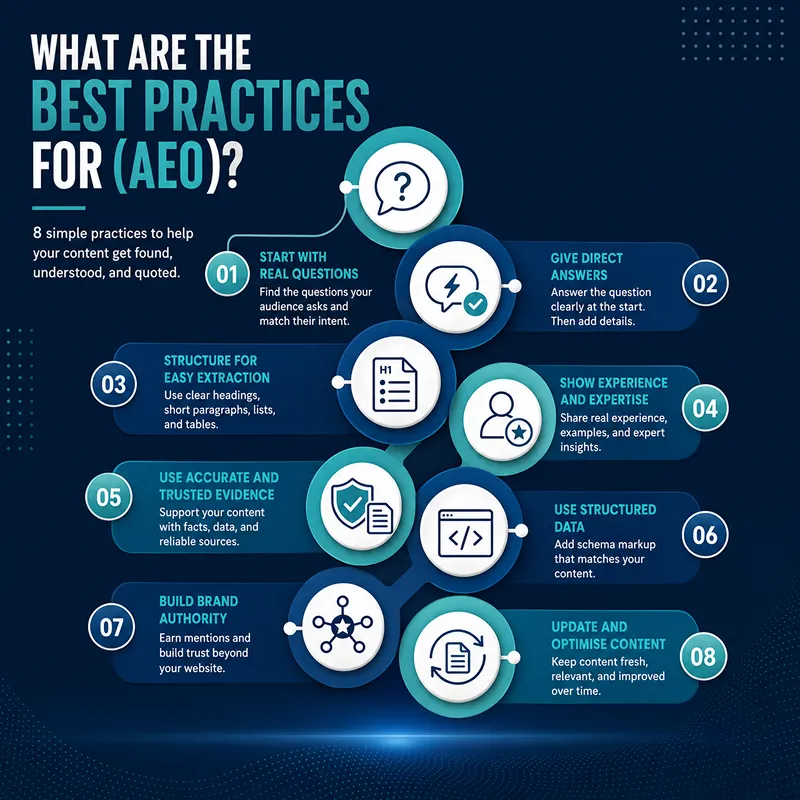
AEO Best Practices Checklist for Marketing Teams
AEO works best when it becomes part of the regular content process rather than a one-time task. To ensure this, marketers can follow the given checklist before they publish or update a page. This checklist ensures the content follows the key practices.
Did You Know:
‘AI-driven visitors convert on average 4.4x higher than standard organic visits.’
This checklist is a simple way to find areas in your content that may need improvement. You can also follow the technical AEO checklist to make yourself visible in AI search results.
Case Study: How HubSpot Improved Its AI Search Visibility
HubSpot found that many buyers used AI search tools such as ChatGPT, Gemini and Perplexity to find answers. This shift in user behaviour led the brand to track and improve how often it appeared in AI-generated answers. The results led the brand to improve its AI visibility. For this, the brand focused on three main areas.- Improving content on its own website
- Building a strong external presence
- Engaging with relevant online communities
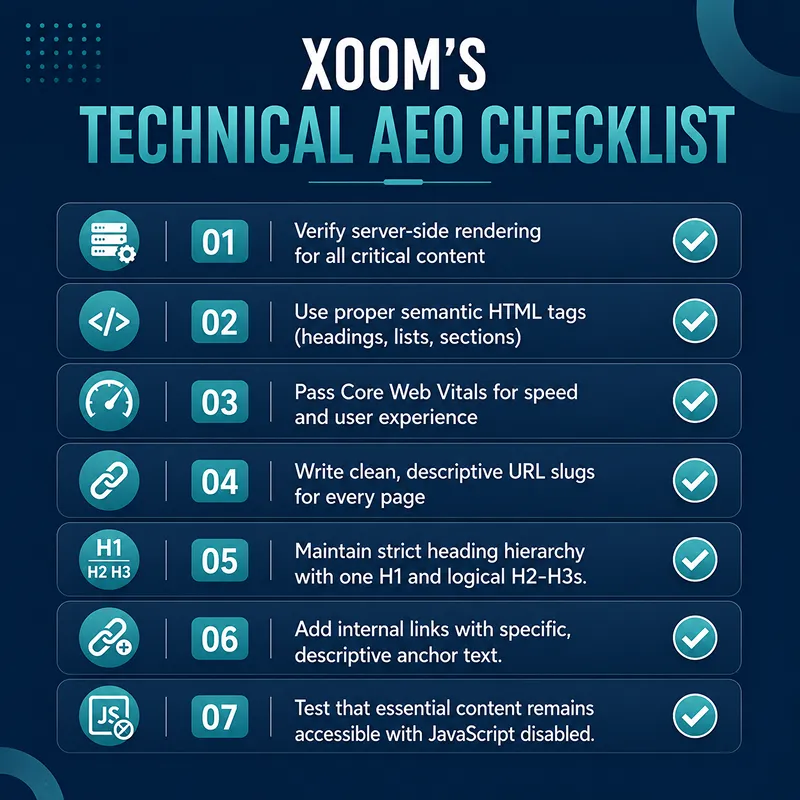
The broad strategy produced even stronger results. HubSpot reported a 433% increase in its citations and an 1850% increase in qualified leads from AI. HubSpot also stated that these AEO leads had a 3x higher conversion rate than leads from other sources.
This clearly shows how AEO is not just about one technical change. Instead, strong results can come through clear content, useful answers, structured data and trusted online reputation.
Conclusion
AEO has changed how marketing teams approach search and visibility. They don’t just focus on ranking pages on SERPs, but appearing in AI search results as well. For this, marketers use information that is clear, trusted and easy for answer engines to understand. The best practice for AEO begins with customers and their needs. From there, marketers create direct answers, use clear content structure and support key claims with trusted sources. This builds a brand’s genuine authority and keeps the information up to date. In addition, technical elements such as HTML, Schema Markup and JSON-LD help provide AI tools with a clear context of the content. At the same time, your brand’s online presence helps build wider authority in the domain.
The best SEO experts know that AEO is not a replacement for SEO. Rather, they work together to make a website useful, accessible and trusted by readers, search engines and AI tools. They help a brand evolve and be better prepared for the way people find information through AI.
Is your content getting seen but not driving real decisions?
We help turn your content into clear answers that are picked by AI and build trust early. We have helped businesses improve visibility and conversions.
Contact us today and start turning your content into answers your customers trust and act on.
FAQs
What are AEO best practices?
AEO best practices include understanding user intent, giving original and useful answers, structuring content so it is easy to extract, updating old content for answer engines, adding strong FAQ sections, optimising for voice search and using structured data markup.
How to do Answer Engine Optimisation (AEO)?
To do AEO well, make each section work on its own because answer engines often pull single passages. Use scannable formats like bullets, numbered lists and tables instead of long blocks of text. Also highlight key facts, definitions and statistics so engines can quote them easily.
What are the two rules of Optimisation?
The two rules of optimisation are simple: first, do not optimise too early. Second, even experts should wait until the right time. In short, measure first and optimise after you know what really needs improvement.
What is the 3-3-3 rule in marketing?
The 3-3-3 rule in marketing is a simple framework that focuses on 3 audiences, 3 key messages and 3 channels. It helps keep campaigns clear, consistent and more effective while reducing wasted time and budget.
What are the best options for Answer Engine Optimisation in AI?
One option for Answer Engine Optimisation in AI is Peec AI. It is suited to marketing teams that want multi-engine tracking with little setup and for brands that can turn search data into a stronger content strategy.
What are the Answer Engine Optimisation trends 2025?
AEO trends in 2025 focus on zero-click search, AI answers and conversational queries. Content must be clear, structured, easy to extract and regularly updated. Voice search, natural language, trusted sources, real data, brand mentions and structured data all matter more than before.