
- July 13, 2026
- Categories: Web Solutions
Essential Features Every Ecommerce Website Needs in 2026
Do you know that a slow digital shop can cost you thousands of pounds?
An ecommerce website is just a digital shopfront where users buy and sell goods over the internet. To gain sales these days, you must know the key features of ecommerce website layout that keep users satisfied. Using suitable features of ecommerce website is no longer an option but is vital for continued success.
In the past, an online shop had only a few buttons but now internet shopping has changed a lot.
Customers in 2026 are extremely active and can’t wait. They look for speed, comfort and trust. If your site does not have these features, they leave within seconds. They go to another site and buy from them without telling you the reason.
Consider thinking about your own habits for a while. You likely compare the rates in seconds and check reviews before you purchase something. You hope for a site to load quickly, especially on your smartphone.
Your clients think the same way about your shop precisely. In fact, data reveals that more than 60% of UK buyers now opt for mobile purchasing rather than using a desktop.
However, attracting this audience needs to be a satisfying experience. Mobile cart loss goes up to a shocking 85.65% if the checkout method is even a little difficult.
This is even more true for the next era of customers. At the moment, 66% of young adults ranging from 18 – 24 use online wallets as their main payment choice.
This transition has moved up very quickly. Leading brands like Amazon and ASOS have educated clients to ensure a high standard. They are looking for speed, simplicity and trust at every phase.
Your clients do not care if you have a small company with a small team. They still hope for your website to load fast and look good on a phone. They also want your site to be just as easy to use as Amazon or ASOS. They will leave quickly if they do not find such elements.
The good news is that you do not need a massive amount of money to succeed. You need the ideal features of ecommerce website designs, created properly and positioned where they actually count.
In this blog, you will learn the crucial features of ecommerce website that helps lower customer dropouts in the UK market. You will also explore how to fix the checkout and discover the trust and security tools.
Key Takeaways
- The most vital features of ecommerce website design are speed, mobile-friendliness, and a smooth checkout. Get these right first
- Good ecommerce website features work together. A fast site that feels unsafe won’t sell, and a safe site that’s slow won’t either
- The key features of an ecommerce website include secure payments, clear product pages, and easy navigation that helps shoppers find what they want fast
- Trust matters just as much as speed. Real features of an ecommerce website like SSL encryption, honest reviews and clear stock status help turn browsers into buyers
- If you’re asking what features an ecommerce website should have, start with guest checkout, address autofill and a short, simple payment flow
- The features of a good ecommerce website also include order tracking, email alerts, and a search tool that handles typos with ease
- You don’t need every feature at once. Begin with mobile design, speed and checkout, then build outward as your store grows
What Is an Ecommerce Website?
An ecommerce website helps people purchase products or services via internet. Clients explore, choose, pay and get their goods delivered, all done without going to a shop.
When a user visits your site, they search, look around and add items to their shopping cart. After all this, they check out and make their payment. Emails are auto sent, your order system keeps track of sales and your stock changes in the background.
Ecommerce shops consist of different types. B2C offers products to regular shoppers while B2B provides goods to other firms, usually with discount pricing.
On the other hand, D2C indicates that a brand markets directly to customers, avoiding retailers. C2C permits that individuals sell to each other, like on eBay. Most basic features of ecommerce website setups apply to all of them.
In 2026, UK retail is defined by convenience, transparency, sustainability, and innovation. AI-driven shopping, social commerce, resale, smarter supply chains, and embedded sustainability are transforming how consumers discover and buy products. Shoppers increasingly expect seamless experiences, ethical practices, and verified product information.
Emma-Michaela Rigby, Engagement Manager at GS1 UK
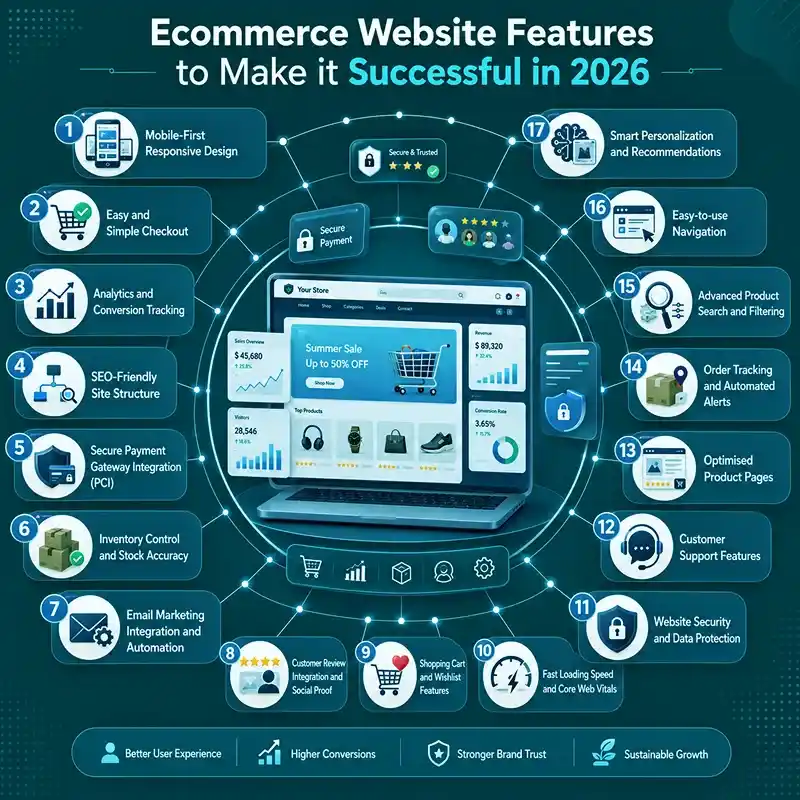
Ecommerce Website Features to Make it Successful in 2026
User experience, speed, safety and convenience are the most important features of an ecommerce website. If you miss one of them, the others suffer too. A fast site without trust won’t convert users, while a safe site that’s slow won’t either.
Nowadays, a basic shopping cart isn’t enough anymore. Shoppers expect personalised suggestions, live order tracking, fast checkout and real reviews. Here are the core key features of an ecommerce website you need to deliver:
Did You Know?
Mobile cart loss can hit 85.65% if your checkout process is even a little difficult. A clunky form could be costing you almost everything you’ve worked for.
1. Mobile-First Responsive Design
The majority of online shopping now happens on a phone, not a desktop. If your site doesn’t work well on mobile, you lose sales and searfch rankings. This is because Google favours mobile-friendly features of ecommerce website layouts.1. Mobile-First Responsive Design
The majority of online shopping now happens on a phone, not a desktop. If your site doesn’t work well on mobile, you lose sales and searfch rankings. This is because Google favours mobile-friendly features of ecommerce website layouts.
For a mobile-friendly approach, you must use big and tappable buttons. Compress images so they load fast, even on a weak connection. Keep checkout short and simple on mobile, since clunky forms are one of the top reasons people abandon their basket.
Test all mobile features of ecommerce website on a real phone, not just a resized browser window.
2. Easy and Simple Checkout
Make guest checkout your primary priority. One of the major reasons for lost sales is the need for account setup before payment. Also, it ruins the practical features of an ecommerce website checkout process.
Any type of form field that isn’t mandatory to finish the order should be removed. Delivery charges should always be specified in advance rather than at the last minute. When possible, opt for address autofill to prevent customers from having to manually input their full address.
Utilise a single column layout with big and easily accessible fields on mobile phones. Besides this, use a suitable keyboard for phone numbers and emails. These ecommerce website features improve your checkout experience.
Pro Tip!
Always show shipping costs early. Hidden fees at the final step are one of the top reasons shoppers abandon their cart, so transparency upfront builds trust and keeps them moving toward buying.
3. Analytics and Conversion Tracking
What you don’t assess, you can’t improve. Track your sales rate, average order value and cart exit rate as your core metrics.
Watch where your traffic comes from and how it behaves on-site. Use this data to guide real changes across your structural features of ecommerce website layouts. Do not utilise it just to fill a dashboard nobody checks.
4. SEO-Friendly Site Structure
A great store nobody can find isn’t much use. Use clean, descriptive URLs and unique meta titles and descriptions for every page. The purpose of this approach is to improve the visibility features of ecommerce website setups.
Add product schema markup, so search engines know about prices, reviews and stock. Build solid internal links between categories and products and avoid thin, copied category pages.
5. Secure Payment Gateway Integration (PCI)
Provide a wide range of payment options. Cards, digital wallets like Apple Pay and Buy Now, Pay Later options all suit different customers. These options also signify important key features of an ecommerce website build.
If you sell globally, it will support multiple currencies. Make sure your payment provider is PCI compliant and includes fraud checks. This is how both you and your customers stay protected by the transactional features of ecommerce website backends.
6. Inventory Control and Stock Accuracy
False stock numbers result in serious issues. Customers order things you can’t actually ship and staff waste time making excuses and refunding.
Update stock in real time, especially if you sell across multiple channels. You can also set up automatic stock alerts. This helps you avoid selling the same item twice through the automated backend features of ecommerce website platforms.
7. Email Marketing Integration and Automation
Email remains one of the most profitable marketing channels. Set up an abandoned cart order, a welcome series for new subscribers and post purchase updates.
In-stock alerts are especially useful for popular or seasonal items. Keep these functions simple at first and make sure your sign up process meets approval rules. In this way, you can grow the marketing features of ecommerce website loops.
8. Customer Review Integration and Social Proof
Most shoppers check reviews before buying. Ratings answer doubts that marketing copy can’t, like real sizing, true colour or how fast delivery actually was.
Show star ratings and reviews directly on the product page, not buried elsewhere on the site. Don’t fear the odd negative review because a perfect score can actually look doubtful to a careful shopper.
A calm, helpful reply to criticism builds more trust than a flawless rating ever could. Ask for reviews a few days after delivery. Make sure to update your product reviews and customer photos after buyers have had time to actually test out the product.
9. Shopping Cart and Wishlist Features
A good basket lets customers adjust quantities and see a clear running total, with shipping shown early.
Wishlists capture interest from shoppers who aren’t ready to buy yet. Most baskets get cancelled before checkout. So set up automated reminder emails to support your cart features of ecommerce website workflows. This is one of the most profitable features of ecommerce website systems you can add.
10. Fast Loading Speed and Core Web Vitals
A one-second delay can cut conversions by up to 7%. Speed also affects your Google ranking through Core Web Vitals, which measure load time, responsiveness and page stability.
Compress your images before uploading them and resize them to the actual size needed on the page. Use lazy loading so images further down the page load only when needed.
Use caching and a content delivery network to speed up the mechanical features of ecommerce website assets and choose decent hosting. Bloated code and too many plugins slow things down too, so remove anything you’re not using.
11. Website Security and Data Protection
Customers need to trust you with their information. Use Secure Sockets Layer (SSL) encryption as standard, shown by the padlock icon in the browser address bar.
Protect customer data with proper access controls and regular security updates. Add fraud checks as part of your payment system to catch doubtful orders early.
Follow data security rules like the General Data Protection Regulation (GDPR). Keep your privacy policy clear and easy to find, not buried in legal language. This is because security remains a top priority among all key features of an ecommerce website template.
Send automatic updates by email or text at each stage, like order confirmed, shipped, out for delivery or delivered. This builds trust and cuts down on Where’s my order? , messages. This enhances the post purchase features of ecommerce website operations.
12. Customer Support Features
Offer live chat for quick, pre purchase questions. Many stores now use AI chatbots to handle simple queries instantly, day or night.
Build a clear FAQ page to answer common questions before they become support tickets. Support multiple channels, like email, phone and social media, so customers can reach you whenever suits them.
13. Optimised Product Pages
Product pages are your digital sales section. Use high quality images from multiple angles, plus short videos where possible, to elevate the visual features of ecommerce website catalogues.
Write outlines that explain perks, not just specs. Show clear pricing, honest stock status and a clear CTA button. Hidden costs or vague descriptions ruin the features ecommerce website strategy and cost you sales and trust.
14. Order Tracking and Automated Alerts
Once an order is placed, customers want to know what’s going on. Live tracking, linked to your courier, reduces anxious support queries.15. Advanced Product Search and Filtering
Search is your online digital shopkeeper. A predictive search, which suggests results as someone types, saves time and keeps shoppers engaged rather than waiting for a results page to load.
Filters should match how customers think, like price, size, colour, brand and availability. Use plain labels rather than internal product codes.
Your search tool should also allow for typos, plural forms and common synonyms. This makes it one of the most practical features of ecommerce website structures. Thus, a small spelling mistake doesn’t return an empty, unhelpful page.
16. Easy-to-use Navigation
Good website navigation is expected to feel almost invisible to your customers. This means they never have to pause and think about exactly where to click next. They do not get mixed up by fancy or odd category labels.
Instead, they just naturally locate the exact product they want within two or three quick taps. Customers do it without even realising your menu structure is guiding them there.
Add breadcrumb links, like Home > Men > Shoes. They help customers backtrack easily and give a small SEO boost too. Cut unnecessary steps anywhere you can to polish the UX features of ecommerce website layout.
17. Smart Personalisation and Recommendations
Personalisation is most effective when it is clear and relevant. Ideas for frequently bought products, recently viewed items and related stuff are all helpful.
Make sure that the suggestions fit the circumstances. Instead of cooking supplies, someone buying walking boots might opt for protection spray. Instead of making too many suggestions or annoying features of ecommerce website layouts, keep them brief and useful.
Features of Ecommerce Website to Watch Beyond 2026
A number of emerging trends are influencing the future of ecommerce. AI shopping assistants are getting better at responding to natural language requests. Voice commerce is slowly growing, as more people search and shop using voice assistants.
Another important feature is multichannel selling, which blends your website with social media and marketplaces. This approach is now the norm rather than the exception for advanced ecommerce website features.
You don’t need to chase every trend quickly but it’s worth watching closely. This is because today’s trend often becomes tomorrow’s basic goal.

Case Study: How Everlane Boosted Checkout Conversions
Everlane is a fashion clothing store known for its focus on honesty. Everlane knows that online shoppers hate friction, long forms, slow checkout and too many steps.
The company fixed this issue for their customer by adding Shop Pay to their checkout. After the fix, their website had a faster, easier checkout and extremely high conversions.
In just 30 days, 15% of Everlane’s sales went through Shop Pay, which is huge for such a short time.
This strategy worked because customers want to tap, pay and go. Now, people don’t want to type out forms. Therefore, Shop Pay made that possible.
This real-life example showed that small tweaks, like a faster checkout and mobile-friendly design, can bring so much change. A trusted payment option is also a wise strategy. Each of these approaches removes friction and the more friction removed, the more sales completed.
Besides this, review your checkout and make sure it is quick and easy on small screens as well. If both of these criteria are not met, this means you may be losing sales without knowing it.
Conclusion
In 2026, creating high quality features for an ecommerce website needs completing the basics first. It’s very important to focus on mobile design, speed, easy navigation and a smooth checkout process.
Build trust first by providing reviews and security. To continue getting better over time, add personalisation, SEO and useful data tracking after that.
You don’t necessarily need every feature from day one. Begin with those that have the biggest effect on revenue, such as checkout, speed and mobile experience. Continue to grow further from there as your store increases.
Do not treat your website as a single project that you complete and forget about. Rather, treat it as something that is always evolving. If you get the basics right, adding more features will be much simpler.
At Xoom Plus, we are familiar with these key elements and build highly converting shopfronts specific to your business aims. Our team offers the accurate features and tools you need to maintain your competitive edge and boost sales.
Get in touch with us right now to start improving your online store.
Tired of watching customers abandon their cart at checkout?
We design seamless, mobile-first ecommerce experiences that keep shoppers engaged. We’ve helped countless UK retailers increase their conversion rates. Reach out to get started.
FAQs
What features should an ecommerce website have?
At a minimum, your site needs mobile-friendly design, fast loading speed, a simple checkout, and secure payment options. Beyond these basics, strong navigation, clear product pages and trust signals like reviews also play a big role. Start with the features that affect revenue most, then build outward as your store grows.
What are the 8 features of ecommerce?
The 8 unique features of ecommerce, originally identified by academics Laudon and Traver, are ubiquity, global reach, universal standards, richness, interactivity, information density, personalisation, and social technology. Together, these set ecommerce apart from traditional retail by making shopping available anywhere, anytime, to a worldwide audience with rich, two-way, and tailored experiences.
What are the 7 C's of ecommerce websites?
The 7 C’s framework, developed by Rayport and Jaworski, covers context, content, community, customisation, communication, connection, and commerce. Context is your site’s look and layout; content is the information you provide; community builds engagement among customers; customisation tailors the experience to each shopper; communication covers how you interact with customers; connection is your integration with other platforms and tools; and commerce is the actual buying and selling functionality.
How much does it cost to build an ecommerce website?
Costs vary widely depending on your needs. A simple store built on a platform like Shopify can start from a few hundred pounds a year, while a custom-built site with advanced features like AI personalisation, multi-currency support and bespoke design can run into tens of thousands. The right approach is to start with the essentials, like mobile design, fast loading speed and a smooth checkout, then add advanced features as your business grows.
How long does it take to build an ecommerce website?
A basic ecommerce site using a template-based platform can take anywhere from a few days to a few weeks. A fully custom site with bespoke design, integrations and advanced features typically takes between two to six months, depending on complexity. Factors like the number of product pages, payment gateway integrations, and the level of customisation all affect the timeline.