Today, choosing between a custom vs template website can shape how your business grows online. A website is not just a page on the internet. It brings customers, builds trust and helps increase sales.
Many businesses feel confused at the start. Should a quick and low-cost option be chosen? Or should more money and time be invested for better results later? These questions matter even more in 2026, where competition online is very high. This is why the custom vs template website decision should be made carefully.
This guide explains everything about custom vs template websites. It compares cost, SEO, speed, design and future growth. By the end, it becomes easier to decide which option fits business needs.
To understand the custom vs template website choice, first look at both options separately.
Key Takeaways
- The custom vs template website decision should be based on long-term growth, not just starting cost
- In a template vs custom website comparison, website templates are faster and cheaper but come with limits in SEO, performance and flexibility
- Custom website development gives full control over design, speed, SEO and user experience, which helps improve rankings and conversions
- A template website can work for startups or simple sites but it may struggle with scalability, advanced features and future business needs
- For businesses handling payments or sensitive data, custom website development offers stronger security and better protection
- Custom e-commerce website development is more reliable for high traffic, better performance and smooth checkout experience
- If the goal is to grow, rank on Google and stand out, the custom vs template website choice should favour a custom build
What Is a Template Website?
A template website uses a pre-designed layout that is already built and ready to go. In the custom vs template website debate, templates mainly win on speed and cost.
Platforms like Wix, Squarespace, Shopify and WordPress offer hundreds of site templates. You just need to pick one, add a logo, photos and text and your site is live. Think of it as shelves in a shop. The shelves are already built and in place. Just stock them with products.
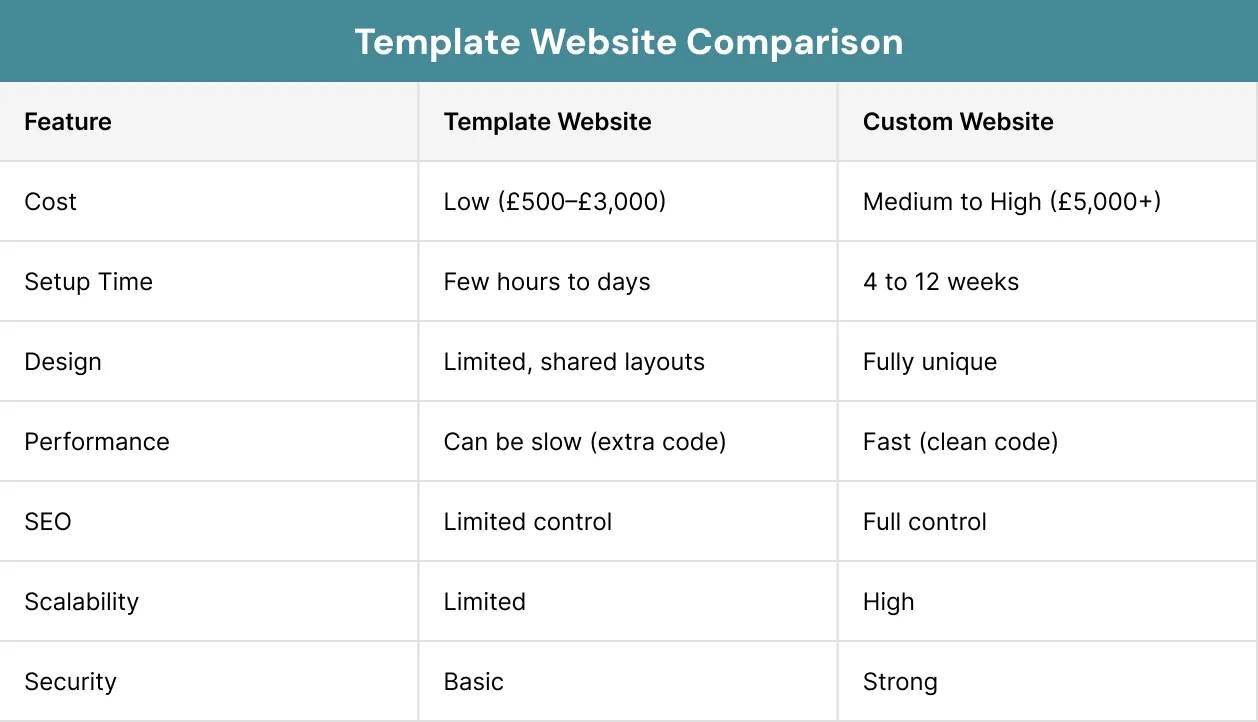
The whole process can take anywhere from a few hours to a few days. The cost is also low, typically between £500 and £3,000 for a basic setup. There is no need for deep coding knowledge or waiting weeks for a developer. This is why website templates are a good starting point for many businesses.
Not all site templates are created equal, though. Some are fixed and you cannot change them. Others are flexible and you can easily adjust the design. The quality varies widely too. Finding the right template that suits your business and audience can sometimes feel like a bit of a guess.
What Is Custom Website Development?
A custom website is the complete opposite of using a template website. In a custom vs template website comparison, custom sites offer more control. Nothing comes pre built. A developer or agency starts from a blank page and builds everything, such as:
- The layout
- The features
- The code
- The user journey specifically for the business goals and brand
This usually takes four to twelve weeks, depending on how complex the project is. It also costs more, anywhere from £5,000 to £50,000 or more for larger or more advanced projects. As a result, the website is built exactly for the business and works the way it needs to. This website is optimised from day one for performance and search engines.
Development of a custom website is also about far more than just how a site looks. It often involves complex coding, specific integrations and marketing led features like lead management, customer management, APIs, booking systems and e-commerce flows built around how the business actually works.
Custom website development allows full control over features and performance. Read more about the
development process.
The Core Differences: Custom vs Template Website
When thinking about the custom vs template website choice, most people focus on cost first. Cost is only one part of a much bigger picture. In the template vs custom website debate, some areas really matter. Here is what truly separates the two options.
1. Brand Identity
Brand identity is one of the biggest reasons the custom vs template website choice matters. A website template is used by thousands. Sometimes millions of other businesses. A popular WordPress theme might power hundreds of websites in the same industry. Visitors notice this, even if they cannot explain why a site feels familiar or uninspiring.
A custom built site looks and feels completely unique. Every colour, every font, every layout decision is made specifically for the brand. This builds trust. It tells visitors the business is serious and that matters in a competitive market.
Failing to stand out through a website can cost real money. A generic site that looks like countless others does not inspire confidence in potential customers. It makes it harder to be remembered, trusted or chosen.
2. Flexibility and Functionality
The template vs custom website gap becomes very obvious when a business needs something specific.
A logistics company needing a secure client portal. A membership organisation needing a personalised members only area. An e-commerce brand wanting to connect the website with its CRM and ERP systems. Web page templates cannot handle these things reliably. These are designed for general use, not for complex and specific needs.
Custom websites handle all of interactive tools, booking systems, AI data tracking, geolocation services and machine learning integrations.
If some features are not needed now, the website can still be built in a way that allows them later. This may include voice search, AR/VR and advanced personalisation. This makes the site future ready. New features can be added later without rebuilding the whole site.
3. Performance and Speed
Performance is another major point in the custom vs template website discussion. Website templates come packed with code for features a business will never actually use.
Every extra script and plugin slows the site down. A slow site frustrates visitors, pushes them away quickly and critically damages Google rankings. Google treats page speed as a direct ranking signal.
A custom site only contains the code it needs. This makes it faster. A faster site keeps visitors on the page longer, reduces bounce rates and improves search engine positions over time.
Design is not just what it looks like and feels like. Design is how it works. – Steve Jobs, inventor and co-founder of Apple Inc.
A business that switched from a template to a custom build can improve page load times and increase conversions.
4. Security
Security is one of the most overlooked points in the custom vs template website conversation. Site templates use widely known code. This makes them highly attractive to hackers because codes are predictable.
In case of a hack, the result may be a code being placed on the website, personal customer data being stolen or even the entire website getting encrypted and the owners having to pay a ransom. This is a real risk for any company that deals with financial transactions.
With a custom website, you have unique code. The developer implements reliable security features in the website from scratch. It reduces the risks considerably. If your business deals with personal customer data, you should consider it an absolute priority.
5. Scalability
Scalability often decides the custom vs template website choice for growing businesses. A growing business needs a website that can grow with it. Adding a new service page, expanding a product range, integrating a new payment method should be easy changes.
On a website template, making changes outside the pre-set options can be very difficult. It sometimes requires hiring a developer who did not build the template. This creates extra problems because that developer is working inside someone else’s framework.
Custom websites make scaling much simpler. A development roadmap can be defined from the start as a clear plan for which features get added and when, as the business grows.This helps avoid surprises, limits and expensive rebuilds later.
How the Custom vs Template Website Choice Affects SEO
Search engine optimisation (SEO) is how a website earns higher rankings on Google so more people find the business without paid advertising.
SEO Reality:
Better rankings start with a fast, clean and well-structured website.
The custom vs template website choice has a significant and lasting impact here. Understanding this is crucial because the template vs custom website difference on SEO alone can determine whether a business is visible online or not.
About
75% of users never go past the first page of Google results. It shows why better optimisation (custom sites) matters.
1. Template SEO challenges
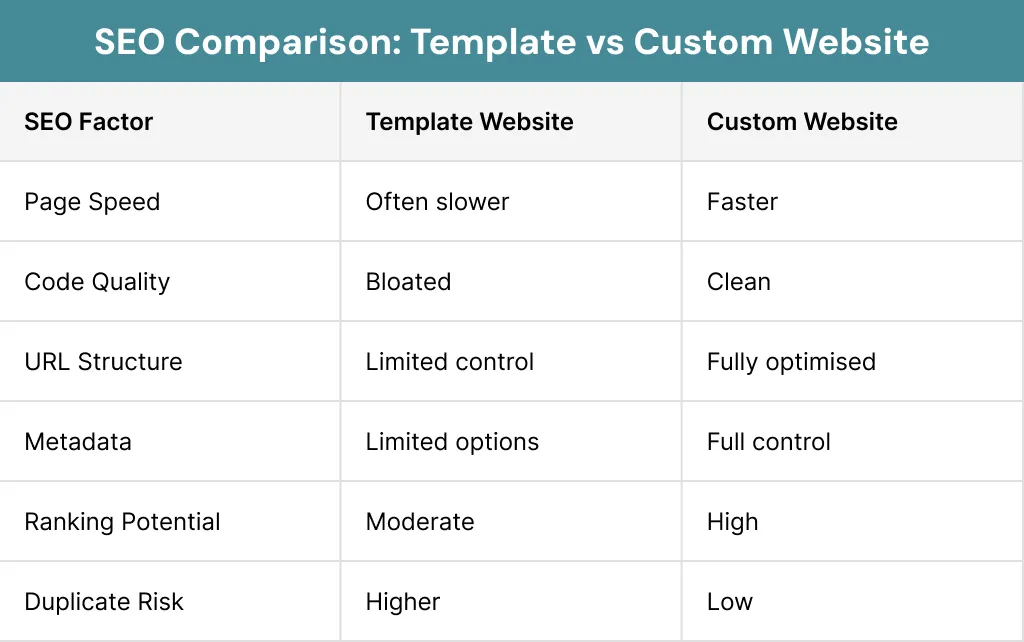
Many site templates have too much extra code. This can make the website load slowly. Some templates are also not built with SEO in mind.
When thousands of websites use the same template, their page structure can look very similar. This may confuse search engines.
Adding more plugins can make the site even slower. Fixing these SEO issues takes time and skill. Even after fixes, the template may still limit what can be improved.
Some templates also create URLs and page layouts that are hard to optimise properly.
2. Custom SEO advantages
A custom site is built with clean HTML, CSS and JavaScript from the beginning. The URL structure, metadata, heading hierarchy, schema markup and internal linking can all be crafted carefully during the build itself. This gives full control over keyword targeting and content strategy.
Site templates can meet minimum SEO requirements. However, there is a real and meaningful difference between being SEO compliant and being genuinely SEO optimised. That difference shows up in Google rankings over time.
For most businesses, better rankings mean more traffic, more enquiries and more revenue. The SEO case for custom websites is strong and well structured.
The Hidden Costs of Website Templates
The custom vs template website cost difference is not only about starting price. Web page templates look cheaper at first, and they are. However, later there can be hidden costs that many businesses do not expect.
When a template does not quite fit what the business needs, a developer has to be hired to modify it. This is because site templates were written by a third party and developers often cannot offer full technical support. They are working within someone else’s system. Changes take more time and cost more compared to a custom website.
Hidden Cost Alert:
A cheap template today can become an expensive rebuild later.
There is also the issue of developer dependency. Many site templates rely on the original creator for security updates and functionality improvements. If that creator stops supporting the template which happens more often than people realise the business is left with an outdated, vulnerable site. Migrating everything at that point becomes a major and expensive project.
If the business grows quickly and the template cannot keep pace, a full redesign becomes unavoidable. That redesign costs money that could have been avoided by investing in a custom website from the beginning. The starting savings becomes a long term cost.
When Is a Template the Right Choice?
In the custom vs template website decision, templates are useful for simple sites. Website templates are not the wrong answer for every business. There are genuine situations where they make complete sense.
Growth Tip:
If your website brings leads, build it for growth from the start.
A startup with a limited budget that needs to get online quickly is a good candidate. A freelance photographer who wants a portfolio site live within a week does not need a £20,000 custom build. A small local business, a plumber, a childminder, a single location cafe whose site mainly shows contact details and basic services is fine with a well chosen template.
Templates also work well for temporary projects, such as:
- A landing page for a short campaign
- A microsite for a public event
- A quick response page for breaking news
Situations where speed matters most and the site does not need to evolve into something more complex.
The honest question is simple: does this website help the business get and convert customers? If yes, a template may become limiting sooner than expected.
A template can still work well for a long time if:
- The website is not the primary revenue tool
- It is more of an online brochure pointing people to a phone number
When Should a Business Invest in Custom Website Development?
Custom websites become the clear choice when a business is serious about long term online growth. Here are the situations where it moves from preference to necessity.
Any business that needs to look completely different from competitors needs a custom build. A site that looks like hundreds of others does not inspire confidence. It blends into the background exactly when it should stand out.
Businesses that need to connect the website to other systems need the flexibility that only custom website development can reliably provide. These systems include:
- CRM platforms
- ERP software
- Booking engines
- Payment processors
The template vs custom website comparison often underplays how critical this is for businesses that depend on joined up digital systems.
High traffic websites and serious e-commerce operations need the speed and security that site templates cannot guarantee. These problems can cost real, measurable money, such as:
- A slow checkout
- A security breach
- A site that crashes during a busy period
Organisations with large websites of over 100 pages, membership portals, association platforms or sites that handle sensitive data should always go custom. The infrastructure needs to be built properly from the start to handle those requirements safely and reliably.
Any business serious about long term SEO performance, not just passing the minimum bar but competing hard for Google rankings will find that a custom built site provides advantages that are genuinely difficult to achieve on even the best site templates.
Six Questions That Make the Decision Clear
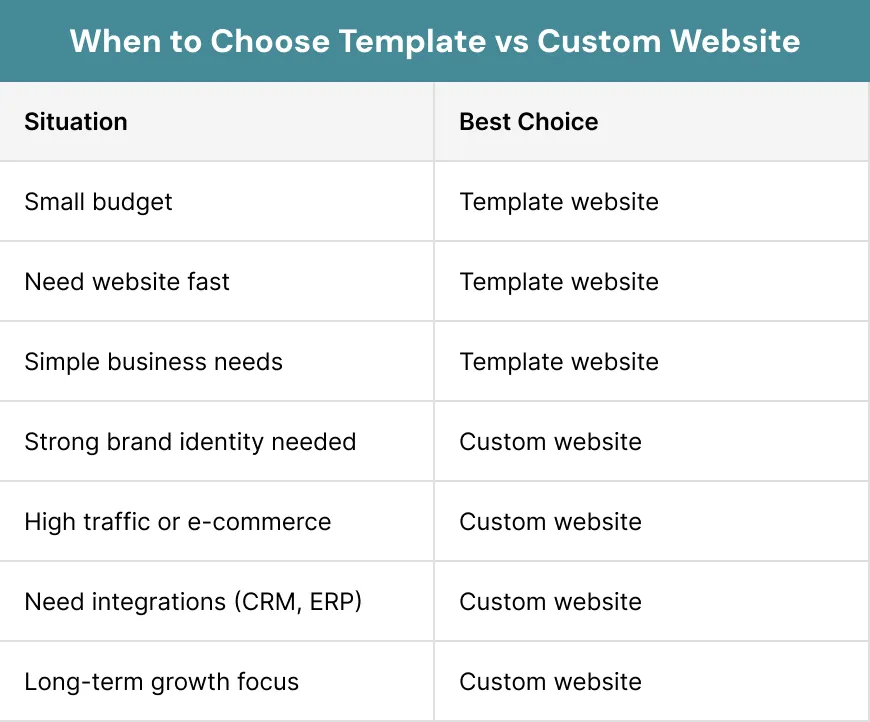
When weighing up the custom vs template website options, these six questions help find the right path.
What is your budget?
If you have a very tight budget with no flexibility then start with a template but go in with honest expectations about its limits.
How fast do you need a website?
If you need to be online in days, templates can help you. If you have four to twelve weeks available then a custom website is worth the wait.
How important is brand identity?
If you need to look completely different from every competitor, only custom guarantees that.
If your website must look different from competitors, custom is the better choice.
What features does the site need?
If you need portals, complex integrations or interactive tools then custom is a more reliable route.
How sensitive is the data being handled?
If your website handles payments, personal details and financial records then custom development provides far stronger protection.
How fast is the business expected to grow?
If you are planning significant growth then build a custom website from the beginning rather than hitting a template’s ceiling two years later.
A Note on the Middle Ground
It is not always a clear-cut either/or decision. Some developers start with a good template in a system such as WordPress or Umbraco. Then they customise it to the point where it starts functioning more like a custom website. This is a good middle way that works better than a basic template and is cheaper than an entire custom website.
The critical issue is whether or not the developer actually has control over the code. Otherwise, the limitations of the original framework will come back at the most inconvenient time for your business.
Real Life Example
This example shows why the custom vs template website choice can affect traffic, speed and conversions.
A business used a template website. It had slow speed, poor SEO and high bounce rate. Customers were leaving quickly.
Later, the business moved to a custom website. The results improved clearly. Page speed increased by around 50%. Conversions improved by 40%. Search rankings also improved, reaching top positions for key terms.
This shows how performance, SEO and user experience together impact growth. This is why many growing businesses move from templates to custom website development after some time.
Final Thoughts
The custom vs template website choice is not the same for every business. However, it does have an honest one. When a website is built around business growth rather than just upfront cost, the custom vs template website decision becomes much clearer.
For businesses just starting out, testing an idea or working with a very tight budget, a website template can be a practical starting point. It gets business online quickly and affordably. There is nothing wrong with starting there. Many successful businesses began exactly that way.
Custom website development is the investment that pays off over time for any business that:
- Wants to grow
- Wants to rank well on Google
- Builds a distinctive brand
- Offers a smooth experience to customers
- Handles data safely and add new features without rebuilding everything from scratch
The businesses that treat their website as a genuine growth tool, not just a digital brochure, are the ones that build it properly. A custom built site is not just a website. It is the infrastructure for everything the business wants to achieve online. Choose based on where the business is going, not just where it is standing today.
After looking at SEO, cost, speed and growth, the custom vs template website choice becomes much easier to understand.
We help businesses build fast, SEO-focused custom websites that actually grow.
Reach out and take the first step towards a website that truly grows your business.