
- May 20, 2026
- Categories: Digital Marketing
What is Keyword Stuffing and How to Avoid it
Are you wondering why a website with awkward content at times ranks highly in search results? When you analyse that content, you will discover that the website is ranked by keyword stuffing. In this process, the same phrases are used repeatedly.
Some site owners use this strategy of keyword stuffing in SEO. In this method, they rank their content by repeating a specific term so many times. Their attention is not towards user experience and readability.
This strategy of the content specialist worked at the time when SEO was developed for the first time. At that time, it was easy to rank content just by repeating a certain word so many times.
However, now search engines have changed their strategy and they have become much smarter. In modern SEO, they focus on context, meaning and user intent instead of repetition. Consider an example from 2025 from a UK study. It suggests that 42% of Google searches resulted in AI overviews. This report tells us that now search engines like helpful and organised content.
You may have seen so many websites with repeated keyword content. The site owners don’t know the techniques of the latest SEO and confuse how modern search works.
Further, relying on repetition to improve your rankings may actually hurt your visibility and lower the value of your content.
This blog will teach you what keyword stuffing is and how damaging it is for your content. You will thoroughly understand how you can improve SEO by avoiding keyword overuse.
Key Takeaways
- Keyword stuffing makes content hard to read, lowers trust, and can reduce search rankings over time
- Stuffing keywords into every paragraph, heading, or link creates a poor user experience and weak content quality
- How to avoid keyword stuffing starts with writing naturally and focusing on what readers actually want to know
- Keyword stuffing SEO issues often happen when the same phrase is repeated too many times without adding value
- SEO keyword stuffing can lead to lower rankings because search engines now focus on meaning, context, and intent
- Google keyword stuffing checks are now more advanced, using AI systems to detect spammy and unnatural keyword use
Describe Keyword Stuffing
To put the content in the highest place of search engines, an old method of adding too many keywords is used. This system of ranking the content is called keyword stuffing.
Keyword overuse is a technique of overloading some keywords in the content to rank on search engines. This strategy makes the content appear difficult to read, machine-written and repetitive.
In the past, SEO systems focused on keyword frequency mainly to rank pages. The page used to rank higher if more keywords were included. This strategy worked in previous times, but now search engines want more than just repetition.
Google and other search engines now look for relevance, context and how well the content aligns with user intent. If you don’t use keywords naturally, it will not rank higher. It is now considered a harmful practice that can damage audience trust and SEO performance.
Google suggests refraining from stuffing keywords and writing naturally for readers.
Related: How NLP is reshaping the future of SEO content strategy
Good SEO content does not repeat keywords for search engines. It answers real questions clearly for real people.
Ann Handley, Digital Marketing Expert and Author
What Are the Types of Keyword Stuffing?
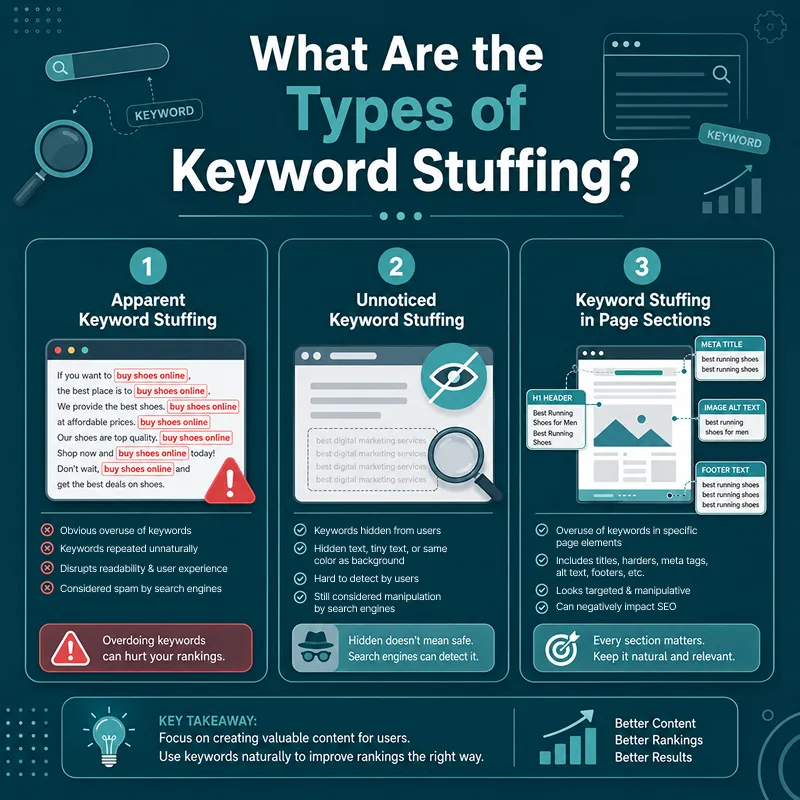
For improved SEO, it is best to stay away from all forms of keyword stuffing. Some of these overused terms are visible to people but some are hidden in technical details. If you know this, you can stay away from typical mistakes. The main types of keyword repetition include:1. Apparent Keyword Stuffing
Visible or apparent keyword stuffing occurs when keywords are overused in the content’s body.
The phrase “high-quality laptops”, for example, will appear fake if it is used repeatedly in a section. People will find the content annoying or useless if it is written in this style. In this manner, engagement will fall and the bounce rate will rise.
2. Unnoticed Keyword Stuffing
Invisible or unnoticed keyword stuffing occurs if you keep your overly used keywords hidden from people. Some content creators apply the colour of the text in the background.
Keywords can also be inserted in HTML elements, such as meta tags, alt attributes or comments.
Search engines discover these terms while crawling, even though visitors are unable to see them. These are now seen as fraudulent practices and can result in SEO penalties.
3. Keyword Stuffing in Page Sections
You will notice that keyword repetition is not limited to the paragraphs only. Content creators add the same phrase in other aspects, such as in alt text, meta descriptions, URLs and anchor text. They utilise it in headings and titles as well.
For instance, putting the keyword in every heading or adding too much to URLs can make your page seem spammy. Placing it in anchor text also makes it annoying.
Regardless of how readable your content is, its SEO will decline if you misuse these keywords in these parts.
Quick Example
If a sentence repeats the same keyword again and again without adding value, it is likely keyword stuffing. Good SEO writing should sound natural and easy to read.
How Do Search Engines Discover Keyword Stuffing?
To check the quality of the content, today’s search engines depend on advanced algorithms and AI. They don’t follow the old strategy to focus on repeating the same keyword. They assess:Context
The topic should be thoroughly covered in the content.Search Intent
It should answer user queries or offer useful insights.Readability and Engagement
Users must stay on the page, interact with content or quickly bounce.
Search engines are able to differentiate between keyword stuffed text and good quality content by looking at these factors.
Why Is Keyword Stuffing in SEO Risky?
Keyword stuffing in SEO is harmful to both readers and search engines. This results in multiple issues that affect content performance, including:Poor User Experience
Using too many keywords makes content difficult to read. Repeated, unclear or robotic sentences irritate readers and prevent engagement.Lower Quality Content
Content with a lot of keywords prioritises search engines over people. This strategy often lacks depth, clarity and useful information. This is why it lowers the overall quality of the page.Loss of Brand Trust
Readers can easily spot unnatural writing. Pages with stuffed keywords can give the impression that a company is manipulative or unprofessional. As a result, trust and reliability will be damaged.Search Engine Penalties
Search engines actively reject pages that are overly filled with keywords. Poorer visibility, removal from search results and lower rankings are examples of penalties. Many websites get penalised for stuffing keywords in their content.
Both visible and invisible keyword overload can lead to these negative effects.
Related: What is semantic SEO
How Keyword Stuffing Affects Ranking in AI Search?
The era when content creators relied on keyword stuffing in SEO to rank pages is over. The latest algorithms pay attention to understanding your content. It does not focus on excessive keyword repetition.
Relevance, context and user intent are now given more value by search engines than just keyword frequency. This change has completely given a new shape to the working of SEO in the era of AI.
AI Is Transforming SEO
Machine learning and artificial intelligence (AI) have entirely altered how search engines analyse content. Search engines no longer rely on just keywords but rather on full topics.
They look at how clearly a page explains a topic and gives users relevant and helpful answers.
Understanding Context and Intent
Search engines have become a lot smarter due to updates like Hummingbird, BERT and MUM. These updates can understand context, interpret language and identify user intent more correctly.
This points out that simply repeating keywords does not guarantee ranking.
Quality Over Quantity
Now you understand that merely repeating keywords is useless. Your content will only be visible in the search results if your pages address the topic fully and give useful insights.
It also depends on whether you have provided answers to the user queries in a better way. In addition, your content must have a natural flow and its readability should be better. This way, it keeps the audience engaged and the performance of your SEO improves.
How to Identify Keyword Stuffing?
The first step in creating high-quality content is to identify keyword stuffing. The main signs are as follows:Read for Natural Flow
To check the natural flow of the content, read it in a loud voice. While reading, if you notice the sentences are awkward, forced and sound repetitive, it shows keyword repetition has been done. In natural content, you will find a smooth flow and it keeps the reader engaged.Check Keyword Repetition
Focus on a particular paragraph or section and read it. If you feel some phrases keep repeating in it, this is a strong sign of overusing keyword repetition. To increase readability and SEO quality, you must be consistent throughout.Review Keyword Placement
If the keywords are used too much in links, headings and paragraphs, it shows poor optimisation. You can achieve a good readability score if the placement of your keyword is balanced. This also ensures that you have avoided a spammy look.Use Keyword Density as a Guide
Keyword density determines how often a term shows up with respect to the total word count. Although helpful in identifying possible overuse, the writing style should not look forced. Fixed percentages should only be used as a guide; natural flow is more important.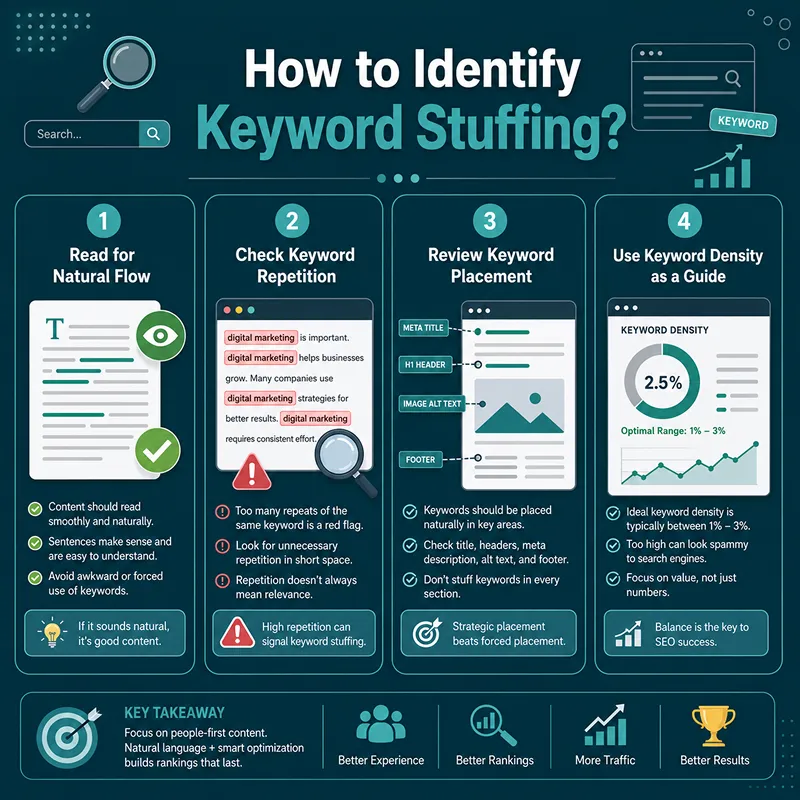
How to Avoid Keyword Stuffing?
Through keyword stuffing, you can harm both the experience of the reader and SEO. While creating content, you should focus on relevance and clarity. Also, your content should be made for humans first.
So if your material answers questions, feels natural and gives real value, search engines reward it and rank it higher. Therefore, aim to use your keywords carefully and strategically and avoid overloading your keywords. Some useful tips to avoid keyword overload are given below:
1. Writing for Your Audience
Keep the following things in your mind when you are writing:- Create content that meets your readers’ needs and provides helpful information
- Use easy to understand, clear and simple language
- Don’t repeat keywords too much that it looks unnatural; write in a way that makes sense
2. Using Keywords Naturally
To use the keywords naturally in your content, write in the following way:- Put primary and secondary keywords in headings, subheadings and the main body where they are appropriate
- To address the topic without repetition, employ synonyms or related terms
- To make sure the content reads naturally, keep a smooth flow of sentences
3. Optimising Content Structure
Optimise your content in the following ways:- Use subheadings to make the content easy to scan and break it into brief paragraphs
- You can make your details digestible if you include numbered lists, examples and bullet points
- To improve the topic coverage without keyword overload, add internal links and contextual references
4. Focusing on User Experience
While writing, focus on user experience in the following way:- Make sure your content gives answers to the user queries fully and precisely
- Give priority to the readability and engagement first and after that, fix it according to SEO
- Instead of repeating keywords, utilise images, examples or case studies to clarify key points
Best Practice
Write for people first and search engines second. If your content answers real questions clearly, keywords will fit naturally without forcing them into every sentence.
How to Do Keyword Research to Avoid Keyword Stuffing?
Keyword research is not only about finding the most popular keywords. This research should aim to understand what your audience is looking for. Also, it means you must use these terms throughout your content naturally. While doing keyword research, focus on the following aspects to avoid keyword spamming:Target One Primary Keyword Per Page
To keep your content focused, use a single primary keyword on each page. The purpose of the secondary keyword is to support the main topic without forcing it to be repeated.Employ Long-Tail Keywords and Synonyms
When a keyword comes repeatedly in your content, you can use its synonym to reduce repetition. On the other hand, long-tail keywords detect differences in search queries. Thus, long tail keywords and synonyms make your content readable and flexible.Focus on Natural Writing
While writing, keep in mind humans first. Secondly, when you are using keywords, you must focus on engagement, helpfulness and clarity. Your keywords appear naturally when your content provides value.Apply Keywords Carefully
Do not overload any section of your content with keywords. Place them in alt text, meta descriptions, headings and titles in a way that makes sense.Look at Keyword Density as a Guideline
Use the keyword density formula just as a guideline, not forcefully as if it controls you. Don’t focus on strict percentages but rather prioritise natural flow and context.How Relevant Content Prevents Keyword Stuffing?
When you focus on relevant content, it means that keywords should come naturally, without awkward repetition. SEO now favours pages that are in-depth, helpful and informative rather than those that simply repeat terms. While writing, keep the content relevant in the following way:Explain the Topic Thoroughly
When you address the subject of content in depth in a natural way, it means:- Variations and linked terms appear in a natural way
- The flow of sentences should be clear and organised by placing the keywords without stuffing
- Readers and search engines both find the content more valuable
Keep Content Relevant and Readable
While keeping content readable and balanced, consider the following points:- Make sure the sections are easy to scan, concise and clear
- To maintain smooth reading, use synonyms or related phrases
- Do not overload a single keyword
Enhance Engagement and SEO Performance
Improve SEO results and interest in the following ways:- Search engines identify unique and organised content as high quality
- It raises total authority, backlinks and shares
- With the help of relevant content, you can attract readers to stay and interact on the page longer
Case Study: UK PHA Penalty Recovery
Recently, the UK Public Health Association dropped most of its Google rankings. Google organic traffic decreased by 98% and overall traffic fell by 90%. When they analysed the system, the prior SEO agency used cheap and spammy strategies.
All this resulted in a manual penalty from Google. SEO must be done carefully in healthcare because in this field, trust and compliance are important.
After thorough analysis, it was found that thousands of spam links were used and over optimised anchor text was present. Thus, the team removed all the low-quality links. After this, high-quality links were placed with varying anchor text.
When all this was done, the process was written down and sent to Google Search Console for a review request.
When 6 weeks passed, Google lifted the penalty. As a result, rankings were returned within a few days and traffic started increasing.
Final Thoughts
In summary, keyword stuffing was used in the old days to rank content but it no longer works. Stuffing keywords makes the text hard to read and lowers user experience. This will frustrate users and lead to search engine penalties.
In contrast, if you write with clarity and focus on user intent, this ensures that your content works well.
For instance, by integrating keywords naturally and covering topics in-depth, you can make your pages more engaging and helpful. Also, you can build credibility and trust with visitors with this approach.
Xoom Plus is aware that the latest SEO is not just about repeating keywords but focuses on value. We guide on creating content that is easy to read, optimised and useful for search engines.
However, you can achieve success only if you are consistent. You must write for your audience first and then organise your content well. Also, let the keywords fit where they make sense.
Contact us today to write in a way that your content is engaging, visible and effective. Learn to make your content visible on search engines without relying on old SEO tactics.
Is your website struggling because of repetitive, low-quality SEO content?
Our team helps businesses create natural, user-focused content that improves readability and search performance. We have helped brands strengthen their SEO content strategies across different industries.
Reach US!
FAQs
What is SEO keyword stuffing?
SEO keyword stuffing is the practice of adding the same keyword too many times in content to try to improve search rankings. This makes the writing sound unnatural and can reduce content quality, user trust, and search performance.
How does Google keyword stuffing detection work?
Google keyword stuffing detection uses advanced algorithms and AI systems to identify unnatural keyword repetition in content. Google now focuses more on user intent, readability, and helpful information instead of keyword frequency alone.
Is keyword stuffing illegal?
Keyword stuffing is not illegal, but it violates search engine spam policies. Websites using this tactic may face lower rankings or removal from search results. It is considered a poor and outdated SEO practice.
What does keyword stuffing look like?
Keyword stuffing looks like repeated words or phrases used unnaturally in content. It can appear in paragraphs, headings, URLs, meta tags, or image alt text. The writing often sounds forced, robotic, and difficult to read.
How to identify keyword stuffing?
Keyword stuffing can be identified by checking for repeated keywords in short sections. If the content sounds unnatural or repetitive, it may be over-optimised. Reviewing headings, links, and keyword placement can also reveal stuffing issues.