- May 19, 2026
- Categories: Digital Marketing
SEO vs AEO vs GEO: Key Differences Every Marketer Must Know in 2026
A business can rank on Google today but the next day, it may not be visible in AI-generated search results. This is because SEO alone is no longer enough.
Search has changed a lot in the last few years. In the past, people used to search on Google only. They just clicked on websites from the search results page. Now people ask questions from AI tools when they need information.
Now, brands think differently about online visibility. SEO vs GEO has become very important for marketers, businesses, bloggers and website owners.
AI has changed the way users find information online. This is why the debate around GEO vs SEO is growing. If a business only focuses on Google rankings, it may slowly lose visibility in AI answers and zero-click searches. 26.10% of Google searches now end as zero-click searches.
Today, search is hybrid and users search through Google, AI assistants, voice search, map applications, social media platforms and generative AI tools. That is why marketers need a strategy which combines SEO, GEO and AEO.
Key Takeaways
- SEO vs GEO is not about choosing one strategy over another because modern search visibility now depends on traditional search, AI-generated answers and voice search together
- GEO vs SEO works differently because SEO focuses on rankings and traffic, while GEO focuses on AI citations, authority, contextual relevance and brand visibility inside ChatGPT, Gemini and Perplexity
- AEO SEO strategies work best when content uses FAQs, schema markup, conversational language and short direct answers that voice assistants and AI systems can easily understand
- The idea that “SEO is dead start AEO” is not fully correct. SEO still helps businesses drive traffic and improve discoverability. However, businesses now also need AEO and GEO to stay visible in zero-click searches and AI-powered search results
- Strong E-E-A-T signals like expert content, backlinks, reviews, citations, author bios and updated information now play a major role in both AEO vs SEO and GEO performance
- AI systems prefer content that is structured clearly with semantic headings, entity optimisation, machine-readable formatting and natural language instead of keyword stuffing and weak content
- Businesses should focus on creating trustworthy, human-first content that works across Google search, AI Overviews, ChatGPT, voice assistants, maps, Reddit, TikTok and other modern search platforms
What Is SEO
SEO means Search Engine Optimisation. It helps websites rank higher on conventional search engines like Google and Bing.
When users type keywords or search queries, SEO helps websites appear in organic search results. The aim of SEO is to increase traffic, visibility, clicks and conversions.
It is important to understand that SEO is still the foundation of digital visibility when debating SEO vs GEO. SEO works through many important areas, such as:
1. On-Page SEO
On-page SEO plays a key role in improving the content and structure of a website. This includes title tags, meta descriptions, headings and internal links. This also includes image alt text, keyword placement and content quality.2. Technical SEO
Technical SEO is crucial for website performance and crawlability. Search engines need easy access to your website. Effective technical search engine optimisation includes page speed, mobile optimisation and XML sitemaps. This also includes sitemaps, core web vitals and secure HTTPS connection.
Technical performance matters greatly in SEO vs GEO strategies because AI systems also prefer structured and accessible content.
3. Off-Page SEO
Off-page SEO works on authority and trust signals outside the website. This includes backlinks, brand mentions, reviews, citations and people trust. Search engines use these signals to understand if a business or website is built on trust.4. Why Does SEO Still Matter
SEO is the foundation of digital visibility. It is still as important as it was before because many people are still using Google to find services, products and answers. Many businesses also get customers from Google search. Many people think SEO is dying because of AI tools. That is not true because:- Google still processes billions of searches daily
- Traditional search still drives strong traffic
- Commercial and local keywords still bring clicks
- Businesses still depend on search visibility
- Organic rankings still build trust and authority
What Is GEO
GEO stands for Generative Engine Optimisation. It helps AI systems understand, cite and use content in AI-generated responses. GEO works for AI tools like ChatGPT, Google AI Overviews and Gemini. It also works for Claude, Perplexity, Bing AI and other large language models.
In SEO vs GEO discussions, GEO is becoming one of the biggest areas of interest. It does not work like traditional search engines that mostly list websites. In this type of search, generative engines create summarised responses using information from multiple sources. GEO makes your content trustworthy enough that AI systems reference it directly.
Content is king but context is God. – Gary Vaynerchuk, Digital Marketing Expert
1. How Does GEO Work
GEO works on semantic clarity, contextual understanding, entity signals and citation-ready content. It also works on machine-readable structure, authoritative information, original research and E-E-A-T signals.
In simple words, GEO makes sure AI can understand who you are, what your content means and why it should trust your information.
2. GEO Strategies
Strong GEO strategies include:- Creating high quality content
- Adding statistics and citations
- Writing with conversational NLP language
- Structuring content clearly
- Building topical authority
- Creating content clusters
- Using semantic HTML
- Implementing schema markup
- Building trust signals online
- Adding author bios and publication dates
3. GEO and AI Citations
SEO and GEO have different traffic behaviour. SEO focuses on getting clicks and GEO focuses more on visibility and citations inside AI answers.
For example, ChatGPT may answer a question by saying, ‘According to Brand X…’ This type of citation helps increase authority and visibility even when users do not directly click the website.
What Is AEO
AEO means Answer Engine Optimisation. It helps content appear as a direct answer instead of just a search result. AEO is built for voice assistants, featured snippets, Google AI Overviews and People Also Ask sections. It is also built for zero-click search, Siri, Alexa and Google Assistant. AEO is different from traditional SEO, such as:- SEO wants users to click a website
- AEO wants the content to become the answer itself
1. How AEO Works
AEO works heavily on structure and clarity. Answer engines prefer content that is easy to scan, question based, short and direct. It also prefers content that is written naturally.
For example, ‘What is GEO?’ A well optimised AEO page does not go directly into details and gives a direct answer in the first few lines.
2. Important AEO Strategies
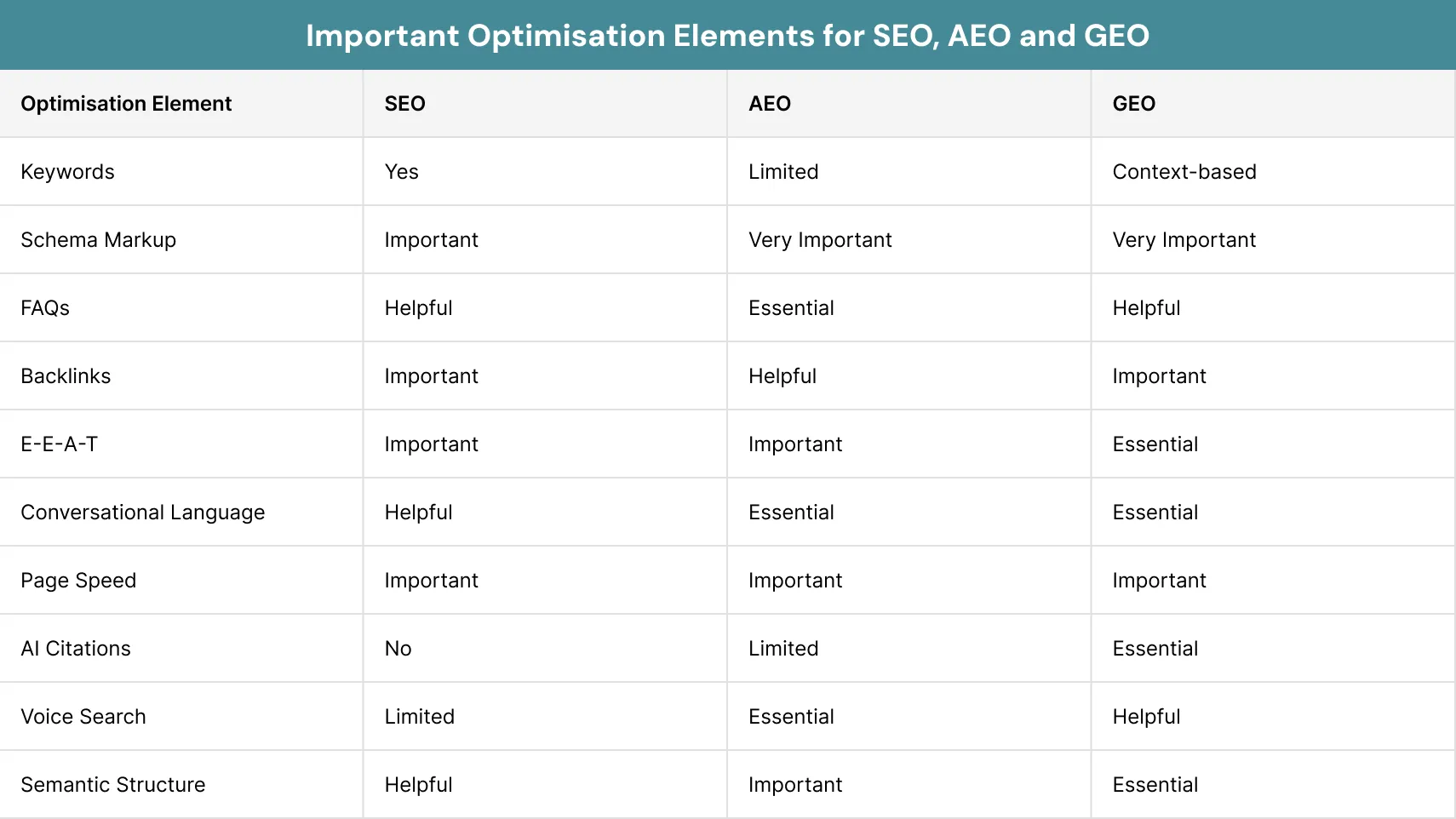
AEO strategies include FAQ sections, schema markup, conversational language and clear headings. These also include question and answer formatting, natural language processing and voice search optimisation.
Schema markup is the most important among these strategies because it helps search engines understand the meaning and structure of content.
3. Why Is AEO Growing
AEO is growing because search behaviour has changed. It is more like a chat. People no longer only type short keywords. They ask full conversational questions, such as, ‘What is the best project management software?’, ‘How does SEO work?’ and ‘Where can I find the best Italian restaurant near me?’.
Demand for a direct answer arises due to voice search and AI assistants. Hence, when considering SEO vs GEO, companies also need to be aware of AEO.
Understanding SEO vs GEO
Many people are often confused about SEO vs GEO because both strategies focus on visibility. However, they play different roles, such as:- SEO helps websites rank in traditional search results
- GEO helps brands become trusted sources in AI responses
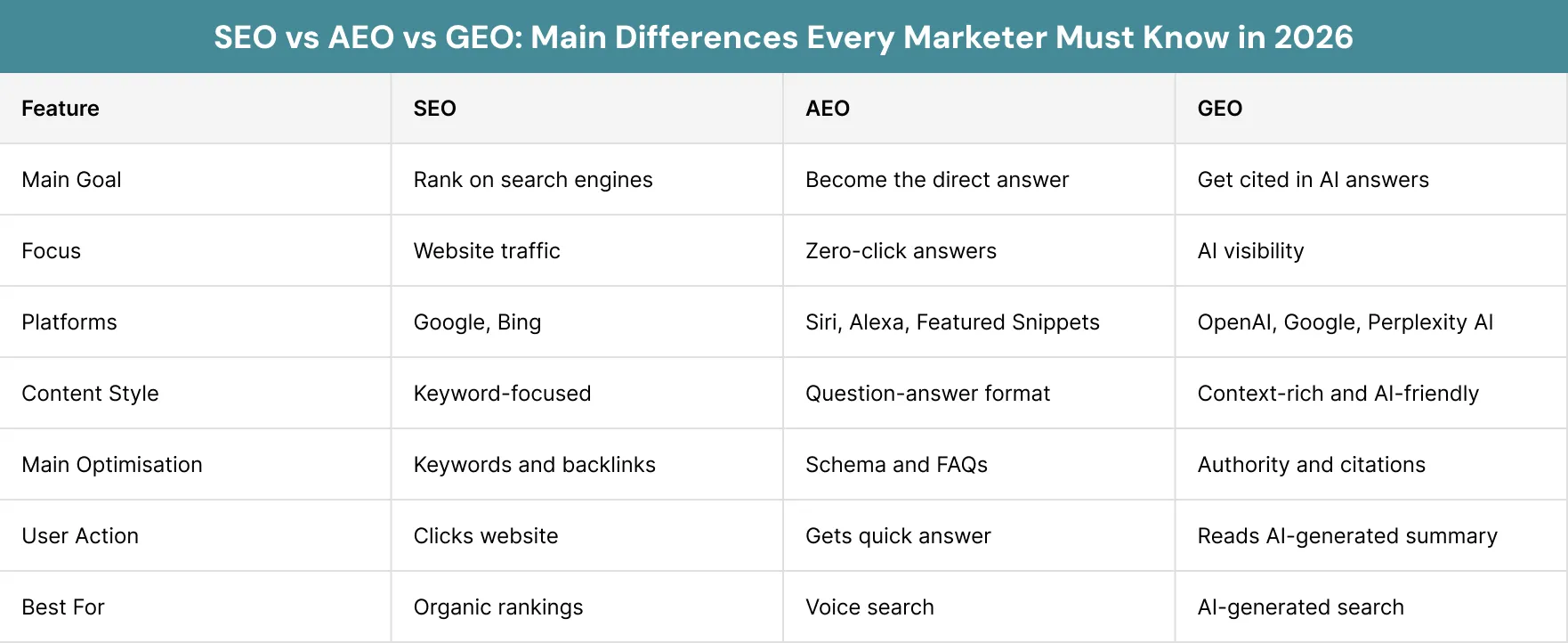
1. Main Difference Between SEO vs GEO
SEO focuses on search engine rankings, organic clicks, SERP visibility, blue links, keywords and backlinks. GEO focuses on AI citations, contextual understanding, AI answers, semantic clarity and authority signals. It also focuses on content that is easy to cite.2. SEO vs GEO and User Intent
User intent is an important part of SEO vs GEO. Traditional search users do not always make decisions immediately. They often visit many links before making decisions.
AI search users want instant and direct answers. This means GEO content must be easy to summarise, factually accurate and highly trustworthy. It should clearly answer questions in a conversational language.
3. SEO vs GEO in Zero-Click Search
Zero-click search happens when users get answers without clicking websites. This search is increasing with Google AI Overviews and voice assistants. This is one of the reasons why SEO vs GEO is widely discussed in digital marketing.
Search Shift
Users now get answers from AI without clicking websites. SEO alone may not be enough.
Businesses need visibility inside AI answers. This is why they can no longer depend only on traffic.
GEO vs SEO: Which One Matters More
Many people think GEO vs SEO means traditional SEO is losing value in digital marketing. This is not true and it is still important. AI systems still use information from websites that search engines have already indexed.
The best method is to use both together because if your SEO is weak, your GEO results may also become weak.
1. Is GEO vs SEO a Competition
No, you do not need to see GEO vs SEO as a competition. It does not mean that one strategy is less in value than the other. Instead both strategies support each other. GEO helps AI tools trust and mention your content in their answers and SEO helps people find your website.2. GEO and SEO for Local Businesses
SEO is still crucial in many local searches. For example, ‘coffee shop near me’ and ‘best dentist in London’. These keywords still bring local search results and organic clicks. This shows that GEO and SEO both depend a lot on what the user is actually searching for.3. GEO vs SEO for Informational Content
Informational keywords are more likely to lead to AI Overviews. For example, ‘what is SEO?’, ‘how does life insurance work?’ and ‘benefits of physiotherapy’. Such searches often result in zero-click activity. This is where GEO comes into play.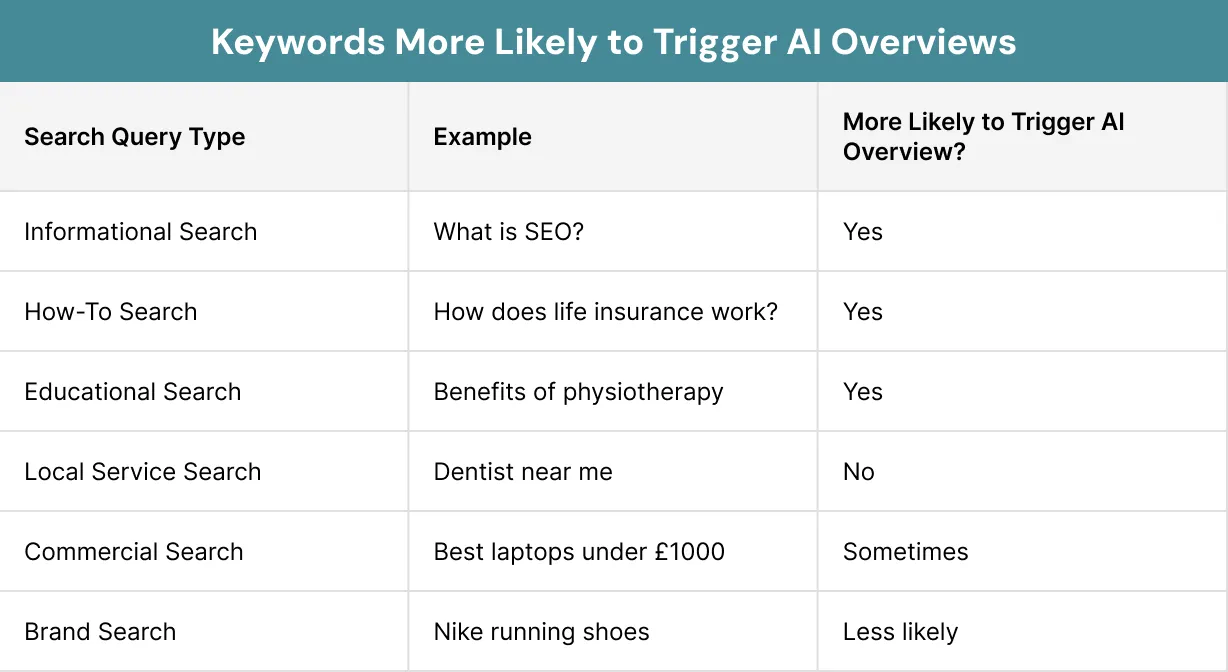
Understanding AEO and SEO Together
Many companies are now using AEO and SEO together. They are not keeping them separate like they used to. This is because search engines like to give people direct answers, featured snippets and conversational responses when they search for something.
Search engines are really favouring SEO and AEO strategies that work together to give people what they are looking for.
1. How AEO and SEO Works Together
AEO and SEO together improve rankings and snippet visibility. Strong SEO and AEO strategies usually include traditional keyword optimisation, FAQ sections and structured schema markup. These also include conversational headings, short direct answers and effective technical website optimisation.2. Why AEO and SEO Matters for Voice Search
Voice assistants favour short and chatty replies. This suggests that AEO and SEO optimisation help websites being ranked in Siri replies, Alexa replies, Google Assistant replies and Voice search.
Voice search is becoming more popular since people talk to devices naturally like a chat rather than typing brief keywords.
The Role of E-E-A-T in Modern Search
E-E-A-T stands for experience, expertise, authoritativeness and trustworthiness. This is now important across SEO, AEO and GEO. This is especially important in SEO vs GEO because AI systems strongly prefer trustworthy and authoritative sources.- Expertise is built by showing deep knowledge and understanding of a topic. This includes detailed guides, expert written content, industry knowledge and research based information. This also includes accurate explanations, updated content and professional insights
- Experience signals include first-hand knowledge, tutorials, practical examples, videos and industry expertise
- Authority is built through backlinks, brand mentions, expert content and industry citations. Whitepapers, case studies and original research are also key factors
- Trust is built through consistent branding, online reviews, Trustpilot presence and Google reviews. Real author profiles, accurate information and strong website security also help to build trust
AI Search and Hybrid Search Behaviour
Today, people no longer search only on Google. They now search on ChatGPT, Gemini, TikTok and Instagram. People also search on Reddit, YouTube, Google Maps and Perplexity.
The way people search for things on the internet is one reason why people are talking about SEO vs GEO so much.
The Relevance of Reddit and Social Search
Reddit debates are viewed as being genuine and less commercial. TikTok and Instagram also play a role in how people search for information since they are interested in seeing things. In today’s world, companies have to be present on various platforms.Technical Optimisation for SEO, AEO and GEO
Technical optimisation supports SEO, AEO and GEO at the same time. Some key technical factors are:- Schema markup
- Core Web Vitals
- Fast page speed
- Mobile optimisation
- Semantic HTML
- Crawlability
- XML sitemaps
- Internal linking
- Clean website structure
- LLMs.txt
- Robots.txt management
Content Strategy for Modern Search
Good content is the base of SEO, AEO and GEO. Modern content should be helpful, structured, easy to scan and factually correct. It should also be conversational, contextual, human-friendly and machine-readable.Long-Form Content Still Matters
Long-form content still matters because it builds topical authority, improves trust and supports AI citations. It also answers complex questions deeply. Strong SEO vs GEO strategies usually combine concise answers with deeper explanations.Important Tools for SEO, AEO and GEO
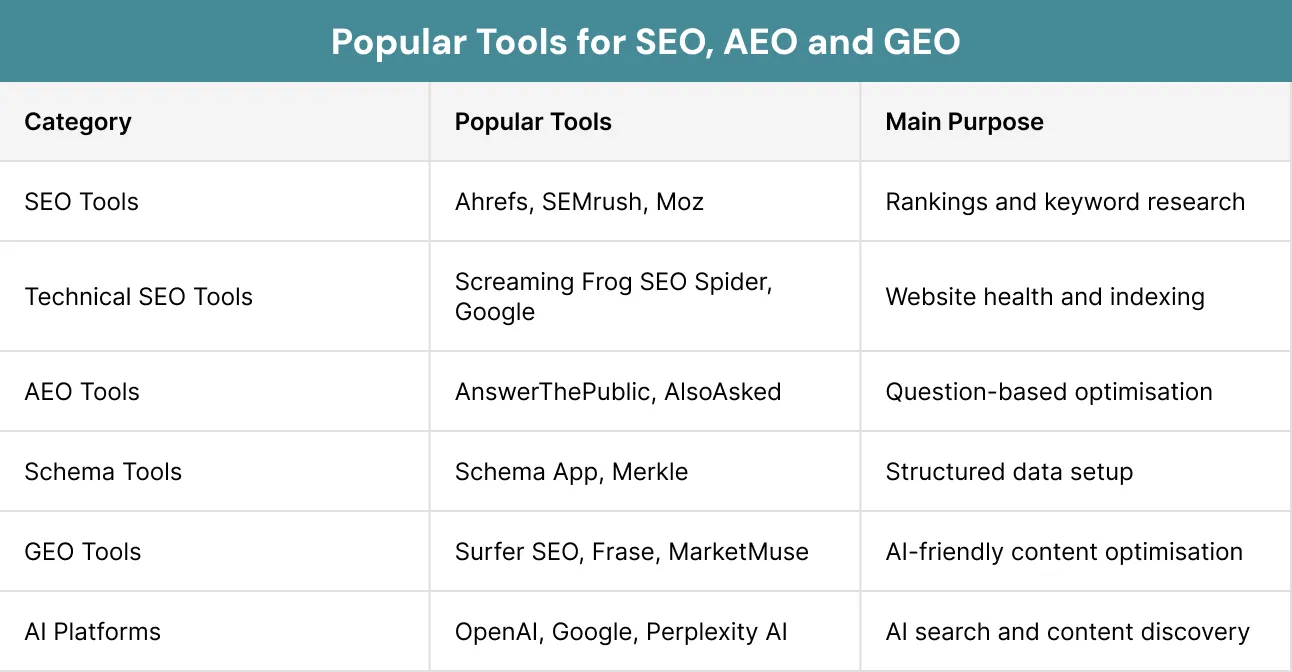
The following tools help businesses improve visibility across modern search systems:- SEO tools include Ahrefs, SEMrush, Moz, Google Search Console and Screaming Frog
- AEO tools include AnswerThePublic, AlsoAsked, Schema tools and FAQ generators
- GEO tools include Surfer SEO, Frase, Jasper, MarketMuse and AI visibility tracking tools
The Future of Search
AI technologies have been evolving on a monthly basis and they will continue transforming search. Future SEO vs GEO trends will also continue evolving with AI technology.
Recent data indicates that 16% of firms in the United Kingdom have already integrated AI technology into their operations. Looking ahead, search engine trends will shift toward highly personalised results, voice and image search and interactive AI chat interfaces.
Traditional Google searches will also remain relevant but AI summaries and conversations will continue evolving. Businesses that fail to adapt may gradually lose visibility.
Why Businesses Need SEO, AEO and GEO Together
Successful marketers do not choose between SEO, AEO and GEO. They are smart enough to combine all three strategies for better outcomes. They know businesses need SEO for rankings and traffic and AEO for direct answers and snippets. They also adopt GEO for AI visibility and citations.
Use All Three
SEO brings traffic, AEO gives answers and GEO builds AI visibility.
Modern search visibility depends on appearing in Google rankings, featured snippets and voice search. It also focuses on AI Overviews, ChatGPT and Gemini answers. It appears across social search platforms as well.
Real-Life Example
Let’s discuss a case where SEO, AEO and GEO work together to help find answers. The following are the details:Background
A person looking for a physiotherapy clinic in Birmingham may use more than one search platform in a single day.Findings
- First, they may search for the best physiotherapy clinic near me on Google and click a website through traditional SEO
- Later, they may ask ChatGPT, which physiotherapy clinic in Birmingham has good reviews and fast appointments? This is where GEO becomes important because AI tools may cite trusted brands
- At night, they may ask Siri, what is the best clinic for back pain near me? Siri may give one direct answer through AEO
Outcome
This shows why businesses now need SEO, AEO and GEO together. This also shows depending only on Google rankings is no longer enough to find answers.Conclusion
The debate around SEO vs GEO shows how search has shifted from basic searches using keywords to advanced searches driven by artificial intelligence (AI).
SEO will continue to drive traffic and visibility online. AEO helps brands to become direct answers to questions asked on snippets and in voice search queries. GEO helps brands to become authoritative resources within the text generated by AI. Marketers should know that the future of SEO lies in combining all three practices together.
Strong SEO, structured data, authority indicators, natural language, E-E-A-T standards and AI-friendly format will be crucial for success.
Those brands that understand the need for SEO, AEO and GEO will gain better visibility, authority and credibility across Google, AI search engines and other advanced search platforms in the future.
XoomPlus understands the importance of SEO, AEO and GEO in AI searches. Contact us today and make your brand visible on Google, AI search and voice assistants.
Worried that your business is disappearing from Google, AI Overviews and ChatGPT results?
Xoom Plus helps brands improve SEO, AEO and GEO visibility with content built for modern search behaviour.
Reach out and get a strategy built for Google, AI search, voice assistants and the future of online visibility.
FAQs
What is the difference between SEO, AEO and GEO?
SEO helps websites rank on Google and Bing. AEO helps content appear as direct answers in snippets, voice search and AI assistants. GEO helps AI tools like ChatGPT, Gemini and Perplexity understand, cite and use content in AI-generated answers. SEO focuses on traffic, AEO focuses on answer visibility and GEO focuses on AI authority and citations.
Is SEO still important in 2026?
Yes, SEO is still important in 2026 because Google, Bing, maps and local packs still drive strong traffic. Local and service-based searches still bring clicks. But SEO alone is not enough now. AI Overviews, voice search and AI chat tools mean businesses also need AEO and GEO for wider visibility.
What is AEO in digital marketing?
AEO means Answer Engine Optimisation. It helps content become the direct answer in featured snippets, People Also Ask, voice assistants and AI answers. It works best with FAQs, schema markup, natural language and short clear answers. AEO is useful for zero-click searches where users get answers without opening a website.
What is GEO and why does it matter?
GEO means Generative Engine Optimisation. It helps AI systems like ChatGPT, Gemini, Claude and Perplexity understand and cite content in generated answers. GEO matters because more users now ask AI tools for answers, comparisons and recommendations. It improves AI visibility, authority, citations and brand recognition.
Can one article support SEO, AEO and GEO together?
Yes, one article can support SEO, AEO and GEO if it is structured well. It should include clear headings, FAQs, natural language, internal links, structured data, citations and detailed answers. SEO helps it rank, AEO helps it become a direct answer and GEO helps AI systems understand and reference it.
Why are AI Overviews changing SEO?
AI Overviews are changing SEO because Google now gives AI-generated summaries for many informational searches. Users may get answers without clicking any website, creating more zero-click searches. So businesses now need GEO and AEO along with SEO. The goal is not only ranking anymore but appearing inside AI-generated answers too.