- April 1, 2026
- Categories: Digital Marketing
What is Lead Generation? A Complete Beginner Guide
People are exposed to a lot of messages and offers in today’s digital landscape. In fact, buyers use an average of 10 different channels during their buying journey.
This makes it harder than ever for businesses to stand out. To differentiate themselves, businesses must grab attention and spark genuine interest in their products and services. This is where lead generation becomes essential.
The end goal of generating leads is to create interest so that it converts to a sale.
Let’s discuss what lead generation is, the steps you need to follow to identify and retain leads successfully and the marketing tools that can support you along the way.
Key Takeaways
- Lead generation is about attracting the right people, not just more people: The goal is to create genuine interest and convert high-quality prospects into customers, not simply collect contacts.
- A structured process drives results: Effective lead generation follows four steps, namely attract, capture, nurture and convert. Skipping any stage reduces conversion chances.
- Content and value are the foundation: Addressing audience pain points through helpful content (blogs, videos, webinars) is key to building trust and generating interest.
- Quality beats quantity every time: Using lead scoring, targeting and personalisation helps focus on prospects most likely to convert, improving ROI.
- Testing, tools and data improve performance: Continuous A/B testing, analytics and the use of CRM and automation tools help refine strategies and increase conversions over time.
What Is Lead Generation?
A process by which you create interest in a product or service and convert it into a sale is known as lead generation (lead gen).
If someone asks what lead generation is, the simple answer is that it is the process of attracting people who may be interested in what your business offers and guiding them towards becoming customers.
This process makes sales much more effective because it concentrates on the most promising and valuable outcomes. This, in turn, increases the chances of success in getting new customers and converting prospective customers.
Important:
More leads ≠ more sales. Right leads = real growth.
The three types of leads are:
Qualified Lead: A potential customer who has shown a keen interest in a product or service and is likely to buy that product.
Unqualified Lead: Someone who does not show a sufficient level of interest to become a customer.
Warm Lead: Prospects who fall between qualified and unqualified leads. They show a degree of interest in the product or service you’re offering. However, it depends on the sales team to follow up and find out if it can generate a lead.
The first step of lead generation starts with raising awareness and generating interest among potential customers. This can be done by publishing blogs that inform and educate the audience. It can also be done by connecting with users through social media.
Email newsletters or exclusive content like webinars, dossiers or a free ebook also help in lead generation. They can be shared with those customers who sign up on your website or social media. In this process, users share their contact details by themselves. You can then use this to collect data and follow up with potential leads.
Once you have gathered leads, you can use their contact details to reach out to them through personalised communications, such as email or through targeted promotions, such as social media ads or Google Ads. Many businesses now use lead generation services to make this process more organised and effective.
What Are the Most Effective Lead Generation Strategies?
So, you have a clear understanding of what lead generation is. But how do you actually convert leads into customers?
You can do this by producing, publishing and testing content that captures the attention of your audience or leads. Good lead generation services usually follow this same pattern because it helps businesses move people from interest to action in a more practical way.
1. Make Sure Your Content Addresses Pain Points
The starting point in ensuring that your content resonates with leads is to concentrate on their pain points and how your product or service addresses and solves those problems.
For instance, for a business specialising in project management software solutions, it would make a great deal of sense to produce a video series on project planning and case studies of how integrating certain software can skyrocket productivity.
Potential buyers appreciate it when you clearly show that you can follow through on your promises and deliver for them. Make this a priority so that your customers are reassured that what you’re offering is what they need to solve their pain points.
This is especially important in B2B lead generation, where buyers often take more time before making a decision.
2. Set Up a Lead Scoring System
To convert leads into sales, you also need a lead scoring system. In a lead scoring system, you award points based on particular actions taken by leads, such as attending a webinar, whitepaper downloads or engagement with high ranking pages on your website.
The next step is to assign a higher lead score to those leads who show a keen interest by engaging with product features on your website, compared to those leads who show mild interest by sporadically visiting your website.
By directing your efforts towards leads with a higher score on the scoring system, your sales team can focus on those leads who have a bigger probability of resulting in a conversion.
This is one of the most useful ways to improve B2B lead generation because it helps teams focus on the right prospects instead of chasing everyone.
3. Go Where Your Audience Is
Identifying the social media platforms your target demographic uses is essential. If you want to reel in the right clients, you have to be in the right place.
You will not be able to get leads from X if your business is centred around a more visually focused demographic.
For that, you need to use sites such as Instagram or Pinterest, where your aesthetically appealing content can get more clicks and potentially more leads.
A lot of lead generation services begin by helping brands understand exactly where their audience already spends time online.
4. Dial In a Great Call To Action
Irrespective of whatever channel you’re using to get to your target audience, you need to understand that a clear and persuasive call to action paired with an intuitive design is essential.
For subscription based services, you can get better conversion rates by using a well crafted sign up form alongside customer testimonials on your site’s landing page.
5. Perform A/B Testing for Best Results
A/B testing and analytics can be used to fine tune various elements such as headlines, imagery or calls to action that are drawn from real time analytics data.
A/B testing is a method of comparing different versions of a single element to identify which performs better.
For example, to A/B test newsletter subject lines, you can analyse email open rates and find out which subject line resonated the most with the audience. Doing this will help you refine your email campaigns for better engagement and improved conversions.
Businesses that invest in lead generation services often use testing like this on a regular basis because small improvements can create stronger long term results.
What Are the Trends in Generation of Leads?
AI appears to be shaping the marketing environment in all aspects, including lead generation. This is an overview of some of the areas in which marketers are becoming more adept at lead gen.1. AI Tools
It is the task of marketers to comprehend lead behaviours and preferences and AI powered lead gen tools have made this task a bit simpler. Machine learning algorithms can even guess what lead is most likely to interact based on previous interactions.
Use AI and analyse the purchase history of a customer to recommend complementary products. The analysis will provide subtle insight into what customers are specifically interested in. It will also assist in finding broader trends in your expansive customer base. It also helps enhance targeting and customised marketing plans.
This is becoming increasingly useful in B2B lead generation, where buyer intent and behaviour matter a lot.
2. Automation and Personalisation
Another use of marketing automation tools is to scale up and automate processes and deliver content that is personalised.
In case you come up with adaptable email campaigns, create content depending on lead behaviours and use the tool to do personalised communications. By observing customers, businesses can make them feel special.
You can go past the first stage of lead gen with personalisation. Clients will be better satisfied and you stand a better chance of doing repeat business.
This is why many lead generation services now combine automation with personalisation rather than treating them as separate tasks.
3. Video Marketing
An alternative method of providing a vigorous experience is video marketing. The visual and auditory appeal of videos grabs the attention of people. This means that by promoting them on your social media, your website and through email campaigns, you will attract even more people.
Ensure that the content is interesting but not too long. Product demos, testimonials or even educational messages can boost the lead gen process.
When you make it memorable, you get the chance to build brand ambassadors. Create an easy to share format to ensure that leads take into consideration your compact style and utility.
What Is Your Lead Generation Strategy Success?
It is important to have metrics included in your toolkit when it comes to measuring lead gen activity because of various reasons. One, they provide a clear idea of what works and what doesn’t. Two, these measures create accountability.
By estimating the cost effectiveness of lead purchase and the quality of lead, you are in a better position to budget in a way that supports your marketing strategy. Finally, the use of measurable metrics will motivate you to establish achievable milestones and the type of advancement you wish to get within a certain period.
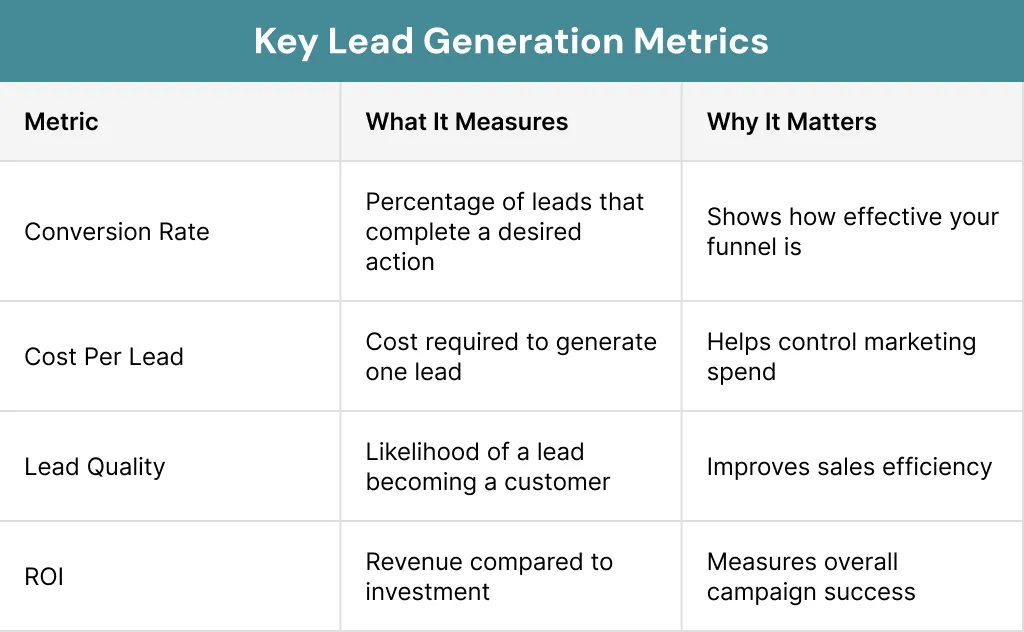
Fundamental indicators that are used in assessing lead generation activities include:
1. Conversion rate: Use this to monitor the percentage of leads doing one of your desired actions, such as filling out a form or making a purchase.
2. Cost per lead (CPL): Determine how much it costs to obtain a lead. You do this by dividing the aggregate amount spent by the number of leads obtained. In the case of a marketing campaign that costs £1,000 and brings 200 leads, CPL is £5.
3. Quality of leads: Determine the quality of leads in terms of their customer conversion. An example is when a business takes on a lead scoring strategy and finds that leads scoring above 80 have a high chance of conversion. That would be an indication of the effectiveness of the lead generation strategy.
4. Return on investment (ROI): Determine the efficiency of the lead gen activities by comparing revenue generated to investment.
These indicators are especially useful in B2B lead generation, where the buying cycle can be longer and more layered
What to Do to Attract Quality Leads?
According to B2B marketers, they are able to attract:- 39% leads from Facebook
- 30% leads from Twitter
- 44% leads from LinkedIn
The most popular social network which generates B2B leads is LinkedIn. Then, it is logical to begin here because the platform is made up of business owners and professionals who want to get into contact with one another.
For many brands, this makes LinkedIn a major channel for B2B lead generation.
1. Create a Quiz on Your Webpage
By uploading a quiz on your website, visitors will be able to respond to the questions which you require to qualify them as a good lead. At the end of the quiz, you can provide them with a free resource, such as an ebook or PDF, which will bring value to your quiz.2. Talk Directly to Potential Leads
When B2B marketing is involved, it is difficult to reach company owners or executives. Before you can reach the boss, you often have to put up with other channels such as PAs, employees and receptionists.
Attempt to reach company owners by directly contacting them through platforms like LinkedIn.
LinkedIn is a business focused site. Therefore, when you pitch to an executive there, it is more likely to be accepted. Other platforms like email, WhatsApp or Facebook may also be usable. However, in this case, there is a risk of offending the person you are reaching out to.
When you are about to use these platforms to communicate with potential leads, it is good if you do your research first and learn more about the person you are initiating contact with.
After effectively contacting an executive, you have to make sure that you have a strong presentation or sample prepared.
This direct approach continues to be a reliable tactic in B2B lead generation because business decisions often depend on the right conversation with the right person.
3. Get Referrals
Quality leads can be obtained through referrals. When a person has experienced the benefits of your product and achieved impressive outcomes, they may tell their colleagues and friends about it.
In most cases, they won’t spread the word to people with little to no interest in your product because that would be a waste of time. Instead, they will refer to somebody who they believe will have the money and the desire for your product, which fits the definition of a good lead.
Nevertheless, customers will not simply give you quality leads. They need a reason to refer you. This process can be encouraged by providing a discount on the following purchase.
Airbnb gives credit to both the new user who has been referred and the user who made the referral. They essentially adopted a referral programme which rewards customers who generate quality leads.
Top managers constantly connect with each other. When you establish a good relationship with one company owner, they might introduce you to other company owners and executives who would be interested in your product.
4. Facebook Is a Source for Quality Leads
Facebook has numerous business customisation features on business pages and groups. However, most companies don’t make full use of these options and instead just post content related to their products.
Note the design of your Facebook page and make it more of a sales page or a landing page for your site. Constantly update the page with engaging content and make sure that there is a clear call to action for leads on your Facebook page.
Businesses that offer lead generation services often improve these small details first because they can influence results more than people expect.
How to Identify Quality Leads
A quality lead will be defined depending on the product or service of a company. The most effective way to get quality leads would be to monitor all inbound leads.
A possible way to track lead data is with forms on websites and marketing campaign tools such as Mailshake.
A potential lead will be asked to share information when completing a form on a site to access a free downloadable file such as a PDF or ebook. By simply entering a name, email address and contact number, you will be in a position to categorise the information into leads, existing customers and spam.
When your company offers several products such as software, applications or technical hardware, you might want to include more fields on your forms to receive more information on leads. This can also subdivide your leads by department, product, interests and more.
In case you intend to get leads via social media or email, then you might as well just have a spreadsheet to track your lead interactions. Be sure to include any communications with prospective customers and leads. The better information you possess, the more you will be able to evaluate the quality of your leads.
It may be time consuming and sometimes hard to manage manually, so it is advisable to utilise lead management software.
If someone still asks what lead generation is, this stage shows the practical side of it. It is not just about attracting people. It is also about identifying who is actually worth pursuing.
How Do You Improve Lead Quality?
These steps help you focus on the right leads and save your time.1. Use Lead Scoring
Lead scoring enables you to prioritise your leads according to their level of interest and willingness to purchase.
You give leads points based on the actions and behaviour they show on your website. Scoring leads has no particular fixed approach. This is why companies have their own scoring systems according to their requirements.
Scoring can be done by:
- Visiting your website
- Opening your emails
- Browsing an offer
- Free downloading of materials such as an ebook or PDF
- Watching a webinar
- Starting a free trial
Leads with above average scores are warm leads. The next time you intend on marketing your products, you can put these leads into consideration and warm them up further.
B2B marketers go a step further to segment leads based on their explicit information like industry, position and company.
This makes a major difference in B2B lead generation, where lead quality matters much more than just lead volume.
2. Use Marketing Sales Feedback Loop
The information that you gather on your leads does not end when the marketer transfers the lead to the sales team. This is especially true in complicated sales cycles.
The sales team should give feedback on all interactions with the lead to the marketing team.
If marketers wait too long, they run the risk of having to analyse old data that becomes irrelevant because the sale has already been made or lost. When all marketing does is pass on leads to the sales team without any feedback, they may think that they are making sales and keep on generating the same kind of leads.
By getting feedback on marketing through sales, whether weekly or monthly, teams are in a position to make changes to future lead gen campaigns and enhance the quality of the leads being forwarded to sales.
Types of Lead Generation
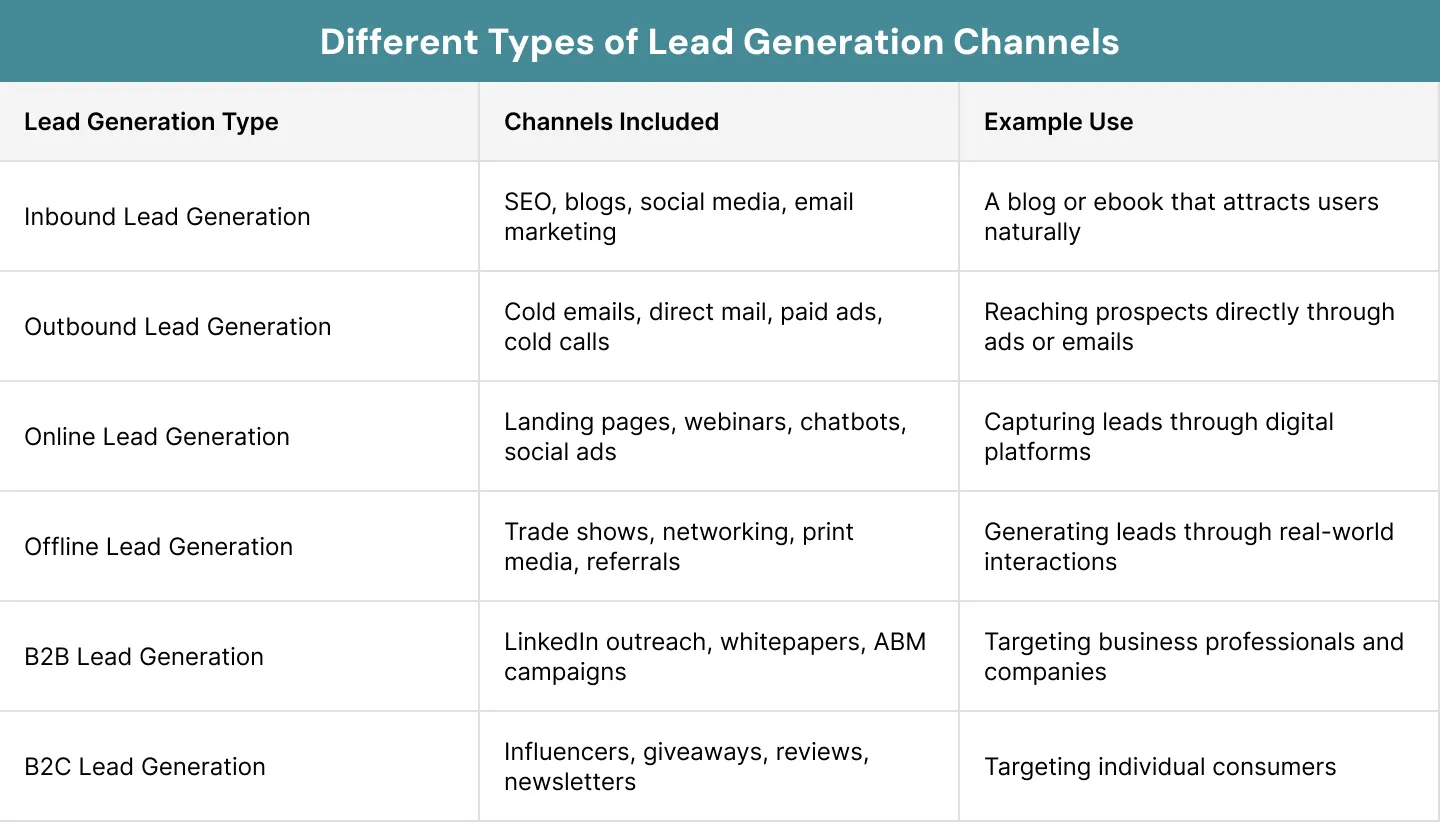
To attract and convert potential customers, it is important to understand different types of lead generation.
The primary types of lead gen are as follows:
1. Inbound Lead Generation
This method brings leads to you through useful and trusted content. It includes:- Content Marketing: It covers the composing and sharing of effective content, such as ebooks, blogs, white papers and videos, to persuade the target audience.
- SEO: Enhancing and tailoring the website and content to get more traffic by ranking higher in search engine results.
- Social Media Marketing: Utilisation of social media platforms by sharing content, connecting with followers and increasing traffic to your website.
- Email Marketing: Targeted and personalised emails to nurture the leads.
2. Outbound Lead Generation
This method reaches out to potential customers directly through active outreach and paid channels. It includes:- Cold Calling: Interacting with potential leads directly through a phone call.
- Direct Mail: Sharing physical promotional materials with likely customers.
- Email Outreach: Initiating contact with expected leads by sending uninvited emails.
- Paid Advertising: Reaching potential leads by using PPC (Pay-Per-Click) ads, display ads and retargeting ads.
3. Online Lead Generation
This method captures and converts leads through digital platforms and interactive online tools. It includes:- Webinars and Online Events: Capturing leads by hosting online events and webinars.
- Landing Pages: Converting visitors into leads by creating optimised landing pages with lead capture forms.
- Social Media Ads: Generating leads through targeted ads on social media platforms.
- Chatbots: Capturing leads and engaging visitors in real time by making use of chatbots on your website.
4. Offline Lead Generation
This method generates leads through real world interactions and traditional marketing channels. It includes:- Trade Shows and Conferences: Extending networks and generating leads by attending industry events.
- Networking: Exploiting professional networking events and groups to build relationships.
- Print Advertising: Reaching probable leads through print media, magazines and newspapers.
- Referrals: Motivating current customers to use referral programmes to refer new leads.
5. B2B Lead Generation
This method focuses on targeting and engaging other businesses using professional and high value content.
B2B lead generation includes:
- Account Based Marketing (ABM): Using personalised marketing strategies to target particular high value accounts.
- LinkedIn Outreach: Utilising LinkedIn for lead generation and professional networking.
- Industry Reports and Whitepapers: Capturing business leads by offering in depth industry reports.
- Webinars and Workshops: Moderating educational webinars or workshops customised to business professionals.
6. B2C Lead Generation
This method focuses on attracting and converting individual consumers through engaging and trust building strategies. It includes:- Social Media Influencers: Affiliating with influencers to approach and connect with their followers.
- Contests and Giveaways: Attracting and capturing consumer leads by running online contests.
- Customer Reviews and Testimonials: Building trust and generating leads by leveraging positive customer feedback.
How Does Lead Generation Work? Complete Process
The process follows four simple steps.Step 1: Attracting Potential Customers
First, identify your target audience. After getting a clear understanding, connect with them through content marketing, SEO, social media and paid advertising.
If your clients consist of gym enthusiasts or health conscious individuals, you could write a blog titled The Top 10 Benefits of Organic Food. This enhances the chances of your website being noticed by leveraging popular search interests.
Step 2: Capturing Information
Once you draw the attention of likely customers with engaging content, the next important step is to capture their information.
It is normally accomplished using a lead capture form on a dedicated landing page. Visitors are persuaded to exchange their contact details, including a phone number and email address, for a valuable offer. That offer could be an ebook, a webinar or a free trial of your service or product.
Step 3: Nurturing Leads
The next crucial step is to nurture leads. It can be done through personalised emails, sharing relevant content and connecting with them on social media.
The objective is to build trust and relationships with the leads.
Step 4: Converting Leads Into Customers
The last step comprising a sales process includes sales calls, meetings and product demonstrations.
The objective is to persuade the leads that your product or service is the best for fulfilling their needs.
This full process is usually where professional lead generation services bring the most value because they help businesses manage each stage more carefully.
Best Practices for Lead Generation
Here are some key strategies to follow.1. Creating Attention Grabbing and Valuable Content
The content should be of high value so that it can reach the target audience and become a beneficial asset to them. Below are a few tips to address:- Understand your customer’s mind in order to shape your content accordingly
- Make the headlines catchy
- Add engaging and colourful visuals where relevant
- Include impressive stories of individuals to inspire the audience
- Offer courses and ebooks without charges so that clients are encouraged to share their contact details
2. Using Data to Navigate Findings
It is very necessary to use data to guide decisions for finding new leads. This includes making up an efficient method for lead gen, marking up the results and saving resources by keeping in consideration the information given by the client.
You can achieve this task by looking at the following:
- Search for trends to have an idea of your target clients’ shopping habits
- Apply what you already know to boost your lead gen strategy
3. Personalising Communications
In lead generation, personalisation is defined as balancing your marketing to align with certain specifications, actions and needs of every group in your audience.
Follow the tips given below to personalise your approach:
- Send your clients custom messages that are highly relevant to their interests
- Customise landing pages according to audience variety by adding relevant problems and their solutions
4. Consistent Testing and Optimising Strategies
For better lead gen, it is highly recommended to regularly test and refine your approach. It helps show how well your strategy works and also allows you to add new methods for betterment.
Check out these strategies:
- To improve conversions, apply split testing to analyse different landing page headlines, ad formats and quotes in your case studies
- Keep in mind that A/B testing expands to email campaigns and ad copy and not just landing pages
- Keep your ad campaign’s performance under observation and adjust it to enhance outcomes
- Add new images, visuals or text to see what catches more attention and engagement from the audience
5. Ensuring an Ideal User Experience
For better conversion rates, it is a key factor to enhance the user experience by optimising your website. As mobile device use is higher now, your website should be more suitable for these users.
Follow these:
- Your website must be user friendly and eye catching
- Make the user experience based on present and past interests
- To collect information from potential leads, apply forms and calls to action properly
- Fix slow or buffering pages which often result in clients losing interest
- Make sure your application works efficiently on different devices
Tools and Platforms for Lead Generation
Tools and platforms are grouped into the following key categories.1. CRM Systems
These are some of the most used CRM tools:- Salesforce: It is a powerful and changeable platform for large companies and complex sales processes.
- HubSpot: It is a user friendly CRM system with integrated marketing and sales tools, best for small and medium sized networks.
- Zoho CRM: It is a cloud based CRM platform with a great range of features and reasonable rates.
2. Email Marketing Platforms
These platforms help you send and manage email campaigns easily. For example:- ActiveCampaign: It offers advanced automation traits, A/B testing and personalised email campaigns.
- Mailchimp: It is a famous and very handy email marketing platform along with a drag and drop builder.
- Constant Contact: It is a user friendly email marketing platform with a focus on small networks.
3. Landing Page Builders
These tools help you build landing pages that turn visitors into leads. These include:- Unbounce: It provides a great range of customised templates to create high converting landing pages.
- Leadpages: It offers a user accessible interface and integration with famous marketing tools.
- Instapage: It focuses on high converting designs and A/B testing.
4. Analytics Tools
These tools help you track performance and understand your data. These include:- SEMrush: A detailed SEO and marketing analytics platform which searches for website traffic, keyword rankings and competitor analysis.
- Google Analytics: It is a free tool by Google which offers detailed website analytics.
- Adobe Analytics: A great analytics programme with high tech features for large companies.
5. Social Media Management Tools
These tools help you manage and grow your social media presence. These include:- Hootsuite: It is a well known social media management platform that helps you manage scheduled posts, check your conversations and measure engagement on different social media networks.
- Buffer: It gives a user friendly interface to schedule posts and review media performance.
Pro Tip:
Test. Track. Improve. That’s how leads turn into revenue.
Case Study
A real example of lead generation is Kellogg Brown & Root’s Clear on Carbon campaign for its CleanSPEND software.
Instead of selling directly, the company used helpful content to explain problems about carbon tracking and cost control in a simple way.
They used different methods like a free guide, LinkedIn ads, PR articles and landing pages. People who were interested were asked to share their details to get the guide. This helped the company collect good quality leads who already had interest in their solution.
The campaign shows that when businesses focus on helpful content and the right audience, they can get better leads and better results instead of only chasing clicks or traffic.
This is a strong example of B2B lead generation done properly because it focused on relevance, trust and gradual nurturing.
Conclusion
Lead generation is a great way to make your customers permanent ones. That is how businesses can grow in various ways by adding related blogs across different social media platforms.
You can improve the data by following lead gen strategies that help you reach the real target audience.
Partner with XoomPlus to build and scale a high performing lead gen strategy tailored to your business. Discover how our lead generation services can help you attract, nurture and convert high quality leads.
Have questions or are you ready to begin? Get in touch today and let’s grow your business together through stronger B2C and B2B lead generation strategies that deliver better results.
Getting visits but not real conversions?
We have helped businesses turn interest into leads. Reach out for a personalised B2B lead generation strategy to target genuine buyers and boost search rankings.
FAQs
What do you mean by lead generation?
Lead generation is simply a way to find people who could be interested in buying what you have to sell. It starts with user interest, like clicking on something or visiting a website and then it turns into a contact or question.
What is the 3-3-3 rule in sales?
Businesses get leads through multiple channels including social media, creating blogs and running ad campaigns. People click, visit or sign up when they see something beneficial.
How do I generate leads?
No, it’s also very significant for small businesses because they don’t have to wait for customers. They may attract people even operating alone.
Why am I not getting enough leads?
You can generate leads by creating valuable content, optimising your website for SEO, using social media, running paid ads, offering free resources (like eBooks or webinars) and capturing user information through forms.
Can ChatGPT do lead generation?
Lead generation services allow small firms to access enterprise-level data and automation without the high overhead of building internal teams.
What is the difference between a lead and a prospect?
Lead generation services allow small firms to access enterprise-level data and automation without the high overhead of building internal teams.