- June 25, 2026
- Categories: Web Solutions
How Custom Websites Improve SEO Performance
Ever wondered why some websites keep people engaged while others make them exit in seconds?
A generic website can make it hard for your business to stand out in a highly competitive online market. Custom websites are designed around your brand, goals and audience. Therefore, these sites give you greater control over design, functionality and user experience.
This tailored plan helps create a stronger online presence while supporting ongoing business growth. At present, your website is often the first view that people have of your company. So, this makes custom website SEO more important than ever.
One of the many perks of a custom website is improved performance. When it comes to attracting and keeping visitors, speed is highly crucial. Studies show that a page loading in 3 seconds instead of 1 can spike customer exit rates by around 32%. This shows that even a short wait can cost you potential clients.
Simply stated, custom websites mean creating a site specifically for a business and easy to understand for search engines. For example, visitors are more likely to explore a website and stay longer if it loads quickly and is easy to use. Also, it should give consumers the data they need.
However, not every website operates in the same manner. Many firms use predefined templates because they are easy to set up. On the other hand, custom websites are built around a business’s aims, clients and future success.
In addition, they give companies more authority over speed, design, content and user satisfaction.
In this blog, you’ll learn why custom websites are so essential and how they improve SEO performance. You will also explore what makes them a wise long-term investment for company growth.
Key Takeaways
- Custom websites give businesses full control over design, content, and site structure, helping create a stronger online presence and better user experience
- Custom web design SEO works best when page speed, mobile use, clear navigation, and user needs are built into the website from the start
- Custom website SEO benefits from clean code, strong site architecture, and flexible content management that supports long-term growth
- Custom-built website performance examples often show faster load times, lower bounce rates, and higher user engagement compared with template-based websites
- Custom website build UK projects should focus on scalability, security, analytics, and mobile responsiveness to support future business goals and search visibility
What Are Custom Websites?
Custom websites are the sites developed exclusively for a single business. They are not made by simply putting written content and graphics into a prebuilt layout. Every major element of the site is planned around the business, its audience, its brand, and its objectives.
You get a fixed layout with a template website. You can also edit some colours, pictures and text but you still have to work within specific limits. One of the key perks of custom website SEO is the flexibility to adapt layouts, pages, navigation, forms and features. Besides this, the content supports changing business norms.
This benefits custom website SEO because the site can be created with a clear plan from the beginning. The page layout can highlight with key services. The content can respond to real client questions.
The navigation can make it easy for users to proceed from one page to another.
As part of a strong custom website SEO strategy, firms can create service pages, landing pages, location pages, blogs and FAQs. Also, they can make booking forms that match user needs and search intent. It also includes e-commerce tools, customer portals and business systems.
The primary goal is to create the website based on the business instead of forcing the business into a template.
Design is not just what it looks like and feels like. Design is how it works.
Steve Jobs, Co-founder of Apple
What Is Custom Website SEO?
Setting up and managing a custom site to boost its search engine ranking is known as custom website SEO. It also means giving users a better service. In addition, it is not only about putting keywords on web pages.
Some other factors are also included in it, such as website speed, mobile design and clear look. Besides this, helpful content, internal linking and easy access must also be present. A custom website gives a firm more control over these domains.
The content can be laid out to satisfy user needs and the pages can be fully set up from the start. The design should also be set up in a way to guide visitors towards actions like calling, booking or buying.
This method makes custom website SEO distinct from basic SEO work on a template website. Many issues are already fixed when using a template. However, with a custom website, the structure, layout, content sections and features can be created around the business goals.
Proper custom website SEO helps search engines grasp the website more properly. It also makes using the website less stressful for actual visitors. When both users and search engines can read the website concisely, the site has a high chance of lasting success.
Why Does Custom Website SEO Matter?
Custom website SEO is important because it helps a business create a more powerful digital experience. They are designed based on real aims, actual users and real business demands.
A website should help people learn about what the business provides and why it can be trusted. In addition, it needs to point out the next plan of action for the user. A custom website makes this simpler because every page can be designed with an objective.
This approach promotes custom website SEO because visitors are more likely to stay when the site is helpful and clear. They are also more willing to read and click.
How Do Templates Compare With Custom Website SEO?
Template websites can be helpful for small or simple tasks. They are often faster to begin with and may be priced less at the initial stage. For a company that only needs a basic online page, a template may be suitable.
However, templates can also set up boundaries. They may consist of excess code, unused features, slow design blocks and fixed designs. These aspects can make the website difficult to update later. They may also impact speed, user satisfaction, and ongoing search performance.
A company has more authority with custom website SEO. The website can be developed with clean code, clear structure, helpful internal links, better content sections and enhanced mobile layouts. Every component can support both clients and search engines.
This is also where custom web design SEO proves beneficial. It links a design with search results. A page should be visually pleasing but it should also load quickly, be easy to read and guide visitors clearly.
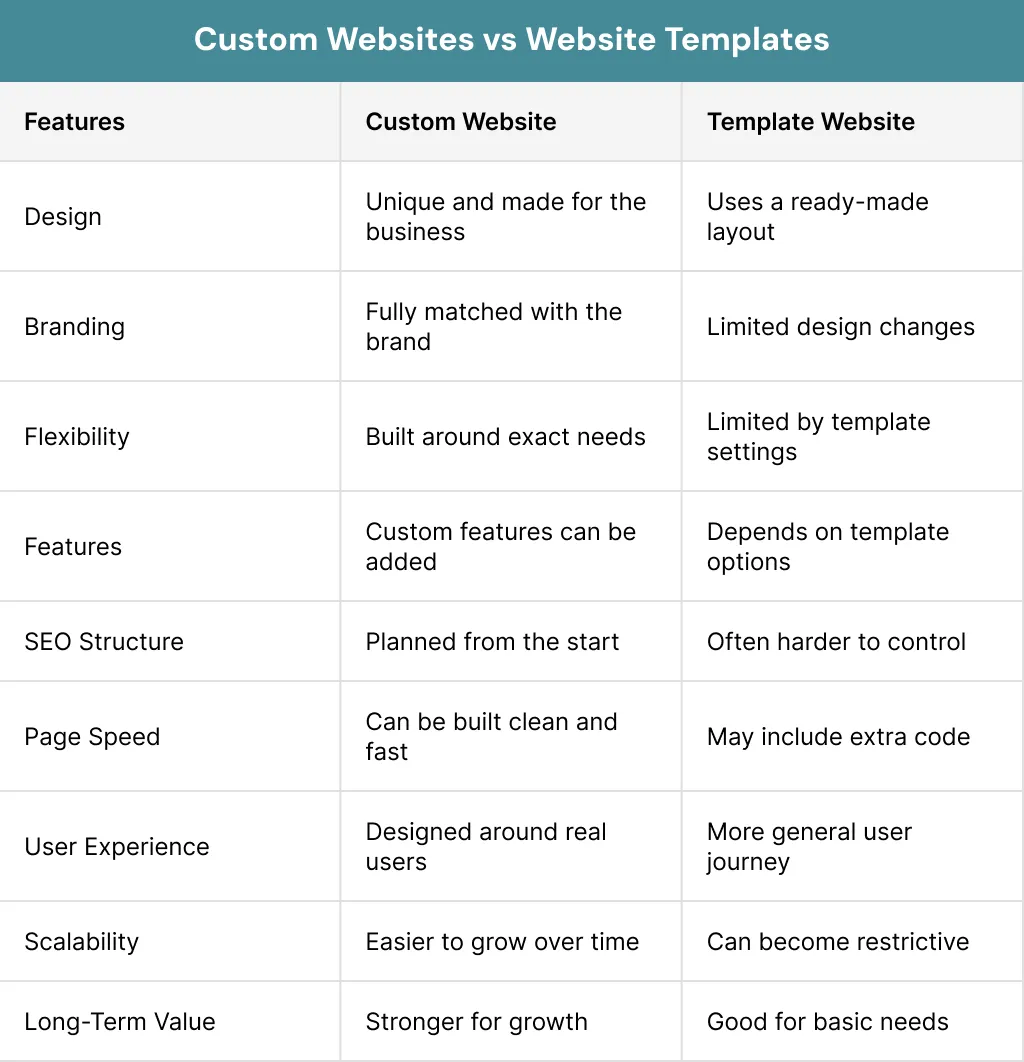
Not all templates are unsafe. Basic websites can benefit from their practical application. However, firms that want stronger progress, better control and lasting search performance usually get more value from a customised website.
Quick Insight!
Custom websites are built around business goals rather than template limitations. This gives businesses greater control over website structure, user experience, content organisation, and future growth opportunities.
What Benefits Support Custom Website SEO?
A company has more control over design, speed, layout, content, features and user experience with a custom website. This makes it less tricky to create a site that works well for both people and search engines.
A strong custom web design SEO involves more than just keywords. It also depends on how the website is built, how fast it loads and how ordered the pages are. It also relies on how simple it is for users to take action.
Custom web design SEO is most beneficial when design and search engine optimisation are planned together. This helps in creating a better experience for users and search engines alike. The site should look decent but it should also be clear to read, easy to crawl and simple to use.
Read more: Web designing tips
1. Unique Brand Identity
A custom website helps a company develop a unique digital look. The colours, text, graphics, page layouts, buttons and content style can all align with the brand. This helps the website feel more polished and visual.
When a website seems unique from competitors, users are more likely to keep it in mind. This can help develop trust and make the company look more credible. A strong brand service also makes clients feel more assured and at ease.
Brand identity has value because users tend to judge a company quickly. If the website feels clear, polished and reliable, users are more likely to stay and look around.
2. Better User Experience
User experience is defined as how easy and enjoyable it is to use a website. A custom website can be built around how real customers think, search, read and click.
For this purpose, menus can be simple, pages can be easy to scan and buttons can be placed where needed. Besides this, forms can be shorter and easier to complete. These small points can make a huge difference.
A better user experience supports custom website SEO because people are likely to stay engaged, visit more pages and take action. A website that helps visitors clearly is more beneficial than one that is only visually attractive.
3. Greater Flexibility
Firms require changes over time. A company may add updated services, fresh products, new spots or more offers. A custom website makes it easier to add these tweaks without harming the main structure.
On the other hand, templates can make revisions harder. Some designs cannot support new elements easily and some features may need extra plugins or solutions. This can make the site slower or tougher to deal with.
With custom design, the website can be modified as the business expands. This gives more freedom and allows you to protect lasting value.
4. Future-Proof Development
Resilient web design is the practice of creating a website that can expand and improve over time. A good website should not become outdated too soon. It should be easy to change, grow and improve.
A custom website can support new tech, emerging content types, better user journeys, and new business apps. This gives the business a solid base for future online success.
This also aids in custom website SEO because search demands shift over time. A flexible site can respond to updated content, new search trends, and emerging customer actions.
5. Improved Business Efficiency
A custom website can also support how a company runs behind the scenes. It can link with CRMs, booking systems, payment apps, email services, customer support tools and reporting dashboards.
These integrations lead to time savings. They can lower manual work and help teams deal with leads, orders, schedules and customer emails more easily.
A website should not only draw in customers. It should also help the company manage those people better. This is one of the primary lasting perks of custom design.
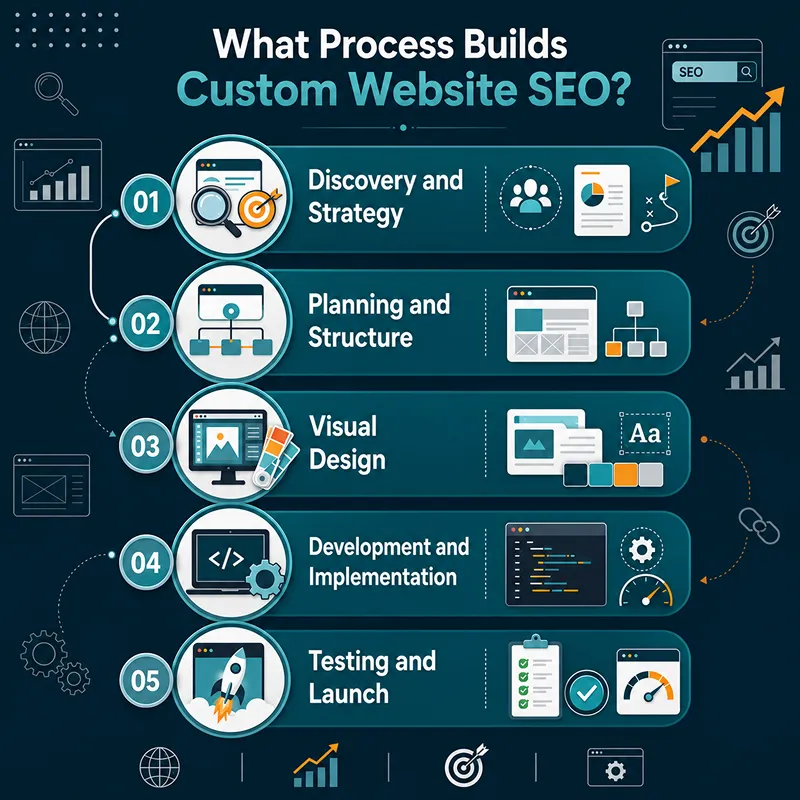
What Process Builds Custom Website SEO?
A clear process is a must for a robust custom website. Setting it up at random is not a wise idea. Every action should support the business aims, user demands and website performance.
Effective custom website SEO starts during the planning and development phases, not after the website has been set up. It shouldn’t be added only after the website is fully built. Search plans should lay out the site format, page design, content plan, technical layout and user journey.
This is also where custom web design SEO serves a vital function. It helps align the visual design with SEO needs, so the website looks attractive and works properly.
1. Discovery and Strategy
Being familiar with the business is the initial step. It means knowing its target audience, services, competitors and client issues. The team needs to know what the website must meet before design starts.
This stage may consist of keyword research, audience research, competitor analysis and target audience. These specifics help develop a clear strategy for the website.
A strong style makes the website more targeted. It helps every single page fulfil a need instead of just taking up space.
2. Planning and Structure
After a typical method, the website layout is set up. This consists of the sitemap, page order, menus, layouts and user journeys. This phase is like drawing a clear map before creating the website.
A good design helps people find data more rapidly. It also helps search engines figure out how pages connect and which pages are most vital.
Making a plan also helps stop messy websites. When pages are set up well from the start, the website becomes easier to grow later.
3. Visual Design
Visual design turns the plan into a real website style. This includes hues, fonts, images, spacing, icons, buttons and page parts. The design should align with the brand and support clear messaging.
A good layout is not about adding too many graphical effects. It is about making the website easy to read, trustworthy and easy to use.
Great visual design also helps with custom website SEO because users stay longer when the website looks clear and polished.
4. Development and Implementation
Development is the step where the design becomes a useful website. Designers build the front end, back end, CMS, forms, tools, integrations and other technical parts.
Simple coding helps the website load more rapidly and work better on all devices. It also makes future updates simpler.
This stage is very crucial because faulty code can slow the website down. A clean design gives the site a better tech base.
5. Testing and Launch
The website is required to be fully tested before going live. Forms, links, menus, speed, mobile designs, browser screens, content and security are all checked in this process.
Testing aids in finding issues before real users do. Also, it defends the brand from poor mobile display quality, slow loading times and faulty pages.
A smooth launch will provide users with a more pleasant first visit. Also, it gives the business a solid basis for its website.
Why Do KPIs Guide Custom Website SEO?
KPIs are numbers that indicate how well a website is functioning. They help firms understand if the website is helping people and supporting growth.
Custom website SEO becomes more effective when the right KPIs are monitored. These numbers reveal what is working and what requires improvement. Without KPIs, website choices are frequently based on guesses.
KPIs also help organisations optimise the website over time. They can indicate if pages are slow, if people are leaving too soon or if clients are not taking action.
1. Page Load Speed
Page load speed defines how fast a webpage loads. Fast pages give visitors a more seamless experience. Slow pages can make people leave before they even go through anything.
A custom website can be developed with cleaner code and smaller files. This helps web pages open faster and keeps users engaged.
2. Bounce Rate
Bounce rate indicates how many people go away after viewing only a single page. A high bounce rate may suggest that the page did not respond to their question or the website was hard to use.
Clear content, better internal links and more effective calls to action can help lower the bounce rate. This gives consumers more reasons to continue searching.
3. Conversion Rate
Conversion rate measures how many customers take the action you want. This may involve calling, booking, ordering, filling out a form or signing up.
A custom website can set up calls to action in useful places. This makes it easier for people to take the next action.
4. Mobile Responsiveness
Mobile responsiveness shows how well the website works on smartphones and tablets. This is crucial because many people access websites from mobile devices.
A responsive custom website keeps text that is readable and buttons that are easy to touch. It also maintains clean layouts that are clear on all screen sizes.
5. Time on Page
The amount of time people spend on a page is expressed by time on page. More time spent on a page can indicate that the details are clear, beneficial and worthy to read.
Users can stay longer and engage more when there are clear headings, straightforward text, helpful answers and neat layouts.
Why Is Scalability Good for Custom Website SEO?
Scalability refers to how the website can develop as the business expands. A business may begin with a couple of pages but later it may need extra services and more products. It may also require more content or more features.
Custom website SEO benefits from scalability because fresh pages can be added neatly. New services can fit into the proper structure and new content can assist with more search topics.
A scalable website can allow for e-commerce, membership sections, booking services and multiple language pages. It is also suitable for customer portals and advanced integrations. This helps the website remain useful as the business shifts.
Templates can prove limiting when a business expands. On the other hand, a custom website gives more room for future expansion.
Supporting Business Growth
A growing business requires a website that can evolve along with it. New products, locations, services and customer needs should be easy to provide assistance.
A custom website can be modified over time without having to undergo a full rebuild. This makes it a solid strategic choice.
Expanding Functionality
New features can alter how people engage with the website. These may consist of online payments, goods filters, live chat, custom forms or member sections.
When these features are designed properly, they make the website more practical. They also help the company serve people better.
How Does Security Help Custom Website SEO?
Security protects the website, the business and the customers. People want to know their data is secure when they complete forms, make payments or set up accounts.
Custom website SEO is based on trust and reliability. If a website is hacked, unsafe or frequently broken, it can harm the brand and damage performance.
A custom website can lower risks by using only the resources and features it really wants. Developers can also add safety controls tailored to the website’s specific needs.
Custom Security Controls
Security measures may consist of strong login rules, information safety, encrypted forms, user permissions, firewalls, backups and regular upgrades.
The right buttons depend on the website category. For example, an e-commerce website needs greater safety for customer and payment information.
Long-Term Stability
A safe website is more trustworthy. It is less likely to crash, lose data or lead to common issues for users.
Continual stability builds confidence. It also helps the company avoid downtime, repairs and lost customers.
Why It Matters!
Even a well-designed website can struggle if it loads slowly or performs poorly on mobile devices. Custom website SEO helps create faster, more responsive experiences that keep visitors engaged and encourage them to take action.
Why Does Hosting Affect Custom Website SEO?
Hosting is where the website is stored and served from the internet. Good hosting helps the website run faster, keep itself online, handle traffic and remain safe.
Custom website SEO can be affected if hosting is slow or unstable. Visitors may leave if pages take too long to be displayed. Search engines may also have difficulties finding the website if downtime happens a lot.
Custom websites often require hosting that fits their size and goals. Small websites may demand simple hosting, while larger websites may require VPS, cloud hosting or specialised servers.
Cloud and VPS Hosting
Cloud and VPS hosting allow for more power and better performance compared to basic shared hosting. They can manage higher traffic and allow resources to scale when needed.
This is helpful for firms that are expecting growth. The website can remain swift and reliable even when more people come to it.
Performance and Reliability
Trustworthy hosting keeps the website accessible. It also helps pages open up faster and minimises errors.This is helpful for firms that are expecting growth. The website can remain swift and reliable even when more people come to it.
Performance and Reliability
Trustworthy hosting keeps the website accessible. It also helps pages open up faster and minimises errors.
Custom website SEO becomes more effective when decisions are based on actual information. A business can see which pages work smoothly and which pages require upgrades.
Analytics can also identify where users quit. For example, people may access a service page but not complete the form. This may indicate that the page requires clearer content, stronger proof or a more effective call to action.
Understanding User Behaviour
Analytics can display what users click, how much time they stay and where they proceed next. This helps firms figure out what visitors are concerned about.
When this data is clear, the website can be enhanced in the appropriate places. This makes the site more beneficial and simpler to use.
Continuous Optimisation
A good website is never completely done. It should get better over time depending on real user behaviour.
Ongoing optimisation may consist of updating content, optimising buttons, altering layouts, adding FAQs or repairing slow pages.
Why Do The 7C’s Help Custom Website SEO?
Some web designers use the 7C rules as a guide when creating websites. These consist of creativity, consistency, clarity, content, continuity, compatibility and customisation. The aim is to create a website that is easy to use and fulfils user needs.
Many of these concepts support custom website SEO. For example, clear content, simple navigation and mobile-friendly design can help users stay on your site for longer. A better user experience often leads to better SEO results over time.
The 7C’s also link effectively with custom web design SEO. They prove that visual appeal is not only about good looks. It is also about trust, ease of use, content and performance.
1. Creativity
Creativity makes a website truly stand out. A distinctive design can make the brand less difficult to remember.
It also helps the website seem unique from competitors. This is beneficial when many companies offer comparable services.
2. Consistency
Consistency refers to how the website adheres to the same style on all pages. This covers colours, text, icons, headings and layouts.
A consistent website appears more upscale and competent. It also makes people feel more at ease as they navigate from page to page.
3. Clarity
Clarity indicates that individuals can comprehend the website quickly. They should be aware of what the company has to offer and what to do next.
Simple headings, clear words and direct CTAs make the website easier to navigate.
4. Content
Content provides consumers with the facts they want. It should respond to questions, clarify services and build confidence.
Beneficial content also keeps users hooked. It gives them a reason to stay engaged and go through more pages.
5. Continuity
Continuity refers to how the website experience feels seamless. Each page should effortlessly guide users to the next beneficial step.
This helps customers prevent confusion. It also helps them get closer to taking action.
6. Compatibility
Compatibility refers to how the website performs smoothly on different devices, browsers and screen sizes. Customers should get a seamless experience all the time.
This is essential because people may visit the site from smartphones, tablets, laptops or desktops.
7. Customisation
Customisation indicates the website is made around the company and its customers and it should not appear generic.
A customised experience ensures that visitors know that the website was made for their needs. This can strengthen confidence and engagement.
Final Thoughts
Custom websites aid in SEO because they are created with a specific objective in mind. They improve user satisfaction, security, content quality, speed and mobile performance. Also, they promote success through flexible analytics and design.
People can easily search for details, trust your brand and take action on a trustworthy website. Although templates are beneficial for simple projects, custom websites provide greater power, flexibility and lasting value.
We at Xoom Plus are conscious of the custom website SEO strength and how it can support firms’ digital growth. We construct websites that are speedy, simple to use and built to produce outcomes.
Contact us today to improve your website performance and develop your business.
Struggling to improve your rankings with a slow or outdated website?
Our team builds custom websites designed to support stronger SEO performance, user experience, and business growth.
We have helped businesses create high-performing websites that deliver long-term results. Reach us today.
FAQs
What are some custom-built website performance examples?
Custom built website performance examples often include faster page loading, better mobile responsiveness, cleaner site architecture, and improved user engagement. These websites are designed around business goals, helping deliver a smoother experience for both users and search engines.
Why should businesses invest in a custom website build UK solution?
A custom website build UK solution provides greater flexibility, stronger branding, and better long-term scalability than many template-based options. It allows businesses to create a website tailored to their audience while supporting growth, performance, and SEO objectives.
How to do SEO for a custom website?
SEO for a custom website starts with a clear site structure, fast page speeds, mobile responsiveness, and high-quality content. You should also optimise page titles, meta descriptions, internal links, images, and user experience while monitoring performance through analytics tools.
What are the 7 C's of a custom website?
The 7 C’s of a custom website are creativity, consistency, clarity, content, continuity, compatibility, and customisation. Together, these principles help create a website that is visually appealing, easy to use, accessible across devices, and aligned with business goals.
Can ChatGPT do the SEO of a custom website?
ChatGPT can help with many SEO tasks for a custom website, including keyword research, content planning, metadata creation, blog writing, and on-page SEO recommendations. However, technical implementation, website development, and performance optimisation still require human expertise and specialised tools.