
- June 11, 2026
- Categories: Web Solutions
Top Website Mistakes That Hurt SEO and Sales
Ever caught yourself in a scenario where you spent a lot on building a website but still haven’t seen business growth? Due to common website mistakes, you might be pushing away your potential customers.
Sometimes your website is the first place people meet your business when they search online. At the same time, your site works like the front of a store, a salesperson and a trust signal. This is the reason that you must avoid the common SEO mistakes that destroy sales and SEO.
In other words, you can say that due to these errors, search engines have difficulty in figuring out your pages. So, you also make it harder for visitors to take action.
You might have seen many sites with good design but have slow loading speed and poor content quality. You will also notice a weak structure or a confusing checkout. Many firms ignore common website mistakes because their site seems fine at first glance.
Poor checkout and delivery experiences in the UK led to 24.8% of web-based orders being cancelled. This often occurred because clients couldn’t select their preferred delivery option.
However, you must not think that SEO is only about rankings and keywords. In this approach, you also have to make your website clear, easy to use, fast and useful. When you build a site and people do not find what they need easily, they leave in seconds.
On the other hand, you build trust and drive more leads if you create your site with clear answers. You must also make a smooth path to purchase and enquiries.
When you find your pages crawling hard, with limited useful content or when the mobile optimisation is poor, your visibility will drop.
This can mean fewer people visit your site or may leave faster. Thus, you may lose sales.
In this blog, you’ll learn the most common website mistakes that hurt your Google ranking and sales. You’ll also discover why these common website mistakes matter and how to fix them before they slow down your business.
Key Takeaways
- Common website mistakes like slow speed, weak links, and poor mobile use can lower trust, reduce traffic, and hurt sales
- Common SEO mistakes often include thin content, keyword stuffing, and pages that do not match what users want to find
- Common website design mistakes, such as hard menus, weak CTAs, and poor layout, can stop users from taking action
- Common website design mistakes that hurt local seo include poor business details, weak local pages, and missing location signals
- How much a slow website actually hurts sales can be seen when users leave before pages load, leading to lost leads and missed sales
What Are Common Website Mistakes?
Before going in-depth into it, first understand what common website mistakes are. Common website mistakes are flaws on your site that make it harder for people or Google to use it.
These common website mistakes can be found in a few places:
- Technical concerns (such as crawlability, speed and mobile problems)
- Content problems (like weak content or keyword stuffing)
- Structural defects (for example, poor navigation or faulty links)
- Trust and usability problems (such as lacking CTAs or a shortage of social proof)
Many firms lose useful traffic because they do not find common SEO mistakes buried within their site.
People ignore design that ignores people.
Frank Chimero, Designer and Author
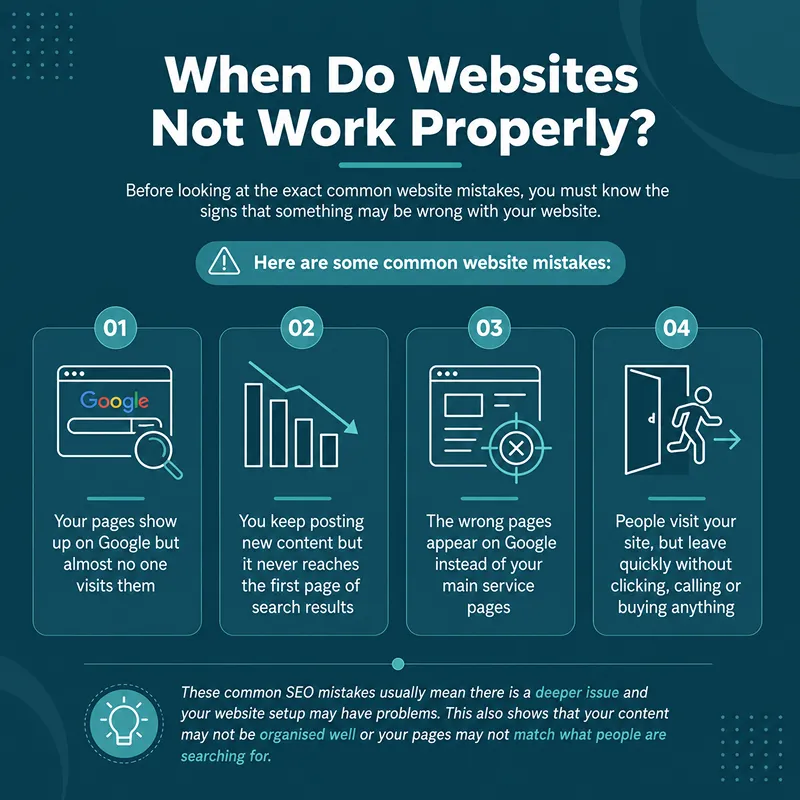
When Do Websites Not Work Properly?
Before looking at the exact common website mistakes, you must know the signs that something may be wrong with your website. Many sites have the same problems without knowing the exact cause.
Here are some common website mistakes:
- Your pages show up on Google but almost no one visits them
- You keep posting new content but it never reaches the first page of search results
- The wrong pages appear on Google instead of your main service pages
- People visit your site, but leave quickly without clicking, calling or buying anything
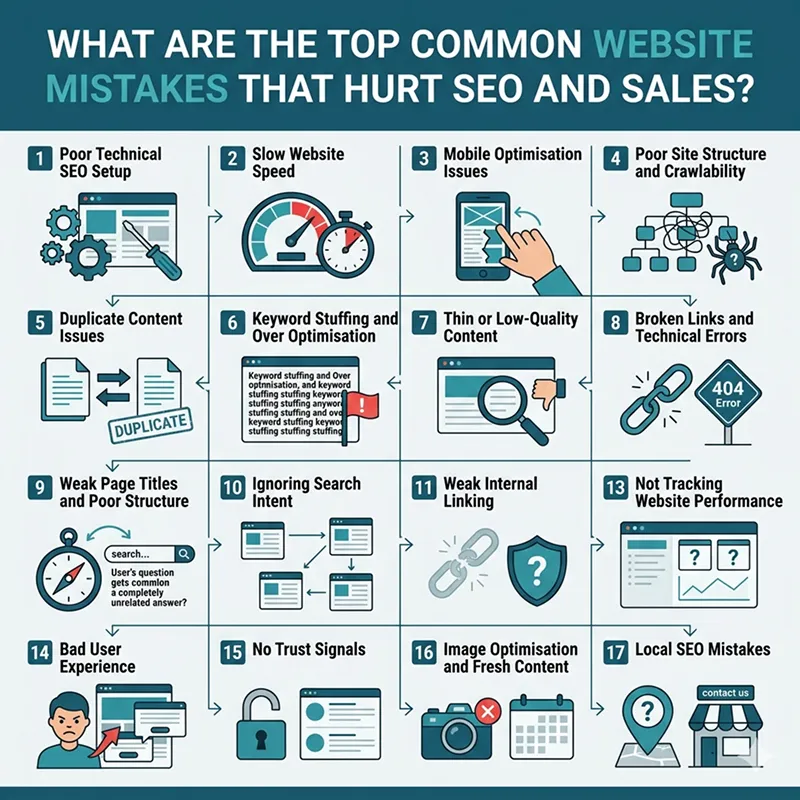
What Are the Top Common Website Mistakes That Hurt SEO and Sales?
The most common website mistakes that affect both search visibility and business performance are given below:1. Poor Technical SEO Setup
One of the biggest common website mistakes happens when Google cannot properly read or reach your pages. This can happen by accident or because of wrong settings on your site. For example, some pages may be hidden from Google.
Some site rules may block Google from entering important pages. You will also see that sometimes websites do not have a clear map that helps Google find all the pages. Other times, Google gets confused about which page is the main one.
When this happens, even great content may not show up in search results. If Google cannot properly reach a page, it usually cannot rank it. There are also other tech problems that can hurt your site. These common website mistakes include:
- Some links may not work
- Some pages may create redirect loops
- Sometimes the server stops working correctly
A healthy website should be easy for Google to crawl through. You must also understand that there should be no blocked pages, broken links or confusing paths.
These common SEO mistakes can make it tougher for Google to grasp your pages. Customers find it trickier to trust your site as a result.
2. Slow Website Speed
Website speed is also an important factor that you must consider. If a website loads slowly, people often get annoyed and leave before doing anything. A minor lag can have a major impact.
If a page takes too long to open, many visitors leave before they even see the full page. Slow websites usually happen because of problems behind the scenes. For example:
- Images may be too large
- The website design may be too heavy
- The hosting service may be slow
- The site’s code might not be correctly built
From a visitor’s point of view, speed matters a lot. Everyone expects websites to open almost instantly. So, if a site feels slow, they often go back to Google and choose another website instead.
On the other hand, a fast website feels smoother and easier to use. It keeps people engaged and helps them stay longer on your pages.
Addressing common website mistakes helps your site become simpler to read, quicker to use and more trusted by users.
Why It Matters!
A slow website not only tests patience. It can reduce trust, increase bounce rates, and push potential customers towards faster competitors before they even view your content.
3. Mobile Optimisation Issues
As you see, today, most people use their phones to visit websites. That is why a website must work well on mobile devices. If it does not, you can lose a lot of visitors.
The most common website mistakes associated with mobile phones are:
- Some websites look broken on small screens
- Some buttons are too hard to tap
- Some text is so small that people cannot read it easily
A good mobile website should automatically fit different screen sizes. Everything should be easy to read, tap and use on any device. If a website is hard to use on a phone, people usually leave quickly.
They may not read the content, click buttons, or take action. This scenario can lead to fewer sales, fewer calls and lower engagement.
When common website mistakes are not resolved promptly, they can turn into major SEO and conversion issues.
If you fix common website design mistakes, it can make your site easier to navigate on all devices.
4. Poor Site Structure and Crawlability
Website structure is very important because it helps both people and Google understand your site. If a web page is messy or confusing, important sections can be hard to find.
Some pages may be buried too deeply inside the site and some menus may be unclear or hard to use. Sometimes pages are not linked anywhere at all, so visitors and Google cannot easily find them.
In other cases, the website is not organised in a clear way. This makes it harder to understand how the content connects together. Google uses website structure to discover and understand pages.
Therefore, if the structure is weak, important pages may get ignored or seem less important. A clear website structure makes everything easier. So, people can move around the site without getting lost. This also makes it easy for Google because it can understand and rank the pages more easily.
Removing common website mistakes makes your site simpler for Google and more helpful for real users.
5. Duplicate Content Issues
When the same or extremely similar content shows up on multiple website pages, it is known as duplicate content. This often arises when firms simply alter a few words when rewriting content for specific locations, items or service pages.
The issue is that Google often has trouble choosing which page to rank in search results. The pages may end up battling with one another rather than promoting your site. Your Google rankings may go down as a result.
Some sites reuse the same page titles and descriptions, over and over, on various pages. That makes things even more confusing for search engines.
Websites can use special settings to tell Google which page is the main version. If those settings aren’t accurately set up, redundant content can still be a hurdle for rankings.
Keeping your visibility and raising conversions will go more easily if you fix common website mistakes faster.
6. Keyword Stuffing and Over Optimisation
Using the same terms too often in your content is called keyword stuffing. Some websites do this because they believe it will help with their Google visibility. However, generally, it harms the content.
Such content’s sentences can sound awkward and repetitive. The writing stops feeling natural and becomes harder to read. So, this creates a poor experience for visitors. Google can also tell when content sounds forced.
If a page repeats the same words too much, Google may trust it less. That can hurt your rankings. Thus, place keywords in a flow because good content uses keywords naturally.
You must also understand that the writing should sound clear, smooth and helpful. It should provide clear reasons that are easy for people to grasp.
Common website design mistakes can damage user trust and give the sense that a company is unreliable.
What to Avoid!
Repeating keywords too often or forcing them into headings and paragraphs can make content sound unnatural. Search engines and users both prefer clear, helpful, and natural writing.
7. Thin or Low-Quality Content
Another common problem is content that feels too thin. This means the page does not give enough helpful information. Your site might have a very short page or it might be a basic blog post.
In some cases, it might also be a service page that does not explain things well. When a page does not answer people’s questions, they often leave. This can show that the page was not helpful enough.
However, good content is clear and useful. This is because it explains the topic in a simple way. And it gives real tips and helpful details. It can also include examples, common questions or extra information.
These things help people understand the topic better. Pages with useful content may attract visitors at first. Keep in mind that people usually do not stay on poor content for long.
You should inspect your site often because common website mistakes can occur after redesigns, alterations or new content uploads.
8. Broken Links and Technical Errors
Broken links are also a common website problem. A link that does not work is called a broken link. It may send people to a missing page or may point to another website that is gone. In some cases, it may make people go through extra steps before they reach the right page.
These errors make it more difficult to use a site. Some faulty links result in incorrect pages, such as 404 URLs. When the site’s server is not working properly, other issues may also develop.
This can stop visitors from moving around the site easily. The site may also be considered less reliable as a result.
Proper links are also required for search engines to search for and interpret pages. Some pages may be harder to find when links are damaged. This may make it tougher for search engines to show those pages in their search results.
Optimising rankings is only one factor in correcting common SEO mistakes. It is also about building a better user experience.
9. Weak Page Titles and Poor Structure
Every webpage has parts that help people and search engines understand it.
These parts include:
- Page title
- Headings
- Page link (URL)
- Short descriptions in search results
They may also create long and messy links. When this happens, pages become harder to understand.
You must focus on clarity because clear titles and a clean page structure make reading easier. They also help search engines understand the content better. Good structure also helps visitors move through the website more easily.
10. Ignoring Search Intent
A big part of SEO is understanding why someone searches for something. You must know that some people want answers while others want to compare products. In some cases, others are ready to buy something.
Many websites fail because their pages do not match what people expect. For example, someone may search for product comparisons. Due to this, instead of helpful information, they land on a sales page. This can frustrate visitors.
They often leave the page quickly. Even if the page at first ranks in search results, it may not stay there for long time. This is because the page failed to respond to user queries. Quality content offers the right kind of data at the ideal time and aligns with the user’s goal.
The user experience and speed of a site are made better by staying away from common website design mistakes.
11. Weak Internal Linking
Internal links are those that connect pages on the same website. They help you move from one page to another and help you discover how different topics are related. Some common website mistakes are building pages without linking them to other helpful pages.
Older pages are also often forgotten. So, they may never get updated with links to newer content.
When internal links are weak, important pages can get buried. Therefore, people may have trouble finding useful information.
Search engines can also struggle to understand how pages connect to each other. Good internal linking keeps content organised and makes the website easier to explore and understand.
12. Ignoring Backlinks and Trust
Links that lead to your site from other websites are called backlinks. A site’s reliability can be proven by these links. In such a case, problems happen when sites ignore backlinks or get links from bad web pages.
By buying links or using fake linking methods, some people do their best to cheat. This might be helpful for a short time but it may result in more severe problems ahead.
Keeping your links organic is, therefore, a more effective strategy. This happens when people share helpful and useful content. Links from trusted and relevant websites can make a website look more reliable.
13. Not Tracking Website Performance
Many websites post articles and information but don’t check how well they are doing. This means they don’t know which pages are popular and which ones are not. Without this information, it’s hard to make things better.
Websites might keep making the same mistakes and not know why their results are bad. Tools like analytics platforms can help them see how many people visit and how they interact. These tools are also helpful when filling out forms or buying things.
14. Bad User Experience
How easy it is for visitors to use a website is really important. If a website is confusing, visitors might leave. Common SEO mistakes include hard to find menus, unclear buttons, annoying pop-ups and tricky checkout processes.
If visitors don’t know what to do next, they probably won’t do anything at all. Also, if contact information is hidden, people may not trust the website and might not want to get involved.
Clear menus, easy to find contact details and simple steps help users do what they want more easily.
One of the common website design mistakes is setting up a messy format that confuses visitors.
15. No Trust Signals
Websites that don’t have reviews or happy customer stories have a hard time getting people to trust them. When people want to buy something, they like to see that others have had good experiences first.
If there are no reviews, visitors might be unsure about making a purchase. Adding real comments from customers can help people feel more confident and safe.
Firms should spot common website design mistakes swiftly to improve engagement and conversions.
16. Image Optimisation and Fresh Content
Pictures are important but they are often not given much attention. If pictures are too big, they can make websites slow. Also, if there is no description for images, it can be hard for some people to see them.
Assuring the content’s originality is also vital. A site may look worn out or faulty due to old articles or pages. Updating content regularly helps keep information useful and interesting.
17. Local SEO Mistakes
Local SEO is essential for enterprises that belong to certain regions. One of the most common website mistakes is wrongly setting up Google Business Profiles. It is also a mistake to keep business details the same on different websites.
Another issue is not reaching local customers properly, especially when different languages are involved. To be seen by local people, businesses need to have accurate information and clear location details.
Even small common website mistakes can result in a bad experience for both users and search engines.
The One Website Mistake Nobody Talks About
Many companies focus on visible issues with their sites, such as bad writing or slow loading times. However, one of the most common website mistakes is sometimes overlooked. That is making a website based on what the business thinks instead of what real users need.
This mistake can hurt how well the website does in searches and how many sales it makes.
Businesses sometimes create websites for what they want to tell people instead of what visitors really want to see.
So, even if a website looks nice, it might not help visitors.
Here are some signs of this problem:
- The pages talk a lot about the company instead of what customers care about
- The writing focuses on business ideas instead of answering user questions
- Menus are set up for departments, not for what visitors are trying to find
- Important information is hard to find and takes too many clicks
- The buttons that tell you what to do are about what the company wants, not what the customer needs
People come to websites with goals. They want answers, price info or ways to contact someone before they make a choice. If a website doesn’t focus on what users expect, they might leave without doing anything.
This is also why some websites still struggle, even if they are technically good. A site can load quickly and look great on phones. However, if it doesn’t talk about what users care about, it won’t do well.
This mistake isn’t often talked about because it’s hard to see with just numbers. Businesses need to look at their websites like a visitor would.
Here are some warning signs to watch for:
- Lots of people visit but few buy anything
- Users look at many pages but don’t take any action
- Important pages don’t keep visitors interested
- Many visitors leave right away, even if the site ranks well in searches
- Customers keep asking questions that the website should answer
Case study: DFS Website Rebuild
In the UK, DFS is a major furniture supplier. To make their web-based store faster and more user-friendly, they redesigned it. This was a big job.
They had to:
- Make new page designs
- Rebuild the parts you click and see
- Hook up the outside tools again
- Keep shopping smoothly for customers the whole time
After the fix, things got better:
- Pages loaded 20% faster
- Fewer people left right away (bounce rate dropped 9%)
- They found and fixed 9 API errors
- Tech mistakes, slow pages and checkout bugs can hurt how many people find the site and how many buy
- Watching the site during a rebuild is key
- Detect bugs promptly and fix them quickly to protect both traffic and sales
Final Thoughts
Common website mistakes may turn out to be minor issues. However, they become challenging when merged. As a result, people may not be able to find you or may not trust you. You could even lose sales.
It is an error if a page loads slowly or the website is not mobile-friendly. It also counts if the site is difficult to use or the content is unclear and unengaging. Every minor aspect shapes how visitors feel about your site.
Repairing a website involves fixing multiple issues, from site structure and speed to content quality and user satisfaction. It is about fixing minor issues all the time. The reason is that you want your site to be fast, helpful and easy to use.
At Xoom Plus, we help firms detect and resolve common website mistakes so their sites can support real business success. We are available to assist you in making your site easy to use. We also help more people find you online and make sure visitors have a good experience.
Reach us today! We can help your website work better and help your business grow.
Is your website losing traffic and sales because of hidden SEO mistakes?
We help businesses fix website issues that hurt visibility and customer experience. We have helped many businesses strengthen their online presence and improve website performance. Contact us today.
FAQs
What are common website design mistakes that hurt local SEO?
Common website design mistakes that hurt local SEO include poor mobile design, missing location details, weak navigation, and inconsistent business information. These issues can make it harder for local customers and search engines to trust or find your website.
How much does a slow website actually hurt sales?
How much a slow website actually hurts sales depends on user behaviour, but even small delays can lead to lost visitors and abandoned purchases. Slow websites often frustrate users, reduce trust, and lower conversion rates.
What are the 7 C's of web design?
The 7 C’s of web design are context, content, community, customisation, communication, connection and commerce. These elements help create websites that are easy to use, useful and built around user needs and business goals.
What's the biggest UX mistake designers often make?
One of the biggest UX mistakes is designing for business preferences instead of user needs. When visitors cannot find information or complete tasks easily, they often leave without taking action.
What are the most common SEO mistakes?
The most common SEO mistakes include slow website speed, poor mobile optimisation, keyword stuffing, duplicate content, weak page structure, and ignoring search intent. These issues can reduce visibility, traffic, and conversions over time.