- October 31, 2025
- Categories: Web Solutions
Future Focused Web Development Trends for 2026
Did you know that almost 78% of small business owners in the UK currently have a website? Brands’ need for websites has grown as more customers shop online. This has led to a rise in competition as well. As a result, simple web designs are no longer the best way for online businesses.
New trends have changed how websites are built, how they perform and how they interact with users. In 2026, the focus has moved towards sites that are faster, smarter and more accessible. AI also plays a key role in this development. Meanwhile, modern frameworks and headless architecture have redefined what websites can do. The roles of performance, security and privacy are central to modern web development trends.
This guide explores the latest web development trends. It explains why they matter and how they shape the future of web development.
Key Takeaways
- AI is changing web development by supporting coding, testing, personalisation and smarter website features.
- Performance is a priority as users expect fast, responsive websites across devices.
- Modern frameworks and API-first architecture are making websites more flexible and scalable.
- PWAs and WebAssembly are expanding what websites can do, creating more app-like experiences.
- Accessibility, security and privacy are becoming essential parts of the development process.
- Sustainable development can reduce resource use while improving website performance.
- The best approach is purposeful innovation. Businesses should adopt trends that improve their website and meet real user needs.
Why Are Web Development Trends Important in 2026?
Web development trends directly affect the performance and revenue of a brand. This is why these trends are crucial for modern websites. The present trends have shaped what users and brands expect from a website. Users now expect websites to load quickly and respond without delay. They also expect a smooth and personalised experience across every device. As a result, features that once felt futuristic are now part of the normal web experience. Like users, brands now need websites that can adapt as their needs change. They need secure websites that can adapt to trends.
To meet these expectations, modern trends make use of AI-driven workflows, edge computing and headless architecture. This helps brands give the best web experience. While the customers get exactly what they want from a website.
The latest web development trends address the needs of both brands and users.
“Great web design without functionality is like a sports car with no engine.”
Paul Cookson.
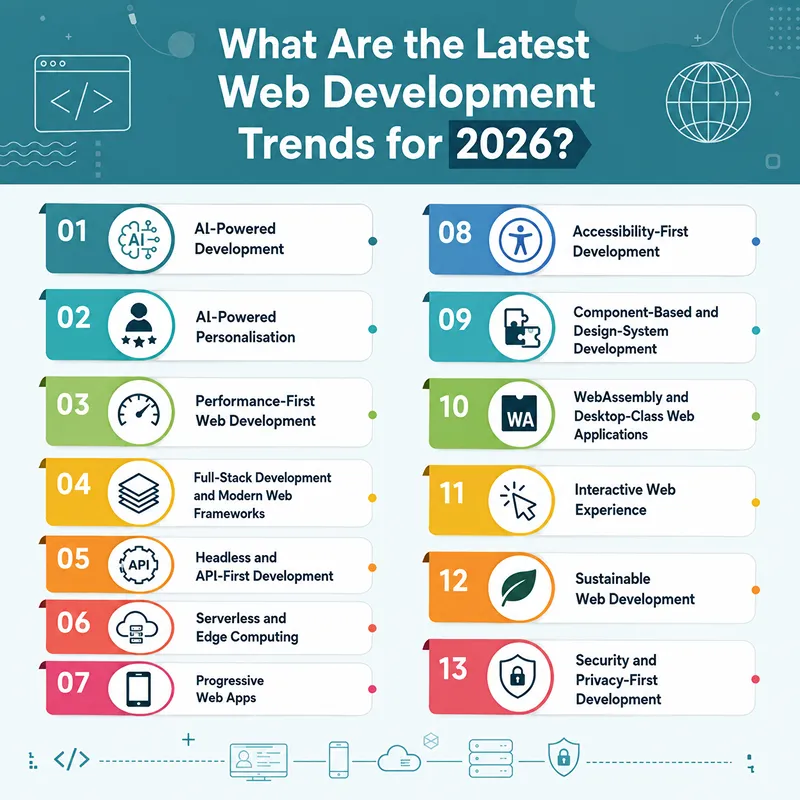
What Are the Latest Web Development Trends for 2026?
The latest web development trends make websites more intelligent, faster and scalable. While the role of AI and PWAs has grown with modern trends.
The following web development trends explain what is expected from a website in 2026 and the process it follows.
1. AI-Powered Development
AI is a vital part of web development trends. Developers use AI to write code, find errors and generate tests. This speeds up the development process while developers focus more on complex problems. Hence, AI acts as a partner to improve the pace and process of website development. However, AI still needs the oversight of a skilled developer. They help review, test and adapt AI to the project’s needs.2. AI-Powered Personalisation
AI has made it possible for websites to give a personalised experience to each user. This trend has shifted websites from a standard layout to a unique web experience. AI uses behaviour patterns and data to give a unique experience to each user. You often see this trend used in e-commerce websites to suggest products based on visitors’ history. It is also used in content platforms to show articles based on users’ interests.
This trend makes the web experience more dynamic. Instead of a standard experience, AI adapts the content of a website to every user.
3. Performance-First Web Development
The performance of a website is a key aspect of user experience. This is why it is a vital part of web development trends. As a result, modern websites have moved more processing to servers. This reduces the JavaScript sent to browsers to lessen the load on a browser. In turn, it improves the speed and performance of a website. This uses techniques such as Server-Side Rendering (SSR), Static Site Generation (SSG) and Incremental Static Regeneration (ISR).
A performance-first approach can involve:
- Less need for JavaScript
- Content rendered on the server
- Optimised images
- Reduced unnecessary code
- Improved interaction speed
- Core Web Vitals are monitored
4. Full-Stack Development and Modern Web Frameworks
Modern web frameworks have brought frontend and backend development closer. Instead of separate systems, an application is now built within a single codebase. This is possible through frameworks like Next.js, which make common tasks easier. They can handle routing, data fetching and server-side rendering with less setup. This lets developers spend more time on features and less on infrastructure management.
TypeScript has also become more common across both frontend and backend projects. The use of the same language across the stack lets developers share types and data models between servers. This improves safety and helps catch errors earlier. It also makes the code easier to maintain and simplifies the entire development process of web apps. This web development trend is simpler and more effective. It reduces complexity for developers and makes it easier to build, test and deploy web apps.
5. Headless and API-First Development
Old websites often tied their CMS closely to the frontend, but that has changed. A Headless CMS separates these two parts. The Headless CMS manages the content, while APIs deliver it to websites and apps. This gives developers more choice about how content is displayed online. It also helps reuse the same content across several channels without duplicating it.
For brands, a headless CMS can make future changes easier to implement. Developers can choose modern frontend technologies without being limited by a traditional CMS. This web development trend supports multiple digital experiences from the same content.
6. Serverless and Edge Computing
Web development trends have changed how web applications process data and handle traffic. Modern websites now use Serverless and Edge Computing to do these tasks. Serverless computing lets developers run code, while Cloud providers manage the servers. This trend is useful for websites that have high and low traffic throughout the day. Whereas Edge computing follows a different path. It processes data closer to the user instead of a distant location. This improves response times and reduces delays for users in different regions.
Together, these two trends create faster and more scalable applications. However, they may not be the right choice for every website. Serverless and edge systems add complexity to deployment, monitoring and data management. So, use them only when they solve a real problem.
7. Progressive Web Apps
PWAs infuse common features of mobile apps into web apps. They trend helps with quick page loads, offline access, push notifications and app-like interaction. What makes this effective is that it is done without the need to download the app. PWAs help brands deliver a consistent experience across all devices. Even on devices with limited or unstable connections. This web development trend helps brands do more than just display static information. It helps narrow the gap between websites and native apps.8. Accessibility-First Development
Accessibility-first development ensures that websites are built with the inclusion of people with disabilities. The trend ensures that this inclusion is planned from day one. Instead of fixing problems at the very end, teams make sure keyboard navigation, screen readers, and clear text work before writing code. This includes.- Use of semantic HTML
- Support keyboard navigation
- Support screen readers
- Make forms easier to use
- Test accessibility
- Maintain suitable colour contrast
9. Component-Based Development
A recent trend is the shift to reusable parts and shared design systems. This trend lets developers create components once and use them multiple times throughout a website or application. This is used instead of building each page from scratch. An example of this would be a single button, form or navigation used across many pages. Since the changes are central, reusable components allow developers to update a shared component instead of making separate changes to each page. This improves consistency, speeds up development and makes maintenance easier. It also builds a strong connection between teams, as they work from shared components.10. WebAssembly and Desktop-Class Web Applications
WebAssembly has improved what browsers could handle before. Now, it lets developers run high-performance code in the browser. As a result, web applications can handle more tasks. This is useful for applications such as:- Video editing
- 3D Design
- Complex data processing
- Graphics-heavy applications
- Browser-based productivity tools
11. Sustainable Web Development
Sustainable web development is a fast-growing web development trend. It is an efficient way to build websites through optimised images and smaller files. This helps save space and energy. It also speeds up page load by reducing data transfer. The key features of sustainable websites are:- Compressed images and media
- Unnecessary code is removed
- Reduced large JavaScript files
- Efficient hosting
- Limited data transfer of unnecessary files.
12. Security and Privacy-First Development
Security and privacy are now an integral part of modern websites. These are vital throughout the development phase. These are crucial for websites that collect personal information or connect to external services.
A privacy- and security-first approach includes:
- Secure authentication
- Protection of APIs and user data
- Regular security tests
- Limited data collection
- Privacy controls built within the applications
- Dependencies are updated regularly
These trends in web development show that the future is not driven by technology alone. The strongest development combines new technology with performance, access, security and usability. This is what makes the website more aligned with user expectations in 2026.
Case Study: How PWA Improved User Experience
MakeMyTrip is a strong example of the right use of modern web development trends. The brand used these trends to improve its performance and user experience. The brand realised that a large segment could be captured using a mobile website, which also had a lower cost per lead. So, the brand used PWAs to target users with mobile devices and slow internet. This would give users a better web experience on their phones without the need to download the native app. After the launch, the brand saw a visible change. It saw a 38% improvement in speed, a 3x jump in mobile conversion and a 160% hike in shopper sessions.
The case study shows how web development trends improved the experience of users with lower-end devices and poor internet connections. These changes led to a visible rise in revenue as well. The brand used the right trend in web development to solve a real user problem. This improved the performance, speed and mobile accessibility of the brand. As a result, it saw a visible growth in the use of its app.
Conclusion
Web development trends of 2026 focus on smarter, faster and more accessible websites. These trends also led to a rise in the use of AI for development. Developers now build and personalise websites with the help of AI. While modern frameworks and API-first architecture help scale web apps rapidly. These trends have also made security and privacy central to the development process.
The key is not to follow every new trend. It is to choose what solves real user problems and supports growth. Experts who understand the trends focus on innovation and a better user experience. This is how they build websites that are ready for the future.
Ready to Build a Future-Ready Website?
If you are unsure which trend best serves your business needs and goals, speak to the experts who do. Contact our development team today to build a website that is ready for what comes next.
FAQs
The latest web development trends include AI-powered development, AI personalisation, performance-first development, modern full-stack frameworks, headless architecture, serverless and edge computing, PWAs, WebAssembly, accessibility-first development and stronger security practices.
AI is helping developers write and test code, identify errors and automate repetitive tasks. It is also being used to create personalised website experiences, recommendations and smarter search features.
Users expect websites to load quickly and respond smoothly. A performance-first approach can improve the user experience by reducing load times, unnecessary code and processing on the user's device.
Yes. Progressive Web Apps can provide app-like features through a browser, including fast loading, offline functionality and installable experiences. They can be useful for businesses that want a strong mobile experience without building a separate native app.
Headless web development separates the website's frontend from its backend or content management system. APIs connect the two, giving developers more flexibility to deliver content across websites, apps and other digital platforms.
WebAssembly allows browsers to run high-performance code, making web applications capable of handling more demanding tasks. This can support applications involving areas such as 3D graphics, video editing and complex data processing.
Accessibility-first development ensures that accessibility is considered from the beginning of a project. This can make websites easier to use for people with different abilities and reduce the need for major accessibility changes later.
Businesses should focus on trends that solve real user or business needs. Reviewing website performance, security, accessibility and scalability can help identify where newer technologies could provide genuine value.