- June 23, 2026
- Categories: Web Solutions
Why Accessibility Matters in Modern Web Design
Did you know that 95.9% of the world’s top 1 million home pages had detectable Web Content Accessibility Guidelines (WCAG 2) failures? These stats show that many websites still have accessibility barriers.
A website should work for as many people as possible. This includes people who use screen readers, keyboard controls, captions, larger text or other tools to browse the website. Here, accessibility in web design comes into play, which makes websites easier to use for people with different needs. Good design is not only about how a website looks. It is also about how easily people can read, understand, navigate and use it.
In this guide, we will explain why accessibility in web design matters and how to make a website accessible.
Key Takeaways
- An accessible website helps people with disabilities use content, services and online tools more easily. It can also improve the experience for all visitors.
- Legal rules, better user experience, wider audience reach, SEO and brand trust all make accessibility an important part of web design.
- A good accessible website should be perceivable, operable, understandable and robust.
- Clear text, good colour contrast, keyboard support, captions, simple navigation and mobile-friendly pages can remove common barriers
What is Web Accessibility?
Web accessibility means making websites usable for people with different disabilities. For example, a person with poor vision may use a screen reader, or someone with limited movement may use only a keyboard. Similarly, a person with hearing loss may need captions for videos. Accessibility in web design aims to remove barriers that could prevent these users from accessing the website’s content.
An accessible website design approach also benefits people without disabilities. Clear text, simple navigation, captions, good contrast and mobile-friendly layouts can make your website easier for visitors.
‘The Web was designed to be a universal space of information.’
— Tim Berners-Lee, Web inventor
Why Accessibility Matters in Modern Web Design
Accessibility plays a key role in modern web design because it helps people access website content with ease. Below, we explain some factors that help you understand why it matters.1. Legal Compliance
Accessibility can be a legal issue. Different countries have laws and rules that require certain digital services to be accessible. In Europe, the European Accessibility Act (EAA) started applying to many covered products and services from 28 June 2025. It includes areas such as e-commerce, banking, electronic and certain digital services. You should check which rules apply to your website, service, industry and location.
Did you know?
WCAG is a technical accessibility standard. It is not itself a law. Governments and regulators may use WCAG or other standards when setting accessibility requirements.
2. Improved User Experience
Good accessibility also helps to improve user experience (UX). For example, clear menus on your website help people find pages with ease. Clear buttons tell users what will happen next when they click on them. Similarly, WCAG colour contrast makes text easier to read. These features can make accessibility in web design useful for all visitors. For example, captions can help someone with hearing loss. They can also help someone watching a video in a noisy place.3. Enhanced SEO Performance
Accessibility and SEO are not the same thing. But some accessibility practices can also help search engines understand a website. For example, useful image descriptions can help search engines to understand the image. Clear headings help organise a page and make the content easy to understand for users and search engines. Similarly, link text tells users and search engines what a linked page is about. These practices can support SEO while also improving usability. However, accessibility should never be added only to improve rankings. The main goal should always be to help people use the website with ease.4. Broader Audience Reach
An accessible website can help remove barriers for a larger group of users. This can be important for businesses that serve large or varied audiences. A site that works well with assistive technology can help more people read content, contact a business, buy products or use online services.5. Enhanced Brand Trust
People are more likely to trust a business when its website is easy to use. Good accessibility in web design can show that a company takes its users seriously. It can also support a positive brand image.
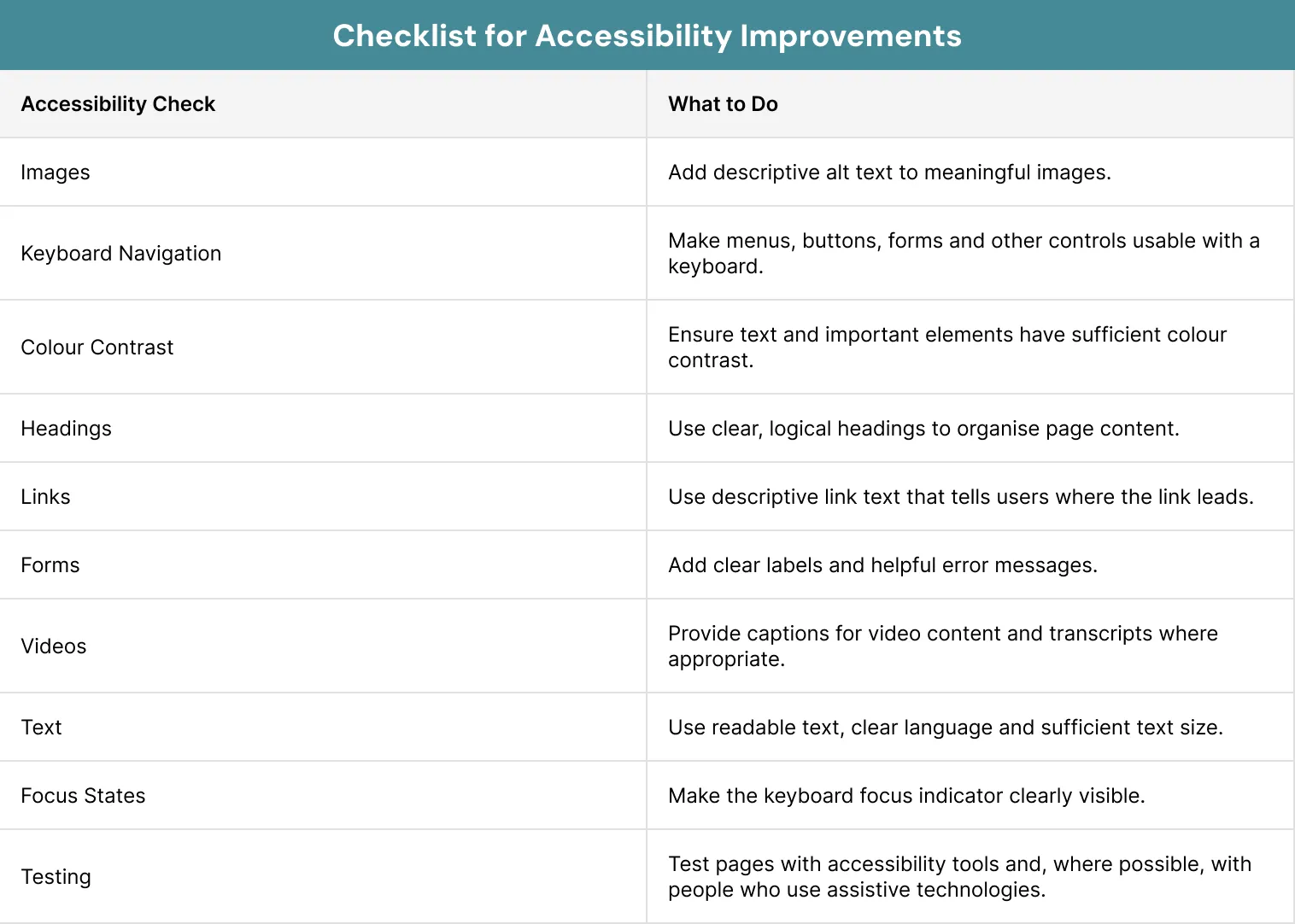
You can use this checklist to identify key accessibility improvements for your website:
What Are the Core Principles of Web Accessibility?
WCAG, developed by the World Wide Web Consortium (W3C), provides widely used guidance for making web content more accessible. WCAG is built around four main principles. They are often remembered with the word POUR.1. Perceivable
People should be able to see, hear or read the available information on a website. For example, images should have simple alternative text, videos should have captions and text should also be easy to see with good colour contrast. The goal of accessibility in web design is to give people different ways to get the same information.2. Operable
Users should be able to move around and interact with a website. This means key functions should not depend only on a mouse. People should be able to use keyboard controls where needed. Menus, buttons, forms and other controls should also be easy to operate.3. Understandable
Users should be able to understand both the content and how the website works. To make a website like this, you should use clear headings, simple instructions and familiar words. Forms on your site should explain what information is needed and clearly show errors.4. Robust
A website should work with different browsers, devices and assistive technologies. This includes tools such as screen readers. For this, developers should use clean, standard HTML markup. W3C says robust content should work reliably with current and future user tools.Case Study: Accessibility Helps Increase ROI by 100%
Legal & General (L&G) is a major UK financial services company. The company wanted to make its website easier for more people to use. It began by conducting an accessibility audit and usability testing. The team also researched customer needs and included people with disabilities in its testing.
Based on these findings, L&G redesigned its website. The goal was to make the site more accessible, easier to use and faster. The improvements included:
- Identifying accessibility issues on the existing website
- Testing the website’s usability
- Researching customer needs
- Designing a new website
- Testing the new website with people with disabilities
- Improving the website for different devices
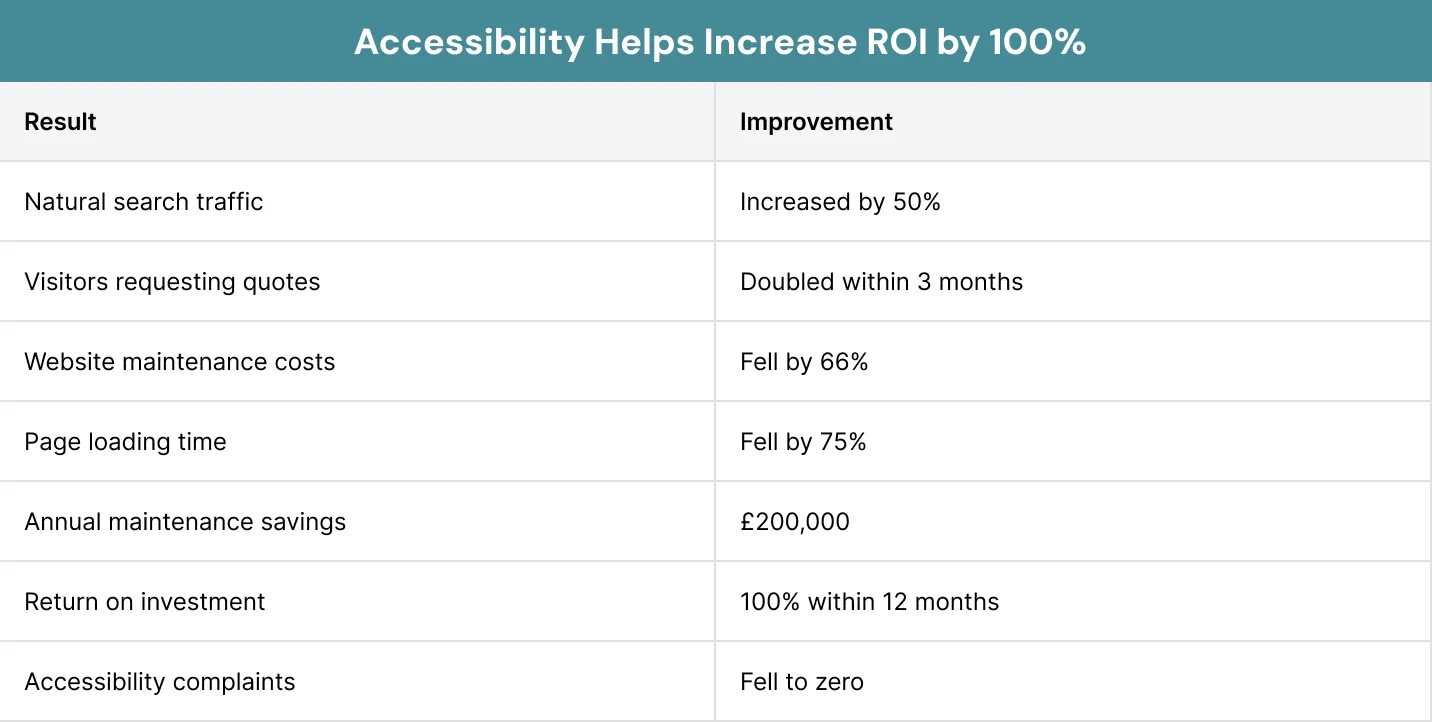
These results show that accessibility improvements can benefit both users and businesses. A better website can:
- Help more people use the site
- Make pages easier to understand
- Improve website speed
- Reduce maintenance work
- Support search traffic
Conclusion
Accessibility should be part of every modern website. It helps people with disabilities use websites and find information more easily. It also makes websites clearer and easier for everyone. Simple changes can make a big difference. Use easy-to-read text, good colour contrast, keyboard support and captions for videos. Following WCAG guidelines is a good way to make a website accessible. The goal of accessibility in web design is simple: create websites that more people can use easily and with confidence. At Xoom Plus, we build websites by following WCAG guidelines to improve accessibility so more people benefit from your website.Is your website hard to use for some visitors?
XoomPlus helps businesses create websites that are clear, easy to use, and accessible for all users. Our team builds sites that support both user experience and compliance goals. Reach out today to see how we can help.
FAQs
What is accessibility in web design?
Accessibility in web design means making a website easy for everyone to use. This includes people with visual, hearing, or mobility impairments. It helps all visitors access content more easily.
Why is accessibility important in web design?
Website design affects user experience by influencing how easily visitors can navigate, understand, and interact with a website. Clear layouts, fast loading speeds, and mobile-friendly designs help users complete tasks with less effort.
How does web accessibility help businesses?
An accessible website can reach a wider audience. It may improve engagement and user satisfaction. It also shows that your business values inclusion.
What are common accessibility features on a website?
Clear headings, image alt text, and keyboard navigation are common features. Good colour contrast is also important. These features make websites easier to use.
Can accessibility improve SEO?
Yes, accessibility can support SEO. Many accessibility practices also help search engines understand content. This can improve visibility and user experience at the same time.