
- July 15, 2026
- Categories: Web Solutions
Why Businesses Are Moving Away From Generic Website Templates
There was a time when having any website was enough. If your business was online, you were ahead of most. That time has passed.
Today, a generic website template is no longer a smart solution and it is working against the businesses that use one. More UK businesses are switching to custom built websites. Not just because it looks better, but because poor rankings, lost leads and the rising costs are making the decision for them.
In 2026, custom websites increase conversions by 10-25% for service and e-commerce based businesses. Templates cost less upfront but often require redesigns, upgrades or migrations within a year.
Key Takeaways
- A generic website template may be quick and affordable to launch, but it often limits SEO performance, user experience and long term business growth
- Most Generic sites contain unnecessary code and platform restrictions that can negatively impact page speed, search rankings and conversion rates
- A template site is designed to serve many industries at once, making it difficult to create a unique customer journey that reflects your brand and business goals
- Businesses using a generic business website often face hidden costs through subscriptions, plugins, maintenance and future redesigns
- Generic website designs can make your company look similar to competitors, reducing trust, credibility and brand differentiation in the eyes of potential customers
- Custom websites provide full ownership, greater flexibility and complete control over technical SEO elements such as schema markup, site structure and Core Web Vitals optimisation
- If your website struggles to rank on Google, generate enquiries or deliver a strong mobile experience, replacing a generic website template with a custom-built solution can significantly improve performance and ROI
What Is a Generic Website Template and Why Did Businesses Use Them?
A generic website template is a pre-built design that anyone can buy, download or subscribe to. Platforms like Wix, Squarespace and WordPress theme marketplaces let you go from nothing to a live website in just a few hours. Some charge a small monthly fee. Others are free if you are happy to show adverts from their sponsors. You can also pick up ready made WordPress and Joomla templates from independent developers for as little as £25.
It is easy to understand why many businesses choose template websites. They are quick, cheap and need no coding knowledge. For a new business on a tight budget, a template site feels like the sensible first step. For simple projects like a personal blog, they work just fine. But for a business that needs to attract clients, rank on Google and convert visitors into customers, they quickly start to fall short.
Why Are Generic Website Templates Failing Businesses Today?
The problems with a generic website template do not always appear immediately. Instead, they build over time and often result in:- Low search rankings
- Visitors who leave without making contact
- A brand that nobody remembers
1. They Were Built for Everyone, So They Work Well for No One
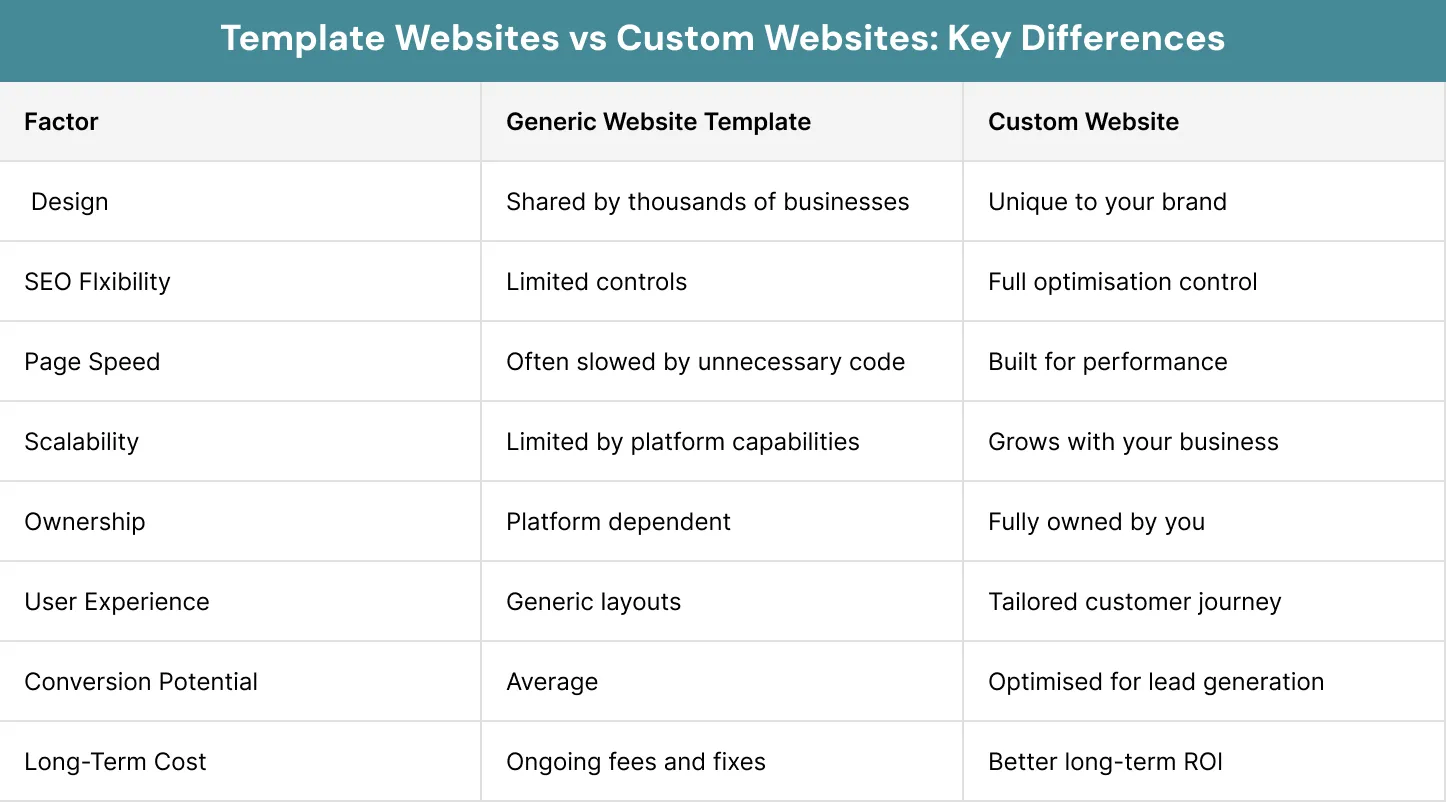
A generic website template has to work for a bakery, a law firm, a fitness coach and a tech startup all at once. To do that, it makes compromises. It tries to suit every business, so it truly suits none of them.
Custom website design starts from your business. Your services, your clients, your brand and your goals. Every layout choice and every line of code is there for a reason. There is no wasted space and no filler. The result is a website that talks directly to your audience, rather than trying to speak to everyone at once.
2. They Make You Look Like Everyone Else
Millions of businesses pick from the same list of templates and themes. Even if yours feels fresh, thousands of other businesses, some in your exact industry are using the same one. Some of those businesses may not be trustworthy. Your site can look untrustworthy just by looking the same as theirs.
People form an opinion about a website in 0.05 seconds. That is 50 milliseconds. At that moment, they decide if your brand is worth their time. A generic website template used by thousands of others does not make a strong impression that lasts. A custom design built around your audience does.
Did You Know?
75% of consumers judge a company’s credibility based on its website design.
The research backs this up. 94% of first impressions are design related, according to Stanford Web Credibility Research. And 88% of users will not come back after a bad experience. A template made for one type of customer will not work for a completely different one. Changing the font or adding a new colour will not fix that.
Does a Generic Website Template Actually Save You Money?
This is the first question most business owners ask. The upfront cost of a template looks appealing, especially early on. But the true cost only becomes clear once you add up everything that follows.1. The False Economy of Template Sites
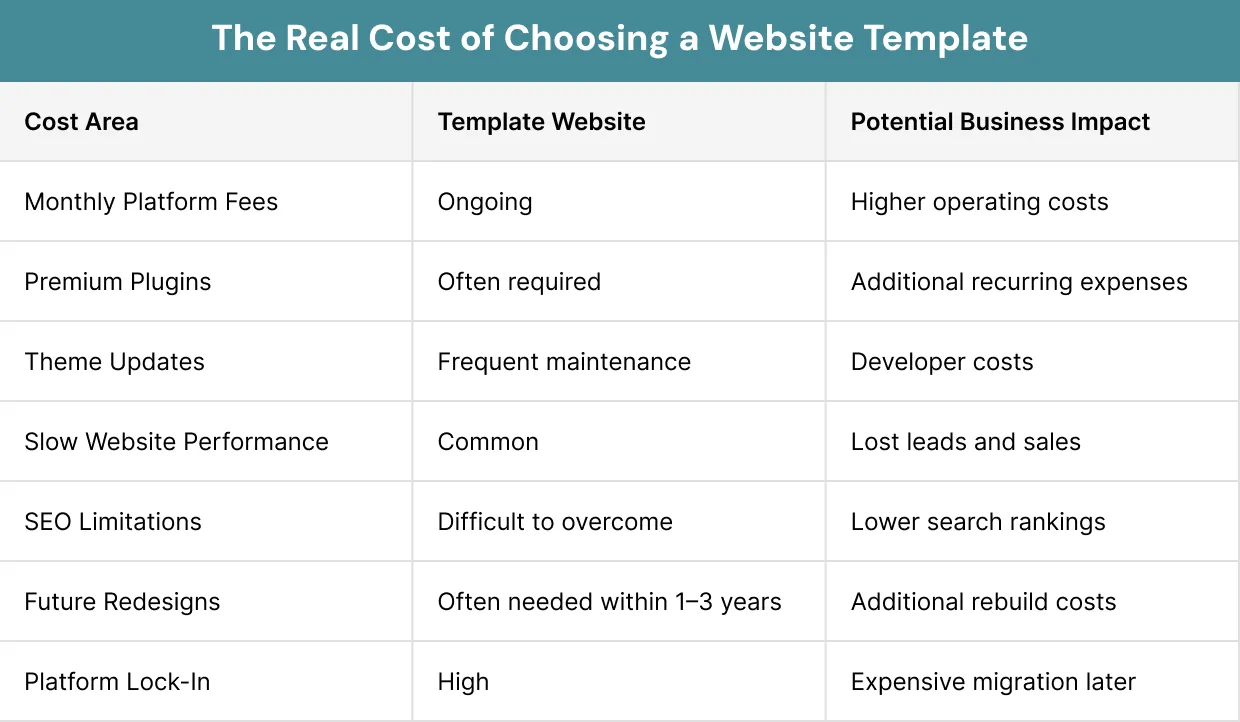
A template website looks affordable at first. But the ongoing costs of monthly fees, plugins, theme upgrades and developer time to fix problems quickly add up. Many businesses find they have spent more in two or three years than a custom build would have cost and they still do not own anything.
There are hidden costs too. When a template website loads slowly or fails to turn visitors into leads, that lost revenue is real. It never shows up on an invoice, but it drains the business every month.
Custom website development is also far more affordable than it used to be. For most small businesses, the numbers now favour going custom from the start rather than patching up a template year after year.
2. You Don’t Own What You Build on Someone Else’s Platform
There is another risk that catches many business owners off guard. When your whole online presence sits on a platform you do not control, you are more exposed than you think.
Building on Wix or Squarespace means renting your website. The platform owns everything. If they put up their prices, remove a feature you need or shut down, your site goes with them. If you want to leave, you start again from nothing.
A custom website on WordPress, hosted on your own server, is fully yours. You own the files, the database, the hosting and the domain. Nothing changes unless you choose to change it. No template website can offer that.
How Do Generic Sites Affect Your SEO and Search Rankings?
SEO is one of the clearest areas where the gap between a generic website template and a custom site shows up. Many business owners think good content is enough to rank on Google. But the foundation your site is built on matters just as much. Here is how generic websites hold businesses back in search.
Interesting Fact:
Google processes billions of searches every day, but over 90% of web pages receive no organic traffic from Google.
1. Page Speed Is Now a Business Problem
Google has confirmed that page speed affects your search ranking. A slow site does not just annoy visitors. It gets pushed down in results. Template websites carry a heavy load of scripts, styles and plugins your site does not need. They are built to be flexible for every type of business, which makes them slow for yours.
A custom site loads only what it needs. No unused code, no background scripts doing nothing. The result is faster load times, better Core Web Vitals scores and higher rankings. Popular page builders like Elementor and Divi fail Google’s Core Web Vitals on their default settings. For small businesses trying to get found online, that gap matters a great deal.
2. The SEO Ceiling on Template Sites
Page speed is just one part of the problem. Even if your template loads quickly, there is a hard limit on the SEO work you can actually do with the tools a template gives you.
Most builders offer basic SEO controls including a title tag, a meta description and maybe a sitemap. That is just the surface. Real SEO needs full control over:
- Schema markup
- Heading structure
- Internal links
- Canonical tags
- Server settings
If your template has not been updated in a while, it could be quietly working against you. A generic website template is not a strong SEO foundation. Businesses that are serious about ranking need something built properly from the start.
What Happens to Conversion and User Experience on Template Sites?
Getting visitors to your site is just one part of the job. Once they arrive, your website needs to earn their trust, hold their attention and move them towards taking action. This is where template websites consistently let businesses down and it shows up in your enquiry rates and sales.1. Responsiveness and Mobile Experience
More than 60% of web traffic now comes from mobile devices. How your site performs on a phone is no longer a side issue. It is central to whether you keep or lose a potential customer in those first few seconds.
Many template websites do adjust to different screen sizes, but the adjustment is fixed. If you do not like how the mobile version looks, you cannot do much about it. Website responsiveness is how a page shrinks, grows or reorganises to look good on any screen. With a custom site, HTML and CSS give you full control over that. With a generic website template, you get what the template decides and nothing more.
Mobile-friendly websites see 40% higher conversion rates. In contrast, 45% of users often have a poor experience on non-mobile optimised sites, resulting in a 60% bounce rate.
2. Trust, Branding and First Impressions
Responsiveness matters but trust is what turns a visitor into a customer. Generic sites struggle to build that trust because they were never made with your audience in mind.
You Should Know:
Visitors spend 80% of their time looking at content above the fold.
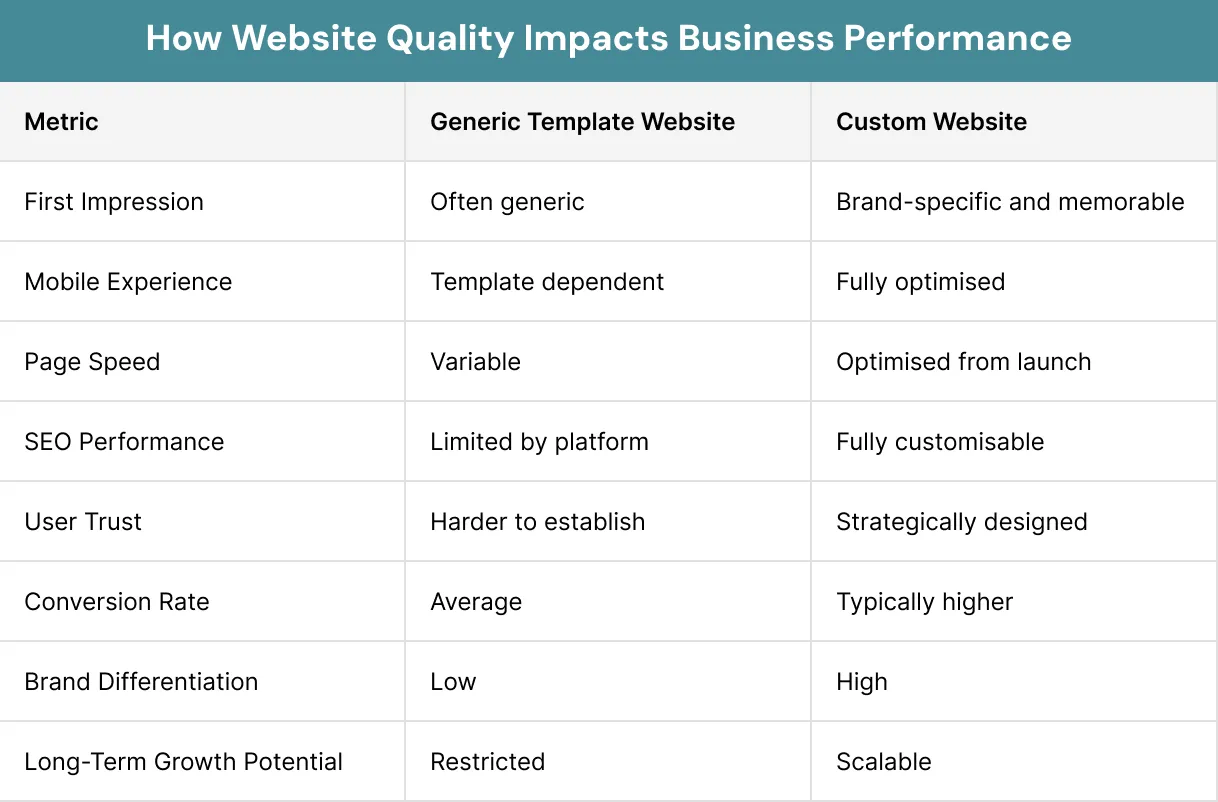
Your website is the face of your business online. It carries more than 50% of your SEO and is where all your digital marketing eventually leads. It needs to make visitors feel welcome, build desire for what you offer and guide them towards getting in touch. Template layouts get in the way of all of this. Your calls to action go where the template allows. Your navigation is built for no one in particular. Enquiry forms sit where the design permits, not where your customers would expect to find them.
People are more sceptical online than ever before. A custom design lets you place trust signals, social proof and clear value messages exactly where they need to be. Generic websites cannot do that.
What Does a Custom Website Actually Give You?
Now that we have covered what goes wrong with a generic website template, it is worth being clear about what businesses gain when they make the switch. Custom development is not just about avoiding problems. It creates real advantages that grow over time.1. A Design Process Built Around Your Business
A custom website starts with understanding. Your audience, your competitors, your goals and your brand. Before any visual design begins, the user journey is mapped out through wireframing and planning. Every decision that follows has a clear reason behind it.
The process covers:
- Brand audit
- UX wireframing
- Visual design
- Development from scratch using clean modern code
- Core Web Vitals testing
- Full cross device testing before launch
Design is not just what it looks like and feels like. Design is how it works.
– Jonathan Ive, British Designer & Former Chief Design Officer at Apple
2. Ownership, Control and Long Term Value
The design process is just the beginning. Once your custom site is live, the advantages keep building in ways a template site never could.
A custom website is a one time investment that grows in value over time. It removes the technical debt that template websites build up through plugin conflicts, outdated code and broken updates. It gives your team a platform they can actually work with, rather than a rented space they are always trying to work around.
Real Life Example
Biscuiteers is a London based luxury biscuit and gifting brand. Rather than using a generic website template or an off-the-shelf theme, they built a custom e-commerce experience around their brand and their customers. The result is a site that feels unique, loads well and guides visitors naturally towards buying.
Their online presence has played a big part in their growth. It helped them scale their gifting business across the UK and build a strong, loyal customer base. Their website reflects the premium nature of what they sell, something a generic template could never do with the same clarity.
Conclusion
Template sites had their moment. They made sense when just being online was the goal. But that is no longer enough. Your website needs to load fast, rank well, convert visitors and reflect your brand in a way that builds real trust.
A generic website template cannot do that at the level a growing business needs. Generic sites blend in, load slowly, hit SEO walls and end up costing more than expected. Custom websites stand out, perform better and give you the control your business deserves.
If your website is not doing enough for your business, it may not be a content problem or a marketing problem. It may simply be a template problem and that has a clear solution
Xoom Plus understands that your website is one of the most important investments your business can make. We build custom websites designed around your goals, your audience and your brand with no templates and no shortcuts. Contact us today and let’s build something worth clicking on.
Is your website blending in instead of bringing in business?
At Xoom Plus, we build custom websites that rank, convert, and represent your brand properly backed by real results. Contact us today and let’s get started.
FAQs
Is a custom website better than a website template?
Focus on SEO, content marketing, strong CTAs, fast page speeds, and trust signals. These elements work together to improve conversions.
Why do website templates struggle with SEO?
Website templates often include unnecessary code, limited SEO controls and restricted customisation options. This can affect page speed, technical SEO and your ability to optimise the site for search engines.
Are website templates cheaper than custom websites?
Templates usually have a lower upfront cost, but ongoing subscription fees, premium plugins, maintenance, and future redesigns can make them more expensive over time. A custom website often delivers better long-term value.
Can a custom website improve conversion rates?
Yes, custom websites are designed around user behavior and business objectives. They allow for strategic placement of calls-to-action, trust signals and optimised user journeys that can help increase leads and sales.
When should a business upgrade from a website template?
A business should consider upgrading when its website struggles to rank on Google, generates few enquiries, loads slowly or no longer reflects its brand. These are common signs that a template website has reached its limits.